
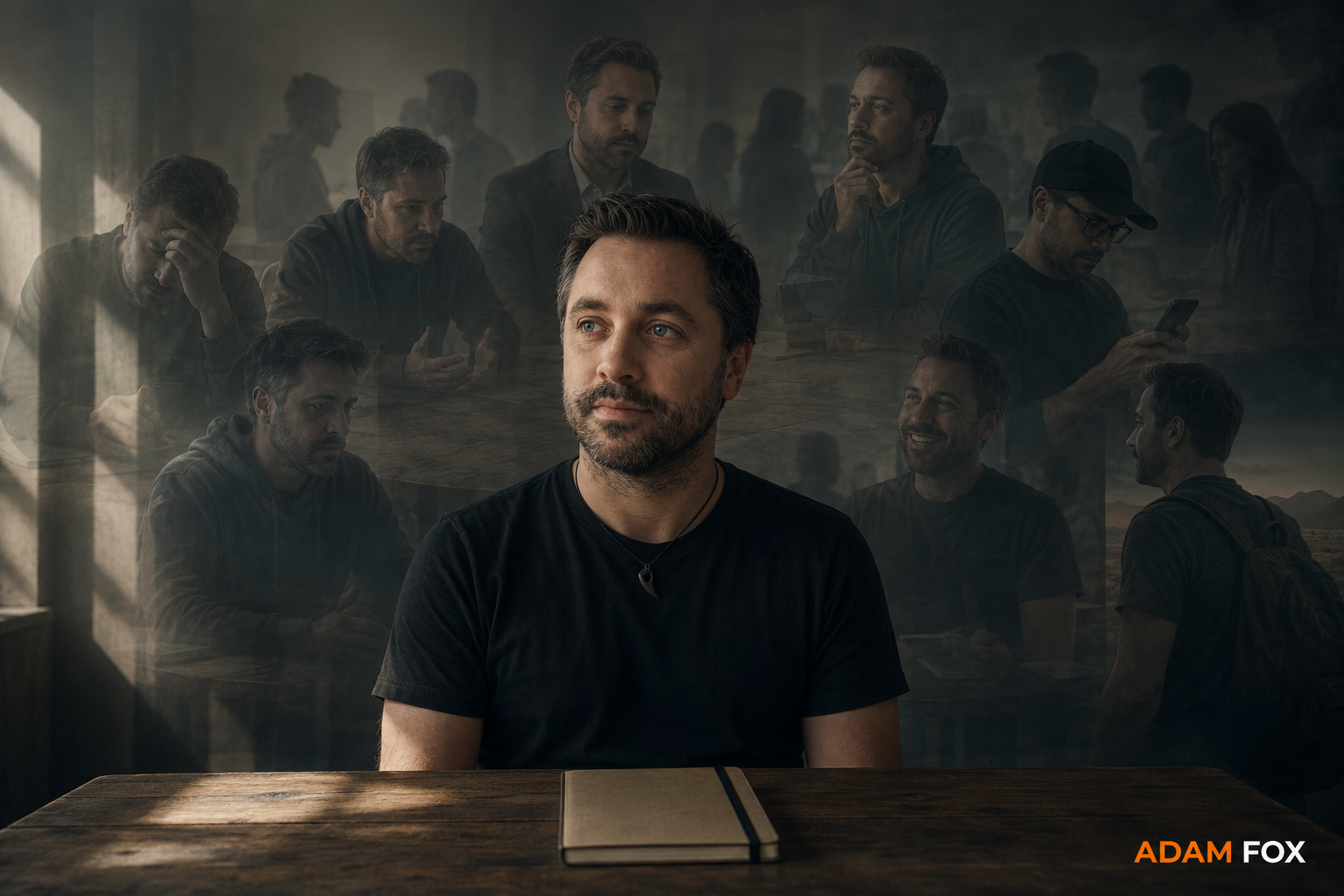
The Story Before Procrastination
Why We’ve Been Trying to Explain the Wrong Thing
Chapter One — The Question We’ve Been Asking Is Wrong
Every few weeks, another article about procrastination appears.
Some blame perfectionism. Others point to fear of failure, poor time management, low motivation, burnout, ADHD, smartphones or the endless lure of social media. Each offers a slightly different explanation and, almost inevitably, a slightly different solution.
Read enough of them and you begin to notice a pattern.
Not in procrastination itself.
In the way we talk about it.
We’ve become remarkably good at describing what procrastination looks like. We can recognise it in ourselves almost instantly. We know the feeling of opening a laptop only to find ourselves checking emails, tidying the desk, making another coffee or convincing ourselves we’ll “start properly” after lunch. We know the quiet frustration of ending the day having been busy without moving the one thing that mattered.
Recognition, however, is not the same as understanding.
And description is not the same as explanation.
That distinction matters more than it might first appear.
Because the moment we mistake a description for an explanation, we stop asking questions. We hear a phrase like perfectionism or overwhelm and feel as though we’ve reached the answer, when in reality we’ve often reached the point where the investigation should begin.
Imagine taking your car to a mechanic because an alarm light appears on the dashboard.
You explain the problem.
“The warning light keeps coming on.”
The mechanic nods thoughtfully before replying,
“Yes… that’s because the warning light is illuminated.”
Technically, they’re correct.
But they haven’t explained anything.
They’ve simply described the thing you already knew.
The real questions still remain.
Why did the light come on?
What triggered it?
What changed?
What is the system trying to tell us?
Until those questions are answered, we haven’t explained the warning light. We’ve merely given it a name.
I sometimes wonder whether we’ve done something remarkably similar with procrastination.
We say people procrastinate because they’re overwhelmed.
But what made them overwhelmed?
We say they’re avoiding failure.
What made failure feel so threatening?
We say they’re distracted.
What made distraction more compelling than the task itself?
We say they’re burnt out.
What created the conditions for burnout?
Each answer feels satisfying for a moment.
Until you ask one more question.
Then another.
And another.
Eventually something interesting begins to happen.
The explanations we were so confident in start to look less like explanations…
…and more like stopping points.
Places where our curiosity quietly ran out.
This isn’t a criticism of the research. On the contrary, decades of psychological research have transformed our understanding of human behaviour. We know more today about attention, emotion, decision-making and motivation than at any point in history.
But knowledge and understanding aren’t quite the same thing.
Knowledge tells us that certain patterns often occur together.
Understanding explains why those patterns emerge in the first place.
Those are different pursuits.
One identifies relationships.
The other seeks mechanisms.
The difference matters because human behaviour is rarely caused by a single thing.
Think about the last time you postponed something important.
Not something trivial.
Something that genuinely mattered.
Perhaps it was an important conversation.
A report.
A job application.
A difficult decision.
A health check.
A creative project you’ve wanted to begin for months.
You probably didn’t wake up that morning intending to avoid it.
Very few people do.
Most people fully intend to make progress.
They know the task matters.
They know delaying it may make life more difficult.
They know they’ll probably feel guilty later.
And yet, somehow, tomorrow begins to feel like a more attractive option than today.
That moment is fascinating.
Not because it reveals a weakness.
But because it reveals that something changed.
Somewhere between intention and action, the brain reached a conclusion.
Most conversations about procrastination begin there.
I think that’s where they go wrong.
Because by the time you notice yourself procrastinating, the most interesting part of the story has already happened.
The decision you experience consciously is the end result of countless unconscious evaluations. Your brain has already weighed effort against energy, certainty against uncertainty, reward against risk, present discomfort against future consequence. It has integrated past experiences, current circumstances, available resources and perceived demands long before you become aware of the verdict.
You don’t witness the negotiation.
You witness the outcome.
That changes everything.
Because it means procrastination isn’t the beginning of the story.
It’s where the story finally becomes visible.
If that’s true—and over the pages that follow, I’ll make the case that it is—then we’ve been pointing our questions in the wrong direction all along.
The question isn’t:
“Why do people procrastinate?”
The better question is:
“What happened before procrastination became the answer?”
That is the investigation we’re about to begin.
Not into procrastination itself…
…but into the invisible conditions that make procrastination seem, in that moment, like the most reasonable conclusion a human brain could reach.
Because I no longer believe procrastination is the mystery.
I think it’s the clue.
Chapter Two — When an Explanation Isn’t Really an Explanation
One of the hardest things about understanding human behaviour is knowing when to stop asking questions.
Most of us stop far too early.
Not because we’re lazy.
Because our brains like certainty.
The moment we can attach a label to something, we experience a small sense of relief. The uncertainty begins to disappear. The problem feels named, and once something has a name, it feels as though we’ve understood it.
But naming something and understanding it are not the same thing.
If somebody tells you they’re exhausted because they’re burnt out, you probably wouldn’t respond,
“That makes sense.”
You’d almost certainly ask another question.
“What caused the burnout?”
If they said it was because they were working seventy-hour weeks, you’d probably ask,
“Why were you working seventy-hour weeks?”
Perhaps they’d tell you they couldn’t afford to say no to clients.
So you’d ask,
“Why couldn’t you afford to say no?”
Maybe they’d explain they were terrified of losing work after a difficult period in their business.
Now we’re somewhere different.
We’ve moved from labels to history.
From description to explanation.
Notice what happened there.
Every answer became the starting point for another question.
Not because the earlier answers were wrong.
Because they weren’t complete.
I think this is where many conversations about procrastination quietly stall.
Someone says,
“I’m procrastinating because I’m overwhelmed.”
That may be true.
But overwhelm doesn’t explain itself.
It’s a condition that requires its own explanation.
The same is true of perfectionism.
Fear of failure.
Fear of success.
Distraction.
Burnout.
Low motivation.
Decision fatigue.
Even confidence.
These aren’t explanations that end the conversation.
They’re invitations to continue it.
Each one should provoke exactly the same response.
“What made that true?”
And then…
“What made that true?”
Again.
And again.
Until the behaviour finally begins to make sense.
This isn’t unique to procrastination.
We do it everywhere.
An employee is labelled “difficult.”
A child is labelled “disruptive.”
A manager is labelled “toxic.”
A student is labelled “gifted.”
An entrepreneur is labelled “driven.”
Labels spread quickly because they’re efficient.
They compress complexity into a single word.
Sometimes that’s useful.
But efficiency comes at a cost.
The moment we believe the label is the explanation, curiosity disappears.
The investigation stops.
The human being quietly vanishes behind the description.
Imagine walking into a forest and finding a fallen tree.
One person says,
“The tree fell because it hit the ground.”
Technically, that’s true.
The impact with the ground is part of the story.
But it explains almost nothing.
You’d want to know whether it had been struck by lightning.
Whether disease had weakened it.
Whether years of drought had damaged its roots.
Whether strong winds had finally exposed a weakness that had been developing for decades.
The visible event isn’t where the explanation lives.
It’s where the explanation becomes impossible to ignore.
Behaviour works in much the same way.
By the time it becomes visible, it has usually been forming beneath the surface for much longer than we realise.
I think this matters because of what happens next.
If we mistake descriptions for explanations, we inevitably design solutions for the wrong problem.
Suppose someone tells themselves,
“I’m procrastinating because I’m lazy.”
The obvious solution is to become more disciplined.
If they believe it’s poor organisation, they’ll buy another planner.
If they believe it’s distractions, they’ll delete another app.
If they believe it’s motivation, they’ll wait until they feel more inspired.
Sometimes those things help.
Often they do.
But if the explanation itself is incomplete, then the solution can only ever be partial.
It’s like treating a fever without asking what caused the infection.
The symptom may improve.
The underlying conditions remain.
This is where I want to make an important distinction.
I’m not arguing that perfectionism, distraction, burnout or overwhelm don’t influence procrastination.
They absolutely can.
Nor am I suggesting that the strategies designed to address them are ineffective.
Many are supported by excellent evidence and have helped countless people.
The problem isn’t that these ideas are wrong.
The problem is what we sometimes ask them to do.
We ask them to explain more than they can.
Knowing that somebody is overwhelmed tells us something important.
It doesn’t tell us why they became overwhelmed.
Knowing somebody fears failure tells us something important.
It doesn’t tell us where that fear came from, why it feels so powerful in this particular situation, or why it influences one area of their life more than another.
Every explanation has a horizon.
Beyond that horizon lies another question.
The deeper I’ve explored human behaviour, the more convinced I’ve become that our biggest obstacle isn’t ignorance.
It’s premature certainty.
We reach an answer that feels plausible…
…and we stop digging.
Not because we’ve reached bedrock.
Because we’ve reached something that feels comfortable enough.
Human beings are remarkably good at accepting explanations that reduce uncertainty.
We’re much less comfortable sitting with unanswered questions.
Yet the unanswered questions are often where the most important discoveries are hiding.
So before we go any further, I’d like to suggest a simple change.
Whenever you hear an explanation for procrastination—whether it’s in a book, a podcast, a research paper or your own internal monologue—resist the temptation to treat it as the destination.
Treat it as the next signpost.
Ask yourself:
What does this explain?
Then ask:
What doesn’t it explain?
Because explanations should do more than name a phenomenon.
They should increase our ability to predict it.
To understand it.
To make sense of it.
If they don’t, perhaps we haven’t found an explanation after all.
Perhaps we’ve simply found the next place where the investigation needs to continue.
At this point, we’ve established two ideas.
First, procrastination is not where the story begins.
Second, many of the explanations we rely on are descriptions waiting to be explained.
That naturally leads to a much bigger question.
If procrastination isn’t the beginning…
where does the story actually start?
Chapter Three — Behaviour Is Never Where the Story Begins
Imagine meeting someone who apologises constantly.
They apologise for asking questions.
They apologise before speaking in meetings.
They apologise when somebody else interrupts them.
They apologise for things that clearly aren’t their fault.
You could describe them as someone with low confidence.
You might even be right.
But have you explained their behaviour?
Not really.
You’ve simply replaced one observation with another.
The interesting questions still remain.
Why does this person expect to inconvenience others?
Why do they assume they’re the problem?
What experiences taught them that making themselves smaller felt safer than taking up space?
Until those questions are explored, the behaviour remains only partially understood.
The same principle applies almost everywhere.
The employee who never says no.
The parent who struggles to switch off.
The entrepreneur who works every weekend.
The manager who micromanages every decision.
The student who leaves revision until the night before the exam.
The colleague who checks their inbox every three minutes.
The person who can’t stop scrolling despite desperately wanting to.
Behaviour doesn’t emerge in isolation.
It emerges from history.
One of the most common mistakes we make is assuming that because behaviour is visible, it’s also where the explanation lives.
Visibility is deceptive.
Think about an iceberg.
The visible portion isn’t the iceberg.
It’s the part of the iceberg you happen to be able to see.
Everything that gives it its shape lies beneath the surface.
Behaviour is remarkably similar.
What we observe is often the final expression of processes that have been unfolding for minutes, days, years or even decades.
Some of those processes are conscious.
Many are not.
Take procrastination.
By the time you consciously decide to postpone a task, your brain has already processed an extraordinary amount of information.
Some of it obvious.
Some of it so automatic that you never notice it happening.
How difficult does this task look?
How uncertain is the outcome?
How much energy do I have?
Have I succeeded at something like this before?
How important is it?
What happens if I get it wrong?
What happens if I don’t do it today?
How many other demands am I already carrying?
Is this worth the effort right now?
You don’t sit down and answer those questions one by one.
If you did, you’d never get anything done.
Your brain performs these calculations continuously, drawing on memory, emotion, experience and context with astonishing speed.
By the time you become aware of your decision, most of the work has already been done.
You experience the conclusion.
Not the process that produced it.
That matters because we tend to judge ourselves by the conclusion.
“Why did I do that?”
“Why can’t I just get on with it?”
“What’s wrong with me?”
They’re understandable questions.
But they’re aimed at the wrong target.
It’s a little like reading the final page of a detective novel and assuming you’ve understood the whole story.
You know who was arrested.
You don’t yet know why.
You certainly don’t know everything that happened beforehand.
Behaviour is the final chapter.
Not the opening scene.
This is one of the reasons I’m increasingly sceptical of advice that focuses exclusively on changing behaviour.
Not because behaviour doesn’t matter.
Of course it does.
But behaviour is downstream.
If we never explore what sits upstream, we’re left trying to redirect the river without understanding where the current comes from.
Sometimes that works.
Often it doesn’t.
And when it doesn’t, people frequently assume they’ve failed.
Perhaps the strategy wasn’t strong enough.
Perhaps they lacked discipline.
Perhaps they simply didn’t want it badly enough.
There is another possibility.
Perhaps they were trying to change the visible outcome without understanding the invisible process that kept producing it.
This is where I think we need to be especially careful.
It’s tempting to search for a single root cause.
One childhood experience.
One personality trait.
One defining moment.
Human beings rarely work like that.
We are not equations with a single variable waiting to be discovered.
We’re living systems.
Everything influences everything else.
Our experiences shape our expectations.
Our expectations shape our perceptions.
Our perceptions influence our decisions.
Our decisions create new experiences.
Those experiences reinforce—or challenge—the expectations we carry into the next situation.
It’s less like a straight line…
…and more like an ecosystem.
That’s why two people can face the same task and respond completely differently.
Imagine asking two colleagues to present to the board next Friday.
The task is identical.
The deadline is identical.
The stakes are identical.
Yet one begins preparing immediately.
The other delays until Thursday evening.
It would be easy to conclude that one is disciplined while the other procrastinates.
But behaviour alone tells us almost nothing.
One person may see the presentation as an opportunity.
The other may see it as a threat.
One may have spent years developing confidence in public speaking.
The other may still carry the memory of being humiliated in a classroom decades earlier.
One may have slept well all week.
The other may be caring for a newborn.
One may have three uninterrupted mornings available.
The other may be juggling constant interruptions, competing priorities and a calendar that leaves no room to think.
Same task.
Different history.
Different environment.
Different negotiation.
Different behaviour.
The visible difference isn’t the whole explanation.
It’s the visible consequence of many invisible differences.
This is why I struggle with statements like:
“Just stop procrastinating.”
They’re not entirely wrong.
Action is, ultimately, the goal.
But they skip over the most important part of the story.
Imagine telling someone with a persistent cough to simply stop coughing.
Technically, you’ve described the desired outcome.
You haven’t helped explain why the cough exists.
You haven’t investigated whether it’s an allergy, an infection, smoke in the air or something more serious.
You haven’t become curious.
You’ve become impatient.
Human behaviour deserves more curiosity than impatience.
Especially when the behaviour belongs to us.
Perhaps that’s the shift this essay is really inviting.
Not from procrastination to productivity.
But from judgement to investigation.
From asking:
“Why can’t I just do it?”
to asking:
“What sequence of events, experiences, perceptions and conditions made delaying this task feel like the better option?”
They’re very different questions.
One searches for blame.
The other searches for understanding.
And understanding is almost always where meaningful change begins.
If behaviour is the end of the story…
then we have to look further upstream.
Because somewhere before the procrastination…
before the hesitation…
before the delay…
something else has already happened.
The question is:
Where?
Chapter Four — The Environment Always Gets a Vote
When we talk about procrastination, we almost always talk about people.
Their habits.
Their personalities.
Their motivation.
Their mindset.
Their discipline.
Their emotions.
The spotlight rarely moves.
It stays fixed on the individual, as though behaviour exists in a vacuum.
As though human beings simply decide how they’ll behave, independent of the conditions surrounding them.
I don’t think that’s how life works.
Because the environment always gets a vote.
Whether we acknowledge it or not.
Imagine trying to grow the same plant in four different places.
One sits in rich soil, receives plenty of sunlight and is watered regularly.
Another spends its life in the shade.
A third is planted in poor soil.
The fourth is exposed to relentless wind.
Months later, they look completely different.
One flourishes.
One survives.
One struggles.
One never really grows at all.
Would we conclude that one plant is simply “better” than the others?
Probably not.
We instinctively understand that living systems are shaped by the conditions in which they exist.
We recognise it in forests.
In gardens.
In ecosystems.
Yet when the living system happens to be a human being, we often abandon that instinct.
We begin looking almost exclusively at the individual.
This isn’t to suggest that personal responsibility disappears.
Far from it.
People make choices.
Those choices matter.
But choices never happen in isolation.
Every choice is made within a context.
The environment doesn’t remove agency.
It influences the conditions under which agency is exercised.
That distinction is important.
Because acknowledging influence isn’t the same as denying responsibility.
Imagine asking someone to write an important report.
Now imagine four different versions of that same person.
In the first, they’re well-rested.
They’ve had a quiet morning.
Their phone is on silent.
Their priorities are clear.
They know exactly what’s expected.
Nothing else is demanding their attention.
In the second, they’ve slept badly for three nights.
Their inbox already contains eighty unread emails.
Messages are arriving every few minutes.
They’re switching between meetings, phone calls and instant messages.
They’ve been told three different deadlines are all “urgent.”
They’re worried about money.
They haven’t had an uninterrupted hour to think in weeks.
It’s the same person.
The same intelligence.
The same experience.
The same task.
Would we honestly expect the same behaviour?
Of course not.
So why do we spend so much time talking about procrastination as though context barely matters?
One of the reasons environmental influence is so easy to overlook is because it rarely arrives dramatically.
It accumulates.
No single notification destroys your concentration.
No single interruption prevents deep work.
No single unnecessary meeting leaves you mentally exhausted.
No single expectation to remain constantly available changes the way your brain functions.
But hundreds of them?
Every day.
Every week.
Every month.
That’s different.
Tiny influences compound.
Eventually, they stop feeling like influences at all.
They simply become normal.
Think about how much of modern work involves invisible effort.
Switching between tasks.
Remembering dozens of unfinished commitments.
Monitoring multiple communication channels.
Managing calendars.
Responding to messages.
Tracking priorities.
Context switching.
Recovering lost concentration.
Making hundreds of small decisions that nobody notices because they never appear on a to-do list.
None of these activities, in isolation, seem especially demanding.
Together, they create a constant cognitive background noise.
Like living beside a busy motorway.
At first you notice every passing vehicle.
Eventually, you stop hearing them consciously.
But your nervous system never truly stops processing them.
This is where I think we’ve underestimated the modern environment.
We’ve become accustomed to conditions that would have seemed extraordinary only a generation ago.
Our attention is fragmented dozens, sometimes hundreds, of times a day.
Our work increasingly follows us home.
Silence has become unusual.
Boredom has almost disappeared.
The expectation of immediate availability has become so normal that delayed responses can feel rude.
We celebrate busyness.
We wear overwhelm almost as a badge of honour.
And somewhere along the way, we began expecting the human brain to produce deep, sustained concentration in an environment that seems almost perfectly designed to interrupt it.
When attention becomes difficult under those conditions, we ask:
“What’s wrong with people?”
Perhaps we should spend a little more time asking:
“What’s happened to the conditions under which people are trying to think?”
I want to be careful here.
This isn’t an argument that smartphones caused procrastination.
Or that email caused procrastination.
Or that open-plan offices caused procrastination.
Human beings have postponed difficult tasks for as long as difficult tasks have existed.
What has changed is the environment in which those decisions are made.
The negotiation your brain performs before beginning a task now takes place amidst an unprecedented volume of competing demands.
More information.
More interruptions.
More decisions.
More uncertainty.
More opportunities to switch attention.
More reminders of everything you haven’t yet finished.
The environment hasn’t invented procrastination.
But it may well have changed the terms of the negotiation.
And that phrase is important.
The terms of the negotiation.
Imagine negotiating the price of a house.
If interest rates change, the negotiation changes.
If your income changes, the negotiation changes.
If another buyer appears, the negotiation changes.
The people may remain exactly the same.
The outcome doesn’t.
Because the conditions changed.
I think something remarkably similar happens inside the human mind.
The task hasn’t changed.
You haven’t changed.
But the conditions under which your brain evaluates that task have.
And if the conditions change…
the verdict often changes too.
This, perhaps, is why I’ve become increasingly uncomfortable with the idea that procrastination is primarily a personal failing.
Not because personal responsibility doesn’t matter.
It absolutely does.
But because personal responsibility explains very little on its own.
It tells us who ultimately acts.
It tells us almost nothing about why one course of action felt more psychologically manageable than another.
Behaviour doesn’t emerge from responsibility alone.
It emerges from the interaction between the person and the conditions in which that person is operating.
The environment always gets a vote.
Sometimes a much bigger vote than we’ve been willing to acknowledge.
If that’s true, then the obvious question isn’t:
“How do I become more disciplined?”
It’s something far more interesting.
“What conditions keep making delay feel like the better option?”
Because if the environment keeps changing the negotiation…
perhaps that’s where our investigation needs to go next.
Not into the behaviour.
But into the negotiation that produces it.
Chapter Five — The Invisible Negotiation (Part One)
Let’s return to that moment.
You’re sitting in front of a task you know matters.
You know it needs doing.
You know delaying it will probably make your life more difficult.
You know you’ll almost certainly feel better once it’s finished.
And yet…
…you don’t begin.
Instead, you check your inbox.
You make a coffee.
You tidy your desk.
You decide you’ll start after lunch.
Then after lunch becomes tomorrow.
If we only look at the behaviour, it makes very little sense.
Why would someone knowingly choose the option that creates more stress later?
For years, that’s been the question we’ve tried to answer.
I think we’ve been asking the wrong one.
The more interesting question is this:
What happened between seeing the task… and deciding not to begin it?
Because something happened.
Whether you noticed it or not.
I don’t believe procrastination is a decision in the way we often imagine.
It isn’t usually a conscious conversation that goes something like this:
“I know this is important, but I’ve decided I’d rather make life harder for myself next week.”
Almost nobody thinks like that.
Instead, something much quieter happens.
Something faster.
Something largely invisible.
Before conscious thought catches up, your brain has already begun weighing competing demands.
How much energy do I have?
How uncertain is the outcome?
How difficult does this feel?
How meaningful is it?
How much attention will this require?
What else am I carrying?
How likely am I to succeed?
How uncomfortable is this likely to become?
What happens if I delay?
What happens if I don’t?
You never hear those questions.
But you experience their conclusion.
This is why I think we’ve misunderstood the role of consciousness in procrastination.
We often imagine that conscious thought is driving the process.
In reality, conscious thought frequently arrives afterwards.
Not to make the decision…
…but to explain it.
Once you’ve delayed the task, your mind begins constructing a story.
“I’m just not motivated today.”
“I work better under pressure.”
“I’m too tired.”
“I’ll have more time tomorrow.”
Sometimes those explanations are accurate.
Sometimes they’re little more than the brain making sense of a verdict it has already reached.
That isn’t a criticism.
It’s part of being human.
We are natural storytellers.
We like our behaviour to feel coherent.
So we build narratives that help it make sense.
The danger comes when we mistake those narratives for the entire explanation.
This is why I’ve started thinking about behaviour differently.
Not as a choice in isolation.
But as the outcome of a negotiation.
Imagine a boardroom.
Around the table sit dozens of voices.
One represents ambition.
Another represents fear.
One speaks for exhaustion.
Another for curiosity.
One argues for certainty.
Another for growth.
One wants immediate relief.
Another keeps pointing towards the future.
Confidence has a seat.
Past experience has a seat.
Attention has a seat.
Identity has a seat.
Your environment has a seat.
So do your relationships, your responsibilities, your physical energy, your emotional state and the countless experiences you’ve accumulated throughout your life.
Every one of them gets a vote.
Not an equal vote.
Not a permanent vote.
But a vote nonetheless.
The negotiation begins long before you’re consciously aware it’s taking place.
Now imagine that boardroom on two different days.
On Monday, you’ve slept well.
You finished an important project last week.
You’re clear about today’s priorities.
You have a quiet morning ahead.
The task feels challenging but manageable.
The voices around the table begin to speak.
Confidence is persuasive.
Energy is present.
Curiosity sees an opportunity.
The future seems worth investing in.
The negotiation ends quickly.
Begin now.
Fast-forward to Thursday.
Three nights of poor sleep.
Constant interruptions.
A difficult conversation still playing on your mind.
An inbox that never seems to shrink.
Three competing deadlines.
A task whose outcome feels uncertain.
The people around the table haven’t changed.
But the balance of influence has.
Exhaustion speaks more loudly.
Uncertainty has gained confidence.
Immediate relief suddenly sounds very convincing.
The negotiation ends differently.
Not now.
Same person.
Same task.
Different verdict.
Why?
Because the negotiation changed.
This, I think, explains something that has puzzled people for years.
Why do we procrastinate on some things but not others?
If procrastination were simply laziness, that question shouldn’t exist.
A lazy person should avoid effort everywhere.
Yet that’s not what we observe.
The same individual who avoids writing a report might spend three uninterrupted hours planning a holiday.
The entrepreneur delaying their accounts may happily work all weekend designing a new product.
The student postponing revision might enthusiastically practise the guitar until midnight.
The ability to focus clearly exists.
The willingness to direct that focus towards one particular task does not.
That’s a very different problem.
It suggests that procrastination isn’t an inability to act.
It’s the outcome of a negotiation that ended differently for different tasks.
Each task presents a different combination of uncertainty, meaning, effort, perceived reward, emotional exposure and personal history.
Each negotiation is unique.
So why would we expect every verdict to be the same?
This is also why advice that relies on sheer willpower often works…
…until it doesn’t.
Willpower absolutely matters.
There are times when we all have to do difficult things despite not feeling like it.
But willpower is a participant in the negotiation.
It isn’t the negotiation itself.
If every other voice around the table is screaming that resources are depleted, uncertainty is high and the emotional cost feels overwhelming, willpower may still win.
Sometimes it does.
But if that same negotiation keeps producing the same verdict, day after day, week after week, eventually we have to ask a different question.
Not:
“Why isn’t my willpower strong enough?”
But:
“Why does this negotiation keep ending in delay?”
That’s a fundamentally different investigation.
Because it doesn’t assume the problem is your character.
It assumes the outcome has causes.
And causes can be understood.
There’s something deeply hopeful about that.
Not because it makes procrastination disappear.
It doesn’t.
But because it moves us away from self-condemnation and towards curiosity.
Curiosity doesn’t excuse behaviour.
It explains it.
And explanation is where meaningful change begins.
Because once you understand why the negotiation keeps reaching the same conclusion…
you are finally in a position to change the conditions under which the next negotiation takes place.
So perhaps procrastination isn’t the mystery we’ve spent decades trying to solve.
Perhaps the real mystery has always been this:
What determines the outcome of the negotiation?
That’s the question we’ll tackle next.
Because if we can understand why one negotiation ends in action while another ends in delay…
we move beyond describing procrastination.
We begin explaining it.
Chapter Five — The Invisible Negotiation (Part Two)
If procrastination is the outcome of an internal negotiation, then one question becomes more important than any other.
What changes the result?
Because negotiations don’t produce fixed outcomes.
They respond to changing conditions.
The same person can reach a completely different conclusion about the same task from one day to the next.
Sometimes even from one hour to the next.
That’s something most of us have experienced.
You’ve probably had days when a task felt almost impossible.
You avoided it.
Thought about it constantly.
Felt guilty about it.
Then, seemingly without explanation, you sat down the following morning and finished it in forty-five minutes.
What changed?
The task didn’t.
The deadline may not have changed.
Your intelligence certainly didn’t.
So what did?
The negotiation.
This is where I think many conversations about procrastination become unnecessarily moral.
We tend to divide people into categories.
Disciplined.
Undisciplined.
Motivated.
Unmotivated.
Focused.
Distracted.
Productive.
Unproductive.
As though these are permanent characteristics.
But if behaviour emerges from a negotiation, those labels become surprisingly fragile.
The person who appears disciplined in one environment may struggle profoundly in another.
The entrepreneur who runs a successful company may avoid making a dentist appointment for six months.
The confident public speaker may procrastinate for weeks before sending one difficult email.
The organised parent may feel completely overwhelmed at work.
We already know this.
We just don’t always notice what it tells us.
It tells us behaviour isn’t fixed.
It’s conditional.
That’s an important word.
Conditional.
Not random.
Not inevitable.
Conditional.
Behaviour changes because the conditions under which decisions are made keep changing.
Which means our job isn’t simply to ask,
“How do I change my behaviour?”
It’s to ask,
“What conditions consistently produce this behaviour?”
That’s a much richer question.
Think about confidence.
People often talk about confidence as though you either have it or you don’t.
But confidence behaves much more like a relationship than a possession.
A surgeon may feel enormously confident in an operating theatre.
Ask that same surgeon to sing alone on stage in front of two thousand people and the negotiation changes instantly.
Confidence isn’t missing.
It’s context-dependent.
The environment changed.
The history changed.
The perceived risk changed.
The negotiation changed.
The behaviour followed.
Why should procrastination be any different?
The same applies to energy.
We often underestimate how profoundly physical state influences psychological decision-making.
When you’re well rested, uncertainty feels smaller.
Complex problems feel more manageable.
Patience increases.
Frustration arrives more slowly.
Long-term thinking becomes easier.
When you’re exhausted, exactly the opposite can happen.
The task hasn’t become objectively harder.
But the cost of engaging with it has increased.
The negotiation reflects that reality.
Delay becomes more persuasive.
Again, this isn’t an excuse.
It’s information.
Meaning works in much the same way.
Imagine spending three hours assembling flat-pack furniture.
Now imagine spending three hours building a treehouse with your child.
The physical effort may be remarkably similar.
The emotional experience often isn’t.
Why?
Because meaning changes the negotiation.
The same effort can feel either draining or worthwhile depending on what that effort represents.
We often talk about time management.
I sometimes wonder whether we’re really talking about meaning management.
Tasks that feel connected to something important are negotiated differently from tasks that feel empty, imposed or disconnected from our values.
Meaning doesn’t remove effort.
But it often changes how much effort we’re willing to invest.
Then there’s clarity.
One of the simplest ways to change a negotiation is to remove unnecessary uncertainty.
Think about the difference between these two instructions.
“Sort out the project.”
“Spend twenty minutes outlining the introduction.”
One feels enormous.
The other feels specific.
One leaves the brain searching for boundaries.
The other provides them.
The task itself may not have changed very much.
But the negotiation has.
Uncertainty has lost one of its strongest arguments.
This is one reason so many practical productivity techniques work.
Not because they’re magical.
Because they quietly change the conditions under which the negotiation takes place.
This, I think, is an important point.
The negotiation model doesn’t replace existing advice.
It explains why some of it works.
Take breaking a task into smaller steps.
From the outside, it can seem almost trivial.
But from the perspective of the negotiation, something significant has happened.
You’ve reduced ambiguity.
You’ve increased certainty.
You’ve lowered perceived effort.
You’ve made progress feel more attainable.
In other words, you’ve changed the balance of the negotiation.
The verdict becomes more likely to favour action.
The same is true of reducing distractions.
Improving sleep.
Clarifying priorities.
Creating accountability.
Protecting time.
None of these techniques work because they somehow defeat procrastination.
They work because they alter the conditions under which your brain evaluates whether beginning now is worth the psychological cost.
That’s a much more satisfying explanation.
It also explains why no single technique works for everyone.
Imagine two people struggling with exactly the same behaviour.
Both are delaying an important presentation.
One is exhausted.
The other is terrified of public speaking.
If we prescribe the same solution to both, one of them is likely to feel misunderstood.
Not because the advice is poor.
Because the negotiations are different.
The same verdict can emerge from completely different conditions.
That’s why generic advice so often feels frustrating.
It treats identical behaviours as though they were produced by identical causes.
Human beings are rarely that simple.
Perhaps this is the shift I’d like you to make.
The next time you procrastinate, resist the urge to ask,
“How do I force myself to do this?”
Instead, become curious.
Ask:
“What made delay win today?”
Not yesterday.
Not last month.
Today.
Was it uncertainty?
Lack of clarity?
Exhaustion?
Competing priorities?
Fear of the outcome?
A task that no longer feels meaningful?
An environment full of interruptions?
The answer may not always be obvious.
It may not even be singular.
Several conditions may have combined to produce the same verdict.
That’s exactly what we’d expect if behaviour emerges from a negotiation rather than a single cause.
This is why I believe curiosity is far more powerful than criticism.
Criticism asks,
“What’s wrong with me?”
Curiosity asks,
“What changed?”
One attacks identity.
The other investigates conditions.
One closes the conversation.
The other keeps it alive.
And if there’s one idea I’d like you to carry into the rest of this essay, it’s this:
Behaviour is never the end of the investigation.
It’s the point at which the investigation finally has enough information to begin.
Chapter Six — The Cost of Asking the Wrong Question
Every model of human behaviour does more than explain behaviour.
It shapes identity.
The questions we ask don’t simply influence the answers we find.
They influence the people we believe ourselves to be.
That matters.
Because if you’ve spent years asking yourself the wrong question, you’ve probably spent years reaching the wrong conclusion.
Imagine someone who repeatedly struggles to start important work.
Each morning they promise themselves that today will be different.
Each evening they carry the same unfinished task into tomorrow.
Eventually, they stop describing what they’re doing.
They start describing who they are.
“I’m just lazy.”
“I’ve always been like this.”
“I’m useless at finishing things.”
“I’m terrible at managing my time.”
At first glance, those statements seem harmless.
They’re anything but.
Because something subtle has happened.
Behaviour has become identity.
This is one of the things that concerns me most about the way we talk about procrastination.
The behaviour lasts a day.
The identity can last decades.
A task gets delayed.
Then another.
Then another.
Slowly, almost without noticing, the person stops saying,
“I procrastinated.”
They begin saying,
“I’m a procrastinator.”
Those are profoundly different statements.
One describes an event.
The other defines a person.
Think about how rarely we do this elsewhere.
If someone forgets where they left their keys, we don’t usually conclude they have become “a forgetful person.”
If someone catches a cold, they don’t suddenly become “a sick person.”
If they burn dinner one evening, we don’t tell them they’re “a terrible cook” for the rest of their lives.
Yet when it comes to behaviour involving effort, attention or productivity, we often leap astonishingly quickly from action to identity.
We confuse what happened…
…with who we are.
I don’t think that’s an accident.
The human brain likes stable stories.
Identity provides one.
If I believe I’m lazy, then every future delay makes sense.
The story explains itself.
Ironically, that’s precisely why identity can become so dangerous.
It closes the investigation.
If procrastination is simply “who I am,” then there is nothing left to explore.
The case is closed.
But if everything we’ve discussed so far is true…
…then identity is the least interesting explanation available.
Let’s return to the negotiation.
Imagine two people who both delay writing an important report.
The first slept four hours, has spent the week firefighting crises and has just been told their role is at risk.
The second slept well, has a clear diary, feels psychologically safe and simply can’t decide where to begin.
The behaviour looks identical.
The negotiations almost certainly aren’t.
So why would we conclude they share the same identity?
Behaviour may be the same.
The conditions aren’t.
This is where I think language quietly shapes lives.
Language doesn’t merely describe reality.
It frames it.
Compare these two questions.
“Why am I so lazy?”
“Why did delay win today?”
The first assumes the answer already exists.
You are lazy.
The only remaining task is to understand why.
The second assumes nothing.
It stays curious.
It asks what changed.
One question invites shame.
The other invites investigation.
And investigations uncover possibilities that shame rarely does.
This is one reason I believe curiosity is one of the most underrated psychological skills we possess.
Curiosity keeps explanations alive.
Shame shuts them down.
Shame says,
“This is who you are.”
Curiosity says,
“Something happened here.”
Those are not the same conversation.
Imagine a doctor who looks at every patient and reaches the same conclusion within five seconds.
They would almost certainly misdiagnose people.
Not because they lack intelligence.
Because they stopped being curious too soon.
Yet many of us diagnose ourselves with astonishing speed.
One delayed task.
One missed deadline.
One abandoned project.
Verdict delivered.
“I’m hopeless.”
The evidence rarely justifies the conclusion.
There’s another consequence of asking the wrong question.
We start searching for the wrong solutions.
If I believe the problem is laziness, I’ll try to become tougher.
If I believe the problem is poor discipline, I’ll rely on more self-control.
If I believe the problem is weak character, I’ll attempt to change my personality.
But if the behaviour emerged from a negotiation…
…then those interventions may never touch the conditions that actually produced it.
It’s a bit like replacing a smoke alarm because you don’t like the noise.
You haven’t addressed what caused the alarm.
You’ve merely silenced the information.
I wonder how many people have spent years trying to become somebody else…
…when what they really needed was to understand themselves better.
Not to excuse every behaviour.
Not to avoid responsibility.
But to stop confusing explanation with justification.
Those two ideas are often treated as though they’re opposites.
They’re not.
Understanding why a bridge collapsed doesn’t excuse poor engineering.
It helps prevent future collapses.
Understanding why a behaviour emerged doesn’t justify it.
It helps explain how to change the conditions that keep producing it.
Explanation isn’t the enemy of responsibility.
It’s one of its foundations.
Because if we never understand what produced the behaviour, we’re left trying to change it through force alone.
Sometimes that works.
Often it doesn’t.
And when it doesn’t, we blame ourselves instead of questioning our explanation.
Perhaps the greatest cost of asking the wrong question isn’t that we misunderstand procrastination.
It’s that we misunderstand ourselves.
We stop seeing a human being responding to a unique combination of history, environment, expectation, energy, uncertainty and meaning.
Instead, we see a label.
A flaw.
A fixed identity.
Once that happens, change becomes much harder.
Not because the behaviour has become permanent.
Because the story has.
So I’d like to offer you a different story.
Not one that tells you procrastination doesn’t matter.
It does.
Not one that tells you to ignore missed deadlines or abandoned ambitions.
You shouldn’t.
Just one that begins somewhere different.
Instead of asking:
“What’s wrong with me?”
Ask:
“What conditions made this outcome feel reasonable?”
That’s a more demanding question.
It takes longer to answer.
It rarely fits neatly into a social media post.
But it has one enormous advantage.
It leaves room for discovery.
And discovery is where lasting change almost always begins.
Up to this point, we’ve explored the individual.
Their history.
Their environment.
Their internal negotiation.
But one question still remains.
If procrastination is information…
what, exactly, is it trying to tell us?
Chapter Seven — It’s Never Just About Procrastination
By now, you may be wondering whether this essay is really about procrastination at all.
I think that’s a fair question.
Because somewhere along the way, the conversation became much bigger.
We started by asking why people postpone important work.
We ended up exploring how human behaviour emerges in the first place.
That wasn’t a detour.
It was the destination.
Because the more I’ve thought about procrastination, the more convinced I’ve become that it isn’t unique.
It follows the same pattern as almost every meaningful behaviour we exhibit.
Take burnout.
We often talk about burnout as though it appears suddenly.
One day you’re coping.
The next you’re not.
But burnout isn’t an event.
It’s the visible outcome of countless negotiations that reached the same conclusion.
Keep going.
Say yes.
Skip lunch.
Answer the email.
Work the weekend.
One negotiation changes very little.
Thousands of negotiations quietly reshape a life.
Think about difficult conversations.
Most people don’t avoid difficult conversations because they enjoy conflict remaining unresolved.
They avoid them because, in that moment, silence feels psychologically cheaper than confrontation.
The negotiation ends in avoidance.
Until one day the consequences become impossible to ignore.
Or think about leadership.
Why do some leaders micromanage?
It would be easy to conclude that they don’t trust their team.
Sometimes that’s true.
But perhaps the more interesting question is:
What negotiation keeps ending in control?
Perhaps previous experiences taught them delegation feels dangerous.
Perhaps uncertainty feels intolerable.
Perhaps their identity became intertwined with always having the answers.
The behaviour makes far more sense once you stop treating it as the beginning of the story.
Parenting offers another example.
Every parent has moments they later regret.
A raised voice.
A short temper.
An impatient response.
It’s tempting to judge that single moment in isolation.
But behaviour rarely arrives alone.
What negotiation preceded it?
Poor sleep?
Weeks of accumulated stress?
Competing demands?
Emotional exhaustion?
A child isn’t simply responding to a parent’s behaviour.
They’re responding to the conditions that produced it.
The parent is too.
Even relationships begin to look different.
When someone withdraws…
When they become defensive…
When they struggle to communicate…
When they avoid vulnerability…
The easiest question is:
“Why are they behaving like that?”
The more difficult question is:
“What experiences taught them this behaviour made sense?”
That question doesn’t guarantee agreement.
It doesn’t remove accountability.
But it replaces assumption with curiosity.
And curiosity is often where compassion begins.
I think this is why I’ve become increasingly uncomfortable with explanations that reduce people to labels.
Lazy.
Driven.
Resilient.
Anxious.
Confident.
Disorganised.
Perfectionist.
Every one of those words may describe a pattern.
None of them explains the conditions that produced it.
Human beings are not collections of labels.
We’re collections of negotiations.
Negotiations that change as our environments change.
As our relationships change.
As our health changes.
As our experiences accumulate.
As our understanding of ourselves evolves.
This is why I believe context deserves far more attention than it usually receives.
Not because context explains everything.
It doesn’t.
People retain agency.
We still make choices.
We still carry responsibility for those choices.
But agency doesn’t exist outside context.
It exists within it.
Every decision you make is shaped by the conditions under which you make it.
Ignoring those conditions doesn’t make them disappear.
It simply makes our explanations less complete.
Perhaps that’s the biggest shift I’d like this essay to leave you with.
The next time you see a behaviour—your own or someone else’s—resist the temptation to ask,
“What’s wrong with this person?”
Instead ask,
“What sequence of negotiations, experiences and conditions could have made this behaviour feel like the most reasonable conclusion?”
Notice what that question does.
It doesn’t remove accountability.
It doesn’t excuse harmful behaviour.
It doesn’t pretend consequences don’t matter.
It simply refuses to confuse judgement with understanding.
Because understanding asks one more question.
And then another.
Until the behaviour finally makes sense.
I don’t believe curiosity makes us softer.
I think it makes us more accurate.
It asks us to replace certainty with investigation.
To replace labels with history.
To replace assumptions with evidence.
To replace condemnation with understanding.
Not because understanding is always comfortable.
Because it’s almost always closer to the truth.
So perhaps this essay was never really about procrastination.
Procrastination simply gave us somewhere to begin.
The real subject has always been the same.
How do human beings become the people they become?
How do ordinary environments produce extraordinary behaviours?
How do countless invisible negotiations quietly shape visible lives?
Those questions don’t end with procrastination.
If anything…
that’s where they begin.
Chapter Eight — What Procrastination Is Trying to Tell You
If you’ve read this far, you may have noticed something.
I’ve spent thousands of words talking about procrastination…
…without spending much time talking about how to overcome it.
That wasn’t an oversight.
It was deliberate.
Because I don’t think our greatest problem is a shortage of strategies.
It’s a shortage of understanding.
Modern life has no shortage of productivity advice.
Wake up earlier.
Plan your day.
Break tasks into smaller pieces.
Remove distractions.
Use a timer.
Block your calendar.
Build better habits.
Hold yourself accountable.
Many of these ideas are excellent.
Many genuinely help.
But none of them answer the question this essay has been asking.
Why did delay become the conclusion in the first place?
Until we understand that, every strategy risks becoming another attempt to influence the verdict without understanding the negotiation that produced it.
If there’s one idea I’d like you to take away from this essay, it’s this:
Procrastination is information.
Not an identity.
Not a personality trait.
Not proof that you’re lazy.
Not evidence that you’re broken.
Information.
Information about the relationship between you, the task in front of you, the environment you’re operating within and the resources you currently have available.
That’s all.
Nothing more.
Nothing less.
Like all information, it can be interpreted well…
…or badly.
Think about physical pain.
Pain isn’t pleasant.
Nobody enjoys it.
Sometimes it’s temporary.
Sometimes it’s chronic.
Sometimes it accurately reflects serious injury.
Sometimes the signal becomes overprotective.
But regardless of the underlying cause, pain serves a purpose.
It tells us something requires attention.
Ignoring pain isn’t wisdom.
Neither is assuming pain itself is the problem.
The important question is always:
What is this signal trying to tell me?
I think procrastination deserves the same curiosity.
Not because it’s identical to pain.
It isn’t.
But because we often make the same mistake.
We focus so heavily on eliminating the signal that we never investigate what generated it.
This changes the role procrastination plays in our lives.
Instead of treating it as an enemy…
…we begin treating it as evidence.
Evidence that something within the negotiation deserves closer examination.
Perhaps the task feels unnecessarily ambiguous.
Perhaps you’ve committed to too much.
Perhaps you’re exhausted.
Perhaps the outcome feels emotionally risky.
Perhaps the work has become disconnected from what matters to you.
Perhaps you’re trying to think deeply in an environment that rewards constant interruption.
Perhaps several of those things are true at the same time.
The behaviour itself doesn’t tell us which explanation is correct.
It tells us there is something worth investigating.
Notice what this doesn’t mean.
It doesn’t mean every instance of procrastination is wise.
It doesn’t mean your brain always reaches the best conclusion.
Far from it.
Human beings are perfectly capable of making decisions that harm our future selves.
Delay can become habitual.
Avoidance can become self-reinforcing.
Sometimes the negotiation consistently overestimates immediate discomfort or underestimates future consequences.
Sometimes it becomes trapped in patterns that no longer serve us.
Understanding that doesn’t weaken this model.
It strengthens it.
Because information isn’t always accurate.
But it’s always informative.
Even a faulty compass tells you something important.
It tells you not to trust the direction it’s pointing.
The answer isn’t to smash the compass.
It’s to understand why it isn’t pointing north.
That, I think, is the difference between changing behaviour and understanding behaviour.
Changing behaviour asks:
“How do I make myself act differently?”
Understanding behaviour asks:
“What keeps producing this result?”
The first question is sometimes enough.
The second question is almost always deeper.
And depth matters because sustainable change rarely comes from overpowering ourselves indefinitely.
It comes from changing the conditions that repeatedly produce the same outcome.
Sometimes that’s practical.
Sometimes it’s emotional.
Sometimes it’s environmental.
Sometimes it’s relational.
Often it’s a combination of all four.
When you begin looking through this lens, something else changes too.
You stop treating every delayed task as a personal failure.
Instead, each one becomes a source of data.
Not data in the cold, clinical sense.
Data in the deeply human sense.
Each hesitation invites a question.
Each avoidance reveals something.
Each negotiation leaves clues about how your mind is making sense of the world in that moment.
Curiosity gradually replaces condemnation.
Not because curiosity feels nicer.
Because curiosity is more useful.
Perhaps that’s the real purpose of this essay.
Not to convince you that procrastination is good.
It isn’t.
Not to persuade you that deadlines don’t matter.
They do.
Not to encourage endless self-analysis.
At some point, action still has to happen.
Its purpose is simply to suggest that we’ve been looking in the wrong direction.
We’ve stared at behaviour for so long that we’ve forgotten to investigate the conditions that produce it.
We’ve become fascinated by the verdict while ignoring the negotiation.
We’ve tried to explain the visible outcome while overlooking the invisible system that made that outcome feel reasonable.
So the next time you catch yourself saying,
“I’ll do it tomorrow,”
don’t rush to judge yourself.
Don’t rush to excuse yourself either.
Pause.
Become curious.
Ask a different question.
Not:
“Why am I like this?”
Not even:
“Why am I procrastinating?”
Ask this instead:
“What made delay feel like the most reasonable conclusion today?”
Stay with that question.
Don’t settle for the first answer.
If the answer is “I’m overwhelmed,” ask what created the overwhelm.
If the answer is “I’m distracted,” ask why distraction became more compelling.
If the answer is “I’m tired,” ask what has been consuming your resources.
Keep following the thread.
Because behaviour is almost never the beginning of the story.
It’s the point where the story finally becomes visible.
For decades, we’ve asked how to stop procrastinating.
I wonder if that was never the most interesting question.
Perhaps the better question has always been this:
What kind of world, what kind of environment, what kind of expectations, and what kind of internal negotiations make postponing something important feel like the most reasonable thing a human brain can do?
Because once we begin answering that question, procrastination stops looking like a mystery.
Every behaviour tells a story.
The mistake isn’t failing to change the ending.
The mistake is believing the story began there.