
The Road Was Empty. Except I Was on It.
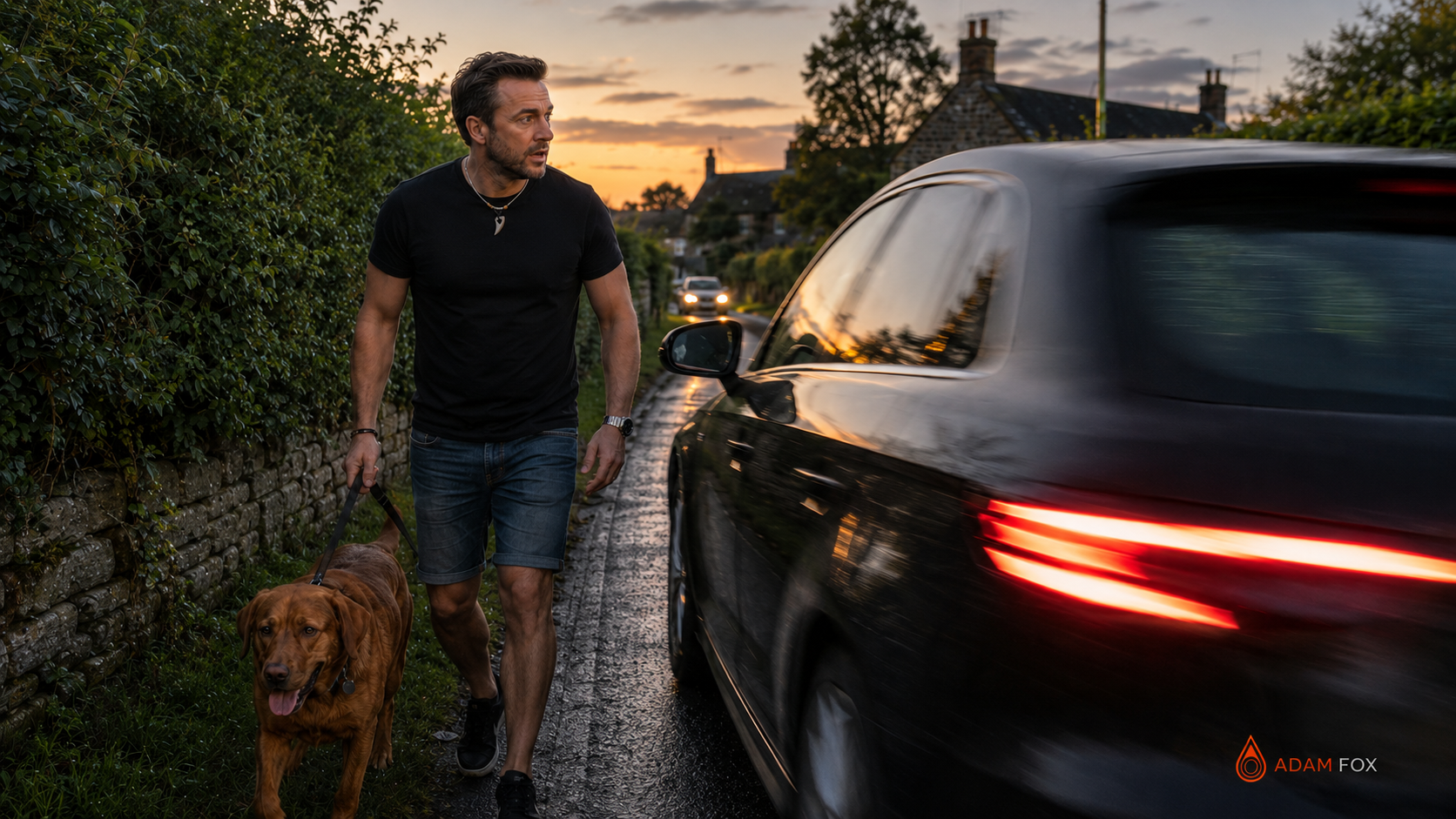
At 5:30 this morning, some absolute prick drove past me and my dog on a narrow village lane at what must have been at least 80 miles an hour.
The speed limit was 30.
His wing mirror passed less than six inches from my left arm.
He did not brake before reaching a blind bend. He continued at the same speed, forcing an oncoming car sharply onto the verge to avoid a collision.
Still no brake lights.
Less than 100 yards further ahead was an even tighter blind bend and two road junctions, one of which has virtually no visibility in the direction he was approaching from.
My immediate explanation was simple.
The driver was a prick
That description may still be entirely accurate.
But I write about human behaviour, attention and agency, which means simply calling someone a prick is rarely enough. Satisfying, certainly. Complete, no.
The more interesting question is what happened inside that driver’s head that allowed the behaviour to feel acceptable.
He cannot have believed that driving at 80 miles an hour through a narrow 30-mile-an-hour village lane was objectively safe.
No functioning adult could examine the road, the blind bends, the junctions, the houses and the possibility of pedestrians, cyclists, animals or oncoming vehicles and conclude that 80 was an appropriate speed.
Something else happened.
He decided the road would probably be empty.
That word matters.
Probably.
Not definitely.
He did not believe nobody could be there.
He believed fewer people would be there.
Then he converted a reduced probability of encountering another human being into permission to behave as though no human beings existed at all.
Except I did.
My dog did.
The driver he forced onto the verge did.
The road was not empty.
There were simply fewer of us available to be killed.
Low Probability Is Not Zero Risk
This is one of the recurring failures in human judgement.
We confuse unlikely with impossible.
People do it with health.
They do it with money.
They do it with relationships.
They do it with safety.
Most of the time, the consequence they fear does not occur. That absence of consequence then becomes evidence that the behaviour was safe.
It was not safe.
They were fortunate.
That distinction disappears surprisingly quickly.
A driver speeds down the same road ten times and nothing happens.
On the eleventh journey, they do not think:
I have survived ten unnecessary risks.
They think:
I know this road.
The successful outcome gets credited to judgement and driving ability rather than luck, the actions of other road users or the simple absence of anyone in the wrong place at the wrong moment.
Research into driving behaviour has repeatedly found that people tend to judge themselves as more skilful and less likely to crash than other drivers. One study found that comparative optimism about driving ability was the strongest predictor of speeding; almost three-quarters of participants rated their driving ability above that of the average comparable driver.
In other words, dangerous drivers rarely experience themselves as dangerous drivers.
They experience themselves as unusually capable drivers operating below their personal limit.
The rules are written for everyone else.
The speed limit applies to the nervous, the elderly, the inexperienced and the people who do not know the road.
Not them.
They know what they are doing.
Until they do not.
He Was Not Driving at 80 Miles an Hour
Eighty miles an hour sounds like a number on a dashboard.
It does not properly communicate the physical reality.
At 80 miles an hour, a vehicle travels almost 36 metres every second.
That is not much time for a dog to move sideways.
Not much time for a pedestrian to stumble.
Not much time for someone to emerge from a junction.
Not much time for an oncoming driver to react around a blind bend.
Not much time for anything unexpected to happen.
The official Highway Code gives a typical stopping distance of 96 metres at 70 miles an hour in dry conditions. One hundred yards is approximately 91 metres. At 70, therefore, the typical stopping distance already exceeds the distance from where he passed me to the next tighter bend. At 80, the distance required would inevitably be greater.
He was not driving at a speed that allowed him to respond to what he could see.
He was driving at a speed that required nothing unexpected to exist.
That is not control.
It is dependence on luck disguised as confidence.
The Risk Was Not His
People often defend speeding as though the driver is making a personal decision.
It is my licence.
It is my car.
I know my ability.
I accept the risk.
Except the driver this morning was not only accepting risk for himself.
He accepted it for me.
For my dog.
For the person approaching around the bend.
For anyone pulling out of either junction.
For someone beginning an early shift.
For an elderly person collecting a newspaper.
For a runner.
For a cyclist.
For a child who woke early and slipped out of the house.
None of us agreed to participate.
That is the moral problem beneath dangerous driving.
The driver receives the benefit.
A shorter journey.
A burst of excitement.
A feeling of freedom.
A sense of mastery.
Perhaps nothing more significant than arriving three minutes earlier.
Everyone else carries the potential cost.
Injury.
Disability.
Trauma.
Death.
A family receiving a phone call that permanently divides their life into before and after.
The benefit is private.
The risk is distributed.
That imbalance makes the behaviour fundamentally different from taking a risk alone.
Jump from an aeroplane if you want.
Climb a mountain.
Surf a wave that terrifies you.
Those decisions may be dangerous, but they do not normally require an unsuspecting dog walker to become collateral damage in your private appetite for risk.
Driving at 80 through a village does.
He Probably Thought Nobody Would Catch Him
The time matters.
At 5:30 in the morning, there are fewer cars.
Fewer pedestrians.
Fewer witnesses.
Probably no speed camera.
Probably no police officer sitting around the bend.
The driver may have considered all of those things.
What he appears not to have considered is whether the behaviour was right without someone present to punish it.
That distinction exposes something uncomfortable about human morality.
Some people treat rules as safety boundaries.
Others treat them as enforcement boundaries.
The first person asks:
What speed allows me to respond safely to this environment?
The second asks:
What speed can I get away with here?
Those are not the same question.
One is governed internally.
The other depends on surveillance.
Remove the camera, the police car or the realistic likelihood of punishment and the rule disappears with it.
This is not agency.
It is outsourced morality.
The person has not decided what responsible behaviour looks like. They have decided how likely someone else is to stop them behaving irresponsibly.
At that speed and in those circumstances, the behaviour could potentially support a charge of dangerous driving. A conviction for dangerous driving carries obligatory disqualification for at least 12 months and requires an extended driving test before the driver can regain a licence.
But the absence of an officer did not make the driving safer.
It made the consequences less likely to land on the person creating the danger.
Cars Create a Powerful Illusion
A vehicle gives an ordinary person an extraordinary amount of power.
A slight movement of the right foot can propel more than a tonne of metal through a populated environment at a speed the human body has no realistic chance of surviving.
Yet the experience from inside the car can feel almost mundane.
The seat is comfortable.
The temperature is controlled.
Music is playing.
The steering is light.
The road passes smoothly beneath you.
Eighty miles an hour inside a modern vehicle may not feel violent.
From six inches away, it does.
That difference matters.
The driver experiences speed through insulation.
The pedestrian experiences it through vulnerability.
Inside the car, I may have appeared only briefly.
A shape.
An obstruction.
Something to pass.
But I was not scenery.
I was a husband walking the family dog.
A father whose daughters were asleep at home.
A person with a life extending far beyond the few seconds I occupied his windscreen.
The vehicle can make that easy to forget.
We do not see the stories attached to the people outside it.
We see road users.
Pedestrians.
Cyclists.
Slow drivers.
Obstacles.
Labels reduce complexity.
They also reduce empathy.
It becomes easier to squeeze past “a pedestrian” than to drive within inches of a father whose children are expecting him to walk back through the front door.
Familiarity Can Make People More Dangerous
The driver may know the lane.
That possibility does not reassure me.
It makes the behaviour easier to explain.
Familiar environments reduce attention.
The first time someone drives a narrow road, they notice everything.
The bends.
The junctions.
The width.
The visibility.
The places another vehicle might appear.
After hundreds of journeys, much of that information is processed automatically.
The road feels known.
What feels known begins to feel controlled.
The driver stops responding to the road that exists this morning and starts responding to their memory of previous mornings.
No one normally walks here at this time.
Nothing normally comes around that bend.
That junction is normally empty.
“Normally” becomes the basis of the decision.
The danger is that roads do not repeat themselves perfectly.
The tarmac may be familiar.
The conditions are not.
Today there was a man and a dog.
Today there was an oncoming car.
Tomorrow there may be a tractor pulling out.
A broken-down vehicle.
Mud on the road.
A fallen branch.
An animal.
Ice.
Someone does not have to make a mistake for the environment to change.
Reality merely has to differ from expectation.
At 30 miles an hour, some margin remains.
At 80, the driver has spent nearly all of it before the unexpected event begins.
The Near Miss May Teach Him the Wrong Lesson
This is the part that concerns me most.
He passed me without hitting me.
He reached the bend without colliding with the other car.
Presumably, he continued through the next bend and both junctions without killing anyone.
That means he may have arrived at his destination believing nothing happened.
Something did happen.
He passed within inches of a pedestrian at a speed capable of killing him instantly.
He forced another road user onto a verge.
He entered multiple blind hazards without enough visible road to stop safely.
Those were events.
The absence of a collision does not erase them.
But because there was no impact, no flashing blue light, no damaged vehicle and no immediate punishment, the driver may interpret the journey as successful.
He may even believe his skill prevented the collision.
He held the line.
He judged the gap.
He handled the bend.
The oncoming car moved.
Everything was fine.
That is how luck becomes converted into confidence.
The greater the number of near misses someone survives, the more evidence they may believe they have that their judgement is sound.
The lesson should be:
I came extraordinarily close to causing a catastrophe.
The lesson often becomes:
I knew I could make it.
Until one day, they cannot.
The Word “Inadvertently” Does Too Much Work
We describe many road deaths as accidents.
The word is useful.
It communicates that the driver did not deliberately set out to kill someone.
But intention is not the only form of responsibility.
A person can create a foreseeable risk without desiring the outcome.
The driver this morning presumably did not want to kill me.
That is not enough.
Nobody gets to place another person in mortal danger and defend themselves by saying the death would have been inadvertent.
At 80 miles an hour on a narrow village lane, the possibility of encountering another person is not an unforeseeable freak event.
Villages contain people.
Roads contain vehicles.
Bends conceal things.
Junctions produce traffic.
Dogs move unpredictably.
This is not specialist knowledge.
The driver did not fail to understand the possibility.
He discounted it.
The chance seemed low enough.
My life became part of his calculation.
Speed Changes Consequences, Not Just Arrival Times
The public conversation about speeding is often framed as obedience.
Follow the limit.
Do not break the law.
Avoid points.
Avoid fines.
Keep your licence.
All of that matters.
But it can obscure why the limit exists.
Speed affects whether the driver can recognise a hazard.
Whether they can react.
Whether they can stop.
And what happens to a human body if they do not.
The relationship between speed and harm is not linear in the way people intuitively imagine. Small increases in speed can produce large increases in stopping distance and impact severity. Transport for London has previously reported that the estimated risk of fatal injury to a pedestrian rises sharply as impact speed increases, from 7 per cent at 30 miles an hour to 31 per cent at 40.
He was doing roughly twice 40.
I do not need a precise percentage to understand what that would have meant for me.
There would have been no meaningful opportunity for my body to absorb it.
The difference between him passing six inches away and six inches further left was not a damaged sleeve.
It was likely the difference between continuing my walk and never returning home.
This Is What Entitlement Looks Like
Entitlement is often imagined as arrogance expressed through words.
Someone demanding special treatment.
Someone believing they deserve more.
But entitlement can also appear as risk imposed on strangers.
It says:
My urgency matters more than your safety.
My confidence matters more than your consent.
My journey matters more than your right to occupy this road.
My assessment of the odds is sufficient authority to gamble with your life.
The driver did not need to hate me.
He did not need to see me and actively decide that my life had no value.
He only needed to value his own preference more in that moment.
That is how serious harm is often created.
Not through cinematic evil.
Through ordinary selfishness combined with power, speed and insufficient consequence.
The person may be kind to their family.
Helpful to colleagues.
Generous to friends.
Then climb into a car and behave as though the people beyond the windscreen are less real.
Human behaviour is rarely consistent enough to divide the world neatly into good people and bad people.
A person can be decent in many environments and catastrophically irresponsible in one.
The consequences do not care about the rest of their character.
Agency Requires More Than Control of the Car
The driver probably believed he was in control.
He kept the car on the road.
He missed me.
He missed the oncoming vehicle.
He negotiated the bends.
But control of a machine is not the same as control of an outcome.
Agency requires an accurate understanding of the system in which we are acting.
It means recognising uncertainty.
Allowing margin.
Accounting for other people.
Taking responsibility before the consequence forces us to.
The truly capable driver is not the one who can push hardest without crashing.
It is the one who understands that public roads are not a demonstration of personal ability.
Restraint is part of skill.
Anyone can press an accelerator.
The judgement lies in knowing when not to.
The Road Was Never Empty
I keep returning to the assumption beneath what happened.
It was early.
The lane was quiet.
There would not be many people around.
All of that was true.
But “not many” is not the same as “none.”
The driver knew that.
He simply treated the difference as unimportant.
That is the behaviour I am trying to understand.
Not ignorance.
Not inability.
The deliberate conversion of lower likelihood into acceptable danger.
It appears in countless areas of life.
People ignore a safety procedure because accidents are rare.
They check a phone while driving because they have done it before.
They leave a child unattended for two minutes because nothing normally happens.
They take a financial risk because the downside seems distant.
They dismiss a symptom because the serious diagnosis is unlikely.
Most of the time, they get away with it.
Then one person does not.
The probability may be small.
The consequence is total.
For the driver, this morning may already have been forgotten.
For me, it was six inches.
Six inches between an ordinary dog walk and my wife being told I was dead.
Six inches between my daughters waking to a normal morning and the worst day of their lives.
Six inches between him continuing his journey and facing the knowledge that his impatience, arrogance or appetite for speed had destroyed a family.
He may have believed the road was empty.
It was not.
I was on it.
And a society in which people behave responsibly only when the roads are busy, the cameras are active or the police are watching is not a society governed by agency.
It is a society gambling on absence.
The road does not need to be full for your behaviour to matter.
One person is enough.
One dog is enough.
One car around a blind bend is enough.
One unexpected movement is enough.
You do not get to decide another person’s life is an acceptable stake simply because you think the odds are in your favour.
The road was quiet.
That should have made the journey peaceful.
It did not make my life disposable.
Explore Adam Fox’s wider work on attention, agency and the hidden decisions shaping everyday human behaviour.