THE MENU YOU DIDN'T CHOOSE
How algorithms can give us more of what we want while quietly reducing our opportunity to discover what we need
I listened to a podcast yesterday about marketing.
It changed the way I intend to approach some of my marketing.
That wasn't the bit that stayed with me.
The podcast was The ActionCOACH Podcast, hosted by James Vincent, with Daniel Priestley as the guest.
I listen to it most weeks.
Partly because business, marketing, messaging and human behaviour are all directly relevant to what I do. I run businesses. I help other business owners. I write books. I create content. I need people to understand what I do before they can possibly decide whether any of it is useful to them.
Marketing matters.
Messaging matters.
Understanding why an idea lands with one person and sails straight past another matters.
But I also listen because of James.
I've met James Vincent once.
Just once.
It was probably getting on for a decade ago at an annual planning workshop run by my business coach. James had been brought in as a guest speaker.
Once was enough.
There are people you meet and within a relatively short conversation you think:
I could do with more people like this in my life.
James was one of them.
He was obviously incredibly good at what he did. Charismatic without performing charisma. Emotionally intelligent. Confident without seeming remotely interested in proving how clever or successful he was.
Most importantly, he was approachable.
Genuine.
The kind of person whose ability makes an impression but whose humanity makes the impression stick.
I've met a few people like that through business.
Marcus Sheridan is another.
I've met Marcus and spoken to him on a few occasions.
For anyone outside the marketing world, Marcus is hardly a household name.
Inside parts of the international business and marketing community, he's fucking massive.
His They Ask, You Answer philosophy has influenced businesses all over the world and has certainly influenced the way I think about content.
Yet every interaction I've ever had with him has reinforced the same impression.
Humble to the core.
Interested in the person standing in front of him.
No inflated sense of importance.
No need to remind you who he is.
That matters to me.
Authenticity matters.
Probably more than polish.
Maybe that's why I listen to another podcast that, on the surface, has very little to do with my professional life.
It's called Off Grid.
It's hosted by Jake Billsberry-Hawkins.
I've never met Jake, although we've exchanged a few messages.
Jake is earlier in his career than people like James or Marcus, and that's part of what I enjoy about listening to him.
He's unapologetically himself.
He interviews climbers, adventurers and people who have created careers in and around the outdoors. People who've built interesting lives doing things many of us probably looked at as kids and assumed weren't proper jobs.
I've always loved the outdoors, so there is an obvious reason the podcast appeals to me.
But that's rarely the only reason I listen to anything.
Because the best podcasts do something much more valuable than give me answers.
They leave me with questions.
Quite often, questions that have absolutely fuck all to do with the reason I pressed play.
And that is exactly what happened yesterday.
THE PODCAST WAS ABOUT MARKETING
Daniel Priestley was talking about a fundamental shift taking place in content marketing.
His argument, simplified considerably, was that there is becoming less value in trying to reach absolutely everybody and much more value in reaching the relatively small number of people who have already demonstrated an interest in whatever it is you talk about.
He used an analogy that stuck.
Imagine having the choice between being put on the front page of the Daily Mail, where millions of people might see you but the overwhelming majority couldn't give a shit about what you do, or being put directly in front of a few thousand people who have already demonstrated genuine interest in your subject.
From a marketing perspective, the answer is fairly obvious.
The second group is far more valuable.
He then explained a content model I liked.
Short form.
Long form.
Lead form.
Short-form content earns an initial piece of attention.
Long-form content allows somebody sufficiently interested to explore the idea properly.
Only after that do you invite them to take some form of further action.
That final step might be a form, an assessment, an enquiry, a subscription or something else.
Daniel obviously has commercial interests in some of the tools used to facilitate that process, which is worth acknowledging.
That doesn't make the underlying logic wrong.
In fact, it made me reconsider some lead-generation experiments I've tried previously.
I have used lead forms.
They haven't particularly excited me.
But perhaps part of the problem was that I treated the form as the content.
Cold person sees form.
Cold person fills in form.
Business receives lead.
Except most people don't wake up desperate to fill in another fucking online form.
The sequencing Daniel described is different.
Someone discovers an idea.
They consume a little.
They become interested.
They consume more.
They begin to understand how you think.
Then, having invested genuine attention, they decide whether they want something else.
That makes considerably more sense.
There were other useful ideas too.
How short-form content can repeatedly enter through pain, prize, problem and news.
How long-form work can establish proof, principles and process.
How recommendation algorithms increasingly allow creators to reach people who have already demonstrated interest in the subjects they discuss.
And that's where my brain wandered away from marketing.
Because the marketer in me thought:
That's incredibly useful.
The person who spends an unhealthy amount of time thinking about attention and agency thought:
Hang on a fucking minute.
WHAT ABOUT THE PERSON WHO DOESN'T KNOW THEY NEED THE IDEA YET?
I write a lot about attention.
A ridiculous amount, actually.
Attention.
Distraction.
Time.
Technology.
Productivity.
Presence.
Agency.
Human behaviour.
The attention economy.
How modern environments influence the things we notice, the things we ignore and ultimately the decisions we make.
Between the Adam Fox website and The DROP System website, there must now be somewhere around 300 substantial pieces of long-form content.
Then there are the books.
The essays.
The frameworks.
The research.
Years of work.
So from a purely selfish marketing perspective, LinkedIn becoming better at identifying people interested in those subjects sounds fantastic.
LinkedIn announced in March 2026 that it is rolling out a new generation of Feed ranking powered by large language models. The system is designed to understand more deeply what posts are actually about and connect them with a member's evolving professional interests and goals. LinkedIn says it learns from previous activity and uses large amounts of historical interaction data to improve recommendations.
That's the opportunity.
Instead of my writing disappearing into a feed containing thousands of people who may have absolutely no interest in attention, LinkedIn can potentially identify someone who has spent the previous month reading about workplace distraction, burnout or digital overload and think:
Adam writes about this. Maybe they'll find his work useful.
Brilliant.
I want that person to see it.
Of course I do.
But then another person enters the equation.
The person who is distracted constantly but doesn't recognise distraction as the problem.
The manager destroying their team's ability to concentrate while believing the real problem is motivation.
The business owner working fifteen-hour days who thinks they need another productivity technique.
The parent worrying about their child's behaviour without understanding the environment influencing it.
The person who doesn't know the phrase attention economy.
The person who has never thought about agency.
The person who hasn't yet developed an interest in something because they haven't encountered the idea required to create the interest.
What happens to them?
If recommendation systems become increasingly good at identifying what we already care about, who introduces us to the things we don't yet know we should care about?
That question followed me around for the rest of the day.
I DIDN'T KNOW I NEEDED TO UNDERSTAND AGENCY
Which brings me back to Jake Billsberry-Hawkins.
Somewhere during an episode of Off Grid, I encountered the word agency being used in the psychological sense.
I am almost embarrassed to admit this.
For roughly the first 40 years of my life, I didn't really know what it meant.
Obviously I knew the word agency.
Estate agency.
Recruitment agency.
Marketing agency.
Government agency.
But personal agency?
Human agency?
The idea that somebody can possess a greater or lesser sense of their ability to act, make choices and influence outcomes?
That use of the word had somehow passed me by.
Then I heard it.
I looked it up.
And something clicked immediately.
It gave me language for something I had been doing my entire life.
For years, I'd described it as work ethic.
But work ethic didn't explain it properly.
Work ethic is being prepared to work hard.
Agency is asking whether the work needs doing that way in the first place.
Work ethic accepts the process and performs it well.
Agency notices the bottleneck and asks whether it can be removed.
Work ethic asks:
How much effort am I prepared to put in?
Agency asks:
Is there a better way?
That distinction explained an enormous amount of my own history.
My paper round at twelve.
Arriving earlier than everybody else and helping the elderly newsagent write the addresses on the newspapers so I could leave before the bottleneck formed.
Starting surveys ridiculously early because I realised sitting in traffic benefited nobody.
Changing processes instead of simply working harder within them.
Building businesses around the life I wanted rather than building the life around whatever the business demanded.
The pattern had always been there.
I simply didn't have a word for it.
Once I did, I started noticing the word everywhere.
That's hardly mysterious.
Attention works like that.
Learn about something and it becomes more available to your awareness.
The world hasn't necessarily started talking about it more frequently.
You've become capable of noticing it.
That distinction is important to my work now.
My own agency framework describes attention as a prerequisite for agency because you cannot question something you never notice.
But think about the chain of events.
I listened to an outdoor podcast because I love the outdoors.
The podcast introduced me to an unfamiliar concept.
The concept made me reinterpret parts of my own life.
That reinterpretation influenced my thinking.
That thinking connected with years of work around productivity and attention.
And agency is now becoming one of the central subjects I expect to spend years exploring.
None of that was the reason I pressed play.
I wasn't searching Spotify for:
"Please recommend a podcast containing a concept that will give me language for a behavioural pattern I haven't recognised in myself yet."
How could I?
I didn't know what I didn't know.
And that is where algorithmic personalisation runs into one of the oldest problems in human learning.
You cannot search for an idea you do not yet know exists.
THE MENU YOU DIDN'T CHOOSE
Imagine somebody has spent the last ten years eating terribly.
Burgers.
Pizza.
Fried chicken.
Chips.
Chocolate.
Takeaways.
They know it's become a problem.
Their weight has crept up.
Their energy has disappeared.
They feel like crap.
Maybe a doctor has given them a warning.
Maybe they saw themselves in a photograph and didn't like what they saw.
Maybe they've simply reached the point where they know something has to change.
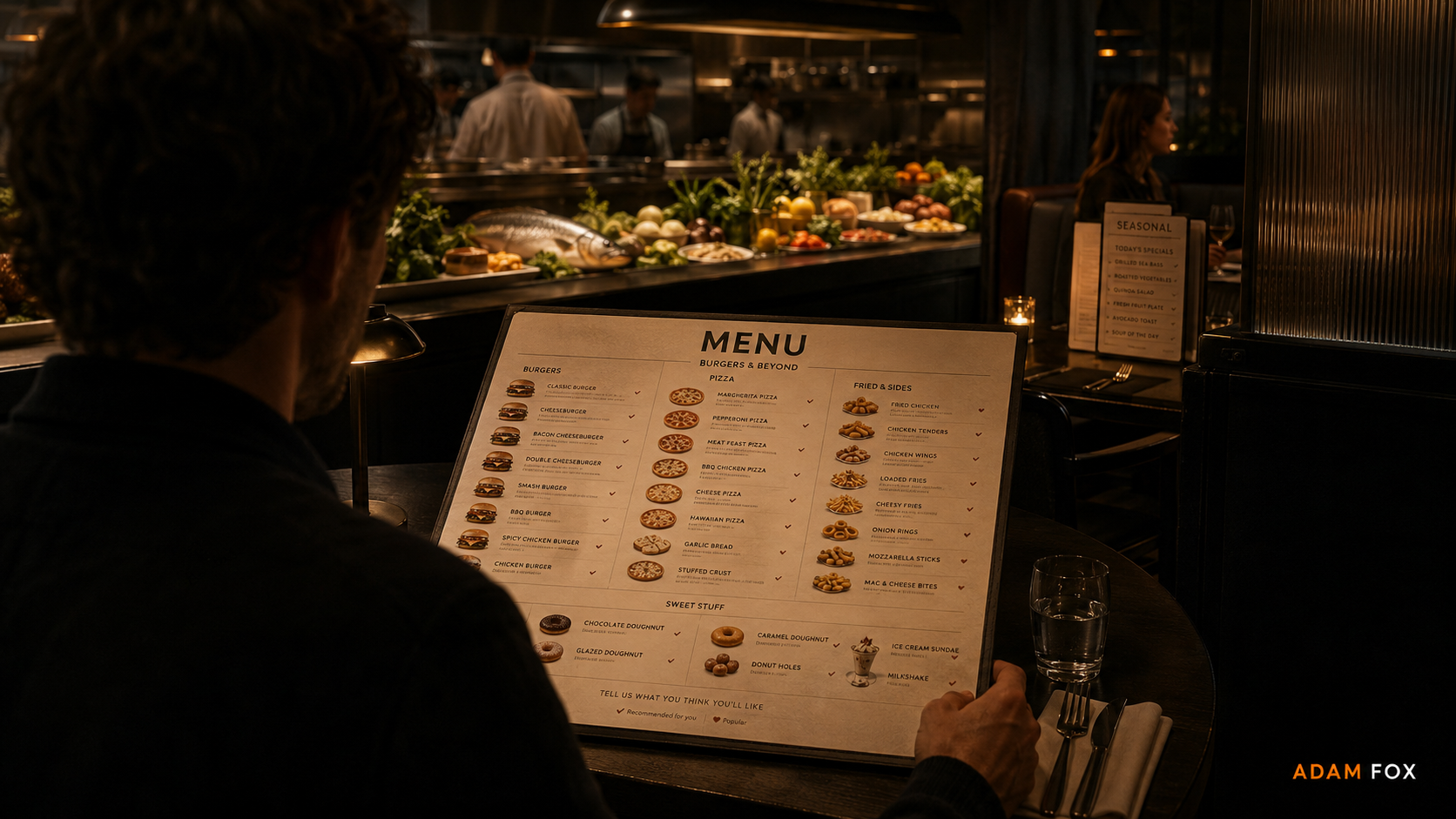
So they walk into a restaurant.
They sit down.
And they are handed a menu.
Burger.
Cheeseburger.
Double burger.
Pizza.
Fried chicken.
Chips.
Doughnuts.
They can order anything they want.
Nobody forces them to choose the burger.
Nobody removes the menu.
Nobody stands over them threatening consequences if they don't order what they've always ordered.
They have complete freedom.
Or at least it feels like they do.
Because what they don't know is that the restaurant originally offered fifty dishes.
Grilled fish.
Vegetables.
Salads.
Rice.
Fresh fruit.
Meals they've never tried.
Food they might discover they actually love.
But the restaurant has ten years of data.
It knows this customer.
This customer clicks burgers.
This customer orders pizza.
This customer rarely looks at vegetables.
So the restaurant decides to improve the experience.
Why overwhelm them with irrelevant choices?
Why make them scroll through food they've never demonstrated an interest in?
Let's personalise the menu.
Let's make it frictionless.
Let's show them what they like.
So the healthy choices disappear.
The person remains completely free to choose.
But only after somebody else has chosen what they are free to choose from.
That's a very different kind of freedom.
The system may even congratulate itself.
Its prediction is excellent.
The customer orders a burger.
Of course they fucking do.
The system predicted correctly.
But did it predict what the person wanted?
Or did it predict what the person's history suggested they would do?
Those are not the same question.
More importantly:
What if the person sitting at the table is trying to become someone their historical data does not yet describe?
ALGORITHMS KNOW WHO YOU WERE
This is the bit I think we need to understand much better.
A recommendation system can become extraordinarily sophisticated at modelling behaviour.
It can learn:
what you click;
what you ignore;
what you watch;
how long you watch it;
what makes you stop scrolling;
what you replay;
what you search;
who you follow;
who you unfollow;
what you buy;
what you abandon;
what time you engage;
what subjects repeatedly capture your attention.
LinkedIn openly says its feed systems consider hundreds of signals from content, profiles, networks and activity when determining what appears.
That is incredible technology.
But ultimately much of what it knows about you comes from evidence of who you have already been.
Your previous behaviour.
Your previous interests.
Your previous clicks.
Your previous choices.
Your previous attention.
That creates an uncomfortable distinction:
Prediction is not aspiration.
A model can become increasingly good at predicting tomorrow from yesterday.
But humans aren't supposed to remain statistically faithful to yesterday forever.
We change.
We learn.
We recover.
We grow.
We abandon beliefs.
We develop new interests.
We stop drinking.
We start exercising.
We leave careers.
We discover hobbies.
We meet people.
We read books that make us rethink things.
We hear one sentence in a podcast and suddenly understand ourselves differently.
A recommendation engine trained heavily on history faces an interesting problem.
How does it know when we are trying to become someone our past behaviour says we aren't?
The person trying to lose weight has historical data screaming:
BURGERS.
The person trying to clear £20,000 of consumer debt has historical data screaming:
BUY THINGS.
The person trying to leave an unhealthy relationship may have years of behavioural data indicating an interest in content that normalises precisely the relationship dynamics they're trying to escape.
The employee thinking about changing career has spent ten years consuming content from the career they increasingly hate.
The person beginning to question a political belief may have an online history almost entirely constructed around that belief.
The aspiring reader has no reading history.
The aspiring runner has no running history.
The person trying to become calmer may have spent years clicking outrage.
The algorithm may understand our patterns extremely well while understanding our intentions extremely badly.
THE SECOND MENU
Take somebody with terrible financial habits.
They're in debt.
They know they're spending too much.
They recognise that comparison has been driving some of it.
They've spent years clicking on clothes, cars, gadgets, holidays, watches, houses and people displaying lifestyles considerably more expensive than their own.
Eventually they decide:
Enough.
I need to change.
Except their informational environment already knows them.
So what appears?
Another car.
Another watch.
Another upgrade.
Another holiday.
Another influencer explaining the ten things everybody needs this summer.
Another finance option.
Another opportunity to spread payments.
Another aspirational home.
Another perfectly curated life.
Another little reminder that everybody else apparently has more.
Again, nobody forces the purchase.
The person technically retains choice.
But where is the competing idea?
Where's the article explaining that perhaps wanting less could improve their life more than earning more?
Where's the person talking about contentment?
Where's the argument against status consumption?
Where's the person explaining hedonic adaptation?
Where's the philosophy they've never encountered?
Where's the story about someone who became happier by stepping off the fucking treadmill?
Maybe they would reject it.
Fine.
That's agency too.
Agency doesn't require agreement.
But first they need the opportunity to encounter the argument.
And that's the part that concerns me.
If the menu is constructed from yesterday's behaviour, how easily do we discover the things capable of changing tomorrow's?
CHOICE ISN'T ONLY ABOUT THE FINAL DECISION
We tend to think about agency at the moment of decision.
Did I click?
Did I buy?
Did I vote?
Did I watch?
Did I believe?
Did I choose?
But perhaps we need to move one step backwards.
Because before choice comes exposure.
Before I choose between A and B, something determines whether A and B enter my awareness at all.
Maybe C existed.
Maybe C was dramatically better.
Maybe I would have chosen C immediately.
But C never appeared.
Did I still exercise agency?
Yes.
But within a narrower environment.
This distinction matters because recommendation algorithms operate largely upstream of conscious choice.
The algorithm isn't necessarily making the final decision for you.
It's shaping the environment in which your decision is made.
That is far subtler.
And potentially far more powerful.
You can choose every dish on the menu voluntarily while remaining completely unaware that someone else removed half the kitchen.
THIS ISN'T A CONSPIRACY
Before this disappears down the inevitable Big Tech rabbit hole, I want to make something very clear.
I am not suggesting there is a room somewhere inside LinkedIn where a group of executives decide:
Adam Fox must not discover philosophy today.
That would be fucking ridiculous.
Nor am I saying recommendation systems are inherently bad.
They're necessary.
The internet contains more information than any human being could consume in millions of lifetimes.
Somebody or something has to filter it.
Without search engines, recommendation systems, directories, subscriptions and social networks, the sheer volume would make much of the internet unusable.
Personalisation can also expand our world.
LinkedIn deliberately recommends posts from outside our immediate network when it predicts that those posts will be professionally useful or relevant.
Spotify introduces people to musicians they've never heard of.
YouTube introduces people to subjects they didn't search for.
Book retailers recommend authors.
Podcast platforms suggest adjacent conversations.
Some of those recommendations create exactly the kind of serendipity I'm arguing matters.
So this isn't:
ALGORITHMS BAD.
That would be intellectually lazy.
The question is about optimisation.
What exactly is the system optimising for?
Relevance?
Engagement?
Satisfaction?
Time spent?
Clicks?
Transactions?
Retention?
Novelty?
Learning?
Diversity?
Wellbeing?
Because those outcomes are not interchangeable.
Something can be extremely engaging and terrible for us.
Something can be highly relevant and intellectually repetitive.
Something can keep us on a platform while making our understanding of the world narrower.
Something can satisfy our current preferences while reinforcing the very preferences we're attempting to change.
Researchers working on recommendation systems recognise this problem themselves. One strand of research focuses specifically on serendipity: how systems might deliberately recommend unexpected but potentially valuable material rather than endlessly repeating what historical behaviour predicts. A 2025 paper on "serendipity recommendations", for example, explicitly describes the feedback-loop problem where recommendation systems trained on responses to their own recommendations can reinforce homogeneous content.
Think about that loop.
The system shows me burgers because I historically liked burgers.
I click the burger.
The system records:
Excellent. Adam likes burgers.
It shows more burgers.
I click another.
Now it has stronger evidence.
At some point we have to ask:
Is the system discovering my preference, or participating in the reinforcement of it?
RELEVANCE IS NOT IMPORTANCE
This is where the whole thing collides with attention.
Platforms talk constantly about relevance.
And relevance sounds unquestionably positive.
Who wants an irrelevant feed?
I certainly don't.
If I open LinkedIn, I don't particularly want to scroll through four hundred posts about industries I know nothing about from people discussing internal company issues I have no reason to care about.
Relevant sounds better.
But relevance has a limitation.
Relevant to what?
My current work?
My previous clicks?
My existing beliefs?
My stated goals?
My unspoken ambitions?
My fears?
My curiosity?
The person I'm becoming?
And even then:
Relevant is not the same as important.
That's a distinction running through almost everything I've written about attention.
Important things are often quiet.
Slow.
Unfashionable.
Demanding.
Sometimes boring initially.
The immediate thing announces itself.
The interesting thing pulls us towards it.
The important thing often waits.
That idea became one of the foundations of The Man Who Collected Silence.
In the story, bells originally signal things that genuinely matter.
Over time they multiply.
Merchants ring them.
Storytellers ring them.
Announcements ring.
Eventually the signals no longer represent importance.
They represent competition for attention.
The bells aren't evil.
People aren't physically forced to respond.
The problem is that responding becomes normal until the villagers stop asking whether every signal deserves an answer.
Recommendation systems introduce a related but different problem.
The bells decide when to ask for attention.
Recommendation algorithms increasingly influence which bells we hear at all.
THE FEED DOESN'T LOOK LIKE A FILTER
This is one of the strangest things about algorithmic curation.
It doesn't feel like curation.
Walk into a library and you know most books aren't visible.
You see shelves.
Rooms.
Categories.
You understand that thousands of other possibilities exist beyond the book directly in front of you.
Open a newspaper and you know an editor made choices.
Stories were selected.
Others were rejected.
Pages were limited.
Editors have names.
Publications have identities.
You can buy another newspaper.
The selection process is visible.
A personalised feed feels different.
It arrives individually.
Continuously.
Infinitely.
There are no empty shelves showing what wasn't selected.
No editor's note saying:
We considered 14,312 possible things to show you and chose these 27.
It simply appears.
And because it appears seamlessly, the distinction between:
what exists
and
what has been selected for me
becomes easier to forget.
LinkedIn at least gives users some controls. It allows people to signal that they are not interested in certain posts, follow fresh perspectives and, in some circumstances, choose a "Most Recent" rather than relevance-ranked feed.
Those controls matter.
But they still require the user to understand that there is something to control.
"JUST TRAIN YOUR ALGORITHM"
I've heard this response plenty of times.
If your feed is shit, train it.
Stop clicking ragebait.
Unfollow idiots.
Use "not interested".
Search for better things.
Follow people who challenge you.
Deliberately diversify what you consume.
I agree with all of that.
I do versions of it myself.
But notice how much awareness that solution requires.
First, you have to realise the feed isn't reality.
Then you have to understand that your behaviour influences it.
Then you have to notice that the current version isn't serving you.
Then you have to imagine an alternative information environment.
Then you have to deliberately provide different signals.
Then you have to keep doing it.
That's agency.
And agency is not evenly distributed.
Not because some people are superior human beings.
Not because entrepreneurs possess some magical cognitive gift.
But because people differ enormously in curiosity, digital literacy, confidence, knowledge, personality, time, stress, education and willingness to question defaults.
If you're exhausted, stressed, rushing between work and childcare and opening an app for ten minutes of relief, you're probably not conducting an audit of the informational architecture around you.
You're scrolling.
That's normal.
The system is invisible precisely when it works smoothly.
Which means the people most able to escape a narrow informational environment may be the people already predisposed to question it.
That creates a nasty possibility.
Agency may increasingly reward the people who already possess enough agency to realise they need to exercise it.
THE ALGORITHM DOESN'T NEED TO KNOW WHAT IS TRUE
Now take the same mechanics away from burgers and marketing.
Move into politics.
This is where the subject becomes considerably more serious and considerably easier to oversimplify.
I don't want to make the lazy claim that algorithms decide election results.
The evidence does not support anything that simple.
Political behaviour is influenced by economics, identity, candidates, culture, institutions, social relationships, traditional media, political campaigning, individual psychology and countless other variables.
But information exposure matters.
And increasingly, social platforms influence that exposure.
A large study published in Nature in May 2026 audited TikTok recommendations during the 2024 US presidential election campaign. Researchers operated 323 controlled accounts and examined more than 280,000 recommendations over 27 weeks. They found systematic asymmetries in political exposure: Republican-seeded accounts received more co-partisan material, while Democratic-seeded accounts received more cross-partisan material, much of it anti-Democratic. Importantly, the researchers were careful not to claim they had established why the imbalance existed; they could identify the exposure pattern but not definitively attribute it to a specific algorithmic rule, content supply or another mechanism.
That last qualification matters.
Because if we care about agency, we should also care about intellectual honesty.
Evidence that an information environment was skewed is not proof that the platform deliberately engineered an election result.
It's not even proof that the skew changed somebody's vote.
But it does demonstrate the power of the menu.
People can be exposed to different political environments despite ostensibly using the same platform.
Recent research on X makes the question even harder to dismiss. A 2026 Nature study found that switching users from a chronological feed to X's algorithmic feed increased engagement and shifted some political opinions in a more conservative direction, although it did not significantly alter every political measure, including self-reported partisanship or affective polarisation.
Yet other research complicates the story.
A major 2023 Science experiment involving Facebook and Instagram during the 2020 US election found that replacing algorithmic feeds with chronological ones substantially changed what users encountered and reduced engagement, but did not detect corresponding changes in political attitudes across several measured outcomes.
Good.
We should want evidence that complicates our argument.
The point isn't:
Algorithms always change people's politics.
The stronger point is:
Algorithms change informational exposure, and under some conditions that exposure appears capable of influencing attitudes. The size, direction and consequences differ across platforms, people and contexts.
That is enough to warrant serious thought.
TWO SMART PEOPLE CAN NOW LIVE IN DIFFERENT WORLDS
Imagine two intelligent people.
Same age.
Similar education.
Similar income.
Same country.
Both genuinely believe they are paying attention to current events.
Person A's behavioural history gradually produces one information environment.
Person B's behavioural history produces another.
Different commentators.
Different news clips.
Different statistics.
Different scandals.
Different explanations.
Different acts of hypocrisy.
Different examples of institutional failure.
Different accounts presented as trustworthy.
Different accounts presented as ridiculous.
Different things repeatedly described as dangerous.
Different things repeatedly described as obvious.
Neither person necessarily lies.
Neither person necessarily lacks intelligence.
Neither has to be brainwashed.
They are simply accumulating different inputs.
Now repeat that for two years.
Five years.
Ten.
Then put them in a room and let them discuss a contentious issue.
Each believes the other has somehow lost their mind.
Person A says:
How can you possibly ignore all this evidence?
Person B thinks:
What fucking evidence?
Not because they interpreted the same menu differently.
Because they were served different menus.
That is a profoundly important distinction.
REPETITION CHANGES THE FEEL OF AN IDEA
Algorithms don't only affect what appears once.
They affect what appears repeatedly.
And repeated exposure matters.
Hear an idea once and it feels like one person's opinion.
Hear variations of it fifty times from apparently independent people and it starts to feel like consensus.
Then something else happens.
The absence of competing explanations becomes evidence in itself.
If virtually everyone in your informational environment describes a situation one way, the alternative begins to seem bizarre.
How could anyone believe it?
You stop needing to defeat opposing arguments because you stop encountering good versions of them.
Eventually you may encounter only caricatures.
The worst argument from the other side.
The stupidest person defending it.
The most offensive example.
The clip designed to make an entire group look insane.
And then your certainty increases.
Not necessarily because you've investigated the issue more deeply.
Because your environment has made alternative interpretations increasingly difficult to imagine.
This is where choice and agency start becoming very uncomfortable.
You still chose every video you watched.
Every article you opened.
Every person you followed.
Every comment you liked.
But each of those choices influenced what arrived next.
And what arrived next influenced the choices available after that.
Agency still exists.
But it exists inside a feedback loop.
THE SYSTEM MAY NOT BE MANIPULATING YOU. IT MAY SIMPLY BE OBEYING YOU TOO WELL.
This is perhaps the most interesting possibility.
We normally imagine manipulation as someone deliberately trying to make us believe something.
But what if nobody needs to?
What if the system simply gets extremely good at giving us more of whatever our behaviour suggests we want?
More outrage if outrage keeps us watching.
More reassurance if reassurance keeps us watching.
More aspiration.
More validation.
More fear.
More novelty.
More confirmation.
More of whatever produces the next interaction.
At that point, the algorithm doesn't need a political ideology.
It doesn't need morals.
It doesn't need an opinion.
It doesn't need to know whether something is true.
It needs a prediction.
What is Adam most likely to engage with next?
That's a very different objective from:
What would Adam benefit from understanding next?
And that gap may be one of the defining tensions of personalised technology.
WHAT IF THE MOST VALUABLE THING IS IRRELEVANT?
Think about Jake's podcast again.
According to a narrow professional model of me, Off Grid might not make much sense.
My businesses aren't in climbing.
I don't work in outdoor recruitment.
I don't guide expeditions.
I don't manufacture tents.
I don't run an adventure company.
I'm not currently looking for a career in the outdoors.
Yet that apparently unrelated podcast handed me language that helped reorganise an entire part of my thinking.
That is serendipity.
The unexpected discovery of something valuable that you weren't deliberately seeking.
And serendipity is awkward for optimisation systems.
Because efficiency says:
Give Adam more of what works.
Curiosity sometimes says:
Give Adam something completely fucking different and see what happens.
Those are competing principles.
Efficiency reduces wasted exposure.
Serendipity depends on some wasted exposure.
Most irrelevant things will remain irrelevant.
If I consume ten subjects outside my usual interests, maybe nine do absolutely nothing for me.
An efficiency model could call those nine failures.
Human curiosity might call them the price of discovering number ten.
That's an important distinction.
SOME INEFFICIENCY MAY BE GOOD FOR US
We've developed an almost religious belief that friction is bad.
Remove friction.
Personalise everything.
Make everything relevant.
Predict the next action.
Reduce the number of clicks.
Anticipate needs.
Make discovery effortless.
In commerce, that often makes sense.
But humans are not checkout processes.
Some friction produces thought.
Some difficulty creates learning.
Some boredom creates imagination.
Some disagreement produces intellectual development.
Some irrelevant conversations expose us to ideas we wouldn't otherwise encounter.
Some wrong turns become the most interesting part of the journey.
I've written elsewhere about boredom and children for similar reasons.
When every empty second is immediately filled, children lose some of the necessity that once forced them to invent, explore and generate their own stimulation. My parenting work is built around the idea that understanding creates agency: the answer isn't simply banning technology, but helping children understand the systems acting upon their attention so they can eventually make choices themselves.
Perhaps informational serendipity works similarly.
If every intellectual gap is immediately filled with the most statistically relevant next thing, we gain convenience.
But what happens to wandering?
What happens to curiosity without a destination?
What happens to the accidental collision between ideas?
What happens to the thought:
I've never heard of that. What the fuck is it?
THIS MAY MATTER EVEN MORE AS AI BECOMES THE INTERFACE
Social feeds are only one part of this.
The bigger question is what happens as artificial intelligence increasingly becomes the layer through which people access information.
A feed chooses from existing content.
An AI system can increasingly synthesise the answer itself.
That's even more convenient.
I use AI.
A lot.
I think its potential is extraordinary.
But the philosophical problem doesn't disappear.
It becomes more concentrated.
If I ask:
What's the best way to solve this problem?
The system can give me an answer immediately.
Fantastic.
But perhaps one of the most valuable experiences available to me would have been reading three conflicting arguments and realising I'd framed the original problem incorrectly.
Efficiency would have answered my question.
Curiosity might have destroyed it.
Sometimes that's better.
This matters because my entire career seems to have been shaped by one recurring question:
Is there a better way?
Not a faster way.
Not an easier way.
A better way.
Agency depends partly upon the willingness to question the frame.
But increasingly sophisticated systems are extraordinarily good at helping us operate inside the frame we provide.
That means the responsibility for questioning the frame may become even more important.
THE DIFFERENCE BETWEEN PERSONALISATION AND IDENTITY
There is another risk here.
Once a system becomes sufficiently good at predicting us, it can begin to feel as though its recommendations reveal who we are.
Spotify Wrapped tells us what kind of listener we've been.
Shopping platforms tell us what people like us buy.
Social platforms tell us what people like us discuss.
News feeds tell us what people like us care about.
Political feeds tell us what people like us believe.
Eventually the model starts feeding identity back to the person it modelled.
You liked this.
Therefore you're this sort of person.
People like you also like this.
Here's more.
Behaviour becomes profile.
Profile influences recommendation.
Recommendation reinforces behaviour.
Behaviour strengthens profile.
Around we go.
That doesn't mean identity becomes fixed.
But it creates inertia.
And human agency is, in part, the capacity to break inertia.
To say:
Yes, that describes what I've done. It doesn't necessarily describe what I'm doing next.
A recommendation system may reasonably use history as its best predictor.
A human being has the capacity to disappoint the prediction.
That may become an increasingly important act.
YOUR PAST BEHAVIOUR IS DATA. IT IS NOT AN INSTRUCTION.
This might be the sentence at the centre of the whole thing.
Your past behaviour is data. It is not an instruction.
You ate burgers.
You don't have to eat burgers tomorrow.
You spent too much.
You don't have to keep spending.
You voted one way.
You can change your mind.
You worked in one industry for twenty years.
You can leave.
You disliked reading at school.
You can become a reader at forty.
You were distracted yesterday.
You can protect your attention today.
You believed something confidently for a decade.
New evidence can change you.
That's agency.
Humans can interrupt behavioural continuity.
But to change direction we often require exposure to something that makes a different direction imaginable.
A person cannot choose a door they cannot see.
THIS IS WHERE ATTENTION AND AGENCY COLLIDE
For years, most conversations about attention have focused on distraction.
Notifications.
Phones.
Social media.
Interruptions.
Multitasking.
Focus.
Those things matter.
But I'm increasingly convinced attention is bigger than concentration.
Attention determines what enters conscious awareness.
Agency determines what we do with what enters awareness.
That creates a sequence:
Exposure.
Attention.
Interpretation.
Choice.
Action.
We spend enormous amounts of time discussing the last two.
Choice and action.
But algorithmic systems increasingly participate in the first.
Exposure.
And exposure constrains everything downstream.
That doesn't mean the algorithm controls the person.
It means agency begins earlier than we tend to think.
Perhaps agency now requires not only deciding what deserves our attention.
Perhaps it requires deliberately influencing what gets the opportunity to compete for it.
WE MAY NEED TO PRACTISE INFORMATIONAL AGENCY
Maybe this becomes another skill.
Informational agency.
Not paranoia.
Not automatically distrusting every recommendation.
Not seeking opposing views simply so we can shout at them.
Not consuming conspiracy theories in the name of being "open minded".
Actual deliberate exposure.
Occasionally choosing Most Recent instead of Most Relevant.
Following somebody thoughtful whose conclusions you often disagree with.
Reading outside your industry.
Buying a magazine you've never read.
Listening to a podcast because the guest sounds interesting rather than because the title perfectly matches your goals.
Reading books from disciplines that appear unrelated to your work.
Asking:
What would I never normally search for?
And perhaps most importantly:
What am I not being shown?
You won't always find anything useful.
That's the point.
Serendipity cannot be guaranteed.
The moment you guarantee it, it stops being serendipity.
ALGORITHMS COULD HELP SOLVE THIS TOO
There is another important point.
The answer doesn't necessarily require abandoning algorithms.
Algorithms could become better at introducing deliberate novelty.
Some recommender-system researchers are already working on exactly that.
Rather than simply asking:
What is this person most likely to click?
systems can incorporate novelty, diversity and serendipity.
One 2025 system deployed on Taobao deliberately sought unexpected-but-relevant recommendations and reported increases not only in exposure to novel items but in clicks and transactions on those items.
That matters because it shows this isn't necessarily a binary choice between:
personalisation
and
randomness.
A system could potentially understand:
Adam is deeply interested in attention.
Adam also enjoys the outdoors.
Adam has demonstrated curiosity about human behaviour.
Here's an interview with a mountaineer discussing decision-making under uncertainty.
That might be exactly the kind of bridge capable of producing something new.
In other words, technology could help protect serendipity.
But only if we value serendipity enough to optimise for it.
And that comes back to incentives.
WHAT DOES THE PLATFORM WANT?
A business exists to make money.
I don't have a problem with that.
I own businesses.
Profit isn't dirty.
But incentives matter.
If attention produces revenue, platforms have an obvious reason to become excellent at holding attention.
Again, that does not mean:
EVIL CORPORATION MANIPULATES EVERYONE.
It means commercial incentives and human interests sometimes align and sometimes don't.
I want LinkedIn to show me interesting content.
LinkedIn wants me to find the platform useful enough to keep returning.
Aligned.
I might benefit from closing LinkedIn after fifteen minutes and spending two hours thinking deeply about one idea.
LinkedIn's commercial incentives may not necessarily improve because I stop using LinkedIn.
Potentially less aligned.
That doesn't make LinkedIn bad.
It makes LinkedIn a business.
Agency means understanding the relationship.
The same applies to practically every attention-funded platform.
Their job is not automatically to decide what's best for my life.
That's my fucking job.
THE DANGER IS OUTSOURCING THAT JOB WITHOUT REALISING IT
Most people would never consciously say:
I would like a technology company to decide which ideas I'm exposed to today.
But functionally, that's partly what a recommendation feed does.
Again, not completely.
We retain enormous influence.
We choose connections.
Follows.
Searches.
Clicks.
Subscriptions.
Platforms themselves increasingly provide preference controls.
But the selection layer remains.
The danger isn't that selection exists.
Selection has always existed.
Parents selected books.
Teachers selected curricula.
Editors selected stories.
Broadcasters selected programmes.
Bookshops selected stock.
Friends recommended films.
What has changed is the scale, speed, precision and individualisation.
My newspaper and your newspaper once contained broadly the same front page.
My feed and your feed can now be entirely different products.
Both called LinkedIn.
Both called TikTok.
Both called YouTube.
Both called X.
Both appearing on identical phones.
But informationally, two completely different worlds.
That deserves far more scrutiny than we've given it.
MAYBE THIS IS WHY THE PODCAST BOTHERED ME SO MUCH
Daniel Priestley was presenting algorithmic relevance as an enormous marketing opportunity.
He was right.
If I can write something genuinely valuable about attention and have LinkedIn put it in front of somebody already struggling with distraction, that's fantastic.
From a marketing perspective, I want the system to become better at doing exactly that.
And I intend to adapt my content accordingly.
Instead of only talking directly about attention, perhaps I enter through subjects people already care about.
AI.
Leadership.
Burnout.
Parenting.
Workplace culture.
Hybrid work.
Technology.
Education.
Then connect those existing interests to the deeper problems I've spent years researching.
That's good marketing.
But there is an irony I can't ignore.
I may need to use algorithmic curation to reach people with a body of work partly arguing that we should become more conscious of algorithmic curation.
I actually quite like that irony.
Because I'm not anti-algorithm.
I'm pro-agency.
Those are not the same thing.
PERHAPS THE REAL PROBLEM ISN'T THAT THE MENU IS CURATED
Every menu is curated.
You cannot put every possible meal in one restaurant.
Every newspaper selects stories.
Every teacher selects examples.
Every author leaves things out.
Every podcast host chooses guests.
Every human conversation excludes billions of possible subjects.
Curation is unavoidable.
The deeper problem is invisible curation combined with the illusion of completeness.
When we forget we're seeing a selection.
When the feed feels like the world.
When repeated exposure feels like universal consensus.
When absence feels like irrelevance.
When prediction begins to substitute for possibility.
That's when we need to become more deliberate.
Not because the algorithm has stolen all our agency.
Because agency requires recognising the environment in which choices are being made.
THE BEST THINGS IN MY LIFE HAVEN'T ALL BEEN OPTIMISED
Some came from deliberate plans.
Others didn't.
People.
Ideas.
Books.
Conversations.
Opportunities.
Questions.
A podcast about the outdoors gave me a word.
A business podcast about marketing gave me an essay about civilisation.
Neither was what I went looking for.
That's precisely why they matter to this argument.
If everything I encounter becomes increasingly optimised around the person a machine predicts I already am, I want to retain enough curiosity to occasionally become unpredictable.
Click the thing that doesn't fit.
Read outside the category.
Speak to someone whose life looks nothing like yours.
Allow yourself to be wrong.
Allow yourself to change.
Allow an idea to interrupt the model.
Because perhaps one of the most important forms of agency in an algorithmically curated world will simply be this:
the ability to surprise the system.
THE MENU WILL ONLY GET BETTER
Recommendation systems are not going away.
They will become dramatically better.
AI will understand context more accurately.
Platforms will understand behaviour more deeply.
Recommendations will become more personalised.
The menu will feel increasingly perfect.
And most of the time, that will probably be brilliant.
Less noise.
Less irrelevant crap.
More useful information.
Better discovery.
But the better the menu becomes, the easier it may become to forget that it's still a menu.
It isn't the whole restaurant.
It certainly isn't the whole world.
So perhaps alongside teaching people how to manage notifications, protect focus and reduce distraction, we need to teach something else.
Look beyond what was selected for you.
Ask what is missing.
Follow curiosity.
Seek unfamiliar perspectives.
Notice when repeated exposure is becoming certainty.
Recognise that relevance is not the same as importance.
Remember that your previous behaviour is not an instruction for your future.
And occasionally go looking for something you have absolutely no fucking reason to be interested in.
Because somewhere inside the irrelevant, inefficient, unexpected mess beyond the personalised menu may be the idea that changes everything.
I know.
That's where I found agency.
And I didn't even know I was looking for it.
THE QUESTION THAT REMAINS
I started yesterday's podcast thinking about marketing.
I finished it thinking about freedom.
Not freedom in the dramatic sense.
Nobody is chaining us to our phones.
Nobody is forcing us to click.
Nobody is physically preventing us from searching elsewhere.
The question is subtler.
How much agency do we really have over our attention when another system increasingly decides what we're given the opportunity to pay attention to?
I don't think the answer is zero.
Far from it.
But I also don't think the answer is as simple as:
I clicked it, therefore I chose it.
Choice begins before the click.
It begins with awareness.
With exposure.
With the existence of alternatives.
With knowing that another option might exist.
With occasionally encountering something your past behaviour could never have predicted you'd need.
Algorithms are becoming astonishingly good at understanding what we have liked.
Perhaps our responsibility is making sure they never become the sole arbiters of what we might learn to love.
Because a machine can build an extraordinarily accurate model of who you have been.
It can predict what you're likely to click next.
It can curate a menu around everything you've done before.
But your history is not your destiny.
And no prediction model, however sophisticated, should be allowed to quietly reduce the possibilities available to the person you haven't become yet.
SOURCES
LinkedIn Engineering: Engineering the next generation of LinkedIn's Feed, March 2026. LinkedIn describes its new LLM-powered ranking architecture, which seeks to understand post meaning more deeply and connect content to members' evolving professional interests and goals using extensive historical activity.
LinkedIn Help: How the Feed ranks content. LinkedIn states that its AI systems use hundreds of signals from posts, profiles, networks and member activity to personalise Feed content.
LinkedIn Help: Suggested posts and Feed controls. LinkedIn explains that suggested posts can originate outside a member's network and that users have controls including following new perspectives, signalling disinterest and changing feed preferences.
Ibrahim et al., Nature, 2026: Systematic partisan content skews in TikTok during the 2024 US elections. Researchers audited more than 280,000 recommendations using 323 controlled accounts over 27 weeks and found systematic asymmetries in partisan political exposure. The study does not establish that the observed skew caused the election outcome or identify the precise mechanism producing the imbalance.
Gauthier et al., Nature, 2026: The political effects of X's feed algorithm. Experimental research found that exposure to X's algorithmic feed increased engagement and shifted some measured political opinions relative to a chronological feed, while not significantly altering all measures of political identity or polarisation.
Guess et al., Science, 2023: How do social media feed algorithms affect attitudes and behaviour in an election campaign? The Facebook and Instagram experiment demonstrated that algorithmic ranking strongly affected exposure and engagement, while switching to chronological feeds did not produce detectable changes in several measured political attitudes during the study. This provides important counter-evidence to simplistic claims that algorithmic feeds inevitably determine political beliefs.
Xi et al., 2025: Bursting Filter Bubble: Enhancing Serendipity Recommendations with Aligned Large Language Models. This research describes feedback loops in recommender systems and explores deliberate recommendation of unexpected but relevant content as a way to increase serendipity and reduce homogeneous exposure.
Adam Fox, Agency & Work Ethic Biography. Existing foundational work defining the relationship between attention and agency, including the distinction between working hard inside systems and recognising opportunities to question and improve those systems.
Adam Fox, The Man Who Collected Silence foundational document. Existing philosophical foundation exploring the gradual surrender of attention, the difference between the important and the immediate, and the human tendency to normalise externally generated demands for attention.
Adam Fox, Before They're Hooked source material. Existing work positioning understanding, rather than blanket technological restriction, as the foundation for developing agency around technology and attention.
RESEARCH GAPS, LIMITATIONS AND QUESTIONS STILL WORTH EXPLORING
There is substantial evidence that recommendation systems influence exposure, but considerably less justification for claiming that exposure straightforwardly determines belief or behaviour.
Platform architecture matters. TikTok, LinkedIn, YouTube, Facebook, Instagram and X do not operate identically, and findings from one should not automatically be transferred to another.
Human behaviour also contributes heavily to informational narrowing. People choose friends, sources, communities and beliefs before algorithms become involved. Algorithmic curation can interact with those preferences rather than independently creating them.
Personalisation can broaden discovery as well as narrow it. Recommendations from outside someone's existing network or explicit interests can produce useful novelty and serendipity.
The political evidence remains contested and developing. Recent studies demonstrate measurable algorithmic effects in some environments, while other large experiments have found substantial changes in content exposure without corresponding changes in measured political attitudes.
There is therefore insufficient evidence to claim that recommendation algorithms caused the outcome of the 2024 US election or any other specific democratic result.
The stronger and more defensible question is whether personalised information environments influence what people have the opportunity to notice, and what that means for human agency when those environments become increasingly individualised.
A further research question deserves particular attention:
How effectively can recommendation systems distinguish between a person's historical preferences and their emerging aspirations?
That may become one of the most important questions in the next generation of personalised technology.