
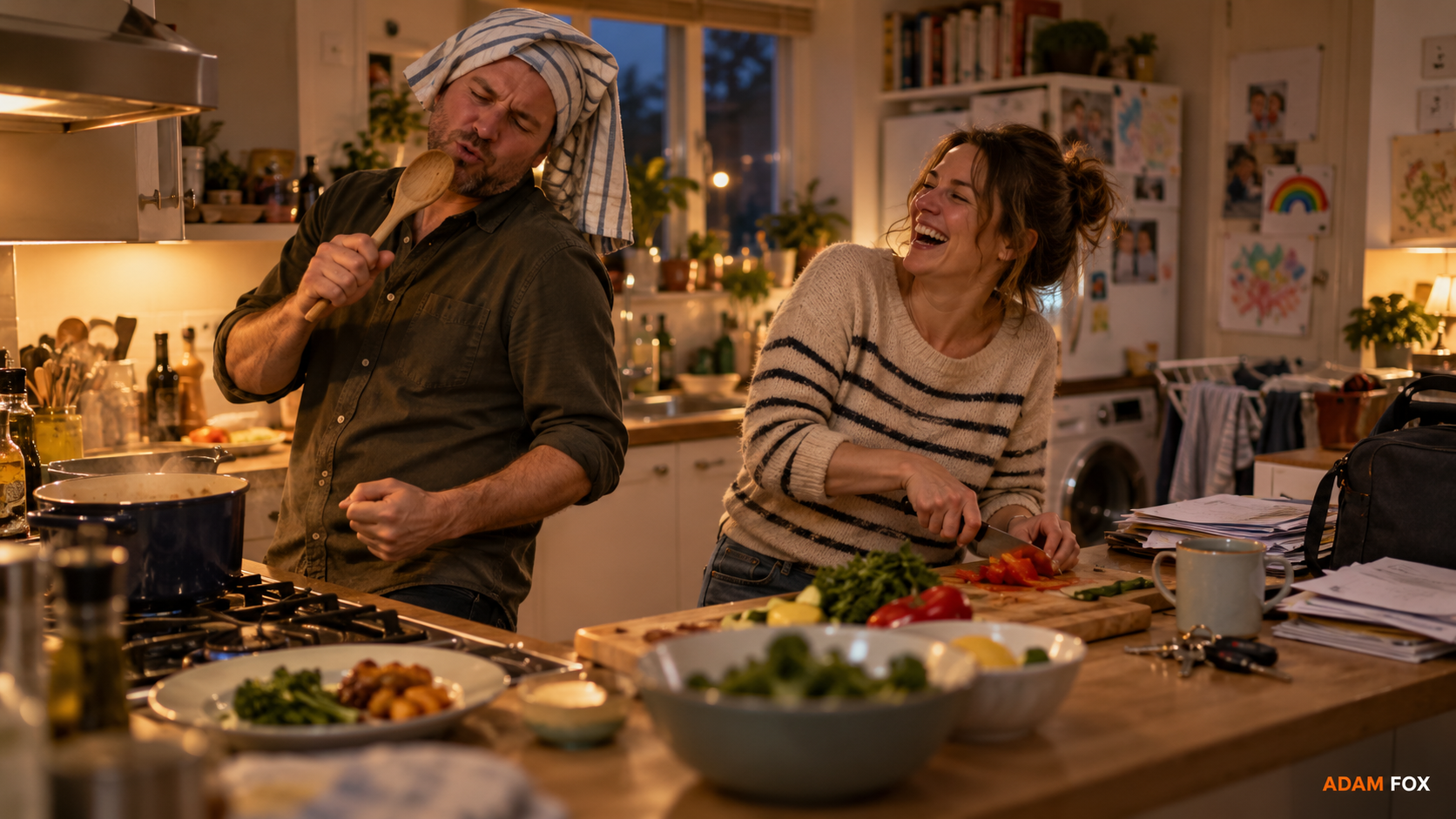
THE LIFE WE POSTPONE: When Did Adults Stop Playing?
My wife and I are incredibly immature.
I mean that as a compliment.
We take the piss out of each other.
We say stupid things.
We laugh at things that probably aren't funny to anybody else.
We behave in ways that would make absolutely no sense if somebody happened to walk into the room halfway through.
Sometimes one of us only needs to make a particular face and the other knows exactly what it means.
There are jokes that have been running for years.
Words that have somehow acquired completely different meanings inside our house.
Ridiculous voices.
Deliberate attempts to annoy each other.
The kind of behaviour that, viewed without context, might lead a responsible adult to ask whether two people in their forties should really be allowed unsupervised access to a mortgage.
And I fucking love it.
Because there are enough parts of adulthood that require us to be responsible.
Bills need paying.
Children need raising.
Work needs doing.
Problems need solving.
People get ill.
Cars break.
Boilers stop working in January rather than conveniently in July.
Schools send emails.
HMRC exists.
Life supplies seriousness perfectly well without us manufacturing extra.
So why do we seem so determined to perform it?
Childhood has a behaviour that adulthood quietly removes
Watch children together.
They make almost anything into something.
A stick becomes a sword.
A sofa becomes a fort.
A cardboard box is briefly more valuable than whatever expensive thing arrived inside it.
They invent rules.
Change the rules.
Argue about the rules.
Forget the rules.
Run around.
Make stupid noises.
Laugh for reasons no adult can identify.
Then, slowly, we start training it out of them.
Sit properly.
Stop messing around.
Concentrate.
Be sensible.
Don't be silly.
Grow up.
That last one is interesting.
Grow up.
We don't normally mean:
Develop emotional regulation.
Take responsibility for your actions.
Learn to care for other people.
Become financially independent.
Understand consequences.
Those would all be perfectly sensible definitions of growing up.
Quite often we mean:
Stop doing the thing that is making you laugh.
At some point, seriousness became evidence of maturity.
And I'm increasingly unconvinced that the two have much to do with each other.
Play does not actually belong to children
Psychologists studying adult playfulness make an important distinction between play and playfulness.
Play is something you do.
Playfulness is more like a disposition — a tendency to frame or reframe situations so they become more entertaining, interesting or intellectually stimulating.
That might mean a board game.
It might also mean teasing your partner, inventing a ridiculous competition while doing something boring, making a stupid observation, playing with language or finding a way of making an ordinary situation more enjoyable.
That definition matters because when we hear the word play, adulthood makes us think of organised recreation.
Football.
Golf.
Gaming.
Board games.
Sport.
Activities with a beginning, an end and usually equipment.
But playfulness is much broader.
It can exist while cooking dinner.
Driving somewhere.
Doing DIY.
Walking the dog.
Sitting in a meeting.
Waiting for a train.
It is less about what you're doing than the way you are inhabiting what you're doing.
That's why two people can experience exactly the same situation completely differently.
One person sees a tedious inconvenience.
Another finds something funny in it.
Neither has changed reality.
One has changed the frame.
We didn't lose the ability
This is the odd bit.
Adults clearly haven't lost the capacity for play.
Get the right group of people together at a wedding.
Watch grown men compete over something utterly meaningless.
Give grandparents small children.
Put old friends back in the same room after ten years.
Watch a couple who genuinely like each other when nobody else is around.
It's all still there.
The idiot survived.
We've just become selective about where we allow them out.
At work?
Careful.
In front of somebody senior?
Professional.
At a formal event?
Appropriate.
With people we don't know?
Guarded.
There seems to be a socially approved perimeter around silliness.
And I wonder how much enjoyment adulthood loses simply because we become increasingly self-conscious about looking like adults.
There are people who appear to be permanently conducting a performance review
I hear it sometimes in podcasts.
Not specifically from women or men — it exists in both.
That strange, relentlessly serious way of talking where every interaction sounds as though it requires analysis.
Every disagreement becomes a boundary.
Every annoyance becomes a behaviour pattern.
Every badly chosen sentence must be unpacked.
Every emotion requires processing.
Every relationship has apparently become a continuing professional development exercise.
And I find myself wondering:
Do you ever just call each other a dickhead and carry on making dinner?
That isn't an argument against emotional intelligence.
Some couples desperately need to communicate better.
Serious problems require serious conversations.
Contempt can destroy relationships.
Cruelty disguised as “banter” is still cruelty.
There is an enormous difference between laughing with someone and repeatedly humiliating them while insisting they can't take a joke.
But healthy playfulness is not the absence of maturity.
It may actually require it.
You need trust before teasing becomes safe.
You need knowledge of the other person.
You need to know where the line is.
You need enough security to occasionally look ridiculous without worrying that it changes how the other person sees you.
Research on romantic relationships gives some support to that intuition.
A study of 211 heterosexual couples found that several dimensions of adult playfulness — particularly playfulness directed towards others and intellectual playfulness — were associated with aspects of relationship satisfaction. Later work with middle-aged and older couples found broadly similar relationships for some forms of playfulness, although the effects differed between dimensions and partners.
Humour research tells a similarly nuanced story.
A meta-analysis combining 43 samples and more than 15,000 participants found positive forms of humour were positively associated with romantic relationship satisfaction, while most negative forms were associated with poorer relationship satisfaction. The strongest relationships tended to appear when humour existed between the partners, rather than simply one person describing themselves as funny.
Which feels right.
Being “the funny one” is not the point.
Having something funny together is.
Shared stupidity is intimacy
There are things my wife and I find hilarious that would require ten minutes of explanation to somebody else.
By the time we'd explained them, they wouldn't be funny.
That's part of their value.
They're ours.
Long relationships develop their own language.
Stories get compressed into a word.
A facial expression refers to something that happened eleven years ago.
A sentence said in a specific accent can resurrect an entire evening.
You build this little cultural archive between you.
It's not important in the conventional sense.
Nobody would put it in marriage guidance literature beside communication, trust and shared financial goals.
But imagine removing all of it.
Imagine the relationship still technically functioning.
Mortgage paid.
Children fed.
Calendar coordinated.
Decisions discussed.
Responsibilities divided.
Perfectly mature.
And completely joyless.
It would look successful from the outside.
It might even be incredibly efficient.
It would also sound fucking exhausting.
Adults are allowed to enjoy being adults
This is what keeps bothering me.
Why do we so often talk about adulthood as though enjoyment is a temporary escape from it?
“Being a big kid.”
“Letting your hair down.”
“Acting your shoe size.”
“Being silly for once.”
The language implies that the default adult is serious and playfulness is a temporary regression.
You are momentarily returning to childhood.
Why?
Why isn't playfulness simply one of the ways an adult can be?
I don't become six years old because I make my daughter laugh by doing something stupid.
I am still 42.
Still responsible for the house.
Still paying the electricity bill.
Still capable of discussing something serious five minutes later.
Human beings contain more than one setting.
That should be obvious.
Yet adulthood often feels like the gradual narrowing of the settings we're permitted to display.
Playfulness is not trivial psychologically either
Adult playfulness remains a relatively small research field compared with the enormous literature on children's play, but what exists doesn't suggest it's some meaningless personality quirk.
Research involving 255 adults found positive associations between playfulness, life satisfaction, enjoyable activities and an active way of life.
Another study looking at playfulness alongside character strengths found relationships with humour, creativity, zest, hope and appreciation of beauty and excellence, among other characteristics. Importantly, different forms of playfulness related differently to different strengths — it isn't simply another word for being extroverted or cheerful.
A randomised placebo-controlled study went further.
More than 500 adults were assigned to short exercises designed to encourage playful behaviour — noticing playful experiences, using playfulness in new ways or identifying playful things during the day — or to a placebo condition.
The playfulness interventions increased measured expressions of playfulness and produced short-term improvements in wellbeing, alongside reductions in depressive symptoms.
That's interesting.
Although I also think there is something wonderfully absurd about science needing to conduct an intervention to remind adults how to fuck about.
Then business discovered play
Of course, once something appears to make humans happier, eventually somebody asks whether it can increase productivity.
And now we have playful work design.
I'm taking the piss slightly, but the research is genuinely interesting.
A major 2026 review of play and playfulness at work notes growing evidence that playfulness can relate to creativity, motivation, engagement and wellbeing, while also warning that context matters and that workplace play should be voluntary rather than forced.
Diary research has found that on days employees deliberately make work more playful or challenging, they can experience greater work-related flow, with flow in turn associated with stronger creative performance.
Other intervention research has found playful improvisation training associated with improvements in reported workplace playfulness and creativity among participating teams.
Fine.
Useful.
But can we please resist the urge to ruin this?
Because there is something magnificently modern about taking play and immediately asking:
How can we leverage this to improve employee output?
No.
Fuck off.
Sometimes fun can just be fun.
We do not need to quantify the ROI of Dave putting googly eyes on the photocopier.
Not every laugh needs a business case.
If play improves creativity, lovely.
If humour helps colleagues bond, brilliant.
If a playful environment makes people enjoy their jobs, excellent.
But the moment HR schedules MANDATORY FUN — 14:00–15:30, something has gone terribly wrong.
Play forced upon you isn't play.
It is another meeting.
We optimise the joy out of everything
This is becoming a recurring problem.
Walk because it improves cardiovascular health.
Read because it develops cognition.
Play because it increases creativity.
Meditate because it improves performance.
Spend time outside because research shows green space improves wellbeing.
Have dinner together because it strengthens family attachment.
Sleep because it makes you more productive tomorrow.
Everything enjoyable must justify itself by producing something useful.
What if I walk because I like walking?
What if I read because the book is good?
What if I lie on the floor being an idiot with my children because for five minutes we're all laughing?
What if I sit around saying absolute bollocks with my wife because saying absolute bollocks with my wife is a perfectly legitimate use of a finite human life?
The instrumentalisation of everything is one of the strangest features of modern adulthood.
We don't simply experience.
We optimise.
Measure.
Improve.
Track.
Extract.
Turn leisure into self-development.
Turn hobbies into side hustles.
Turn interests into content.
Turn exercise into metrics.
Turn family time into intentional parenting.
Turn fucking about into a wellbeing intervention.
At what point are we permitted to do something that achieves nothing?
Children understand this automatically
My daughters don't ask what they're getting from playing.
They don't calculate whether messing around for half an hour will improve resilience.
They don't need to understand the neurological benefits of laughter.
They play because the thing is enjoyable while it is happening.
That may be one of childhood's greatest advantages.
Children are capable of valuing an activity intrinsically.
Then adults introduce outcomes.
Achievement.
Performance.
Assessment.
Productivity.
Return.
And slowly we teach them to explain why their time was worthwhile.
Maybe one of the things children can teach adults isn't how to be more spontaneous.
Maybe it's how to stop demanding that every minute provide evidence in its own defence.
Maturity should increase freedom, not reduce it
This is the contradiction I can't get past.
Growing up is supposed to increase autonomy.
As a child, adults decide when you go to bed.
What you eat.
Where you go.
Whether you can leave the house.
What time you return.
What school you attend.
How much money you have.
Adulthood should be the point at which you finally gain control.
Instead, loads of people reach adulthood and voluntarily become more restricted.
I can't wear that.
Can't say that.
Can't do that.
What would people think?
I'm too old for that.
That's childish.
I need to be sensible.
You spent your entire childhood waiting to become old enough to decide what you were allowed to do.
Then you got there and appointed yourself the strictest fucking parent you've ever had.
That's tragic.
Responsibility does not require emotional beige
The obvious counterargument is that adults cannot behave however they want.
Correct.
A forty-year-old cannot throw a tantrum because Tesco has run out of the yoghurt they like and defend it as “staying connected to their inner child”.
Being playful isn't being irresponsible.
Being childish and being childlike are different.
Childishness can mean refusing accountability.
Impulsiveness.
Self-centredness.
Expecting somebody else to clean up the consequences.
None of that interests me.
I want the adult responsibilities.
Agency requires them.
If I choose the life, I own the consequences.
What I reject is the assumption that responsibility requires emotional beige.
You can pay your mortgage while wearing a stupid hat.
You can chair a board meeting and laugh.
You can be highly competent and deeply unserious about yourself.
You can raise emotionally secure children while occasionally behaving like one of them.
You can have difficult conversations with your partner and still spend most of the evening winding each other up.
In fact, perhaps the people I trust most are those who can move between the two.
Serious when necessary.
Ridiculous when it isn't.
There is strength in not protecting your dignity constantly
Playfulness requires a small amount of vulnerability.
You might look stupid.
The joke might not land.
Somebody might not join in.
You temporarily abandon the need to control exactly how you're perceived.
That's harder than it sounds.
Particularly in adult professional life, where so much energy goes into impression management.
Competent.
Intelligent.
Successful.
Composed.
Knowledgeable.
Professional.
Play creates little cracks in that armour.
You pull a face.
Make the deliberately terrible joke.
Admit something is absurd.
Laugh at yourself.
Suddenly nobody is performing quite so hard.
Perhaps that's part of why it can feel connecting.
For a moment, the hierarchy disappears and there are just humans in the room.
Don't turn playfulness into another personality hierarchy
There is another trap worth avoiding.
Not everybody is loud.
Not everybody wants banter.
Not everybody enjoys being teased.
Some playful people are extroverted.
Others aren't.
Researchers have identified several dimensions of adult playfulness, including forms that are other-directed, lighthearted, intellectual and whimsical. Other models include humorousness, expressiveness and intellectual-creativity.
So playfulness doesn't require becoming the loudest dickhead in the office.
It might be wordplay.
Curiosity.
Absurd observations.
Inventing things.
Private jokes.
Creative problem-solving.
Fantasy.
Storytelling.
Enjoying unusual ideas.
Making mundane things personally interesting.
A quiet person can be deeply playful.
A loud person can have absolutely no playfulness at all.
Volume is not joy.
Perhaps we don't need more adventure
This connects to something else I've been thinking about.
People increasingly seem to talk about living fully in terms of extraordinary experiences.
Travel.
Mountains.
Skydiving.
Surfing.
Expeditions.
Bucket lists.
Adventure has become one way of proving you didn't waste your life.
And again, I love adventure.
But what if the thing missing from a life isn't more extraordinary experiences?
What if the ordinary experiences simply aren't enjoyable enough?
What if you don't need to jump out of an aeroplane to feel alive?
What if laughing in the kitchen on Tuesday counts?
What if making your children laugh counts?
What if sharing a stupid joke with your partner on the sofa counts?
What if the quality of a life is determined far more by thousands of tiny moments of enjoyment than fifty spectacular photographs?
Nobody posts:
Had a completely ordinary Wednesday. Laughed a lot. 10/10.
Maybe they should.
Fun is not a reward for completing life
This may be the most important bit.
We tend to position fun after obligation.
Finish your homework, then play.
Finish your work, then relax.
Get through the week, then enjoy the weekend.
Get through the year, then have the holiday.
Get through the career, then enjoy retirement.
Fun becomes the treat handed out when the important things are finished.
There is one fairly major flaw in this model.
The important things never finish.
There will always be washing.
Emails.
Bills.
Jobs.
Maintenance.
Admin.
People needing things.
Something in the house making a worrying noise.
If you wait until responsibility has completely cleared the stage before allowing enjoyment on, enjoyment will spend most of your life waiting in the wings.
You have to let the two coexist.
A Tuesday worth living
That might be the philosophy underneath this entire series.
I don't want to create a life that requires constant escape.
I don't want to tolerate Monday to Thursday and come alive at the weekend.
I don't want eleven months of serious adulthood in exchange for one month of holidays.
I don't want forty years of responsibility in exchange for a retirement that may or may not arrive in the shape I imagined.
And I don't need every day to be amazing.
That would become exhausting in its own way.
Some days are shit.
Some are boring.
Some involve spreadsheets.
Some involve illness.
Some involve standing in traffic wondering why every other person in Britain apparently chose exactly the same road.
A good life doesn't eliminate those things.
It has enough enjoyment woven through the ordinary parts that you don't need to keep waiting for your real life to resume.
Sometimes that might be nothing more impressive than laughing with the person you love while making dinner.
Good.
That counts.
I intend to remain immature
So yes.
My wife and I are immature.
Long may it continue.
I hope we're still taking the piss out of each other when we're eighty.
I hope my daughters eventually bring partners home who can laugh at themselves.
I hope adulthood never embarrasses the silliness out of them.
I hope they learn to be responsible without becoming overly serious.
I hope they know when something matters.
And, equally importantly, when it really fucking doesn't.
Because life already contains enough gravity.
Illness will come.
Loss will come.
Fear will come.
Responsibility will come.
Nobody reaches the end without receiving a serious education in seriousness.
We don't need to practise it every minute in preparation.
Play when nothing needs doing.
Play while something needs doing.
Laugh at yourself.
Make the stupid observation.
Create the private joke.
Mess about with your kids.
Take the piss out of the person you love and know when to stop.
Be competent.
Be dependable.
Pay your bills.
Keep your promises.
Take responsibility.
And remain just immature enough to remember that being alive is not exclusively a professional undertaking.
We were never supposed to spend childhood learning how to play only to spend adulthood proving we'd grown out of it.
Sources
Proyer, R. T., Gander, F., Brauer, K. & Chick, G. (2021), Can Playfulness be Stimulated? A Randomised Placebo-Controlled Online Playfulness Intervention Study on Effects on Trait Playfulness, Well-Being, and Depression, Applied Psychology: Health and Well-Being. In a randomised study of 533 adults, brief playfulness interventions increased expressions of playfulness and produced short-term changes in wellbeing and depressive symptoms.
Proyer, R. T. (2013), The well-being of playful adults: Adult playfulness, subjective well-being, physical well-being, and the pursuit of enjoyable activities, European Journal of Humour Research. In a sample of 255 adults, playfulness was positively associated with life satisfaction, enjoyable activities and an active way of life.
Proyer, R. T. & Ruch, W. (2011), The virtuousness of adult playfulness: the relation of playfulness with strengths of character, Psychology of Well-Being. Adult playfulness was associated with several character strengths, including humour, creativity, zest and hope, with patterns differing across types of playfulness.
Proyer, R. T., Brauer, K., Wolf, A. & Chick, G. (2019), Adult playfulness and relationship satisfaction: An APIM analysis of romantic couples, Journal of Research in Personality. Study of 211 couples found differing associations between dimensions of adult playfulness and relationship satisfaction.
Brauer, K. et al. (2023), Revisiting Adult Playfulness and Relationship Satisfaction: APIM Analyses of Middle-Aged and Older Couples, International Journal of Applied Positive Psychology. Study of 116 middle-to-older-age couples partially replicated earlier associations between dimensions of playfulness and relationship satisfaction.
Hall, J. A. (2017), Humor in romantic relationships: A meta-analysis, Personal Relationships. Across 43 samples involving 15,177 participants, positive forms of humour were positively associated with relationship satisfaction, while most negative forms were negatively associated.
Proyer, R. T. & Sendatzki, R. (2026), Examining Play and Playfulness at Work: Current Knowledge, Practical Applications, and Future Research Directions, Annual Review of Organizational Psychology and Organizational Behavior. The review examines emerging evidence linking workplace playfulness with creativity, motivation and wellbeing while emphasising context, voluntariness and substantial unresolved questions.
Liu, W., Bakker, A. B., Tse, B. T. & van der Linden, D. (2023), Does playful work design ‘lead to’ more creativity? A diary study on the role of flow, European Journal of Work and Organizational Psychology. Daily playful work design was associated with greater work-related flow, which was in turn associated with creativity in the study.
West, S., Hoff, E. & Carlsson, I. (2017), Enhancing team creativity with playful improvisation theater: a controlled intervention field study, International Journal of Play. Teams receiving improvisation training reported greater workplace playfulness and creativity than controls following the intervention.
Research gaps
Adult playfulness remains substantially less studied than childhood play, and much of the existing evidence is correlational. Associations between playfulness, relationship satisfaction, wellbeing or creativity do not by themselves establish that playfulness causes those outcomes. Personality, relationship quality, social environment and existing wellbeing may influence both playfulness and the measured outcomes.
Definitions also vary. Researchers distinguish play from playfulness and use several different frameworks to describe adult playfulness, including other-directed, lighthearted, intellectual, whimsical, humorous, expressive and creative components. There is therefore no single universally accepted measure capturing everything people might colloquially describe as “being playful”.
The randomised intervention evidence is promising but comparatively limited, and observed wellbeing effects were largely short-term. More long-term research across different cultures, ages and socioeconomic groups is needed before strong claims can be made about deliberately increasing playfulness as an intervention.
Relationship research also requires nuance. Positive, shared humour tends to correlate positively with relationship satisfaction, while aggressive or negative humour can correlate negatively. “Taking the piss” is therefore not inherently relationship-enhancing; its meaning depends on mutuality, trust, context and whether both people genuinely experience it as playful.
Finally, the essay's broader proposition — that modern adulthood culturally overvalues seriousness and unnecessarily suppresses playfulness — is philosophical rather than an established empirical finding. Existing research demonstrates that adult playfulness exists and is associated with several positive outcomes, but it does not establish that contemporary adults are systematically less playful than previous generations or that professional culture universally causes a decline in playfulness.