
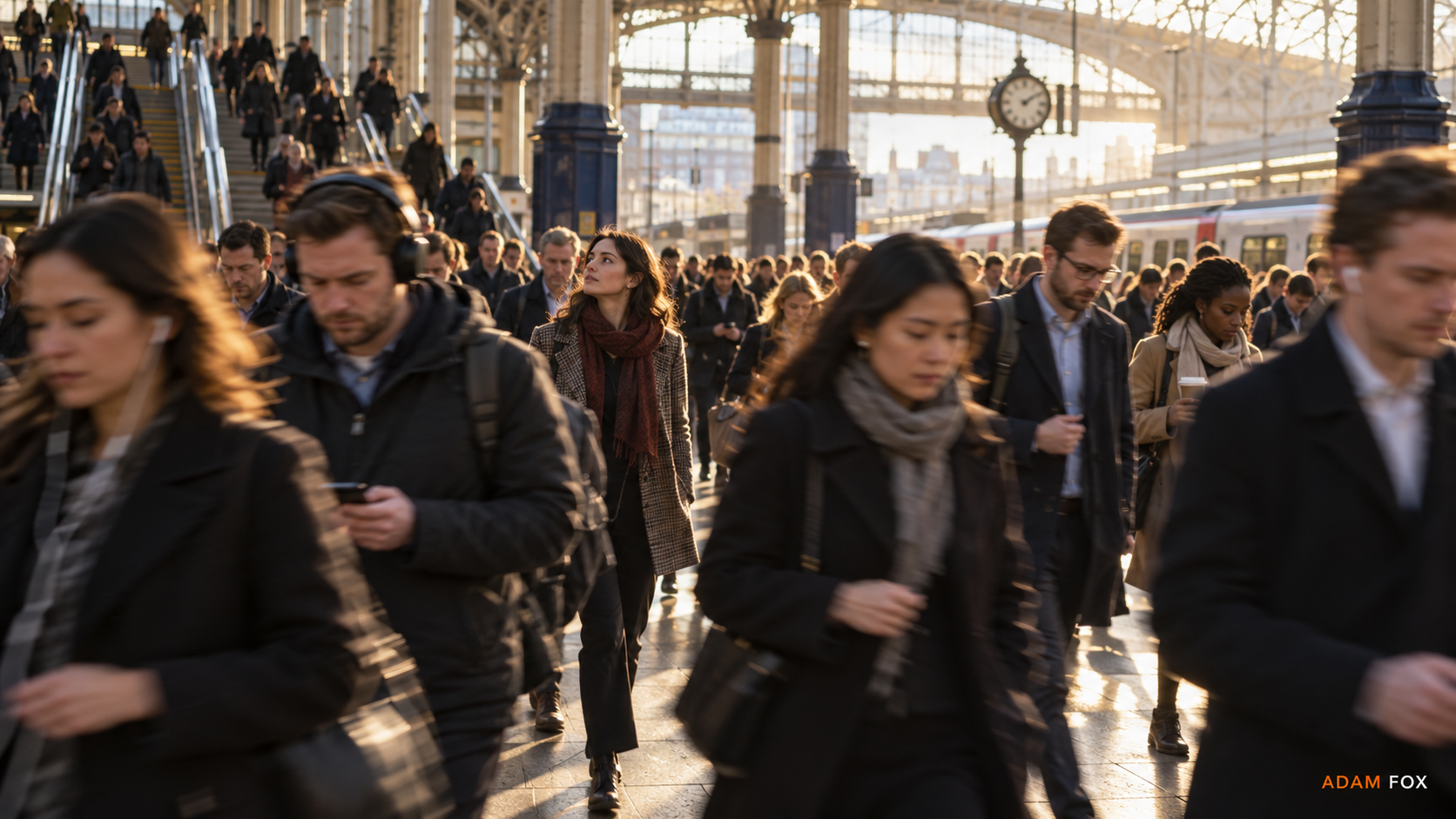
THE LIFE WE POSTPONE: Rats in the Rat Race
At 7:30 this morning, London had already put its face on.
Not London the tourist brochure.
Not London at Christmas.
Not London after three pints when everybody suddenly remembers that strangers are allowed to speak to each other.
Working London.
I had been travelling since getting on the 5:43 train.
By the time I arrived, thousands of people were already pouring through stations, across crossings and along pavements with the same expression.
Eyes forward.
Eyes down.
Headphones in.
Phones out.
Walking quickly.
Very little eye contact.
No real acknowledgement.
Everybody on a mission.
Everyone appearing to have somewhere extremely important to be.
Looking at it, the phrase rat race came into my head.
And immediately I felt slightly guilty about it.
Because I knew absolutely nothing about these people.
The woman walking quickly beside me might have been on her way to a job she adored.
The bloke staring at his phone might have been reading a message from his daughter.
The person who didn't smile when I passed might simply have been awake since five and understandably uninterested in making a new friend before coffee.
You cannot diagnose a stranger's life from their face on a Thursday morning.
But I wasn't really noticing individuals.
I was noticing the behaviour of the crowd.
The sameness.
Hundreds of people moving through the same space while somehow behaving as though nobody else was really there.
And once I saw it, I couldn't stop thinking about it.
Because perhaps the saddest part of the rat race isn't that everybody is running.
Most of us have to run sometimes.
It's how quickly we learn to stop seeing the other rats.
London isn't unfriendly
There is actually a perfectly sensible explanation for some of this.
Cities require social rules.
You cannot meaningfully engage with every human being you encounter in London.
You'd never reach fucking Pret.
More importantly, constantly staring at or attempting to interact with strangers would make crowded environments unbearable.
The sociologist Erving Goffman developed a brilliant term for the behaviour we use instead:
civil inattention.
It describes the tiny social ritual of recognising another person's presence while also signalling that you are not going to intrude on them.
A brief glance.
A slight movement to make space.
An awareness that somebody is there.
Then attention moves elsewhere.
Later research has described civil inattention as an important way of maintaining privacy and social order when strangers are physically close together. It allows us to acknowledge another human without demanding anything from them.
I like that distinction.
Because completely ignoring somebody and respectfully leaving them alone are not actually the same thing.
One says:
You don't exist.
The other says:
I see you. I'm not going to bother you.
That's subtle.
And in somewhere like London, essential.
Try making prolonged eye contact with everybody on a packed Underground carriage and see how quickly you become the fucking problem.
So this is not an argument that Londoners should start hugging each other on the Central line.
Please don't.
Civilisation has suffered enough.
But there is still something worth asking.
At what point does giving each other space become withdrawing from each other completely?
We have learned the commuter posture
You can spot the experienced commuter.
There is an efficiency to them.
They know where to stand.
Which side of the escalator.
Which carriage will stop nearest the exit.
They anticipate the ticket barrier.
They move around slower people before those people realise they're being overtaken.
They don't stop unexpectedly.
They don't block doors.
They understand the system.
There is something genuinely impressive about watching thousands of people coordinate themselves through an enormous city with almost no verbal communication.
But the system trains something else too.
A posture.
Get there.
Don't linger.
Don't interrupt.
Don't become part of anybody else's morning.
Don't invite interaction you don't have time to complete.
Move.
It is incredibly efficient.
And perhaps that is precisely what bothers me.
Because efficiency is brilliant at moving bodies.
It doesn't necessarily produce much life while those bodies are moving.
The commute becomes a corridor
We tend to think of commuting as the gap between two important places.
Home.
Work.
The commute is simply the bit between them.
Necessary travel.
Dead time.
A corridor.
You don't really expect anything to happen there.
You get through it.
Perhaps you listen to something.
Read.
Scroll.
Answer messages.
Work.
Sleep if you're lucky enough to get a seat and brave enough to trust your internal station alarm.
But fundamentally the objective is arrival.
And when you repeat that journey hundreds of times, something subtle can happen.
You stop experiencing the journey as part of your life.
It becomes the cost of reaching the next bit.
That matters more than it sounds.
Because a lot of life happens between destinations.
If your commute takes an hour each way, five days a week, that is ten hours.
Perhaps forty hours a month.
Hundreds of hours a year.
Entire weeks of your waking existence spent travelling between the places you've decided actually count.
And if the assumption is always:
I'll live when I get there
then the conveyor belt we talked about in the previous essay gets smaller conveyor belts attached to it.
Get through school to reach work.
Get through work to reach retirement.
Get through Monday to reach Friday.
Get through the commute to reach the office.
Get through the office to reach home.
Always moving towards life.
Never quite noticing that this bit was life as well.
Commuting genuinely can take something out of us
There are good reasons people retreat into themselves during a commute.
Crowding can be stressful.
A systematic review of research on public transport and commuter health found evidence among rail commuters of increased perceived stress, physiological stress responses and negative reactions associated with crowding, although the evidence base was mixed and varied substantially between studies.
Earlier research into rail crowding also found that physical proximity mattered more than simply the number of people in a carriage. In one study of urban rail commuters, sitting in very close proximity to other passengers was associated with greater self-reported and physiological stress.
Again, perfectly understandable.
Humans weren't designed around the concept of having somebody else's armpit six inches from our face while travelling beneath a city at speed.
Withdrawal can be protection.
Headphones create a wall.
Phones create somewhere else to look.
Books create a socially acceptable forcefield.
The famous British thousand-yard stare says:
I acknowledge that seventeen of us are currently compressed into a space designed for twelve, and the kindest thing we can all do is pretend this isn't happening.
Fair enough.
But here's where things become interesting.
When researchers have actually made commuters interact, the experience has often turned out better than people expect.
We might be getting strangers wrong
Nicholas Epley and Juliana Schroeder ran a series of experiments in which commuters were asked either to connect with a stranger, remain deliberately solitary or simply commute as normal.
The people instructed to interact reported a more positive commuting experience.
They weren't less productive.
And yet another group of commuters predicted the opposite.
They expected solitude to be preferable.
Later research took the idea directly onto trains in the London area.
Again, commuters instructed to talk to a stranger reported a more positive experience and said they learned more than those in solitude or control conditions.
The interesting bit was what stopped people doing it naturally.
They worried the other person wouldn't want to talk.
People anticipated that trying to start a conversation would be less pleasant than the conversations actually turned out to be.
A broader review of experiments involving conversations with strangers has found the same basic mismatch repeatedly:
conversations tend to go better than people expect.
I fucking love that.
Because it means two people can sit opposite each other, both capable of improving the other's morning, and neither says anything because each assumes the other would rather be left alone.
Two social animals mutually protecting each other from a conversation they might both enjoy.
That's wonderfully human.
This doesn't mean talk to everybody
There is a danger here of turning this into another prescription.
NEW RESEARCH SHOWS YOU MUST HARASS THREE COMMUTERS BEFORE 8AM FOR OPTIMAL WELLBEING.
No.
Sometimes I actively don't want to talk to you.
Sometimes you actively don't want to talk to me.
That's fine.
Solitude is valuable.
Silence is valuable.
Privacy is valuable.
Some people use commuting time as their only genuine decompression window between work and family.
For parents of young children, twenty-five minutes staring through a train window without anybody asking where their PE kit is might constitute a luxury retreat.
Leave them the fuck alone.
The point isn't that every silent commuter secretly wants to discuss the weather.
It's that we may have overlearned the idea that disconnection is the safest default.
And once a behaviour becomes a default, we stop choosing it.
We simply do what the environment has taught us to do.
There are thousands of tiny invitations we decline
A smile is tiny.
A nod is tiny.
“Morning” is tiny.
Helping someone with a suitcase.
Making a joke when the ticket machine refuses to recognise any known form of payment.
Rolling your eyes together when the announcement says the train is delayed because of something sufficiently vague to explain absolutely nothing.
None of these requires a new friendship.
They simply puncture the strange fiction that public space is occupied by isolated individuals temporarily sharing coordinates.
I notice this difference whenever I move between environments.
Walk through a small village early in the morning and people are more likely to acknowledge you.
Walk through woodland and complete strangers say hello.
There is something wonderfully ridiculous about that.
Two people can pass each other on Oxford Street six inches apart and behave as though neither exists.
Put the same two people on a footpath with a Labrador nearby and suddenly:
“Morning!”
Why?
We're the same people.
Apparently trees give us permission to acknowledge one another.
The environment changes the rule.
Which means the rule isn't inevitable.
The rat race rewards tunnel vision
Perhaps the lack of acknowledgement isn't really about cities at all.
Perhaps it is about purpose.
Most people travelling through London at 7:30 aren't wandering.
They're trying to get somewhere.
There is a train to catch.
A meeting.
A shift.
A school drop-off.
An opening time.
A boss who notices lateness.
A customer waiting.
A deadline.
Purpose narrows attention.
You become task-oriented.
Station.
Platform.
Office.
Coffee.
Email.
Meeting.
Lunch.
Meeting.
Train.
Home.
When life contains enough demands, anything outside the immediate route can start looking like interference.
The slow walker.
The tourist standing at the barrier.
The person asking directions.
The charity collector.
The stranger attempting conversation.
Obstacles between you and the next requirement.
And that mindset doesn't necessarily switch off when work does.
That's what concerns me.
Because once life becomes a sequence of tasks, other humans can start feeling like friction.
The person ahead of you isn't a person.
They're blocking the escalator.
The driver isn't a person.
They're slowing your journey.
The colleague isn't a person.
They're another email.
The cashier isn't a person.
They're the reason the queue isn't moving.
Everybody becomes part of the system.
Including you.
That's when the rat-race metaphor starts earning its place.
Not because work makes people rodents.
Because systems built entirely around throughput encourage us to treat ourselves and everybody else as units moving through them.
Efficiency removes the unnecessary
That sounds good.
I spend a huge amount of my working life trying to remove unnecessary friction.
Bad processes annoy the shit out of me.
Why do this twice?
Why wait?
Why travel unnecessarily?
Why have the meeting?
Why make ten people sit through information relevant to three?
There is enormous value in efficiency.
But efficiency has a blind spot.
It assumes the unnecessary has no value.
And humans do lots of unnecessary things that make life worth living.
Conversation can be unnecessary.
A joke is unnecessary.
Stopping to look at something is unnecessary.
Taking the scenic route is unnecessary.
Helping somebody when another person could do it is unnecessary.
Sitting around talking absolute bollocks with your partner serves no measurable productivity outcome whatsoever.
Good.
Not everything should.
If you optimise a railway, you want people flowing smoothly.
If you optimise a warehouse, you want minimum wasted movement.
If you optimise a production line, you remove idle time.
If you apply exactly the same philosophy to a human life, you create something fucking horrible.
There must be room for inefficiency.
Otherwise all we have created is throughput.
We even optimise the commute now
Look around a train and notice how much of the journey has become productive.
Emails.
Teams.
Documents.
Podcasts at increased playback speed.
Audiobooks.
Language apps.
News.
Financial markets.
Courses.
Messages.
You can learn.
Work.
Network.
Organise.
Catch up.
There is nothing wrong with any of this.
I listen to podcasts constantly.
I've learned enormous amounts while driving and travelling.
But there is a cultural tendency to colonise every available space.
A spare twenty minutes becomes an opportunity.
A journey becomes a productivity window.
Waiting becomes wasted time.
Silence becomes something to fill.
Boredom becomes failure.
And eventually there is nowhere left where nothing is required of us.
Even the corridor between work and home gets rented out.
What if the commute belonged to you?
That might be the more useful question.
Not:
How do I make my commute productive?
But:
What do I want this piece of my life to be?
Maybe the answer is work.
Fine.
Maybe you genuinely want to clear your inbox so you can walk through the front door completely present.
That's agency.
Maybe you want music.
A book.
Silence.
Sleep.
A podcast.
A conversation.
Looking out the fucking window.
Whatever.
The important part is noticing that the hour is yours.
The train company transports you.
Your employer may own the hours after you arrive.
Neither automatically owns your attention in between.
There is a strange freedom in remembering that.
Because otherwise the commute becomes another unconscious surrender.
Public transport isn't automatically miserable either
It would be easy to write this essay as though all commuting destroys wellbeing.
Research doesn't support something that simple.
One longitudinal British study using eighteen waves of household-panel data found that people using active travel or public transport reported better psychological wellbeing than when commuting by car, after accounting for a range of individual factors. Switching from driving to active travel was also associated with improved wellbeing.
Research specifically examining London commuters has produced a complicated picture too. A study of 3,630 London commuters found differences by travel mode and public-transport connectivity rather than one universal “commuting is bad” effect. Walking was associated with higher life satisfaction than driving in that analysis, while relationships involving train use, connectivity and mental distress were more mixed.
That's important.
The problem is not trains.
It isn't London.
It isn't even commuting in itself.
The experience depends on mode, duration, crowding, autonomy, personality, family circumstances and what the journey replaces.
As usual, real life refuses to fit neatly into a motivational quote.
My argument is not that everyone on the 7:12 is secretly miserable.
It is that we should notice what repeated routines teach us to become.
You practise a life
Anything repeated becomes easier.
Take the same route enough times and your body can almost do it without you.
The same is true psychologically.
Rush often enough and rushing becomes your normal pace.
Ignore enough people and non-acknowledgement becomes automatic.
Check your phone whenever there is a gap and reaching becomes reflexive.
Treat travelling as dead time and eventually you stop looking.
Treat Monday as something to survive and eventually survival becomes the shape of Monday.
We think habits are things like flossing or exercise.
They're also ways of inhabiting the world.
You practise noticing.
You practise ignoring.
You practise patience.
You practise irritation.
You practise conversation.
You practise withdrawal.
You practise joy.
You practise seriousness.
Eventually the behaviour stops feeling practised.
It feels like you.
Maybe this is why the countryside feels different
People often talk about leaving cities to “slow down”.
Sometimes that's sentimental nonsense.
People in Devon still have bills.
Farmers aren't floating around all day admiring sunsets.
Rural life contains plenty of stress and considerably fewer Tube stations when you actually fucking need one.
But I understand the phrase.
“Slow down” often doesn't literally mean move at a lower speed.
It means:
notice more.
Notice where you are.
Notice other people.
Notice the weather.
Notice that the journey itself is happening.
Notice your own thoughts.
Notice your kids.
Notice the dog.
Notice that the person serving your coffee has a face.
Attention changes the texture of time.
A hurried hour and an attentive hour may contain exactly sixty minutes.
They don't feel like the same piece of life.
The rat race isn't somewhere
That's perhaps my biggest realisation from this morning.
We talk about the rat race like it's a location.
London.
Corporate life.
The city.
The office.
But perhaps the rat race is actually a mode of attention.
You can live in a village and be completely consumed by it.
You can work in London and refuse it.
The rat race begins when life becomes predominantly instrumental.
Everything is for something else.
You travel to reach work.
You work to earn money.
You earn money to pay bills.
You pay bills to maintain the life that allows you to continue travelling to work.
Round and round.
The activity may be unavoidable.
The mental reduction of life to the activity isn't.
That distinction matters.
Because otherwise the only imagined solution is escape.
Quit.
Move.
Retire.
Go off grid.
Buy a camper van.
Become one of those people on Instagram making coffee beside a mountain while mysteriously never explaining how they afford diesel.
Most people aren't doing that.
I'm not sure I'd want to.
I quite like central heating.
The more realistic rebellion is smaller.
Stay human inside the system.
Look up occasionally
That is probably all I'm arguing for.
Look up.
Not constantly.
You'll walk into something.
But occasionally.
See who's around you.
Smile if it feels natural.
Say morning.
Make the stupid comment.
Help someone.
Notice architecture.
Watch the city wake up.
Let the phone stay in your pocket for one stop.
Listen to nothing.
Think.
Don't think.
Allow ten minutes of your life to exist without needing to justify itself.
Not because it will make you more productive later.
Not because it improves your neuroplasticity.
Not because a study showed smiling at commuters raises life satisfaction by 7.4%.
Just because you're alive and this counts.
Nobody is coming to refund the commute
That's the thing.
At the end of your career, nobody calculates the hours spent travelling and gives them back.
There is no rebate.
No little account containing fourteen thousand unused train journeys.
No box appears saying:
Congratulations. You successfully endured 7,842 mornings. Click here to reclaim them.
They went.
Each one.
The delayed trains.
The packed platforms.
The quiet carriages.
The rainy walks.
The cups of station coffee.
The person opposite you.
The sunrise you didn't notice.
The conversation you didn't have.
The podcast you loved.
The morning you felt exhausted.
The morning you felt brilliant.
All life.
Not preparation for life.
Not the corridor leading to life.
Life.
And perhaps that's what bothered me watching London move this morning.
It wasn't that everybody looked miserable.
I couldn't possibly know that.
It was that everybody looked elsewhere.
Mentally already at the destination.
Bodies moving through the present on their way to somewhere apparently more important.
I recognise that because I've done it for years.
We probably all have.
And there will always be mornings when that's exactly what is required.
Head down.
Get there.
Do the job.
Pay the bills.
Repeat.
But if we're going to spend thousands of hours travelling through this world in order to survive within it, I'd quite like to experience some of the journey.
The rat race might be unavoidable.
Becoming a rat isn't.
Sources
Goffman's concept of civil inattention describes the subtle public ritual through which strangers acknowledge one another while preserving privacy and avoiding unwanted engagement. Contemporary research has continued to examine it as a mechanism of social order in crowded public environments.
Epley, N. & Schroeder, J. (2014), Mistakenly Seeking Solitude, Journal of Experimental Psychology: General. Across experiments involving commuters on trains and buses, participants asked to connect with strangers reported more positive experiences than those assigned to solitude or normal commuting, despite people predicting that solitude would be preferable.
Boothby, E. J. et al., Hello, stranger? Pleasant conversations are preceded by concerns about starting one. A field experiment with London-area train commuters found that participants asked to talk with strangers reported a more positive experience and learned more, while anticipated concern about others' willingness to talk helped explain avoidance of conversation.
Sandstrom, G. M. & Boothby, E. J. (2021), Why do people avoid talking to strangers? A mini meta-analysis of predicted fears and actual experiences talking to a stranger, Self and Identity. The review found that interactions with strangers generally went better than participants predicted.
Martin, A., Goryakin, Y. & Suhrcke, M. (2014), Does active commuting improve psychological wellbeing? Longitudinal evidence from eighteen waves of the British Household Panel Survey, Preventive Medicine. The study found higher psychological wellbeing associated with active travel and public transport compared with driving within its longitudinal analysis.
Chng, S., White, M., Abraham, C. & Skippon, S. (2016), Commuting and wellbeing in London: The roles of commute mode and local public transport connectivity, Preventive Medicine. Analysis of 3,630 London commuters found heterogeneous relationships between commute mode, transport connectivity and subjective wellbeing rather than a uniform commuting effect.
The impact of public transport on the health of work commuters: a systematic review (2019). The review identified evidence linking aspects of rail commuting, particularly crowding, with perceived stress and physiological stress responses, while also highlighting limitations and inconsistencies in the evidence base.
Evans, G. W. & Wener, R. E. (2007), Crowding and personal space invasion on the train: Please don't make me sit in the middle, Journal of Environmental Psychology. In rush-hour urban rail commuters, immediate proximity to other passengers was associated with several stress indicators.
Research gaps
The observations opening this essay are exactly that: observations. Facial expression, lack of eye contact and fast walking cannot establish whether any particular commuter is unhappy, stressed or dissatisfied with their life. The essay deliberately distinguishes the visible uniformity of commuter behaviour from assumptions about individual wellbeing.
Civil inattention is also not inherently evidence of alienation. Goffman's concept describes it partly as a respectful and functional response to sharing public space with strangers, especially in dense urban environments. Lack of conversation can represent privacy, social competence or a genuine preference for solitude rather than social breakdown.
Experimental research on stranger conversations consistently suggests that people often underestimate how pleasant brief interactions will be, but this does not establish that everybody benefits from interaction in every situation. Personality, culture, safety, neurodiversity, mood, gender, previous experience and context may substantially affect whether contact with a stranger is welcomed.
Evidence on commuting and wellbeing is similarly mixed. Travel mode, journey length, crowding, predictability, physical activity, income, job quality, family structure and personal preference all influence outcomes. Public transport is therefore neither inherently beneficial nor inherently harmful.
Finally, the essay's central idea — that repeated commuting routines may encourage people to experience travel as “dead time” and adopt increasingly instrumental ways of moving through public life — is a philosophical interpretation rather than an established causal finding. Research on civil inattention, stranger interaction, commuting wellbeing and crowding provides useful context, but it does not prove that commuting causes social disengagement or that acknowledging strangers produces a better life.