
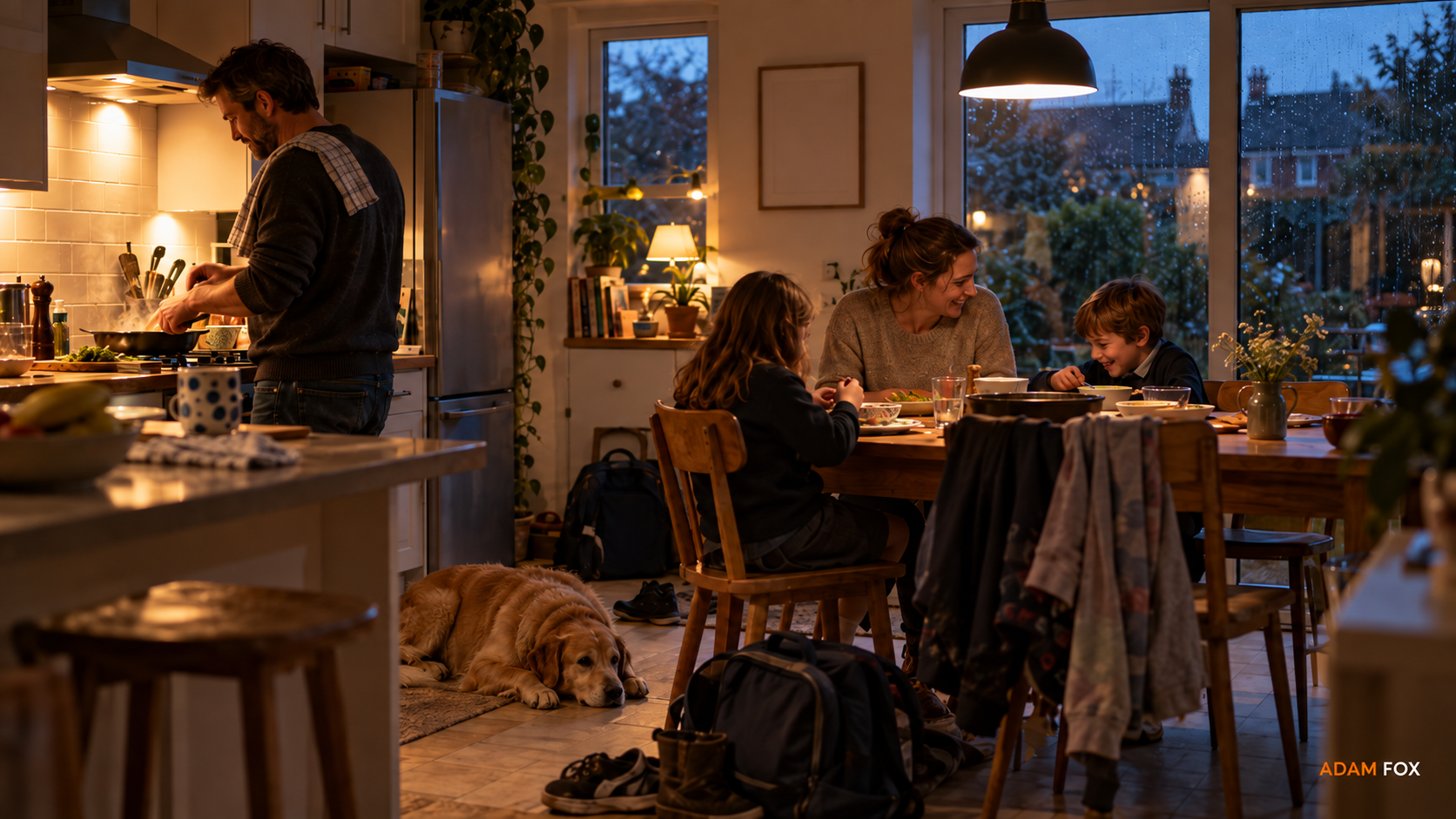
THE LIFE WE POSTPONE: A Tuesday Worth Living
I don't want an extraordinary life.
At least, not in the way we're usually sold one.
I don't need to wake up in Bali.
I don't need a supercar outside.
I don't need to become financially free at 43 and spend the rest of my life posting photographs from business-class lounges.
I don't need fifty countries before fifty.
I don't need to climb Everest.
I don't need to jump from aeroplanes.
I don't even particularly want to stop working.
I want something far less impressive.
I want to enjoy Tuesday.
A normal one.
Wake up.
Walk the dog.
Work on something I actually care about.
Have a decent conversation.
Laugh with my wife.
Be stupid with my daughters.
Eat something nice.
Learn something.
Maybe exercise.
Maybe write.
Maybe do absolutely fuck all useful for half an hour.
Go to bed without feeling as though I spent another day waiting for my real life to begin.
That's pretty much it.
And after writing seven essays about professionalism, work, commuting, retirement, seriousness, bucket lists and the conveyor belt we call adulthood, I think that may be the whole point.
Not escaping life.
Not winning life.
Not optimising life.
Actually being in it.
Tuesday is the test
We are very good at designing special occasions.
Birthdays.
Christmas.
Holidays.
Weddings.
Weekends away.
Anniversaries.
Trips.
Restaurants.
Concerts.
Days out.
We organise them precisely because they are unusual.
Then we photograph them because they are unusual.
Remember them because they are unusual.
Talk about them because they are unusual.
But unusual days are mathematically incapable of making up most of a life.
Ordinary days do that.
Tuesday.
Wednesday.
The random Thursday in February when absolutely nothing significant happened.
Those are the bulk purchase.
If you live for eighty years, most of your existence will not happen beneath the Northern Lights.
It will happen in kitchens.
Cars.
Supermarkets.
Bedrooms.
Offices.
Gardens.
School gates.
Dog walks.
Sofas.
Queues.
At dining tables.
Standing beside the kettle.
If those parts of life are permanently treated as the boring filler between the bits that count, we have a serious fucking problem.
Because the filler is the product.
Happiness probably shouldn't be the target
There is an obvious danger in what I'm saying.
If you turn “enjoy ordinary life” into a requirement, you have simply created another standard people can fail.
Now Tuesday has to be amazing too.
Great.
One more fucking KPI.
That isn't what I mean.
Some Tuesdays will be awful.
People get ill.
Children have bad days.
Work goes wrong.
Relationships become difficult.
Money causes stress.
You get stuck on the M1.
Somebody reverses into your car.
The boiler fails.
You receive an email beginning “Just circling back...”
There is no version of a good life in which every day feels good.
And trying to maintain constant happiness is probably one of the fastest ways to become dissatisfied with perfectly normal emotional life.
Humans aren't built for permanent delight.
We need sadness.
Frustration.
Boredom.
Anger.
Grief.
Restlessness.
Disappointment.
Those emotions tell us things.
A Tuesday worth living isn't a Tuesday on which nothing unpleasant happens.
It is a Tuesday that still feels like your life, rather than an obstacle standing between you and Friday.
That distinction matters.
Daily positive things are not insignificant things
Psychological research has traditionally spent a lot of time looking at major life events.
Birth.
Marriage.
Divorce.
Unemployment.
Bereavement.
Illness.
Understandably.
Big events change lives.
But there is also a substantial body of research on what psychologists sometimes call daily uplifts or positive daily events.
The small stuff.
A pleasant conversation.
Finishing something.
Time with someone you like.
Enjoying a meal.
Receiving good news.
Doing something enjoyable.
A meta-analysis drawing together 142 studies across fifty years found that daily positive events were consistently associated with better wellbeing and mental health across adulthood. The relationship between positive events and some measures of wellbeing was actually stronger in older samples.
That doesn't mean you can cure depression by appreciating a sandwich.
It means the small stuff isn't psychologically irrelevant just because it's small.
And perhaps that is something our culture gets wrong.
We assign importance according to scale.
Big promotion.
Big holiday.
Big birthday.
Big purchase.
Big achievement.
But life is mostly made from tiny repeated experiences.
Scale and significance are not always the same thing.
The good life might be cumulative
Think about your closest relationships.
There probably wasn't one conversation that created them.
There were hundreds.
Thousands.
Tiny interactions accumulating.
A joke.
A look.
A message.
A cup of tea.
Driving somewhere together.
Remembering something the other person mentioned three weeks ago.
Sitting quietly in the same room.
Talking absolute bollocks.
Being there when something went wrong.
The relationship compounds.
Research on everyday social interaction repeatedly points in this direction.
In one experience-sampling study, participants wore audio recorders and reported their happiness and social connectedness throughout normal daily life. Greater quantities of social interaction were robustly associated with greater momentary wellbeing, while aspects of conversational quality — including depth, knowing the other person and liking them — were also associated with wellbeing.
Even relatively weak relationships seem to matter.
Research has found that interactions with acquaintances — classmates, people we know casually, the wider network beyond close friends and family — can contribute to belonging and wellbeing.
Which gives yesterday morning's London commute another dimension.
Perhaps the nod matters.
Perhaps “morning” matters.
Not enormously.
Not transformationally.
Just a tiny positive unit inside an ordinary day.
And enough tiny units eventually become a life.
But I don't want every moment filled with people either
There's another modern trap.
If connection is good, more connection must be better.
Again, no.
Sometimes the best thing anybody can do for me is leave me the fuck alone.
Solitude matters too.
A 2024 daily diary study found that wellbeing during solitude depended partly on whether people experienced autonomy and competence in that time. Solitude in which people felt they had chosen what they were doing and were able to engage meaningfully could contribute positively to daily satisfaction and peaceful affect.
I like that because it reinforces the thing I keep returning to throughout everything I write.
Agency.
It isn't simply being alone.
It isn't simply being with people.
It is having enough authorship over your life to move between the two.
Conversation because you want conversation.
Solitude because you want solitude.
Not isolation you didn't choose.
Not mandatory interaction you can't escape.
The same external situation can feel completely different depending on whether you chose it.
Maybe “enough time” matters more than lots of time
If the argument so far has been that work takes too much time, it would be easy to conclude:
Fine.
Give everybody unlimited free time.
But even that turns out to be more complicated.
A large study using data from more than 35,000 Americans found that very low amounts of discretionary time were associated with lower subjective wellbeing, partly through stress.
But having ever-increasing amounts of free time did not produce ever-increasing happiness.
At high levels of discretionary time, wellbeing sometimes fell, particularly when people felt unproductive or lacked a sense of purpose.
That's important.
Because the goal isn't maximum leisure.
I don't want maximum leisure.
I would get bored.
I want enough time.
Enough space.
Enough control.
Enough interesting work.
Enough connection.
Enough solitude.
Enough silliness.
Enough responsibility to feel useful without so much that it consumes everything around it.
That's a very different objective from retirement at 40.
Enough is an incredibly difficult word
Modern economies don't particularly like “enough”.
Enough doesn't grow very well.
If your house is enough, you don't need a bigger one.
If your car is enough, you don't replace it.
If your income is enough, you might stop chasing the promotion.
If your wardrobe is enough, you stop buying clothes.
If your career is enough, you might work four days.
If your life is enough, selling you an upgraded one becomes difficult.
There is always another level available.
And capitalism isn't uniquely evil for offering it.
Humans are incredibly receptive to wanting more.
Status predates Amazon Prime.
But modern systems have become spectacularly good at reminding us of everything we don't yet have.
Which means the ability to recognise enough may now be one of the most economically inconvenient skills you can develop.
Because enough allows another question:
If I don't need more money, what else could I take instead?
Time?
Energy?
Attention?
A slower morning?
An afternoon with my kids?
We talk about spending money but rarely about spending life
There is some fascinating research around this.
Studies across several countries have found that using money to buy time — paying to remove disliked tasks such as cleaning or other chores — can be associated with greater life satisfaction.
In an experiment, participants reported greater happiness after spending money on a time-saving service than after spending the same amount on a material purchase.
That doesn't mean everyone should outsource the washing-up.
If you're struggling financially, spending money to avoid basic chores could make life considerably more stressful.
But the principle matters.
Money and time can sometimes be exchanged in both directions.
Most of adult life trains us to make one version of the exchange:
time → money
Work another hour.
Take the overtime.
Accept the promotion.
Grow the business.
Earn more.
The opposite transaction can feel strangely indulgent:
money → time
Pay someone.
Earn slightly less.
Take Friday off.
Turn down the extra work.
Buy convenience.
Live in the smaller house.
Drive the older car.
Work fewer hours.
But if time is the genuinely finite resource, perhaps we should become more comfortable making the exchange both ways.
Valuing time changes decisions
Researchers have looked directly at whether people prioritise time or money.
In a preregistered longitudinal study of around one thousand graduating university students, those who valued time over money tended to choose more intrinsically rewarding activities and reported greater happiness one year later, even after accounting for baseline happiness and other factors.
That doesn't prove valuing time always produces a better life.
Money matters enormously when you don't have enough of it.
Financial insecurity destroys choice.
But once basic needs and security are reasonably covered, the calculation changes.
An additional £5,000 may still matter.
But perhaps another fifty afternoons matter more.
The number is personal.
The question is universal.
Even spending money to create time only works if you use the time
There's a lovely detail in more recent research.
A 2025 series of studies found that time-saving purchases were associated with greater relationship satisfaction, particularly among stressed dual-income couples.
But the benefit appeared to depend on what happened after the time was freed.
Couples benefited when the reclaimed time became quality time together.
That's almost comically obvious.
But it exposes another problem.
Freeing time is not enough.
You have to protect what fills the gap.
Because modern life is extraordinarily good at colonising empty space.
Save twenty minutes and another email arrives.
Cancel one meeting and somebody books another.
Automate one process and productivity expectations increase.
Work faster and get more work.
The vacuum fills.
Which means reclaiming time requires something else:
deciding what the time is for.
Not necessarily something productive.
Just something intentional.
I don't want to optimise Tuesday either
There is an irony in writing about this.
You could finish this essay and immediately create:
THE PERFECT TUESDAY PROTOCOL
6:00 — gratitude.
6:15 — mobility.
6:30 — mindful dog walk.
7:15 — intentional family connection.
8:00 — deep work.
12:00 — nutritionally optimal lunch.
13:00 — purposeful social interaction.
17:00 — strength training.
18:00 — quality family time.
21:00 — reflective journalling.
21:30 — optimised sleep protocol.
At which point I would rather fucking die.
That's exactly the mentality I'm arguing against.
A good Tuesday should have room to go wrong.
To change.
To be boring.
To waste time.
To spontaneously decide to do something else.
Agency without flexibility is simply a nicer-looking prison.
The objective isn't to schedule joy efficiently.
It is to stop scheduling it exclusively for later.
Purpose matters, but purpose doesn't need to be grand
There is another mistake we make.
If enjoyment is one half of the conversation, meaning is often presented as the other.
Find your purpose.
Change the world.
Build your legacy.
Do work that matters.
Again, useful ideas ruined by scale.
Purpose doesn't need a fucking TED Talk.
Research following nearly two thousand adults through daily diary assessments found that people with a stronger sense of purpose reported more positive daily events.
But purpose can be small.
Raise decent children.
Do your job well.
Help clients.
Look after people.
Grow vegetables.
Write things.
Coach a football team.
Make furniture.
Care for animals.
Know your neighbours.
Be someone people can rely on.
Maybe the reason people struggle to “find their purpose” is that we've made it sound like they're supposed to identify one world-changing mission.
Most people probably need something far simpler.
A reason to get involved in their own life.
A life needs both involvement and absence
Some of the best moments of my week involve doing things.
Work.
Training.
Writing.
Walking.
Talking.
Cooking.
Being with the girls.
And some involve absolutely nothing.
This matters because modern life loves binaries.
Work or leisure.
Social or solitary.
Productive or lazy.
Ambitious or content.
Driven or relaxed.
Why choose?
A good life probably oscillates.
Periods of challenge followed by recovery.
Connection followed by solitude.
Effort followed by idleness.
Novelty followed by routine.
Adventure followed by home.
Noise followed by quiet.
You don't need to choose between building something and enjoying what you've built.
The whole fucking tragedy is that we ever decided those things belonged in separate phases of life.
The future still matters
This series could easily be misread as an argument against delayed gratification.
It isn't.
Delayed gratification built civilisation.
Plant seeds now.
Harvest later.
Save money.
Train.
Study.
Invest.
Make sacrifices.
Raise children.
Do difficult things whose benefits arrive later.
Some of the most worthwhile things in life require giving up something now.
But delayed gratification becomes pathological when gratification is permanently delayed.
There has to be a dividend.
Otherwise you're just suffering efficiently.
Saving for retirement while also enjoying your forties makes sense.
Destroying your forties so retirement can theoretically be magnificent makes less sense.
Working hard for a promotion that meaningfully improves your family's life can be rational.
Working relentlessly because you've forgotten what the extra money is supposed to achieve is something else.
Sacrifice needs an endpoint.
Your calendar reveals the truth faster than your values do
Ask almost anybody what matters most and you'll hear familiar answers.
Family.
Health.
Friends.
Freedom.
Experiences.
Happiness.
Meaning.
Ask to see their calendar and you may discover something very different.
Work.
Work.
Work.
Travel to work.
Work.
Admin.
Errands.
More work.
Then one hour labelled FAMILY.
I don't say that judgementally.
Life creates obligations.
Calendars reflect necessity as much as priority.
But over long enough periods, a permanent mismatch should bother us.
If something matters and never receives time, eventually the belief that it matters becomes theoretical.
Attention is how values become physical.
Time is how values become visible.
My children won't remember my productivity
This is painfully obvious as a parent.
My daughters do not care how efficiently I answered email.
They don't care about turnover.
They don't care how many things I completed on a Tuesday.
They care whether I am there.
Not constantly.
Children also need independence.
I don't need to turn every hour into an “intentional memory-making opportunity”.
That sounds fucking exhausting for all involved.
Sometimes being there means sitting on the same sofa while everyone does something different.
Sometimes it means walking the dog.
Sometimes it's winding them up.
Sometimes they want absolutely nothing to do with me.
That's fine.
Presence isn't performance.
It is availability without the constant sense that something elsewhere is more important.
And Danni doesn't need a permanently optimised husband
The same applies to marriage.
The things I love about my relationship with Danni are not particularly impressive.
We take the piss.
We laugh.
We're immature.
We annoy each other.
We talk.
Sometimes we sit beside each other doing completely different things.
There is no relationship-growth worksheet.
Nobody is measuring whether the evening delivered appropriate emotional ROI.
It is simply ours.
And that's what a lot of “good life” advice misses.
A good life is incredibly difficult to package because much of it looks boring from outside.
The meaning is relational.
Private.
Contextual.
A stranger cannot see why a stupid phrase makes two people laugh.
Instagram cannot measure it.
LinkedIn definitely cannot understand it.
Good.
Maybe some of the best parts of life should remain useless to everyone except the people living them.
Ordinary life gets better when you stop requiring witnesses
That might be another hidden advantage.
Extraordinary lives attract audiences.
Ordinary happiness usually doesn't.
Nobody cares that you had a lovely dog walk.
Nobody needs photographic proof that dinner was nice.
Nobody applauds because you spent forty-five minutes laughing with your children.
There are no likes for deciding not to take the extra client because you already earn enough.
No award for leaving work on time.
No status in having a wonderfully unremarkable Wednesday.
You have to value those things yourself.
That's harder than it sounds.
External metrics are addictive because they remove ambiguity.
Salary.
Followers.
Job title.
Revenue.
Medals.
Qualifications.
Countries visited.
Houses.
Cars.
Numbers tell you where you stand.
Enjoying your own ordinary life requires an internal measure.
Did I actually like being there?
Much harder.
Much more important.
A Tuesday worth living won't look the same for everyone
Mine isn't yours.
That's another reason universal life advice pisses me off.
Somebody's brilliant Tuesday involves an office full of people.
Someone else's involves not seeing another human until dinner.
One person wants challenge.
Another needs recovery.
One wants a city.
Another wants the countryside.
One loves managing a hundred people.
Another would rather pull their own fingernails out.
There is no correct template.
There is only alignment.
Does your ordinary life increasingly resemble the life you claim to value?
Not perfectly.
Increasingly.
That's enough.
Don't aim for unlimited freedom
Freedom itself needs friction.
Another study found something important about discretionary time: too little was associated with stress and lower wellbeing, but enormous quantities weren't automatically beneficial either. A sense of usefulness and purpose still mattered.
That resonates with me.
I don't want a completely empty calendar.
I want to choose some difficult things.
I want commitments.
People depending on me.
Deadlines sometimes.
Responsibility.
Without any of those things, freedom loses contrast.
The aim isn't to remove obligation.
It is to stop obligation occupying every available surface.
Maybe wealth is having somewhere to put your attention
We tend to define wealth through assets.
Reasonable enough.
But perhaps there are several currencies.
Money.
Time.
Energy.
Attention.
Health.
Relationships.
Agency.
A person can be rich in one and bankrupt in another.
Millions in the bank and nobody to call.
A beautiful house and no time to sit in it.
A huge salary and permanent exhaustion.
Endless leisure and no purpose.
A brilliant career and children you barely know.
The difficult part is that these currencies trade against one another.
More work might create money while consuming time.
More free time might reduce income.
More ambition might create opportunity while consuming attention.
More family time might temporarily slow career progression.
There is no perfect portfolio.
But pretending money is the only balance worth checking produces some very strange forms of poverty.
The goal is not balance either
I have used the word balance plenty over the years.
I still think it has value.
But balance can sound too static.
Fifty percent work.
Fifty percent life.
Perfectly level scales.
Actual life doesn't work like that.
Some weeks I work loads.
Sometimes a project deserves it.
Sometimes family takes virtually everything.
Sometimes somebody is ill.
Sometimes I disappear into writing because I can't stop thinking about something.
Sometimes we go away and I barely work.
The point isn't equal allocation every day.
It is whole-life profitability.
Across months and years, is the life producing enough of the things you value?
Not just money.
All of it.
And crucially, who is paying the cost when one area performs well?
Success that requires somebody else to permanently subsidise it with their time, attention or wellbeing deserves examining.
This is what all the productivity stuff was for
I spent years obsessed with time and productivity.
How do I get more done?
How do I organise things?
How do I stop firefighting?
How do I reduce mental load?
Useful questions.
They helped me enormously.
But eventually another question becomes unavoidable.
More productive for what?
You can create an incredibly efficient machine and then use it to produce a life you don't want.
Being able to complete twelve tasks instead of eight isn't inherently meaningful.
The point of improving productivity should eventually be to release something.
Time.
Attention.
Mental space.
Energy.
Presence.
If every efficiency gain simply creates capacity for additional work, productivity becomes an infinitely expanding gas.
It fills everything.
That's not freedom.
That's a more efficient form of captivity.
This is what attention was for too
Protecting attention isn't about achieving superhuman concentration.
It is about being able to place your mind where your body already is.
On the walk.
At dinner.
With your child.
Talking to your partner.
Doing the work.
Listening to music.
Sitting quietly.
You can own your time on paper and still lose the experience of it completely.
Attention is the thing that turns allocated time into lived time.
Without it, you can spend an entire evening with your family and barely be there.
You can go on the holiday and mentally remain in the office.
You can walk through the woods while existing inside your phone.
Time alone is not enough.
You have to arrive.
And this is what agency was for
Agency isn't about controlling everything.
You can't.
It is noticing where choice exists and using it deliberately.
Can I start earlier and finish earlier?
Can I turn this down?
Can I afford not to chase this?
Can I move?
Can I ask?
Can I stop?
Can I change the system?
Can I put the phone away?
Can I decide this doesn't matter?
Can I choose enough?
Sometimes the answer is no.
Agency isn't magical thinking.
But “no choice” is a conclusion worth interrogating.
Some constraints are structural.
Some are financial.
Some are family obligations.
And some are simply defaults that nobody questioned.
Knowing the difference changes lives.
Four thousand weeks is not a threat
Oliver Burkeman's framing of an approximately 4,000-week human life lands because it makes finitude tangible.
But mortality can easily become another form of pressure.
Make it count.
Don't waste time.
Seize the day.
Maximise every moment.
Jesus Christ.
Now death has become a productivity coach.
That misses the point.
Finitude doesn't make every minute precious in the sense that every minute must produce something memorable.
It makes every minute real.
You are allowed to waste some.
You are allowed to sit around.
You are allowed to watch rubbish television.
You are allowed to have boring conversations.
You are allowed to spend an afternoon doing nothing worth remembering.
Because a well-lived life does not require every moment to justify its existence.
The fact that time is finite should make us more selective about what controls us.
Not more frantic about filling it.
You don't need to love Monday
You don't need to spring out of bed every morning shouting how grateful you are to be alive.
Some mornings are shit.
You don't need your job to be your passion.
You don't need every meal to become a family ritual.
You don't need every walk to become mindful.
You don't need to feel present every second.
You don't need to optimise ordinary life until it becomes yet another project.
You just need enough ordinary life that feels worth being present for.
Enough that Friday isn't always rescue.
Enough that the holiday enhances rather than resuscitates you.
Enough that retirement isn't carrying forty years of deferred expectations.
Enough that when somebody asks whether you enjoy your life, the answer isn't dependent on which week they're asking about.
I want a Tuesday worth living
That's the ambition now.
Not a perfect Tuesday.
Not an Instagram Tuesday.
Not a Tuesday that would make anybody jealous.
Mine.
Work that matters enough.
Money that is enough.
Time that still belongs to me.
People I love.
A body capable of doing things.
Something interesting to think about.
Something stupid to laugh about.
A little space.
A little purpose.
A little play.
And the ability to notice it while it is happening.
Because eventually there will be no Tuesday.
That's not depressing.
It's clarifying.
There will be a final dog walk.
A final family dinner.
A final stupid private joke.
A final ordinary morning.
None of us will know it at the time.
Which means perhaps the best response isn't to desperately make every moment extraordinary.
It is to stop treating the ordinary ones as disposable.
We spend so much of life preparing.
For school.
For work.
For the weekend.
For the holiday.
For retirement.
For the point when things calm down.
For later.
And later keeps moving.
The professional mask can come off.
The work can finish.
The train can arrive.
The bucket list can wait.
The pension can keep compounding.
But life does not happen after those things.
It happens during them.
It happened on the 5:43 train.
It happened during the dog walk.
It happened while making dinner.
It happened while laughing at something stupid with your wife.
It happened while your child was telling you a story you only half understood.
It happened on a completely unremarkable Tuesday that never made it into a photo album.
That was it.
That was the life.
And perhaps the objective was never to build one impressive enough to escape.
Perhaps it was simply to build one you were happy to come home to.
Sources
Sin, N. L. et al. (2022), meta-analysis examining daily positive events and wellbeing across adulthood. Across 142 studies spanning approximately fifty years of research, daily positive events were associated with better wellbeing and mental-health outcomes, with some relationships stronger in older samples.
Sun, J., Harris, K. & Vazire, S. (2020), Is well-being associated with the quantity and quality of social interactions?, Journal of Personality and Social Psychology. Experience-sampling and observer-based data found everyday social interaction quantity robustly associated with momentary and average wellbeing, with several dimensions of interaction quality also related to wellbeing.
Sandstrom, G. M. & Dunn, E. W. (2014), Social Interactions and Well-Being: The Surprising Power of Weak Ties. Across several studies, interactions with weaker social ties were associated with greater happiness and belonging.
Hall, M. et al. (2024), Need satisfaction in daily well-being: Both social and solitude contexts contribute to well-being, British Journal of Social Psychology. A three-week diary study found that autonomy and competence during solitude could contribute to peaceful affect, reduced loneliness and greater daily satisfaction.
Sharif, M. A., Mogilner, C. & Hershfield, H. E. (2021), Having too little or too much time is linked to lower subjective well-being, Journal of Personality and Social Psychology. Across large datasets and experiments, too little discretionary time was associated with lower wellbeing, while very high levels were not automatically beneficial and could be associated with reduced wellbeing when accompanied by a low sense of productivity.
Whillans, A. V. et al. (2017), Buying time promotes happiness, Proceedings of the National Academy of Sciences. Across surveys and an experiment, spending money on time-saving services was associated with greater life satisfaction and produced greater immediate happiness than equivalent spending on a material purchase in the experimental comparison.
Whillans, A. V., Macchia, L. & Dunn, E. W. (2019), Valuing time over money predicts happiness after a major life transition, Science Advances. In a preregistered longitudinal study of graduating students, prioritising time over money predicted greater subsequent happiness and more intrinsically motivated choices one year later.
Whillans, A. V., Pow, J. & Gladstone, J. (2025), Buying (quality) time predicts relationship satisfaction, Journal of Personality and Social Psychology. Across seven studies, time-saving purchases predicted greater relationship satisfaction, particularly among more stressed couples, with benefits linked to converting saved time into positive, supportive time together.
Hill, P. L. et al. (2022), Sense of Purpose Predicts Daily Positive Events and Attenuates Their Influence on Positive Affect, Emotion. In daily diary data from 1,959 adults, sense of purpose predicted the frequency of positive daily events.
Masuda, Y. J., Williams, J. R. & Tallis, H. (2021), Does Life Satisfaction Vary with Time and Income?, Journal of Happiness Studies. The study examined free time and income as distinct resources and found that time availability contributed meaningfully to variation in life satisfaction rather than income alone explaining wellbeing.
Research gaps
The evidence discussed here cannot establish a universal formula for a good ordinary life. Wellbeing is influenced by income, physical and mental health, employment conditions, personality, culture, family circumstances, housing, discrimination, social support and many other factors. Having more discretionary time or more daily positive experiences cannot compensate automatically for serious structural disadvantage or poor health.
Research linking daily positive events and social interaction with wellbeing is largely observational. Happier people may generate more positive events, interpret experiences more positively and engage more socially, meaning causality may operate in both directions.
Evidence around discretionary time is particularly important to interpret carefully. The finding that very large quantities of free time can be associated with lower wellbeing should not be used to justify excessive working hours. The study itself suggests that the way discretionary time is used and whether people experience purpose or productivity helps explain the relationship.
“Buying time” research also has obvious economic limitations. Time-saving purchases are not equally available to people on different incomes, and spending money to outsource disliked tasks could create financial stress that overwhelms any time benefit. Findings therefore should not be converted into a general recommendation to pay other people to perform domestic labour.
Similarly, valuing time over money does not mean money is unimportant. Financial security substantially affects wellbeing and autonomy, particularly at lower incomes. The trade-off between additional income and additional discretionary time will vary sharply according to a person's financial position.
Finally, this essay's central claim — that a good life may be better judged by the quality of ordinary days than by exceptional achievements or experiences — is philosophical rather than experimentally testable in any complete sense. Research can show that ordinary positive events, relationships, autonomy, purpose and discretionary time matter. It cannot decide what an individual Tuesday should contain.
That remains personal.
Which is probably the point.