
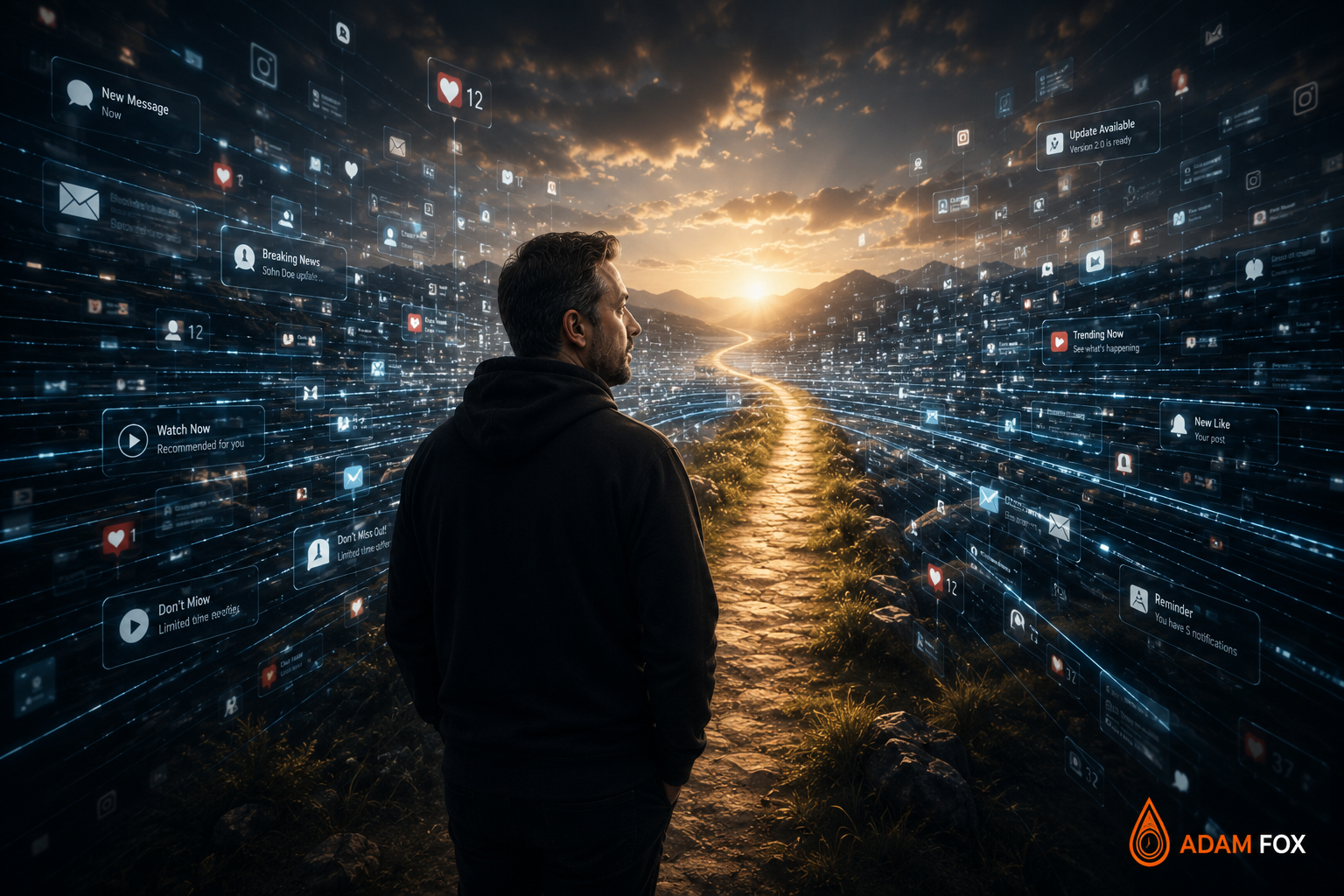
THE HUMAN ATTENTION PROJECT: THE FUTURE BELONGS TO PEOPLE WHO CAN PROTECT THEIR ATTENTION
PART I — ATTENTION HAS BECOME THE DEFINING SKILL OF THE TWENTY-FIRST CENTURY
For centuries, success was largely determined by circumstances.
Where you were born.
The family you belonged to.
The land you inherited.
The education you received.
Many of those factors still matter.
But the modern world has quietly introduced something new.
For perhaps the first time in history, millions of people have access to almost unlimited opportunity.
The same internet that distracts us also educates us.
The same smartphone that steals attention can teach almost any skill.
The same artificial intelligence that automates routine work can accelerate learning on an unprecedented scale.
The barriers to opportunity have fallen dramatically.
Yet something curious has happened.
Despite having more access than any previous generation...
Many people feel less capable of using it.
This appears to be a contradiction.
Surely more opportunity should produce more achievement.
Sometimes it does.
But opportunity only matters if it can be sustained long enough to become action.
And action depends upon attention.
Not intelligence.
Not motivation.
Attention.
Imagine standing in the world's greatest library.
Every book ever written surrounds you.
Every lecture ever recorded is available.
Every expert is willing to answer your questions.
Every piece of software required to build a business, learn a language or master a profession sits waiting.
It sounds extraordinary.
Now imagine that every thirty seconds someone taps you on the shoulder.
Shows you another book.
Another headline.
Another opinion.
Another notification.
Another advertisement.
Another recommendation.
The library has not become less valuable.
Your ability to use it has.
This may be the defining paradox of modern civilisation.
We have become extraordinarily good at creating opportunity.
Far less successful at protecting the attention required to benefit from it.
For most of history, access was the limitation.
Today, attention increasingly is.
Previous generations worried about finding information.
Future generations may struggle far more with filtering it.
Previous generations searched for teachers.
Future generations will need to decide which voices deserve listening to.
Previous generations lacked opportunity.
Future generations may drown in it.
Because abundance creates a different problem from scarcity.
Scarcity asks:
"Where can I find enough?"
Abundance asks:
"What should I ignore?"
The second question is becoming increasingly important.
Economists often describe opportunity cost as the value of what must be given up when making a decision.
Every choice excludes countless alternatives.
Attention works exactly the same way.
Every minute devoted to one thing cannot simultaneously be devoted to something else.
Every notification accepted is another thought interrupted.
Every hour scrolling is another hour not reading.
Not writing.
Not creating.
Not walking.
Not thinking.
Not talking.
Not being fully present with another human being.
Attention is finite.
Everything else competes for it.
This means attention has quietly become something far more significant than concentration.
It has become resource allocation.
Where attention goes...
Learning follows.
Relationships develop.
Businesses grow.
Skills improve.
Habits form.
Identities emerge.
Lives unfold.
Attention is no longer simply about focus.
It is about direction.
Perhaps this explains why previous essays repeatedly returned to the same idea from different angles.
Boredom.
Conversation.
Convenience.
Consciousness.
Identity.
None of these subjects were really separate.
They all revolved around a single invisible force.
Attention determines what repeatedly enters consciousness.
Consciousness shapes identity.
Identity shapes behaviour.
Behaviour eventually becomes destiny.
Protecting attention is therefore not about becoming more productive.
It is about deciding what kind of person repeated attention will gradually create.
This is where many discussions about distraction remain surprisingly shallow.
They frame attention as a workplace problem.
A productivity issue.
A question of getting more done.
That dramatically understates its importance.
Attention decides which ideas influence you.
Which relationships deepen.
Which values strengthen.
Which memories form.
Which habits survive.
Which version of yourself gradually becomes reality.
If attention determines experience...
And experience determines identity...
Then attention may be one of the most important decisions a human being ever makes.
Whether they realise they are making it or not.
The modern world often treats attention as something to be captured.
Advertisers want it.
Platforms monetise it.
Algorithms optimise for it.
Businesses compete for it.
The individual, meanwhile, is encouraged to spend it as quickly as possible.
Perhaps we have misunderstood the relationship entirely.
Attention is not something we own.
It is something we become.
Every moment of attention changes the brain ever so slightly.
Strengthening some neural pathways.
Weakening others.
Making certain thoughts easier to return to tomorrow than they were yesterday.
In that sense, attention is not merely observing reality.
It is continuously constructing it.
If that is true...
Then the future may not belong to the people with the highest IQs.
Or the largest followings.
Or even the greatest access to technology.
It may belong to those who understand something much simpler.
That in a world competing relentlessly for the mind...
The greatest advantage is not possessing more information than everyone else.
It is retaining ownership of the one resource that determines what information eventually becomes.
Your attention.
PART II — THE PEOPLE WHO SHAPE THE FUTURE ARE THE PEOPLE WHO DECIDE WHAT DESERVES THEIR ATTENTION
Every generation likes to believe it chooses its own priorities.
In reality, priorities are often inherited from the environment.
What people repeatedly see begins to feel important.
What constantly demands attention gradually acquires significance, whether it deserves it or not.
This is not a failure of character.
It is how human attention has always worked.
The brain naturally assumes that whatever appears repeatedly must matter.
For most of history, that assumption served us remarkably well.
Today, it is increasingly being exploited.
Imagine walking through a forest.
Every rustle in the undergrowth might signal danger.
Ignoring it could have serious consequences.
Evolution therefore favoured brains that noticed interruption.
That instinct helped our ancestors survive.
The modern world still activates exactly the same circuitry.
Only now the rustling bushes have become notifications.
Headlines.
Breaking news.
Viral videos.
Promotions.
Trending topics.
The machinery inside the brain has barely changed.
The environment surrounding it has transformed completely.
This creates a subtle illusion.
Importance and visibility begin to merge.
The issues discussed most frequently appear to be the issues that matter most.
The opinions repeated most often begin to feel like the dominant opinions.
The people who command the greatest attention appear to possess the greatest wisdom.
None of those assumptions are necessarily true.
They are simply what repeated exposure encourages us to believe.
Attention does not merely reflect reality.
It edits it.
Consider two people.
The first spends three hours every evening reading thoughtful books, reflecting on difficult ideas and having long conversations with people who challenge their thinking.
The second spends those same three hours moving between news alerts, social media, short videos, comment sections and endless recommendations.
Both have devoted exactly the same amount of time to learning.
Yet they have not received the same education.
One has trained depth.
The other has trained responsiveness.
The difference is not intelligence.
It is attention.
This is why protecting attention is not primarily about eliminating distraction.
It is about making conscious decisions about influence.
Every source of information carries assumptions.
Every author.
Every journalist.
Every algorithm.
Every friend.
Every podcast.
Every book.
Every conversation.
Every experience leaves something behind.
Sometimes knowledge.
Sometimes bias.
Sometimes anxiety.
Sometimes hope.
Sometimes curiosity.
Attention is how those influences gain entry.
Protecting attention therefore means becoming increasingly selective about what we repeatedly allow into our minds.
The philosopher William James once wrote:
"My experience is what I agree to attend to."
More than a century later, that observation feels astonishingly modern.
Experience is not simply what happens to us.
It is what we notice.
Two people can live through the same day and remember entirely different things because their attention rested in different places.
One notices beauty.
The other notices inconvenience.
One notices opportunity.
The other notices threat.
Neither is necessarily wrong.
But their lives gradually become shaped by the patterns of attention they repeatedly practise.
This is one reason gratitude exercises sometimes appear surprisingly effective.
Not because they magically improve life.
But because they deliberately redirect attention.
The circumstances may remain unchanged.
The observer changes.
Likewise, constant exposure to outrage gradually teaches the brain to expect outrage.
Constant exposure to fear teaches vigilance.
Constant exposure to comparison teaches inadequacy.
Attention does not merely consume emotional environments.
It recreates them internally.
The modern world rarely encourages this level of awareness.
Instead, attention is often treated as if it were passive.
Something that simply happens.
A notification appears.
You look.
A headline appears.
You click.
A recommendation appears.
You watch.
The sequence feels automatic because, increasingly, it is.
Designers work extraordinarily hard to reduce the distance between stimulus and response.
The less conscious the decision becomes, the more valuable your attention becomes to someone else.
Which raises an uncomfortable possibility.
Perhaps the greatest threat to attention is not distraction itself.
It is unconscious attention.
Protecting attention therefore requires something far deeper than willpower.
It requires intentionality.
Not asking:
"What am I looking at?"
But:
"What is this repeatedly teaching me to value?"
That question changes everything.
Because attention is cumulative.
One article changes little.
One conversation changes little.
One evening scrolling changes little.
But repeated thousands of times over years...
Patterns emerge.
Beliefs strengthen.
Habits solidify.
Identity shifts.
The person you become is not determined by a single moment of attention.
It is determined by millions of them.
There is another misconception worth addressing.
People often imagine protecting attention means withdrawing from the modern world.
Deleting every app.
Ignoring current events.
Living in permanent silence.
That is neither realistic nor desirable.
The goal has never been isolation.
It is sovereignty.
Technology should remain a tool.
Not become an environment from which it feels impossible to escape.
The issue is not whether we use digital systems.
The issue is whether those systems increasingly use us.
Perhaps this is what freedom increasingly means in the twenty-first century.
Not unlimited choice.
Unlimited choice often becomes overwhelming.
Not unlimited access.
We already possess that.
Perhaps freedom now means retaining the ability to consciously decide what deserves entry into your mind.
To choose your influences rather than merely inherit them.
To notice when your attention is being pulled instead of deliberately directed.
Because every civilisation has been shaped by the ideas its people repeatedly attended to.
The future will be no different.
The only difference is that never before have so many competing forces attempted to decide those ideas on our behalf.
If previous generations protected their land...
And later generations protected their wealth...
Perhaps our generation faces a different responsibility.
To protect the invisible resource from which both judgement and freedom quietly emerge.
Our attention.
Because once you understand that attention is not simply where your mind goes, but where your future self is gradually being built...
Protecting it no longer feels like an act of discipline.
It becomes an act of self-respect.
PART III — THE LAST GREAT HUMAN FREEDOM
Every generation believes freedom is under threat from something different.
Empires.
Governments.
War.
Poverty.
Disease.
Each has shaped history in profound ways.
But the defining struggle of the twenty-first century may prove to be far quieter.
Not over where our bodies are.
But over where our minds go.
For much of history, attention simply followed life.
If your crops failed, your attention turned to food.
If winter approached, it turned to shelter.
If a child cried, your attention moved instinctively towards them.
Reality largely determined where attention was directed.
Today, that relationship has changed.
Attention has become contested.
Thousands of organisations.
Millions of advertisers.
Sophisticated algorithms.
Artificial intelligence.
Entire industries now compete to influence what occupies your mind from the moment you wake until the moment you fall asleep.
Not because attention is inherently valuable.
Because attention influences behaviour.
Behaviour creates profit.
This is one of the defining characteristics of the modern economy.
Companies no longer compete solely for customers.
Increasingly, they compete for moments.
A few seconds on a screen.
Another click.
One more episode.
One more notification.
Another scroll.
Individually, those moments appear trivial.
Collectively, they become years of a human life.
Time is not disappearing.
It is being redistributed.
One decision at a time.
It is tempting to imagine that this is simply a technological problem.
It is not.
Technology merely amplifies something much older.
Human beings have always been influenced by stories.
By communities.
By culture.
By those around them.
The difference today is scale.
Never before has influence been so personalised.
So immediate.
So continuous.
Or so invisible.
The most effective influence rarely feels like persuasion.
It feels like your own idea.
This is why attention has become such a profound expression of freedom.
Not because you can choose everything you notice.
You cannot.
The brain will always respond to novelty.
To movement.
To emotion.
To potential threat.
The freedom lies in what happens next.
Do you remain there?
Or do you choose differently?
That small moment, repeated thousands of times across a lifetime, may be one of the most significant expressions of human agency that exists.
Throughout this series, we have explored a recurring pattern.
Attention shapes consciousness.
Consciousness shapes identity.
Identity shapes behaviour.
Behaviour shapes culture.
Culture eventually shapes civilisation.
If that progression is broadly true, then attention sits much closer to the beginning of the chain than most people realise.
Long before societies change...
People do.
Long before behaviour changes...
Attention changes.
Civilisations rarely collapse overnight.
They gradually become collections of individual habits repeated at enormous scale.
This is why protecting attention cannot simply be reduced to productivity techniques.
Blocking notifications.
Turning phones to greyscale.
Deleting applications.
Scheduling focus sessions.
These can all be useful.
But they address symptoms.
The deeper question is philosophical.
What deserves a human life?
Because every act of attention is ultimately an act of allocation.
You are deciding that this...
...rather than something else...
is worthy of a portion of your finite existence.
That is not a technological decision.
It is a moral one.
Imagine reaching the end of your life and being shown a perfect record of everything that received your attention.
Every conversation.
Every article.
Every notification.
Every argument.
Every walk.
Every book.
Every hour with your children.
Every evening lost to endless scrolling.
Every moment spent creating.
Every moment spent consuming.
What story would that record tell?
Not about what you believed mattered.
About what actually did.
Attention has a remarkable honesty.
It reveals our priorities more accurately than our intentions ever can.
Perhaps this is why attention has become such an important subject.
Not because distraction is irritating.
Not because productivity matters.
But because attention quietly answers one of life's deepest questions.
What kind of person are you becoming?
The answer is rarely found in a single dramatic decision.
It emerges through repetition.
What you repeatedly read.
Repeatedly discuss.
Repeatedly watch.
Repeatedly practise.
Repeatedly ignore.
Repeatedly protect.
The extraordinary life is rarely built through extraordinary moments.
It is usually built through ordinary moments that consistently receive extraordinary attention.
There is a tendency to imagine that history is shaped by remarkable people doing remarkable things.
Sometimes it is.
More often, history changes because ordinary people repeatedly choose what deserves their attention.
A scientist refuses to abandon a difficult question.
A parent chooses to put down their phone.
A teacher notices the quiet child at the back of the classroom.
An entrepreneur spends another evening solving a problem others have overlooked.
An artist continues refining work that nobody yet appreciates.
None of these moments appear historically significant.
Yet civilisation is built from millions of moments exactly like them.
Attention has always been the invisible force behind visible achievement.
Artificial intelligence will almost certainly continue becoming more capable.
Technology will become faster.
More personalised.
More persuasive.
More convenient.
Those changes should not necessarily be feared.
Many will improve human life beyond recognition.
But they also make one human quality increasingly precious.
The ability to consciously decide where your own mind will rest.
Because no technology, however sophisticated, can answer the question that ultimately belongs only to you.
What deserves your life?
Perhaps that is the future this series has really been exploring all along.
Not a future in which technology defeats humanity.
Nor one in which humanity rejects technology.
But one in which the defining difference between flourishing and drifting lies in something almost invisible.
The ability to protect the small, ordinary decisions through which attention gradually becomes identity.
FINAL THOUGHT
Every generation inherits powerful tools.
Ours may inherit the most powerful in history.
But tools have never determined civilisation on their own.
The deciding factor has always been the people holding them.
The future will not belong to those with the fastest technology.
Nor those with the most information.
Nor even those with the most artificial intelligence.
It will belong to the people who remain capable of directing the one thing from which wisdom, character, creativity and every meaningful life quietly emerge.
Their attention.
SOURCES AND RESEARCH GAPS
Key research areas
- Herbert Simon's work on attention economics
- Michael Posner's attention networks
- Self-regulation and executive function
- Behavioural design and persuasive technology
- Nicholas Carr on digital attention
- James Williams' work on attention and freedom
- Agency and self-determination theory
- Neuroplasticity and attentional training
Research gaps
- The long-term societal effects of algorithmically directed attention.
- Whether attentional autonomy predicts wellbeing and life satisfaction.
- How AI personalisation influences long-term agency and decision-making.
- The relationship between attentional habits and moral reasoning.
- Which interventions best help people regain attentional sovereignty in digital environments.