
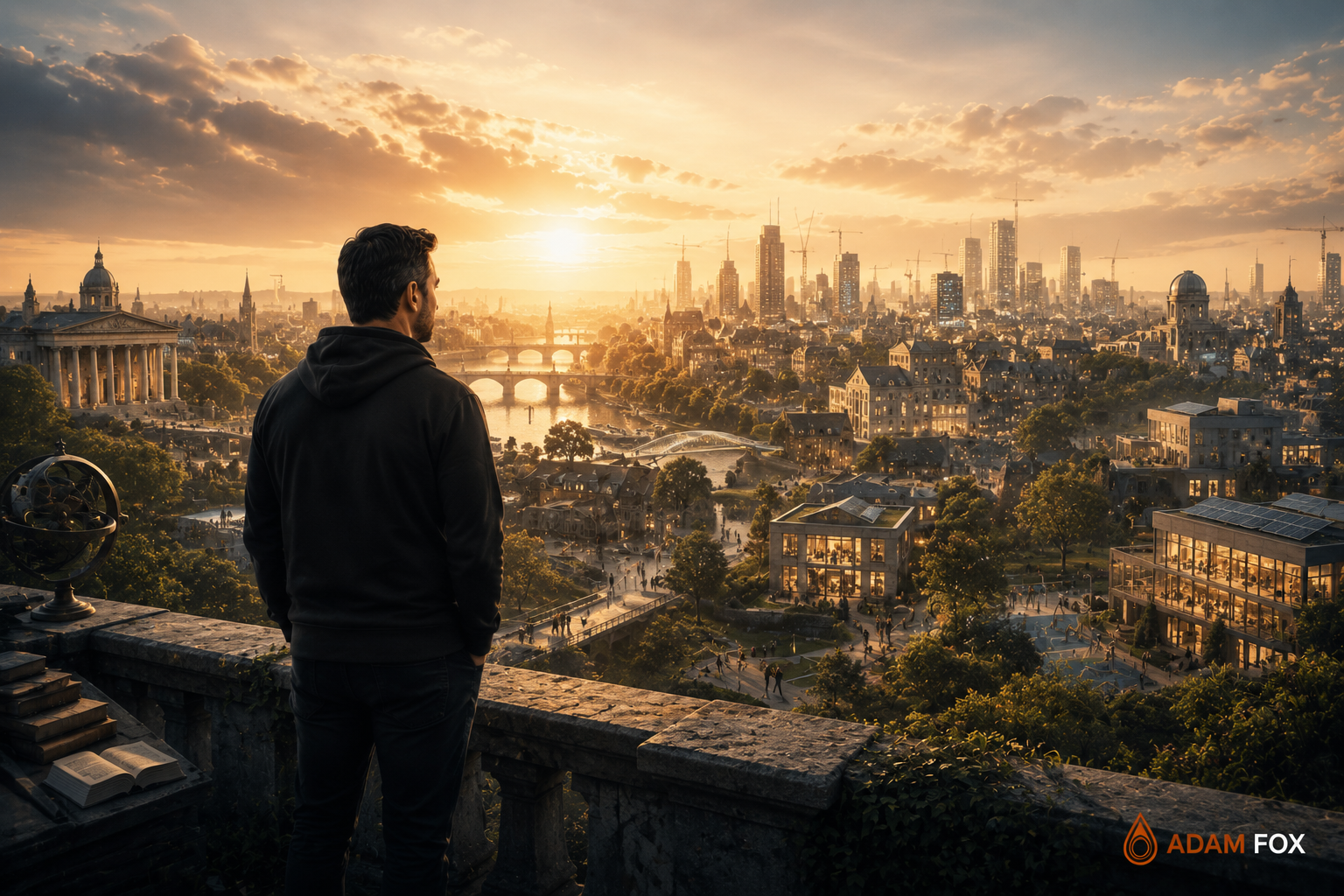
THE HUMAN ATTENTION PROJECT: CONCLUSION
THE FUTURE ISN'T SOMETHING WE ENTER. IT'S SOMETHING WE ARE BUILDING WITH EVERY MOMENT OF ATTENTION
MOVEMENT I — WE THOUGHT THIS WAS ABOUT DISTRACTION
When I began writing this project, I thought I was writing about distraction.
That was certainly where the questions started.
Why did concentrating feel harder than it once had?
Why did intelligent, capable people increasingly describe themselves as overwhelmed, mentally exhausted and unable to think clearly?
Why did so many of us feel permanently busy, yet strangely uncertain that we were making progress on the things that mattered most?
At first, those questions appeared to belong to productivity.
To time management.
To smartphones.
To modern work.
Like many people, I assumed the problem was simply that life had become busier.
I no longer believe that.
The deeper I explored the evidence, the more those original questions began to dissolve.
Every answer seemed to uncover another question beneath it.
Distraction led to boredom.
Boredom led to curiosity.
Curiosity led to consciousness.
Consciousness led to identity.
Identity led to behaviour.
Behaviour led to culture.
Culture eventually led to civilisation.
Every time I thought I had reached the end of the argument, another layer appeared underneath it.
The further I travelled, the less this project resembled a book about productivity.
It became something else entirely.
Along the way, we questioned assumptions that many of us have quietly accepted for years.
We questioned the belief that being constantly stimulated is automatically better than occasionally being bored.
We questioned whether convenience always represents progress.
We questioned whether communication is the same thing as conversation.
We questioned whether having immediate access to information is the same thing as understanding it.
We questioned whether artificial intelligence changes only our tools, or whether it also changes us.
None of those questions were really separate.
Each was simply another way of exploring the same underlying idea.
What happens when human attention becomes one of the world's most valuable resources?
That question matters because attention has a peculiar quality.
It appears insignificant while we are using it.
Looking at a screen for another five minutes doesn't feel historically important.
Neither does reading another chapter of a book.
Listening carefully to a child.
Finishing a difficult piece of work.
Taking a walk without headphones.
Sitting quietly with an unresolved problem.
Almost every important act of attention feels ordinary in the moment.
Only later do we discover what it quietly became.
Looking back, I realise I made the same mistake many people make when they first encounter this subject.
I assumed attention was a tool.
Something that helped us achieve more.
A means to an end.
But as the project developed, that understanding became impossible to maintain.
Attention is not merely the thing that helps us experience life.
It is the mechanism through which life is experienced.
Without attention, there is no learning.
No memory.
No relationship.
No creativity.
No wisdom.
No meaning.
Every experience that has ever shaped you first passed through your attention.
That is a remarkable thought.
Perhaps that explains why so many people instinctively feel that something is different about modern life, even if they struggle to articulate exactly what it is.
The feeling is real.
Not because human beings have suddenly become weaker.
Nor because technology is somehow evil.
But because, for the first time in history, the competition for human attention has become one of the defining forces shaping civilisation.
The economy increasingly competes for it.
Politics competes for it.
Entertainment competes for it.
Advertising competes for it.
Artificial intelligence increasingly competes for it.
Every notification.
Every recommendation.
Every headline.
Every autoplay video.
Every infinite scroll.
Individually, they seem harmless.
Collectively, they reshape the environment in which human minds develop.
Yet this project was never intended to become an argument against technology.
If anything, the opposite happened.
The more I researched, the less interested I became in blaming smartphones, social media or artificial intelligence.
Tools are rarely the whole story.
A hammer can build a home or destroy one.
Fire can cook food or burn a forest.
Writing itself has preserved civilisations and spread propaganda.
Technology amplifies human intention.
It does not replace it.
That distinction became one of the most important discoveries of this entire journey.
Because it means our future is not predetermined.
It remains, as it always has, profoundly human.
Another unexpected discovery emerged.
Every essay in this series appears, at first glance, to discuss a different subject.
Boredom.
Conversation.
Convenience.
Children.
Deep thinking.
Artificial intelligence.
Read independently, they stand alone.
Read together, something else begins to emerge.
They are chapters in a much larger story.
A story about what kind of civilisation we are gradually becoming.
Not through dramatic revolutions.
Not through single inventions.
But through millions of tiny, almost invisible decisions about where human beings repeatedly direct their attention.
That may be the most surprising conclusion of all.
History often teaches us to look for extraordinary moments.
The invention.
The revolution.
The election.
The war.
The speech.
The breakthrough.
Yet history is sustained not by isolated events but by repeated habits.
Before every revolution came years of ideas.
Before every scientific breakthrough came decades of patient observation.
Before every masterpiece came thousands of unnoticed hours.
Before every civilisation reached its height, countless ordinary people quietly chose to pay attention to things that outlived them.
Perhaps that is why attention matters so much.
Not because it makes us more productive.
But because it quietly determines what humanity becomes capable of building.
If there is one thing I hope this project has demonstrated, it is that attention is never merely personal.
It begins with individuals.
But it never ends there.
The quality of our attention shapes the quality of our thinking.
The quality of our thinking shapes the quality of our decisions.
Those decisions shape our families.
Our organisations.
Our communities.
Our institutions.
Eventually, they shape history itself.
The thread connecting all ten essays has never really been distraction.
It has been agency.
The quiet, often overlooked ability to decide what deserves the limited hours of a human life.
Because once that question changes...
Almost everything else begins to change with it.
MOVEMENT II — EVERY CIVILISATION IS BUILT TWICE
Every civilisation is built twice.
The first construction is invisible.
The second is physical.
We tend to notice only the second.
The skyline.
The cathedral.
The university.
The bridge.
The constitution.
The symphony.
The scientific discovery.
The spacecraft.
These are the monuments history leaves behind.
Yet every one of them began somewhere far less impressive.
As an idea that held someone's attention long enough to become reality.
Long before there were cities, there were conversations around fires.
Long before there were libraries, there were stories carefully remembered and retold.
Long before mathematics described the universe, somebody first became curious enough to count.
Long before there were hospitals, someone paid close enough attention to illness to notice patterns.
Long before there were laws, someone imagined that life could be organised differently.
Every civilisation first exists in the human mind.
Only afterwards does it appear in the world.
This is one of history's quietest truths.
Nothing meaningful is built accidentally.
Everything that survives generations demands sustained attention.
Not for a day.
Or a week.
But often for years.
Sometimes for lifetimes.
The pyramids were not built by inspiration.
Nor were the great cathedrals of Europe.
Nor the works of Shakespeare.
Nor the theories of Newton.
Nor the music of Beethoven.
Nor the discoveries that transformed medicine.
Every one required people willing to return to the same questions again and again, often long after novelty had disappeared.
Civilisation has always depended upon human beings remaining with difficult things.
Perhaps we underestimate this because we usually encounter only the finished product.
We visit a cathedral without seeing the centuries of planning that preceded it.
We read a novel without witnessing the countless abandoned drafts.
We admire a scientific breakthrough without recognising the years of failed experiments.
History compresses effort.
It allows us to see the achievement while hiding the attention that made it possible.
That can leave us with the comforting illusion that remarkable things simply happen to remarkable people.
The truth is almost always less dramatic.
Remarkable things usually emerge because ordinary people refused to stop paying attention.
Think about any craft that has survived across generations.
A cabinet maker.
A sculptor.
A surgeon.
A composer.
An architect.
None become exceptional through flashes of brilliance alone.
Mastery accumulates.
Every careful observation builds upon the one before it.
Every mistake teaches something.
Every revision improves what came earlier.
The final result appears inevitable only because we never witnessed the thousands of moments that preceded it.
Attention is invisible while it is happening.
Its consequences are not.
This has always been true.
What has changed is the environment in which that attention now exists.
For most of human history, the greatest challenge was often gaining access to knowledge.
Books were scarce.
Education was limited.
Communication was slow.
Information travelled at the speed of horses and ships.
Today the situation has almost completely reversed.
Knowledge has become astonishingly abundant.
What has become scarce is the uninterrupted attention required to transform information into understanding.
The bottleneck has moved.
Not from intelligence.
But from attention.
That may explain why so many people feel intellectually busy but strangely undernourished.
We consume more information than any previous generation.
We have instant access to lectures from world-leading universities.
Entire libraries fit into our pockets.
Artificial intelligence can answer questions that once required weeks of research.
And yet...
Many people struggle to read a single chapter without interruption.
To remain with a difficult problem.
To think beyond the first obvious answer.
It isn't because we have become less intelligent.
It is because understanding has always required something information alone cannot provide.
Time.
Patience.
Attention.
Imagine giving Michelangelo unlimited marble but allowing him only thirty seconds before interrupting him.
Imagine asking Marie Curie to check her laboratory every two minutes for notifications.
Imagine Charles Darwin abandoning every observation the moment something more stimulating appeared.
The examples sound absurd because they are.
We instinctively recognise that great work requires continuity.
Yet continuity is precisely what modern life increasingly fragments.
Not through malice.
Through design.
A world optimised for engagement naturally rewards what captures attention now.
Civilisation, however, has always depended upon people remaining with what still matters tomorrow.
This is why attention should never be dismissed as merely a personal productivity issue.
It is a civilisational one.
The discoveries that future generations inherit will depend upon what people alive today remain curious enough to explore.
The books our grandchildren read will depend upon what today's writers refuse to abandon halfway through.
The medicines not yet invented.
The technologies not yet imagined.
The works of art not yet created.
The solutions to problems we do not yet understand.
All of them already exist in their earliest form.
Not as physical objects.
As possibilities waiting for sustained human attention.
There is another lesson hidden inside history.
Civilisations rarely decline because people suddenly lose their intelligence.
They decline when short-term priorities begin consistently displacing long-term ones.
When spectacle replaces substance.
When immediate gratification consistently defeats patient investment.
When entertainment becomes easier than education.
When reaction becomes easier than reflection.
None of those shifts happen overnight.
They emerge gradually.
One generation.
One institution.
One ordinary day at a time.
The same process that builds civilisation can, if neglected, slowly weaken it.
Because the quality of a civilisation can never rise much higher than the quality of the attention from which it is built.
Perhaps this is why the question of attention has become so important.
Not because civilisation is on the brink of collapse.
History has survived countless transformations before.
But because every generation inherits the responsibility of deciding what deserves its attention.
Some choose exploration.
Others choose conquest.
Some choose science.
Others choose ideology.
Some build libraries.
Others build monuments to themselves.
Every age reveals its values through the things it repeatedly returns to.
Not what it claims to admire.
What it consistently pays attention to.
If that observation is true, then attention is doing something far greater than helping us concentrate.
It is quietly determining the inheritance we leave behind.
Every generation passes something to the next.
Knowledge.
Institutions.
Stories.
Values.
Scientific understanding.
Works of art.
Ways of thinking.
None appear from nowhere.
Each is the accumulated result of millions of individual acts of attention, layered one upon another until they become culture.
Perhaps civilisation itself is nothing more than attention made visible across time.
And if that is true...
Then every moment of genuine attention becomes something far more significant than it first appears.
It becomes a small contribution to the future we are collectively building.
MOVEMENT III — HISTORY IS WRITTEN ONE ORDINARY DAY AT A TIME
When we think about history, we have a habit of imagining dramatic moments.
The declaration that changed a nation.
The invention that transformed an industry.
The speech that inspired a generation.
The discovery that rewrote science.
History books encourage this way of thinking.
They compress decades into dates.
Centuries into chapters.
Civilisations into a handful of defining events.
It makes the past easier to understand.
It also makes it dangerously easy to misunderstand how history is actually made.
History is rarely created by extraordinary days.
It is created by ordinary ones.
Long before a great speech, someone spent years thinking.
Long before a scientific breakthrough, someone patiently collected observations that appeared insignificant at the time.
Long before a business transformed an industry, someone quietly solved one problem after another while nobody was watching.
The dramatic moment we eventually remember is usually the visible result of thousands of invisible moments that came before it.
We celebrate the harvest.
We rarely notice the seasons that made it possible.
There is something reassuring about this.
It reminds us that history is not reserved for remarkable people.
It belongs to ordinary people doing ordinary things with extraordinary consistency.
The teacher who gives one more hour to a struggling student.
The nurse who notices a symptom everyone else overlooked.
The parent who chooses another bedtime story instead of another email.
The engineer who refuses to ignore a small design flaw.
The writer who returns to the same manuscript after another disappointing draft.
None of these moments attract headlines.
Yet they are precisely the kind of moments from which better futures emerge.
One of the greatest misconceptions about influence is that it requires visibility.
It doesn't.
The people who shape history are not always those standing on stages.
Often they are simply the people who remain committed to something long after everyone else's attention has moved elsewhere.
A researcher spending twenty years studying a disease.
A teacher influencing thousands of children over an entire career.
A craftsman quietly perfecting skills that will outlive them.
A parent modelling kindness every single day without expecting recognition.
These lives rarely appear extraordinary from the outside.
Their significance lies in accumulation.
History rewards consistency far more often than spectacle.
Modern life, however, has a habit of making consistency feel less valuable than novelty.
Every day presents another headline.
Another trend.
Another controversy.
Another reason to look somewhere else.
The extraordinary becomes ordinary almost immediately.
Yesterday's breaking news becomes today's forgotten story.
The environment encourages movement.
Not permanence.
Reaction.
Not reflection.
It quietly teaches us that the next thing is probably more important than the thing already in front of us.
Sometimes that is true.
Often it isn't.
There is a profound difference between being informed and being directed.
An informed person notices what is happening in the world.
A directed person finds their attention constantly pulled wherever someone else decides it should go.
The distinction is subtle.
One preserves agency.
The other gradually weakens it.
This is why attention is so much more than concentration.
Attention is selection.
It is the quiet process through which we decide what enters our minds often enough to influence who we become.
Every decision to continue reading.
To stop scrolling.
To listen.
To interrupt.
To remain curious.
To become angry.
To forgive.
To investigate.
To ignore.
Each appears trivial.
Collectively, they shape a life.
Imagine watching a single raindrop fall into a river.
It changes nothing you can see.
Now imagine billions of raindrops.
Over weeks.
Months.
Years.
Those drops carve valleys.
Shape landscapes.
Create rivers powerful enough to alter continents.
Human attention works in much the same way.
One moment rarely changes a life.
Repeated moments almost always do.
One evening spent reading does not make someone wise.
One conversation does not build a marriage.
One workout does not build strength.
One act of kindness does not define a character.
Yet repeated often enough, these ordinary moments become almost indistinguishable from identity itself.
This is one reason I have become increasingly sceptical of dramatic self-improvement.
Modern culture often encourages us to search for breakthroughs.
The perfect morning routine.
The life-changing application.
The revolutionary productivity system.
The one decision that changes everything.
Reality is usually quieter.
Lives are rarely transformed by single moments.
They are transformed by repeated attention.
The future version of yourself is not waiting to appear after one extraordinary day.
It is slowly emerging through the ordinary decisions you make so consistently that you barely notice them anymore.
The same principle applies to societies.
We sometimes speak as though cultures change overnight.
They don't.
Cultures shift because repeated behaviours slowly become normal.
People begin speaking differently.
Working differently.
Parenting differently.
Learning differently.
Thinking differently.
Eventually those behaviours become expectations.
Expectations become institutions.
Institutions shape the next generation.
The process feels almost invisible while it is happening.
Only in hindsight do we call it history.
This should leave us with an unexpected sense of responsibility.
Not because every decision carries enormous weight.
That would be exhausting.
But because ordinary decisions matter far more than we usually imagine.
The book you decide to finish.
The conversation you refuse to rush.
The difficult idea you choose to stay with.
The child you fully listen to.
The colleague you genuinely encourage.
The craft you patiently improve.
None of these moments will appear in tomorrow's newspaper.
They may, however, quietly influence tomorrow's world.
History is not only written in parliaments, laboratories and boardrooms.
It is written in kitchens.
Classrooms.
Workshops.
Offices.
Living rooms.
Libraries.
Parks.
Every place where human beings repeatedly decide what deserves their attention.
Tomorrow morning will probably feel very similar to today.
You'll wake up.
Perhaps reach for your phone.
Perhaps make a coffee.
Perhaps begin work.
Speak to your family.
Walk the dog.
Answer emails.
Solve problems.
None of it will feel historic.
And yet, this is exactly how history has always been made.
Not through one dramatic decision.
But through billions of ordinary mornings, lived by ordinary people, each quietly deciding what deserves the next few minutes of their attention.
Perhaps history has never really been written by extraordinary moments at all.
Perhaps it has always been written one ordinary day at a time.
MOVEMENT IV — THE GREAT QUESTION OF EVERY GENERATION
There is a temptation, whenever society changes rapidly, to believe we are living through unprecedented times.
In some respects, we are.
Artificial intelligence is developing at extraordinary speed.
Information travels around the world almost instantly.
Children can access more knowledge from a mobile phone than entire universities once contained.
Never before have so many people been connected so continuously.
These are genuine changes.
They will shape the coming century in ways we can barely imagine.
But they are not the first changes humanity has had to navigate.
Nor will they be the last.
History is not simply a story of people.
It is a story of adaptation.
Every generation inherits a world built by those who came before it.
Then, almost inevitably, that world begins to change.
Sometimes gradually.
Sometimes violently.
Agriculture transformed how human beings lived.
Writing transformed how knowledge survived.
The printing press transformed who could learn.
The steam engine transformed work.
Electricity transformed daily life.
Radio transformed communication.
Television transformed culture.
The internet transformed information.
Artificial intelligence is beginning to transform thought itself.
Each innovation created opportunities.
Each created risks.
Each forced society to ask new questions about what it meant to be human.
What is striking is not that technology changes civilisation.
It always has.
What is striking is that every generation initially mistakes the technology for the real story.
When printing emerged in Europe, many feared that books would undermine memory.
When newspapers became widespread, critics worried people would consume too much information.
Television was accused of destroying conversation.
The internet was celebrated as the solution to almost every problem before many of its unintended consequences became visible.
None of those technologies proved entirely good.
None proved entirely bad.
Each became what human beings repeatedly chose to make of it.
That pattern should give us pause.
Because it suggests that the most important question has never been:
"What will technology do to us?"
It has always been:
"What will we choose to become while using it?"
That is a very different question.
One assumes inevitability.
The other assumes agency.
Throughout history, human beings have often spoken as though they were passengers.
Carried helplessly by progress.
Swept along by change.
Victims of circumstance.
Reality is more complicated.
Technology changes possibilities.
People decide priorities.
Those priorities eventually become culture.
Culture becomes civilisation.
At every stage of history, human choice remains part of the equation.
Not complete control.
But meaningful influence.
Enough to matter.
Consider something as simple as a book.
A book has no morality of its own.
It can preserve wisdom.
Or spread hatred.
Teach science.
Or superstition.
Encourage compassion.
Or justify cruelty.
The printing press did not determine any of those outcomes.
People did.
The same principle applies to every powerful technology humanity has ever created.
Including the ones emerging today.
Artificial intelligence will not decide what civilisation values.
It will amplify whatever civilisation already values.
That should concern us.
It should also encourage us.
Because amplification works in both directions.
Imagine a society that prizes speed above all else.
Artificial intelligence will almost certainly make that society even faster.
Imagine one that values convenience above capability.
Technology will probably remove even more friction.
Now imagine a society that values wisdom.
One that teaches children to think deeply.
To question carefully.
To listen generously.
To remain curious.
To build before they consume.
Artificial intelligence would amplify those qualities too.
Technology rarely invents values.
It magnifies existing ones.
That may be one of the most hopeful observations in this entire project.
Because it reminds us that the future is still, fundamentally, a human story.
There is another lesson history repeatedly teaches.
Civilisations are not remembered primarily for the technologies they possessed.
They are remembered for what they built with them.
Ancient Greece is remembered for philosophy.
Rome for engineering and law.
The Renaissance for art and scientific curiosity.
The Enlightenment for ideas that reshaped politics and human rights.
The technologies mattered.
But they were never the legacy.
The legacy was what people repeatedly chose to pursue.
The questions they refused to stop asking.
The knowledge they considered worth preserving.
The values they decided deserved passing to the next generation.
Every civilisation eventually reveals itself through what it consistently pays attention to.
That thought has stayed with me more than almost any other while writing this series.
If historians two hundred years from now looked back at our own civilisation, what would they conclude we valued most?
Not from our speeches.
Or our mission statements.
Or our political slogans.
From our attention.
Where did we collectively spend our time?
What problems fascinated us?
What conversations dominated our lives?
What did we patiently build?
What did we repeatedly interrupt?
What did we protect?
What did we neglect?
Attention has a remarkable honesty.
It reveals priorities far more accurately than intentions ever can.
Perhaps that is why I have become increasingly uncomfortable whenever discussions about technology become tribal.
One side insists technology is saving civilisation.
The other insists it is destroying it.
Neither position feels adequate.
Civilisation has never been saved by technology alone.
Nor destroyed by it alone.
It has always been shaped by the relationship between human values and human tools.
Tools amplify.
Values direct.
Lose sight of either, and the picture becomes distorted.
This may be the great question facing our own generation.
Not whether artificial intelligence becomes more intelligent.
It almost certainly will.
Not whether digital technology becomes more immersive.
It almost certainly will.
The deeper question is whether human beings become more intentional at precisely the same pace.
Will we become as thoughtful as our tools become powerful?
Will our wisdom grow alongside our capability?
Will our judgement mature alongside our technology?
Those are not engineering questions.
They are human ones.
And history suggests they have always been the questions that matter most.
Every generation believes it is remembered for the inventions it creates.
In reality, it is remembered for the choices it makes.
The future will not ask whether we invented extraordinary technologies.
It will ask what kind of civilisation we chose to build with them.
That question has never belonged to governments alone.
Or scientists.
Or entrepreneurs.
It belongs to every one of us.
Because civilisation has always been built in exactly the same way.
One ordinary decision.
One ordinary conversation.
One ordinary act of attention.
Repeated often enough to become history.
MOVEMENT V — WHY I REMAIN OPTIMISTIC
After everything we have explored together, it would be understandable to assume that I feel pessimistic about the future.
If you have read this far, you have spent hundreds of pages considering distraction, fragmented attention, persuasive technology, artificial intelligence, convenience, social media, the decline of boredom and the unprecedented environment in which today's children are growing up.
On paper, it sounds like a bleak diagnosis.
Yet the emotion I feel most strongly is not fear.
It is optimism.
Not because I believe the challenges are small.
They aren't.
Not because I think technology will somehow solve every problem we create.
It won't.
I remain optimistic for a much simpler reason.
Human beings have always demonstrated an extraordinary ability to adapt once they finally understand the question they are facing.
History is full of moments when people believed the future had become impossible to navigate.
The Industrial Revolution transformed work so completely that many feared society itself would collapse.
World wars reshaped continents.
The discovery of nuclear weapons forced humanity to confront the possibility of its own destruction.
Entire economies have risen and fallen.
Pandemics have changed how people live.
Every generation has looked at the uncertainty surrounding it and quietly wondered whether the world had become too complicated.
Yet here we are.
Not because humanity avoided difficulty.
Because it learned.
Adapted.
Adjusted.
Repeatedly.
That should give us confidence.
Not certainty.
Confidence.
There is an important difference.
One of the dangers of modern life is that we often confuse awareness with inevitability.
We notice a trend.
We assume it cannot be changed.
We identify a problem.
We begin speaking about it as though it has already become permanent.
History suggests otherwise.
Smoking rates fell dramatically once societies understood the evidence.
Seatbelts became normal.
Drink-driving became socially unacceptable.
Public attitudes towards countless issues have shifted within a single generation.
Human behaviour is not fixed.
It evolves.
Often more quickly than we expect.
The first step is almost always the same.
People begin asking better questions.
That is what I hope this project contributes.
Not answers to every challenge.
Better questions.
Because better questions change behaviour.
Instead of asking,
"How can I get through more work?"
Perhaps we begin asking,
"What work actually deserves my attention?"
Instead of asking,
"How do I stop my children using technology?"
Perhaps we ask,
"How do I help them develop a healthy relationship with it?"
Instead of asking,
"How do I become more productive?"
Perhaps we ask,
"What kind of life am I actually trying to build?"
Notice what happens.
The problem changes.
And once the problem changes...
The solutions begin changing too.
Optimism is often misunderstood.
People imagine it means believing everything will somehow work out.
I don't think that has ever been true.
Real optimism is not confidence that the future will automatically improve.
It is confidence that human beings retain the capacity to influence it.
Agency is optimistic.
Helplessness is not.
Throughout this series, I have argued repeatedly that attention shapes behaviour.
Behaviour shapes culture.
Culture shapes civilisation.
That chain works both ways.
If human attention can gradually create unhealthy habits...
It can also gradually create healthier ones.
If environments influence us...
We can intentionally design better environments.
If technology amplifies behaviour...
We can choose which behaviours deserve amplifying.
The existence of influence does not eliminate responsibility.
If anything, it increases it.
I often think about children when considering the future.
Not because they represent innocence.
But because they represent possibility.
Watch a young child become fascinated by something.
A butterfly.
A cardboard box.
A puddle.
A story.
A question nobody else considered interesting.
They display a quality adults often spend decades trying to recover.
Complete attention.
Not because someone forced them.
Because curiosity naturally held them there.
That capacity has not disappeared.
It exists in every child.
The challenge is ensuring it survives long enough to become adulthood.
The same observation applies to adults.
Despite everything we have discussed, people still fall deeply into books.
Lose themselves in meaningful conversations.
Build businesses.
Learn instruments.
Master crafts.
Raise extraordinary families.
Conduct scientific research.
Volunteer.
Create art.
Plant gardens.
Write novels.
Teach children.
Care for ageing parents.
None of those activities suggest that deep attention has vanished.
They suggest something more encouraging.
The capacity remains remarkably intact.
It simply exists within an environment that competes for it more aggressively than ever before.
That distinction matters enormously.
Because you cannot recover something that has been lost forever.
You can, however, protect something that still exists.
Artificial intelligence provides another reason for optimism.
That may sound surprising after everything we have discussed.
But every transformative technology eventually forces humanity to become clearer about what only human beings can contribute.
The Industrial Revolution increased the value of creativity and innovation.
Computers increased the value of judgement.
Artificial intelligence may ultimately increase the value of wisdom.
Not because machines cannot generate answers.
But because they cannot decide which questions are worth asking.
They cannot determine what kind of society deserves building.
They cannot choose compassion over efficiency.
Or meaning over optimisation.
Or love over convenience.
Those decisions remain stubbornly human.
Perhaps they always will.
Sometimes I wonder whether future generations will look back on this period in the same way we look back on the early years of the Industrial Revolution.
Chaotic.
Uncertain.
Full of extraordinary opportunity and genuine danger.
A time when society had not yet caught up with the technologies it had created.
If that proves true, then perhaps our responsibility is not to panic.
Nor to pretend everything is fine.
Our responsibility is to help build the cultural wisdom that allows powerful technologies to serve humanity rather than quietly reshape it without reflection.
That work cannot be done by governments alone.
Or technology companies.
Or schools.
It belongs to all of us.
Because culture has always been a shared project.
Perhaps that is the deepest reason I remain optimistic.
Not because I know what the future will look like.
None of us do.
But because I know something history has demonstrated repeatedly.
Human beings are capable of astonishing things once they decide something truly matters.
We have eradicated diseases.
Mapped the human genome.
Walked on the Moon.
Built libraries that preserve thousands of years of knowledge.
Created music capable of moving people centuries after it was written.
Written constitutions.
Ended injustices once considered permanent.
Rebuilt cities from ruins.
Crossed oceans.
Explored space.
None of those achievements happened because the future was easy.
They happened because enough people paid sustained attention to problems that mattered.
That capacity still exists.
It always has.
So yes, I am optimistic.
Not because I believe we are guaranteed a better future.
But because I believe we still possess the single quality upon which every better future has always depended.
The ability to choose what deserves our attention.
And history suggests that when enough people begin making that choice intentionally...
Remarkable things become possible.
MOVEMENT VI — WHAT ATTENTION REALLY IS
If this project has taught me anything, it is that we have misunderstood attention.
We speak about it as though it were a skill.
Something to improve.
Something to train.
Something we either possess or lack.
We describe people as having "a good attention span" or "poor concentration", as though attention were little more than a mental muscle.
Useful, certainly.
Important, perhaps.
But ultimately just another cognitive ability.
I don't think that's true anymore.
Attention is something far more profound than that.
Attention is not simply how we think.
It is how we decide what becomes part of us.
Every day your senses encounter far more information than your brain could ever consciously process.
Millions of sights.
Sounds.
Words.
Ideas.
Conversations.
Memories.
Possibilities.
The overwhelming majority disappear almost instantly.
Only a tiny fraction remains.
Why?
Because attention acts as the gatekeeper.
It quietly decides what enters your inner world.
Long before an experience becomes a memory...
Long before an idea becomes a belief...
Long before knowledge becomes wisdom...
It must first become the object of your attention.
This is why attention cannot simply be reduced to focus.
Focus is a cognitive process.
Attention is an act of selection.
It is the quiet moment in which you decide:
"This matters."
Sometimes consciously.
Often unconsciously.
Every act of attention is, in essence, an act of valuation.
You are deciding that one thing deserves a portion of your finite life while countless others do not.
That is a far more significant decision than it first appears.
Because time is not your most limited resource.
Attention is.
Time passes whether you choose it or not.
Attention is where your life is actually lived.
Think about the people you love most.
Not the people you know.
The people you genuinely love.
How do they experience that love?
Certainly through words.
Sometimes through gifts.
Occasionally through grand gestures.
But most often...
Through attention.
Someone listens.
They notice.
They remember.
They are present.
Strip attention away from love and something essential disappears.
A distracted conversation is not the same as a real one.
A family meal where everyone is physically present but mentally elsewhere is not the same as sharing an evening together.
Presence has always been the language through which love is most consistently communicated.
Perhaps that is why attention feels so precious.
Because, in many ways, it is the purest form of generosity we possess.
The same principle extends far beyond relationships.
Respect is attention.
Curiosity is attention.
Learning is attention.
Craftsmanship is attention.
Leadership is attention.
Teaching is attention.
Even wisdom, at its core, is accumulated attention directed towards questions that remain important long after easier answers have presented themselves.
Seen through that lens, almost everything we value begins to look different.
Because almost everything we admire is built upon sustained attention.
This is one reason I have become increasingly uncomfortable with treating attention merely as an economic resource.
It is true that modern economies compete for it.
Advertisers purchase it.
Platforms measure it.
Algorithms optimise for it.
Entire industries are built around attracting and retaining it.
All of that is real.
But reducing attention to economics misses something essential.
Attention is not valuable because companies can monetise it.
It is valuable because it is the mechanism through which human beings create meaning.
The market values your attention because your life is built from it.
The order matters.
Imagine someone gave you a billion pounds tomorrow morning.
The amount would be extraordinary.
Yet even then, there would remain one thing you could never buy more of.
Another conscious day.
Another hour with someone you love.
Another conversation with a parent no longer alive.
Another afternoon watching your children before they quietly become adults.
Money has limits because life has limits.
Attention is simply the way those limits become visible.
Every moment spent attending to one thing is a moment no longer available for something else.
That is not a reason for anxiety.
It is a reminder of value.
Finite things matter precisely because they are finite.
Perhaps this is where modern life becomes most confusing.
Never before have we had so many opportunities competing simultaneously for our attention.
Read this article.
Watch this video.
Answer this email.
Check this notification.
Listen to this podcast.
Respond to this message.
Buy this product.
Join this discussion.
Learn this skill.
Every option carries some value.
The problem is not that any individual choice is necessarily wrong.
The problem is that no human life is long enough to choose all of them.
Attention, by its very nature, requires exclusion.
To attend deeply to one thing is to accept that countless other things must wait.
There is quiet wisdom in that acceptance.
For much of my life, I thought productivity meant fitting more into the available hours.
The older I become, the less convincing that idea feels.
Perhaps maturity is not learning how to do more.
Perhaps it is learning what deserves to remain undone.
Attention has a remarkable way of exposing this truth.
Whenever you say yes to one thing, you inevitably say no to something else.
Sometimes knowingly.
Sometimes without realising.
The question, therefore, is not simply whether your attention is occupied.
It always will be.
The question is whether it is occupied by things that justify the cost.
That word deserves lingering on for a moment.
Cost.
Every moment has one.
Reading this page has one.
Writing it has one.
Choosing to spend an evening with your family instead of answering another email has one.
Choosing work instead of rest has one.
Choosing convenience instead of learning has one.
None of these costs are automatically right or wrong.
Life constantly asks us to make them.
Attention is simply the currency through which we pay.
If I had to reduce this entire project to a single sentence, it might be this:
Attention is how human beings convert finite time into a meaningful life.
Everything else grows from there.
Not because attention magically solves every problem.
But because every problem we solve...
Every relationship we build...
Every idea we develop...
Every child we raise...
Every civilisation we leave behind...
Must first pass through the quiet doorway of sustained human attention.
Perhaps that is why protecting attention has never really been about becoming more productive.
It has always been about becoming more intentional.
Because in the end...
The quality of your attention quietly becomes the quality of your life.
MOVEMENT VII — THE FUTURE IS ALREADY HERE
When people talk about the future, they often speak as though it exists somewhere beyond the horizon.
A destination we have not yet reached.
Something waiting patiently for us.
One day there will be more artificial intelligence.
One day society will be different.
One day children will inherit a different world.
One day work will change.
One day life will look nothing like it does today.
There is comfort in thinking that way.
It creates distance.
It allows us to imagine that the future is somebody else's responsibility.
The truth is less comforting.
The future is not waiting.
It is already arriving.
Quietly.
Ordinarily.
One decision at a time.
Every generation imagines itself standing on the edge of history.
In reality, every generation is standing inside it.
We are not spectators watching the future unfold.
We are participants shaping it.
Every law we create.
Every technology we design.
Every child we raise.
Every organisation we build.
Every value we reinforce.
Every compromise we accept.
Every conversation we encourage.
Every question we stop asking.
These are not preparations for the future.
They are the future.
History rarely announces when it begins.
It simply accumulates.
Think back to the beginning of this series.
We started with distraction.
At the time, distraction seemed like the problem.
Now, standing here at the end, it feels almost like the symptom.
Because distraction was never simply about phones.
Or notifications.
Or social media.
It was about something much deeper.
What happens when a civilisation gradually loses the ability to decide what deserves sustained attention?
That question reaches far beyond productivity.
It reaches into education.
Parenting.
Leadership.
Science.
Politics.
Relationships.
Art.
Every human endeavour ultimately depends upon people remaining with important things long enough for those things to grow.
Throughout these essays we have encountered the same pattern repeatedly.
Remove boredom...
...and imagination quietly suffers.
Fragment conversation...
...and shared thinking begins to weaken.
Optimise convenience...
...and certain human capabilities slowly disappear through lack of use.
Reward shallow thinking...
...and deep judgement becomes increasingly rare.
Allow childhood to unfold inside environments competing relentlessly for attention...
...and the adults of tomorrow inherit habits they never consciously chose.
None of these changes happen dramatically.
That is precisely what makes them difficult to recognise.
Civilisations rarely change through one enormous decision.
They drift through millions of tiny ones.
Artificial intelligence has become the symbol of this moment in history.
Understandably so.
Its capabilities are extraordinary.
Its potential is difficult to overstate.
It will reshape medicine.
Education.
Science.
Engineering.
Creativity.
Almost every profession will feel its influence.
Some jobs will disappear.
Others will emerge that we cannot yet imagine.
But beneath all of those changes lies a quieter question.
Not what artificial intelligence will become.
What humanity will become while living alongside it.
Because every technological revolution ultimately becomes a human revolution.
Not through the machines themselves.
Through the habits they encourage.
This is why I have resisted treating artificial intelligence as either hero or villain throughout this project.
It is neither.
Like every transformative technology before it, it is an amplifier.
Give it a society obsessed with speed, and it will make that society faster.
Give it a society addicted to convenience, and it will make life easier still.
Give it a society committed to wisdom, curiosity and careful judgement...
...and it may become one of the greatest tools for human flourishing ever created.
The technology is not making that decision.
We are.
Perhaps that is the most important distinction in this entire book.
The same principle applies to children.
When we worry about the next generation, we often ask what kind of world they will inherit.
It is a reasonable question.
Perhaps it is incomplete.
Children do not simply inherit the world.
They inherit the habits of the adults who built it.
They inherit our priorities.
Our assumptions.
Our relationship with technology.
Our relationship with work.
Our relationship with one another.
Most importantly...
They inherit what we repeatedly demonstrated was worthy of our attention.
Children learn far more from the culture we create than the advice we give.
That thought should humble us.
It should also encourage us.
Because culture is not created solely by governments, multinational corporations or technology companies.
Culture emerges from countless ordinary interactions.
Families eating dinner together.
Teachers refusing to give up on struggling pupils.
Friends having uninterrupted conversations.
Employers valuing thoughtful work over constant availability.
Communities choosing to protect green spaces.
Writers choosing depth over outrage.
Engineers choosing responsibility over haste.
Scientists choosing truth over recognition.
Culture is simply repeated behaviour that becomes normal.
Which means every one of us contributes to it, whether intentionally or not.
Perhaps this explains why I have become less interested in predicting the future.
Predictions are usually wrong.
History has a habit of surprising everyone.
Far more interesting is understanding the forces already shaping tomorrow.
The future is not hidden.
It is visible in today's habits.
Look at how children play.
How adults work.
How organisations communicate.
How communities spend their time.
How schools educate.
How businesses define success.
Tomorrow is already quietly taking shape inside those decisions.
The future is never built somewhere else.
It is always built here.
If there is one sentence that has quietly followed me throughout this entire project, it is this:
The future is not a place we are going. It is a pattern we are creating.
Patterns become habits.
Habits become cultures.
Cultures become civilisations.
And every pattern begins the same way.
Someone pays attention to something.
Then does it again tomorrow.
And the next day.
And the day after that.
Until repetition becomes reality.
That may be why attention has always mattered so much.
Not because it determines what you notice today.
Because it quietly determines what exists tomorrow.
Every book ever written.
Every scientific discovery.
Every friendship.
Every company.
Every movement.
Every invention.
Every civilisation.
Once existed only as sustained attention directed towards an idea that refused to let go.
The future has never emerged from nowhere.
It has always emerged from people choosing, again and again, what deserved another hour of their lives.
Which means, whether we realise it or not...
The future is already here.
We are building it now.
MOVEMENT VIII — TOMORROW MORNING
By the time you finish reading this, very little in the world will appear to have changed.
The headlines will continue.
Your inbox will still be waiting.
Your phone will still contain unread notifications.
Artificial intelligence will continue advancing.
Social media will continue competing for your attention.
Children will continue growing up.
The world will continue moving at precisely the same pace it did before you opened the first page of this project.
That is both the challenge and the hope.
Because meaningful change has rarely begun with the world becoming different.
It has almost always begun with someone seeing the same world differently.
If there has been one thread running through every essay in this project, it is this.
Human beings possess more agency than they often realise.
Not complete agency.
Life has never offered that.
We do not choose our genetics.
We do not choose where we are born.
We do not choose every circumstance that shapes our lives.
Technology will continue evolving whether we welcome it or not.
Markets will rise and fall.
Governments will change.
Unexpected events will always interrupt our plans.
None of that has changed.
But within those realities sits a quieter freedom.
The freedom to decide what deserves the next moment of our attention.
And that decision has always mattered more than it first appears.
Perhaps that is why I have never wanted this project to become another argument for abandoning technology.
That was never the point.
The printing press was not the enemy.
Electricity was not the enemy.
The internet is not the enemy.
Artificial intelligence is not the enemy.
The challenge has never been innovation.
It has always been intention.
Every powerful tool humanity has created has eventually forced us to ask the same question.
Will we remain capable of directing it?
Or will we gradually allow it to direct us?
That question has no final answer.
It must be answered again by every generation.
And, ultimately, by every individual.
Tomorrow morning, you will almost certainly make hundreds of decisions without consciously noticing them.
You will decide whether to pick up your phone immediately or leave it where it is for a little longer.
Whether to listen fully when somebody speaks.
Whether to finish the article.
Whether to read the book.
Whether to ask another question.
Whether to sit quietly for five minutes instead of filling every silence.
Whether to watch another episode.
Whether to go for the walk.
Whether to play with your children before answering one more email.
Whether to begin the difficult piece of work you have been avoiding.
None of these choices will feel historic.
That is precisely why they matter.
The future has never been built through dramatic gestures alone.
It has always emerged from repeated ordinary decisions.
A parent reading another bedtime story.
A scientist returning to an unfinished experiment.
A musician practising scales no audience will ever hear.
A teacher preparing tomorrow's lesson.
A business owner choosing long-term trust over short-term profit.
A neighbour stopping to help.
A writer refusing to publish something they know is not yet good enough.
History has always looked ordinary while it was being lived.
Only afterwards do we recognise which moments quietly changed everything.
I sometimes wonder how differently we would live if we truly understood this.
What if we measured success not simply by achievement, but by the quality of attention through which those achievements were pursued?
What if productivity included presence?
What if leadership included listening?
What if education valued curiosity as highly as examination results?
What if success was measured not only by what we accumulated, but by what we consistently chose to notice?
Perhaps we would still build businesses.
Still develop remarkable technologies.
Still innovate.
Still compete.
Still strive.
But we might do so with a clearer understanding of what those achievements are ultimately meant to serve.
Human flourishing.
Not merely human efficiency.
Throughout history, every civilisation has eventually revealed what it truly valued.
Not through monuments alone.
Not through political speeches.
Not even through its greatest inventions.
It revealed itself through the ordinary patterns of everyday life.
What parents taught their children.
What communities protected.
What artists created.
What scientists investigated.
What teachers encouraged.
What citizens repeatedly rewarded with their attention.
Civilisations speak most honestly through habit.
Ours will be no different.
If someone living two hundred years from now were somehow able to observe our daily lives, what would they conclude we believed was important?
Would they see people capable of sustained thought?
Would they see families genuinely present with one another?
Would they see children encouraged to wonder?
Would they see technology serving humanity?
Would they see wisdom keeping pace with capability?
Or would they conclude that we possessed extraordinary tools but gradually forgot why we had built them?
Those questions are uncomfortable.
They should be.
Comfort has rarely been the beginning of meaningful reflection.
When I first sat down to write what eventually became this project, I believed I was exploring attention.
Somewhere along the way, I realised I was really exploring something else.
The kind of civilisation we are choosing to become.
Attention simply turned out to be the thread connecting every part of that question.
Because every civilisation is built from countless individual lives.
Every individual life is built from countless individual moments.
And every moment begins with the same quiet decision.
What deserves my attention now?
So tomorrow morning...
Before the headlines.
Before the emails.
Before the endless stream of opinions competing for your mind.
Pause.
Not because the world has stopped demanding your attention.
It never will.
Pause because, for perhaps the first time, you recognise that your attention is not simply another resource to be managed.
It is your life unfolding in real time.
Where you place it today will shape who you become tomorrow.
Multiply that across your family.
Across your workplace.
Across your community.
Across millions of people making similar choices.
Across generations.
That is how cultures emerge.
That is how civilisations evolve.
That is how futures are built.
History rarely remembers what distracted a civilisation.
It remembers what it paid attention to long enough to build.
The libraries.
The discoveries.
The music.
The families.
The freedoms.
The ideas.
Every one began as someone's attention.
The future has never been built by time.
It has always been built by attention.
Tomorrow morning...
We begin building it again.
Final Thought
The Human Attention Project began as an attempt to understand why so many people felt overwhelmed in an age of unprecedented convenience.
It ended somewhere very different.
Attention is not merely the foundation of productivity.
It is the foundation of agency.
It is how we learn, love, build, create, remember, teach, discover and pass civilisation from one generation to the next.
The greatest challenge of the twenty-first century may not be artificial intelligence, social media or information overload in isolation.
It may be whether human beings can remain intentional enough to decide what deserves their finite lives in a world increasingly designed to decide for them.
That is not a technological question.
It is a profoundly human one.
And, like every generation before us, the answer will not be found in what we invent.
It will be found in what we repeatedly choose to pay attention to.
Sources & Research Gaps
This concluding essay synthesises the arguments developed throughout The Human Attention Project and draws upon the research, books and academic literature cited across the previous essays, including work relating to cognitive psychology, behavioural science, neuroscience, philosophy, media studies, education and human-computer interaction.
No new primary empirical claims are introduced here. Instead, the conclusion integrates the preceding evidence into a broader philosophical framework concerning agency, attention and civilisation.
Future research worth exploring includes:
- Long-term effects of AI-assisted cognition on human judgement.
- Attention development across childhood in increasingly digital environments.
- Cross-cultural differences in sustained attention and community structure.
- Whether societies that intentionally cultivate deep attention demonstrate improved long-term wellbeing, innovation and civic resilience.