
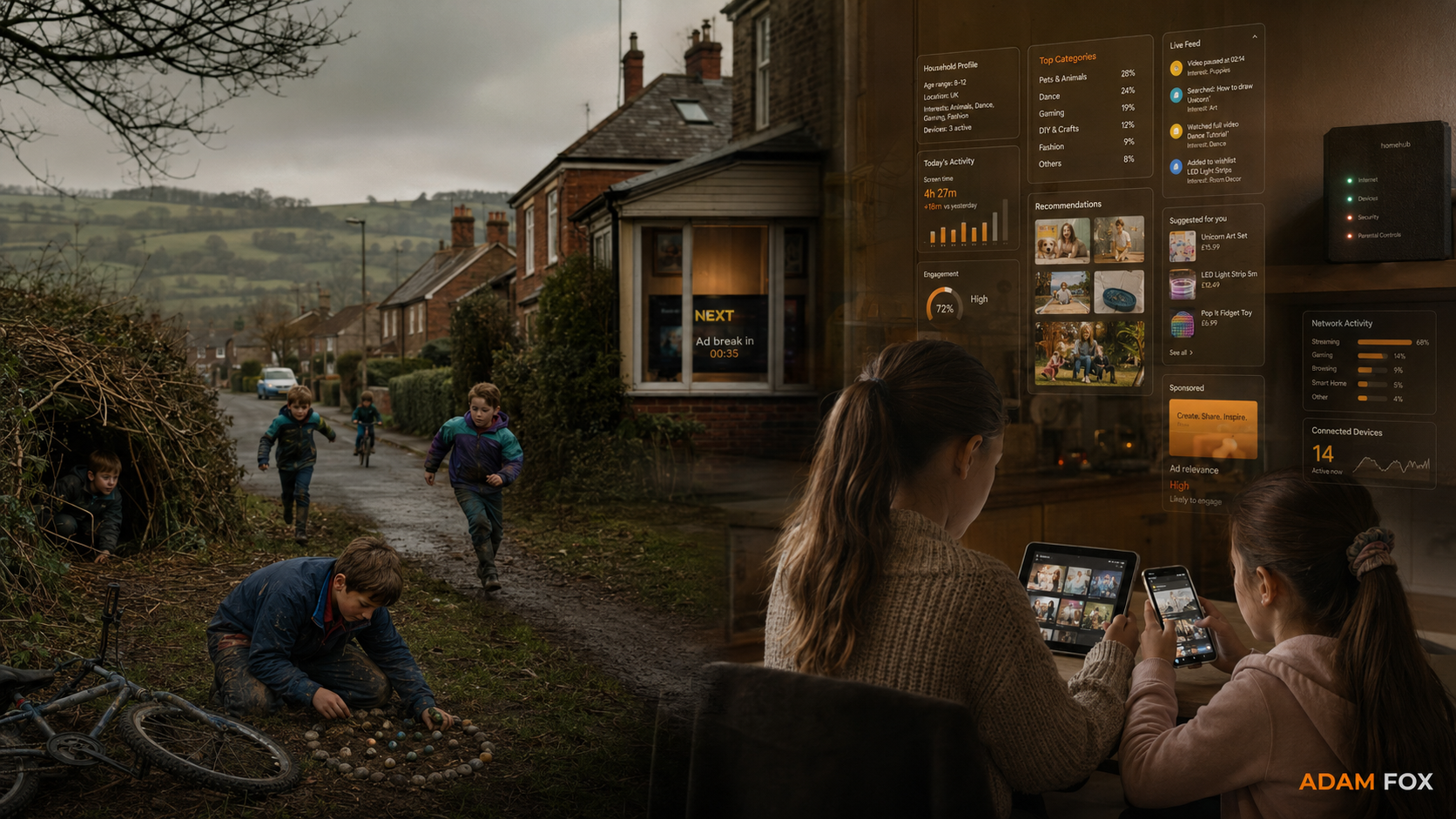
THE GREAT ATTENTION EXPERIMENT: 3 - YOUR CHILDHOOD WASN’T MONETISED. THEIRS IS.
Let me begin by admitting that the title of this essay is not literally true.
My childhood was commercialised.
Companies advertised toys to me.
Breakfast cereals came with cartoon characters.
Television programmes were interrupted by adverts for games, sweets, films, trainers and things designed to be collected in sets.
Brands wanted children to recognise them.
They wanted us to ask our parents for things.
They understood that preferences formed early could persist into adulthood.
The commercialisation of childhood did not begin with smartphones.
Anyone claiming that companies only recently discovered that children influence household spending would be ignoring decades of advertising history.
But my childhood was not monetised in the way childhood is monetised now.
That difference matters.
The advertisements I saw did not know who I was.
They did not record whether I paused.
They did not remember which toy I had looked at yesterday.
They did not compare my behaviour with thousands of other boys my age.
They did not alter the next advert according to what I had watched, searched for, liked, ignored or asked my parents to buy.
They did not follow me out of the living room.
They could not enter my bedroom.
They did not travel in my pocket.
They did not turn every moment of waiting, boredom, curiosity, insecurity or social comparison into another opportunity to influence what I wanted next.
My childhood contained advertising.
My daughters’ childhood is unfolding inside an advertising system.
That is not the same thing.
The World I Grew Up In
I grew up during the late eighties and nineties in a village where life moved slowly enough that my attention did not need defending.
We had one television in the house.
One.
There were four channels.
Even when Channel 5 arrived, we could not receive it because our aerial did not pick up the signal. Nobody considered this a crisis.
Children’s television ran for a couple of hours after school.
If you missed a programme, you missed it.
There was no catch-up service.
No recording in our house.
No alternative screen waiting in another room.
The programme did not pause because you needed the toilet.
It did not continue generating similar programmes indefinitely once the credits rolled.
Most days, I did not get home early enough to watch much of it anyway.
School finished and I went to the park with my mates.
I walked the dogs two or three miles across fields.
I rode my bike.
I played hide and seek across the village.
We hollowed out bushes and built dens inside them.
We crept into derelict barns.
We swam in the river as we became older.
I played with Lego and Meccano.
I made mixtapes.
I trained as a gymnast and later played rugby.
I delivered newspapers from the age of twelve.
There was very little television.
No mobile phone.
No internet until I was around fourteen.
My attention was largely my own to do with as I pleased.
That did not make my childhood superior in every way.
We had fewer sources of information.
Friendships could disappear when people moved away.
Children could be isolated without finding communities of people who understood them.
We were not automatically safer, wiser or more emotionally healthy because we had fewer screens.
The past does not become perfect simply because the present has problems.
But there was one enormous structural difference.
Most of my childhood was commercially unreachable.
When I left the television, the advertising ended.
The field did not track me.
The river did not recommend another activity.
The den did not send a reminder because I had not returned recently.
My bike did not calculate how long I had ridden it and then sell access to the next five minutes of my attention.
The moss growing on the flat roof outside my bedroom window did not know that I had turned its patches into imaginary countries.
The dark green carpet on my bedroom floor did not record that I had placed objects underneath it to create hills for a golf course made from pieces of sandpaper.
Nobody measured whether those games retained me.
Nobody optimised them.
Nobody earned more money if I continued for another hour.
Boredom was not a commercial problem waiting to be solved.
It was simply part of childhood.
The Advert Had Edges
The advertisements of my childhood were visible.
They arrived during the commercial break.
They occupied a page in a magazine.
They appeared on a billboard.
They were printed on packaging.
Children did not necessarily understand every persuasive technique being used, but the advert usually looked like an advert.
There was a separation.
Programme.
Commercial break.
Programme again.
That boundary mattered.
It gave the commercial message edges.
The advert started.
The advert ended.
The programme returned.
Everyone watching the same channel generally saw the same commercial.
A toy company might choose a time when many children were expected to be watching.
It could select a programme whose audience broadly matched the product.
But it was still buying access to a crowd.
The company did not know that one particular child had watched the advert three times, asked for the toy, searched for a review, abandoned a purchase and later felt excluded when a friend received it.
There was no continuous behavioural feedback.
The advertiser could conduct research.
It could measure sales.
It could ask children which brands they remembered.
But it could not observe the intimate sequence of attention and action taking place inside millions of individual childhoods.
Advertising was present.
The child was not transparent.
That privacy was not created by enlightened corporate restraint.
The technology simply could not see very far.
Childhood Has Moved Inside the System
My daughters are growing up approximately thirty years after I did.
The change is not simply that they have access to more screens.
Their childhood exists inside an environment that can observe behaviour, respond to it and alter itself around them.
The internet is now central to the lives of most UK children.
Ofcom reported in 2026 that 88 per cent of children aged three to seven went online, rising to 99 per cent among those aged eight to seventeen. It found that 78 per cent of children aged eight to seventeen owned a mobile phone, with ownership increasing sharply from 56 per cent at age ten to 83 per cent at age eleven. Almost all children who owned a phone had a smartphone.
The transition to secondary school is no longer simply a change of building, teachers and uniform.
For many children, it is the point at which a permanently connected personal screen becomes part of everyday life.
The shift begins much earlier.
Ofcom found that 65 per cent of parents of children aged between six months and two years said their child went online. Eighty-five per cent said their child looked at screens, with smart televisions, tablets and mobile phones among the devices being used.
That does not mean babies are independently browsing social media.
It shows how early digital media enters the environment.
Before many children can read, they can tap.
Before they understand what an advert is, they can follow one.
Before they can understand a privacy notice, their behaviour may already be generating information.
The modern child's first contact with the attention economy often occurs before they possess the language needed to describe what is happening.
It Is Not Just More Content
The obvious comparison between my childhood and my daughters’ is quantity.
I had four television channels.
They have access to almost unlimited content.
I had a couple of hours of children’s television after school.
They can watch videos at any time.
I had to wait for a programme to begin.
They can select something immediately.
I saw a limited number of programmes each week.
They can move through hundreds of short videos in a single sitting.
The difference is enormous.
But quantity alone is not the most important change.
A large library does not automatically manipulate anyone.
Having access to millions of books would not be harmful simply because no person could read them all.
The deeper change is that the content does not sit passively waiting to be chosen.
It is selected.
Ordered.
Recommended.
Inserted.
Tested.
Adjusted.
The system observes what holds attention and uses that information to decide what should appear next.
One child may see football clips.
Another may see beauty tutorials.
Another may see gaming videos.
Another may see pranks, crafts, dance routines, celebrity gossip or increasingly extreme versions of something they watched five minutes earlier.
The screen may look identical from the outside.
The commercial and cultural world visible through it can be entirely different for every child.
My generation watched media.
Their generation is watched by it.
The Device Learns the Child
The word profiling can sound more dramatic than the reality.
It does not necessarily mean a company knows a child's name, school and complete personal history.
The UK's Information Commissioner's Office defines profiling as automated processing used to evaluate or predict aspects of a person, including their preferences, interests, behaviour, location, movements, health or economic situation.
A system does not need to understand a child in the way a parent understands them.
It needs only to identify patterns that make its next selection slightly more effective.
This child watches videos about animals.
That one responds to bright rewards.
This child abandons slow content.
That one continues watching when conflict appears.
This child clicks when a particular creator recommends a product.
That one returns when sent a reminder.
The profile can be incomplete.
It can be inaccurate.
It can misunderstand curiosity as preference.
It can mistake research for desire.
It can interpret one accidental click as evidence of a lasting interest.
It does not need to be perfect.
It only needs to improve the probability that the child will remain, respond or return.
This changes childhood in a way television never could.
Television broadcast to children.
Digital systems can adapt to them.
A Childhood That Answers Back
When I watched an advert, the advert received nothing from me.
It did not know whether I laughed.
Looked away.
Left the room.
Asked my parents for the product.
Forgot it instantly.
The interaction ended at the screen.
Today, nearly every meaningful interaction can produce feedback.
A tap.
A pause.
A replay.
A swipe.
A search.
A completed video.
A skipped advert.
A purchase.
A request to a parent.
A return the following day.
Even the absence of action can become information.
The child may not be consciously communicating with the system.
Behaviour communicates anyway.
That is the fundamental difference between being advertised to and being continuously incorporated into the advertising process.
The child is not only seeing the commercial environment.
They are helping train it.
Their reactions make future targeting, recommendations and design decisions more effective.
The system learns which version of itself retains that child most successfully.
The child learns what the system repeatedly places in front of them.
Both are adapting.
Only one understands that an optimisation process is taking place.
From Scheduled to Permanent
The television of my childhood had natural limits.
Programmes started at fixed times.
Channels stopped broadcasting children's content.
Parents wanted to watch something else.
The family shared one screen.
The advert break finished.
The programme ended.
The child left the room.
Modern digital media has removed many of those stopping points.
Content is available all day.
One video leads directly to another.
Feeds continue for as long as someone continues moving through them.
Recommendations remove the effort of choosing.
Notifications invite the child back after they leave.
The device can travel from the sofa to the car.
From the car to the bedroom.
From the bedroom to school.
From school to the dinner table.
The screen is no longer an object in the corner of the family living room.
It is an individualised environment carried through the child's day.
Ofcom found that video-sharing platforms continued to account for the largest proportion of children's in-home video viewing in 2025. Children aged four to fifteen watched an average of seven hours and seven minutes of YouTube each week.
Those hours do not consist entirely of advertising.
Nor are they necessarily wasted.
Children use video platforms for entertainment, music, humour, learning, creativity and information.
The commercial significance lies in availability.
Every hour spent inside an advertising-supported environment creates repeated opportunities to influence attention, gather information and shape the next recommendation.
My childhood media had an ending.
Their media is designed to continue.
The Advert No Longer Has to Look Like an Advert
Traditional adverts interrupted content.
Modern advertising can become content.
A creator opens a package.
A gamer uses a branded product.
A family visits a theme park.
An influencer applies make-up.
A child watches another child play with a toy.
A video shows a desirable bedroom, outfit, holiday or lifestyle.
The commercial message may be formally disclosed.
It may not be.
It may be paid for.
It may be sent as a gift.
It may be produced by a brand.
It may be created independently by someone who has learned that product-focused content attracts views.
The distinction between advertising, entertainment and ordinary social behaviour becomes increasingly difficult to see.
UK advertising rules require adverts to be obviously identifiable. The Advertising Standards Authority and Committee of Advertising Practice acknowledge that younger children can struggle to recognise marketing that is highly immersive or deeply integrated into surrounding online content. Their guidance states that children under twelve may require enhanced, prominent disclosure because their critical understanding is still developing.
This is not a hypothetical concern.
Ofcom tested children rather than simply asking whether they felt media-literate.
Six in ten children aged eight to seventeen said they were confident recognising online advertising. Yet 38 per cent were confident while failing in practice to identify why paid search results appeared at the top of a page. A similar 35 per cent were confident but unable to recognise advertising within influencer posts.
Confidence is not protection.
A child can believe they recognise advertising while being influenced by commercial material they do not interpret as advertising at all.
Ofcom's qualitative research offered a striking example.
A sixteen-year-old said she saw only one or two adverts a day on TikTok. During a three-minute recording of her use, researchers observed seven adverts and two additional videos in which influencers displayed products they had bought.
The important point is not that this teenager was foolish.
The commercial material had become part of the texture of the platform.
She did not necessarily experience it as advertising because it did not always arrive in the familiar form of an advert.
That is precisely what makes the modern environment different.
My Girls Did Not Choose This World
When my daughters were very young, they used our phones occasionally.
The applications were restricted.
The access was supervised.
There were no social-media accounts.
We believed we were controlling the experience.
Then I watched one of them, at around eighteen months old, follow an advertising trail from a free game towards another download.
She could not read the message.
She did not understand the business model.
She had no concept of advertising, data collection, persuasive design or in-app purchasing.
But she could follow the visual pathway.
Bright image.
Movement.
Button.
Another screen.
Another invitation.
Another tap.
That experience stayed with me because it revealed the imbalance more clearly than any academic definition could.
The child did not need to understand the system to move through it.
The system had been designed so that understanding was unnecessary.
Later, I noticed something else.
My girls had plenty of toys.
Books.
Games.
Craft materials.
A garden.
A dog.
Access to parks and woods.
Yet when a screen was switched off, the response sometimes came almost immediately.
“I’m bored.”
How the fuck do you become bored in five seconds?
I never had one particular toy I needed above everything else.
I moved between whatever was available.
Lego.
Meccano.
Music.
The garden.
My bike.
A book.
My brother, usually for the purpose of annoying him.
My girls' attraction to screens felt different.
Not because they lacked imagination.
They are both exceptionally curious.
Not because screens had destroyed their ability to play.
They can play for hours.
It felt different because the screen offered a concentration of stimulation that ordinary objects were never designed to compete with.
The complaint did not always mean there was nothing to do.
It often seemed to mean that everything else suddenly felt slower.
That is not a diagnosis.
It is a father's observation.
But it is an observation many parents recognise.
The physical world had not changed during those five seconds.
The child's expectation of stimulation had.
Boredom Used to Be Outside the Market
Boredom has always been uncomfortable.
Children have always complained about it.
Parents have always searched for ways to occupy them.
The difference is that boredom is now commercially accessible.
A child waiting in a restaurant can be reached.
A child sitting in the back of a car can be reached.
A child awake before their parents can be reached.
A child unable to sleep can be reached.
A child who feels awkward at a party can be reached.
A child who has finished one activity but not yet begun another can be reached.
Every previously empty interval can now become a media session.
Every media session can generate attention.
Every moment of attention can carry advertising, product placement, data collection or another opportunity to return.
The attention economy did not invent childhood boredom.
It built a business capable of responding to it instantly.
That response feels compassionate in the moment.
The child is restless.
The parent is exhausted.
The device produces silence.
I understand the appeal because I have done it.
Most parents have.
Handing over a screen can transform a difficult meal, a long journey or a public meltdown within seconds.
This is not evidence that parents are lazy.
It is evidence that the product works.
The system offers immediate relief from an immediate problem.
The longer-term consequences are delayed, disputed and difficult to isolate.
The benefit is visible now.
That asymmetry helps explain why the practice has become so normal.
We Mistake Access for Choice
Modern children appear to possess far more choice than we did.
They can choose from millions of videos.
Thousands of games.
Countless creators.
Almost any song.
Almost any subject.
Almost any piece of information.
From the outside, this appears to be an extraordinary expansion of agency.
In many ways, it is.
A child interested in astronomy no longer depends upon the local library having the right book.
A child learning an instrument can watch demonstrations repeatedly.
A child struggling with a school subject can find another explanation.
A child who feels different from those around them can discover that they are not alone.
These benefits are real and should not be dismissed.
But the existence of options does not prove that every option is equally likely to be seen.
A recommendation system stands between the child and the available world.
It decides what appears first.
Which thumbnail is prominent.
Which video begins next.
Which creator receives distribution.
Which trend becomes difficult to avoid.
Which advert fits the profile.
The child can choose.
But they choose from an environment that has already been arranged.
This distinction applies to adults too.
It matters more for children because they are still developing their understanding of persuasion, identity, probability, social approval and commercial intent.
The modern child has unprecedented access to information.
The system has unprecedented access to the child.
Both statements can be true.
Childhood Is Now Datafied
UNICEF describes the modern digital environment as exposing children to risks arising from the commercialisation and datafication of their lives.
It reports that companies can track children's online activity and preferences to show targeted advertising, that marketing can be integrated into games and social spaces, and that algorithms may prioritise what sells rather than what best supports a child's development.
Datafication is an awkward word.
The process it describes is simple.
Parts of childhood that were once fleeting become records.
What the child watched.
What they searched.
Where they paused.
What they replayed.
Which device they used.
What time they returned.
What they bought.
Which products interested them.
Which creators influenced them.
Which content caused them to stay.
That information can be used to improve services.
It can help recommend something genuinely relevant.
It can identify harmful activity.
It can support safety features.
It can personalise education.
Data is not inherently exploitative.
The problem is purpose.
Information collected to serve a child can also be used to make that child more commercially valuable.
The same profile that helps a platform understand what content a young person enjoys can help determine which commercial messages are most likely to influence them.
This is why the ICO's Children's Code requires profiling for children to be switched off by default unless a service can demonstrate a compelling reason consistent with the child's best interests. It also states that profiling should only be used where appropriate protections exist against harmful effects.
That rule exists because the risks are no longer speculative.
Regulators now recognise that personalised digital environments can affect what children encounter and how their data is used.
Childhood Was Always Valuable
Companies have always understood that children matter commercially.
Children influence family spending.
They create demand.
They shape household choices.
They can become loyal customers later.
Essay Seven of this series will examine the economics of childhood in much greater depth.
For now, the important distinction is not whether companies valued children before the internet.
They did.
It is what companies can know and do now.
The toy advert I saw during children's television was hoping that boys of roughly my age might be interested.
A digital system can attempt to identify which individual child is interested.
It can observe whether that interest increases.
It can place the product inside entertainment.
It can bring the product back later.
It can use creators the child already trusts.
It can measure whether the child watched, clicked, shared or asked for more.
It can compare the result with thousands of similar children.
It can refine the approach.
The old model marketed to childhood.
The new model learns from it.
The Parent Is Comparing the Wrong Worlds
One of the most common responses to concern about children's technology use is:
We had television and we turned out fine.
That sentence sounds reasonable because it compares two screens.
Television then.
Phone now.
But the screen is the least important part of the comparison.
A television set was usually shared.
A smartphone is personal.
Television was scheduled.
Digital media is available continuously.
Television offered a limited number of channels.
Digital media offers effectively unlimited content.
Television broadcast the same programme to everyone.
Digital feeds are personalised.
Television advertising was selected for a general audience.
Digital advertising can be shaped by behavioural profiles.
Television remained in the home.
The smartphone travels with the child.
Television viewing created limited feedback.
Digital activity creates a constant stream of measurable behaviour.
Television programmes ended.
Feeds do not need to.
Television advertising usually looked like advertising.
Online commercial influence can be embedded within entertainment, recommendations, games and social relationships.
Saying that we had television too is like saying that a bicycle and a high-speed train are essentially the same because both use wheels.
The surface resemblance conceals a completely different system.
This Is Not an Argument Against Technology
I do not want my daughters to grow up frightened of technology.
I do not want them excluded from the world in which they will have to live.
I do not want them to reach adolescence having learned nothing about algorithms, advertising, comparison, privacy or the emotional pressures of online life.
Technology is not the enemy.
Children are not the problem.
Parents are not the problem.
The problem is that society introduced children into one of the most sophisticated commercial environments ever created before most adults understood how that environment worked.
Parents were handed tools that made communication, education and family life easier.
Those tools changed.
The services became more personalised.
The content became more abundant.
The advertising became less visible.
The feedback loops became faster.
The systems became better at predicting what held attention.
Meanwhile, the advice given to families remained painfully shallow.
Set limits.
Use moderation.
Be sensible.
Those instructions place responsibility almost entirely upon the parent and child while treating the surrounding commercial machinery as though it were neutral.
It is not neutral.
It is funded by outcomes.
Attention.
Engagement.
Clicks.
Purchases.
Returns.
Growth.
That does not make every product harmful.
It means the environment has an objective of its own.
The Difference Is Not Thirty Years of Technology
The difference between my childhood and my daughters' childhood is often described as technological progress.
That is part of it.
But the deeper shift is economic.
The tools did not simply become faster.
Childhood became more commercially legible.
A company can know more.
Test more.
Reach further.
Respond faster.
Personalise more precisely.
Remain present for longer.
The field where I played could not follow me home.
The television advert could not wait beside my bed.
The toy catalogue could not rearrange itself according to what I had looked at.
The magazine could not notify me that I had not opened it recently.
The programme could not study which moment caused me to lose interest and replace it for the next child.
My daughters are not weaker than I was.
They are not less imaginative.
They are not naturally more dependent upon stimulation.
They are growing up inside a system that has spent billions learning how to remove the moments in which their attention might drift elsewhere.
That is not a failure of childhood.
It is the result of industrial optimisation.
The Childhood We Cannot Recreate
There is no realistic route back to the world in which I grew up.
Nor should there be.
My daughters should not have to surrender access to knowledge, communication, creativity and opportunity simply because companies built problematic incentives around those benefits.
We cannot uninvent the internet.
We cannot pretend smartphones will disappear.
We cannot recreate a village with one slow car an hour and four television channels for every child.
The answer will not be nostalgia.
But nostalgia can still reveal what was lost.
Boundaries.
Friction.
Shared experiences.
Natural endings.
Periods of commercial silence.
Moments in which a child was unreachable except by the physical world immediately around them.
These conditions once occurred automatically.
Now they must be created deliberately.
That is an extraordinary transfer of responsibility.
Commercial systems remove the boundaries.
Families are expected to rebuild them.
Platforms create the personalised environment.
Parents are expected to understand it.
Companies test thousands of ways to increase engagement.
A parent is told to be firmer at bedtime.
The imbalance is rarely acknowledged.
What Does It Mean to Grow Up Inside a Market?
A child does not enter the world with a fully formed identity.
They build one.
They discover what they enjoy.
What they fear.
What they value.
What earns approval.
Where they belong.
What makes them attractive.
What makes them successful.
What kind of person they believe they should become.
Previous generations experienced commercial influence during this process.
Modern children experience something more intimate.
Their developing preferences produce data.
That data can shape the environment in which further preferences develop.
The child expresses interest.
The system responds.
The child encounters more of the same.
The behaviour strengthens.
The profile becomes more confident.
The environment narrows.
The child experiences that environment as the world.
This does not mean algorithms control children completely.
They do not.
Families matter.
Schools matter.
Friends matter.
Temperament matters.
Culture matters.
Children possess agency and can surprise every prediction made about them.
But influence does not need complete control to matter.
It needs repetition.
The question is not whether a digital system can dictate a child's identity.
It is whether commercial systems should be allowed to participate so persistently in its construction.
Final Thought
My childhood was advertised to.
My daughters’ childhood is observed.
Mine contained commercial messages.
Theirs generates commercial signals.
I watched the same adverts as thousands of other children.
They can be placed inside individualised environments shaped by behaviour.
The television wanted an audience.
The modern system wants a response.
Then another.
Then enough information to improve the probability of the next one.
This is why the comparison between generations cannot stop at screen time.
We did not simply grow up with fewer screens.
We grew up before childhood could be measured continuously.
Before boredom could be reached instantly.
Before entertainment, friendship, identity and advertising could occupy the same personalised feed.
Before a child's attention could be analysed while it was still learning how to direct itself.
Your childhood may have been commercialised.
It may have been saturated with brands.
It may have contained far more advertising than you remember.
But for large parts of the day, you disappeared beyond the market's reach.
Children today rarely disappear.
The market travels with them.
And when an entire childhood can be observed, predicted, influenced and monetised...
It is no longer enough to say that we had television too.
Sources & Research Gaps
Principal Sources
Adam Fox, Lived-Experience Reference Material
The personal childhood details, including one television, four channels, limited children's programming, outdoor play, dog walking, cycling, gymnastics, the paper round, imaginative games and the absence of a phone or internet until adolescence, come from Adam Fox's locked lived-experience reference document.
The same source records Adam's observations of his daughters' attraction to screens, their immediate claims of boredom after a device is removed and his experience of a very young child following advertising pathways inside a free application.
Ofcom, Children and Parents: Media Use and Attitudes Report 2026
Ofcom provides current UK evidence concerning children's internet use, device ownership, smartphone access, video consumption, advertising recognition and understanding of platform business models.
Key findings used in this essay include:
- 88 per cent of children aged three to seven and 99 per cent aged eight to seventeen go online.
- 78 per cent of eight-to-seventeen-year-olds own a mobile phone.
- Mobile ownership rises from 56 per cent at age ten to 83 per cent at age eleven.
- 65 per cent of parents of children aged six months to two years say their child goes online.
- Children aged four to fifteen averaged seven hours and seven minutes of YouTube viewing each week.
- Significant numbers of children who express confidence in identifying advertising cannot do so reliably in practical tests.
- Some children fail to recognise embedded commercial content or influencer promotion as advertising.
Information Commissioner's Office, Children's Code
The ICO defines profiling and requires online services likely to be accessed by children to switch profiling off by default unless a compelling reason can be demonstrated in the best interests of the child.
The Code also requires protective measures where profiling could expose children to content detrimental to their health or wellbeing.
UNICEF, Children and Digital Marketing
UNICEF's work identifies risks associated with the commercialisation and datafication of children's digital lives, including targeted advertising, data collection, embedded marketing, manipulative design and algorithmic prioritisation of commercially valuable content.
Advertising Standards Authority and Committee of Advertising Practice
ASA and CAP guidance explains why children, particularly those under twelve, may struggle to recognise commercial messages when advertising is deeply integrated into games, social content, influencer posts or other immersive digital environments.
The guidance requires stronger and more prominent disclosure where commercial intent may not be obvious to younger audiences.
Children's Commissioner for England
The Children's Commissioner describes online and offline childhood as increasingly inseparable and reports concerns about children encountering commercial content capable of affecting how they feel about their bodies and identities.
Research Gaps and Limitations
The title Your Childhood Wasn't Monetised. Theirs Is. is deliberately rhetorical.
Children were advertised to and commercially influenced long before the internet. Toy manufacturers, broadcasters, food companies, publishers and retailers all treated children as commercially valuable audiences.
The central argument is therefore not that previous childhoods were free from commerce.
It is that modern childhood can be measured, profiled, personalised and reached continuously in ways that were not technologically possible thirty years ago.
Adam Fox's childhood is one individual experience. It should not be treated as representative of every British child growing up during the late eighties and nineties.
Children's access to outdoor space, parental supervision, television, computers and commercial media varied significantly according to geography, household income, family structure and personal circumstances.
Current Ofcom figures describe population-level patterns. They do not mean that every child uses the same platforms, spends the same amount of time online or encounters the same advertising environment.
Screen use is not a single behaviour. Watching an educational video, speaking to a grandparent, creating music, completing homework and moving through an algorithmic entertainment feed may all involve a screen but have very different effects.
The presence of personalised recommendations does not prove that every recommendation is commercially motivated.
The presence of advertising does not prove harm.
The inability to recognise an advert does not establish that the advert successfully changed the child's behaviour.
Research remains limited in several important areas:
- The number and type of commercial messages children encounter across an entire day.
- The accuracy of advertising profiles created about children.
- The extent to which age-assurance systems prevent children from entering adult or teenage advertising environments.
- The long-term developmental effects of continuous personalised marketing.
- The interaction between advertising, influencer culture, social comparison and identity formation.
- Differences between contextual advertising, personalised advertising and recommendation systems.
- The effectiveness of disclosures such as Ad, Sponsored or Paid Partnership for children of different ages.
- The extent to which data collected for safety, personalisation or functionality is later used for commercial purposes.
- Whether children's reduced tolerance for low-stimulation activities can be causally attributed to digital media rather than broader cultural and environmental changes.
This essay does not attempt to diagnose children, define healthy screen limits or prescribe parenting rules.
Those questions require separate evidence and should not be reduced to a nostalgic comparison between generations.