
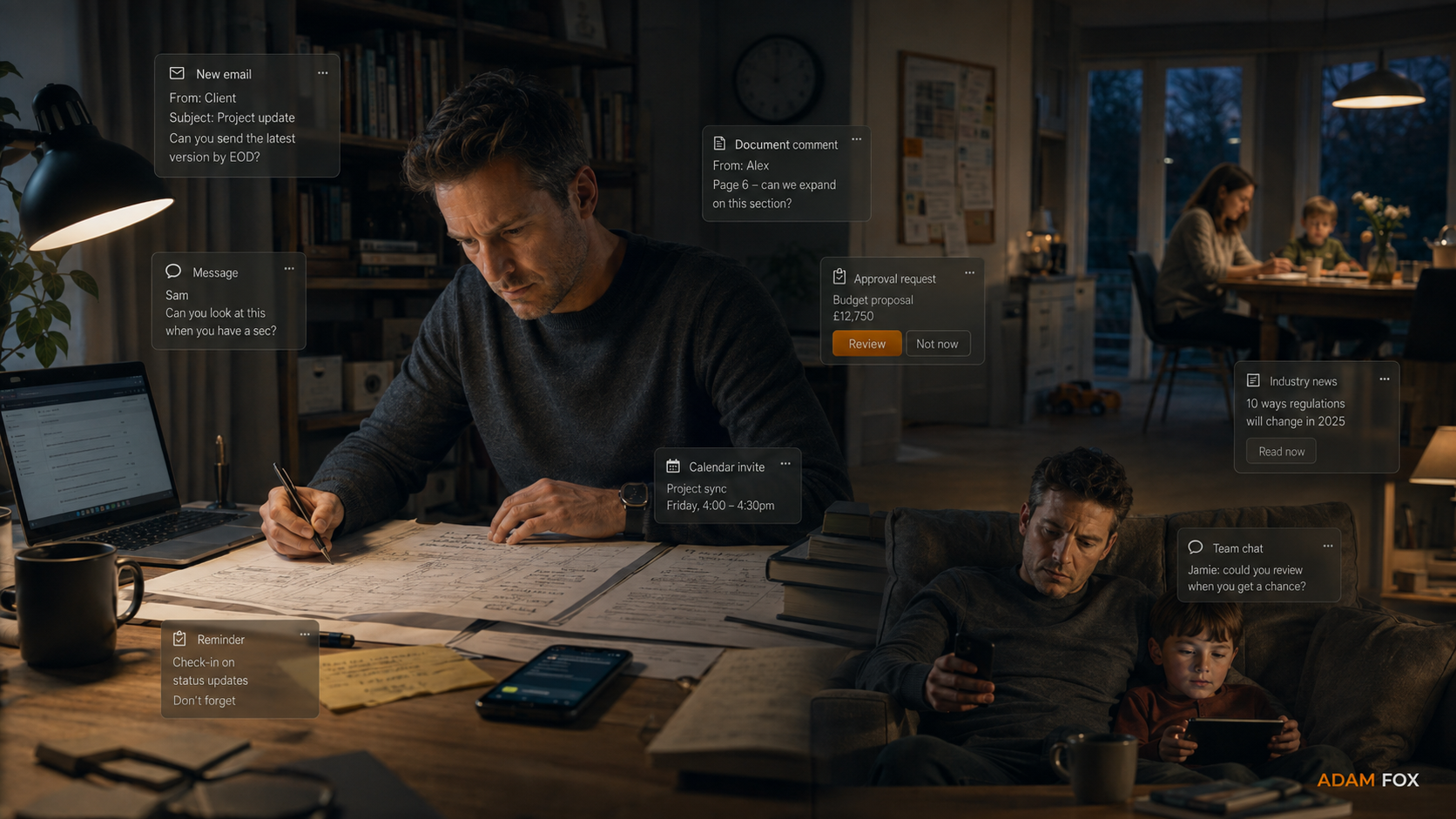
THE GREAT ATTENTION EXPERIMENT: 8 - THE ADULTS DIDN’T ESCAPE EITHER
You sit down to do something that matters.
Not something urgent.
Something difficult.
The kind of work requiring enough uninterrupted thought for several ideas to exist in your mind at the same time.
You open the document.
Read the last paragraph.
Try to remember where your thinking had reached.
An email arrives.
You leave it.
A message appears in the corner of the screen.
You leave that too.
Your phone vibrates.
You turn it face down.
Then you remember a small task connected to something else.
You open another tab before you forget.
While the page loads, you check the message.
It takes twenty seconds to answer.
The email now feels harder to ignore.
You read it.
It contains a question you cannot resolve immediately.
You return to the original document.
The words are still there.
The thought is not.
Nothing dramatic has happened.
You have not wasted an hour watching videos.
You have not opened social media.
You have not behaved irresponsibly.
You have simply experienced modern work.
That is how adult attention is often lost.
Not through one irresistible distraction.
Through a steady accumulation of reasonable interruptions.
A message that deserves a reply.
A meeting that appears necessary.
A client who needs reassurance.
A colleague asking for help.
A notification linked to work.
A thought you are frightened of forgetting.
A task that will take only a minute.
Each demand appears defensible.
Together, they can make sustained attention almost impossible.
We talk about children as though they are the vulnerable participants in the attention economy.
Their judgement is developing.
Their impulse control is incomplete.
Their understanding of commercial persuasion is limited.
All of that matters.
But adults did not stand outside the experiment watching it happen.
We entered it too.
We brought the same devices into our workplaces, bedrooms, kitchens, cars and relationships.
Then we built professional expectations around their permanent presence.
Children were taught to keep checking because entertainment, friendship and social approval might be waiting.
Adults were taught to keep checking because work might be.
We Mistook Maturity for Immunity
Adults understand that platforms are designed to retain attention.
We recognise advertising.
We know notifications can wait.
We understand that an email is not automatically urgent because it arrived immediately.
We possess more experience than children.
That should offer protection.
Sometimes it does.
Adults can change settings.
Set boundaries.
Delete applications.
Choose when to respond.
Explain the commercial model.
Recognise emotional manipulation.
Yet intellectual understanding does not remove psychological vulnerability.
Knowing that a biscuit was designed to taste good does not make it less appealing.
Knowing that a notification is only a prompt does not prevent attention from orienting towards it.
Knowing that task switching carries a cost does not eliminate a workplace culture expecting immediate replies.
Adults are not immune to novelty, uncertainty, social approval, convenience or habit.
We possess the same human psychology examined in Essay Five.
Then work adds another layer.
Responsibility.
A child may check because they hope something interesting has happened.
An adult may check because something important genuinely could have happened.
That possibility makes professional prompts more difficult to dismiss.
Work Gave the Device Moral Authority
A social notification says:
Someone has posted something.
A work notification says:
Someone may need you.
The first can be dismissed as entertainment.
The second arrives carrying responsibility.
A customer could be waiting.
A colleague could be blocked.
A project could be delayed.
A problem could be escalating.
A manager could be noticing how long you take to respond.
The device no longer interrupts merely by offering pleasure.
It interrupts by creating obligation.
That obligation does not need to be written into an employment contract.
People learn it through culture.
Who replies first?
Who remains available?
Who answers outside working hours?
Who solves the problem?
Who appears dependable?
Who never seems to disappear?
Responsiveness becomes a visible form of performance.
Deep thought is harder to display.
Nobody sees the hour in which you resisted every interruption and solved a difficult problem.
Everyone sees the message you failed to answer for forty minutes.
The measurable behaviour begins winning again.
I Know What Permanent Availability Costs
At the peak of my old working life, I was Managing Director of someone else's business.
On paper, it looked like success.
In reality, it was a role without a reliable off-switch.
My days often ran from six in the morning until six at night, sometimes longer.
The hours were only part of it.
The greater burden was the belief that I had to remain mentally available because something might go wrong if I stopped paying attention.
Calls could arrive outside normal hours.
The business followed me on holiday.
Even when nobody was contacting me, part of my mind remained on call.
The work had entered my nervous system.
I woke at two in the morning with unresolved problems circling.
I became the person who absorbed pressure so the wider machine could continue operating.
That identity was rewarded because I was reliable.
The more I proved I could carry, the more I was given to carry.
Eventually, my value within that system felt inseparable from my availability.
When I tried to protect time with my family, I became inconvenient.
That period did not collapse because of one application, one phone or one notification.
The causes were organisational, cultural, personal and commercial.
Technology did not create the expectation that work should come first.
It made that expectation easier to enforce across every hour and every location.
The device was not the entire problem.
It removed the distance that once allowed people to escape it.
Work Used to Have More Geography
The workplace was never perfectly contained.
Doctors were called from home.
Business owners worried at night.
Managers took documents away.
Parents carried stress through the front door.
Factories operated shifts.
Emergency services required permanent availability.
Work has always extended beyond the official working day for many people.
But physical separation created friction.
A document remained in the office.
A colleague could not send a message instantly.
A customer had to wait until morning.
A decision sometimes remained unresolved because the people involved were unreachable.
That could be inconvenient.
It could also be protective.
Modern communication removed much of that friction.
The workplace no longer needs to be somewhere you go.
It can be wherever your phone receives a signal.
Email enters the bedroom.
Messaging enters the school run.
Meetings enter the kitchen.
Documents enter holidays.
Work becomes capable of appearing in almost every previously private space.
The technology offers genuine flexibility.
A parent can attend an appointment.
A disabled employee may work in a more accessible environment.
A business can employ people across the world.
Travel can be reduced.
Someone can organise work around family life rather than travelling to an office at fixed times.
These are substantial benefits.
The same flexibility can produce a workplace that never quite ends.
The Infinite Workday
Microsoft's 2025 research described the emergence of what it called the infinite workday.
Its Microsoft 365 telemetry showed communication spreading beyond traditional working hours, with after-hours chats increasing and meetings beginning after eight in the evening becoming more common.
The company reported that its most heavily interrupted users received enough meetings, emails and chats to create an average interval of approximately two minutes between incoming prompts during an eight-hour working day. The widely repeated figure of 275 daily interruptions refers to the highest 20 per cent of users by communication volume rather than every employee, and the underlying dataset excluded education and European Union tenants.
Those qualifications matter.
The statistic should not be presented as a universal description of every workplace.
A builder on site, a nurse on a ward and a writer working alone do not experience identical patterns.
Even within digital work, the distribution is uneven.
But the data captures a recognisable reality.
Many knowledge workers now spend their days inside communication systems capable of producing a new demand before the previous thought has stabilised.
The interruption is not always a person physically walking into the room.
It is a calendar invitation.
A status update.
A reaction.
An email.
A chat.
A request for approval.
A change to a shared document.
A system notification.
The work environment behaves like a feed.
We Call It Multitasking
The word multitasking makes fragmented work sound like an ability.
A competent person handles several things at once.
They answer messages during meetings.
Review a document while listening to someone speak.
Check email while completing a report.
Move rapidly between projects.
The reality is usually task switching.
The mind stops prioritising one set of information and attempts to orient towards another.
Some activities can genuinely occur simultaneously.
A person can walk and speak.
An experienced driver can operate familiar controls while listening to music.
Routine actions can become sufficiently automatic that they require little conscious supervision.
But two tasks demanding the same limited cognitive resources must compete.
You cannot read a detailed email and listen properly to a complex explanation at precisely the same moment.
Attention moves.
Sometimes quickly.
Sometimes so quickly that the movement feels simultaneous.
The switching still happened.
The Interruption Does Not End When the Message Does
Suppose a colleague asks a simple question.
You answer in thirty seconds.
It is tempting to conclude that the interruption cost thirty seconds.
But the visible interruption is not the complete cost.
Before the message arrived, the mind held a particular goal, context and collection of ideas.
The interruption replaced them.
Returning requires reconstruction.
What was I doing?
Which part mattered?
What had I decided?
What was I about to write?
The original task must be loaded again.
Sophie Leroy's research described part of this problem as attention residue.
Her experiments found that when people moved from one unfinished task to another, some attention remained attached to the previous task, reducing performance on the new one.
People do not always stop thinking about one problem simply because another window has opened.
This explains why a day filled with small tasks can feel mentally exhausting despite containing no single enormous challenge.
The mind repeatedly rebuilds context.
Each reconstruction consumes effort.
The person remains active.
They may never become fully absorbed.
Interrupted Workers Can Appear More Productive
One of the most interesting findings in interruption research is that people sometimes compensate.
Gloria Mark, Daniela Gudith and Ulrich Klocke experimentally interrupted people completing office-like tasks.
The interrupted participants finished more quickly without a measurable reduction in the quality assessed by the researchers.
At first glance, interruption appeared to improve performance.
The psychological cost revealed a different picture.
Participants worked faster while reporting greater stress, frustration, time pressure and effort.
They adapted to disruption by accelerating.
This finding should not be stretched beyond the study.
It does not prove that interruption always makes people faster.
It does not prove that quality never suffers.
The tasks were controlled and cannot represent every form of work.
But the finding reveals why fragmented workplaces can remain functional for so long.
People compensate.
They type faster.
Shorten decisions.
Skip reflection.
Work later.
Carry unresolved thought into the evening.
The organisation sees continued output.
The person experiences the cost.
A system can therefore appear productive while consuming the people keeping it productive.
The Speed Becomes the Evidence
When employees continue delivering, the organisation can conclude that the communication load is manageable.
The work got done.
The customer received an answer.
The deadline was met.
The meeting happened.
The fact that someone finished it while tense, accelerated and mentally depleted remains largely invisible.
This is how excessive availability becomes normal.
People survive it.
Survival is mistaken for sustainability.
The employee's coping strategy becomes proof that no change is needed.
Then the coping strategy becomes the expected standard.
Yesterday, one person answered an evening email.
Today, the team assumes evenings are available.
Yesterday, somebody joined a meeting during lunch.
Today, lunch appears bookable.
Yesterday, a manager responded while on holiday.
Today, absence feels unprofessional.
Nobody needs to announce that boundaries have been abolished.
Enough exceptions become a culture.
Email Became an Endless Queue
Email solved extraordinary problems.
It allowed asynchronous communication across distance.
A message could be sent without requiring both people to be available simultaneously.
Documents could travel instantly.
Conversations could be recorded.
Teams could coordinate without repeated phone calls.
In theory, email should protect attention.
The sender sends when convenient.
The recipient reads when convenient.
The problem emerged when asynchronous communication acquired an expectation of synchronous response.
The inbox stopped being a place people visited.
It became something continuously monitored.
Kostadin Kushlev and Elizabeth Dunn tested whether changing email-checking frequency affected wellbeing.
Across a two-week study, adult participants were asked during one period to limit checking to three occasions each day and during another to check as often as they normally would.
Participants reported lower daily stress during the limited-checking period.
This does not prove that every worker should check email exactly three times.
Some roles require faster communication.
The study relied partly upon self-report and took place over a relatively short period.
Its importance lies in the distinction between email volume and email rhythm.
The same messages may feel different when encountered continuously rather than in deliberate groups.
Fragmentation itself carries a cost.
The Notification Has Already Worked
A person does not need to answer a notification for it to interrupt them.
Research by Cary Stothart and colleagues found that mobile-phone notifications disrupted performance on an attention-demanding task even when participants did not interact with the device.
The alert was brief.
The behaviour did not change visibly.
Attention had still been disturbed.
This makes the standard advice to just ignore it incomplete.
Ignoring a prompt prevents the longer diversion of opening and responding.
It does not necessarily reverse the initial orientation of attention.
The mind has already registered that something may require consideration.
Who sent it?
Is it urgent?
Should I check?
Can I afford not to?
The notification creates an open question.
Adults may answer no.
They still had to ask.
We Interrupt Ourselves
Not every disruption comes from outside.
People check email without receiving an alert.
Open messaging applications automatically.
Look at their phone during a difficult paragraph.
Refresh a page while waiting for another task to load.
Researchers studying workplace email have distinguished external interruptions from self-interruptions, where the person initiates the switch without a new incoming demand.
Email-checking habits and frequent self-interruption have been associated with greater perceived stress and lower feelings of productivity, while batching messages can create a different rhythm of work.
The external environment eventually becomes internal behaviour.
The phone does not need to vibrate.
The possibility that something may have arrived becomes enough.
The employee has learned to monitor the channel.
This is the adult equivalent of the internal trigger examined in the persuasive-technology essay.
Boredom can trigger checking.
So can difficulty.
Uncertainty.
Fatigue.
Avoidance.
The difference is that work provides a respectable justification.
You are not procrastinating.
You are staying informed.
Easy Work Defeats Important Work
Many forms of digital work provide immediate completion.
Reply.
Approve.
React.
Forward.
Schedule.
Mark done.
The action is clear.
The reward is visible.
The queue becomes slightly smaller.
Important work is often less cooperative.
Thinking does not tell you exactly how long it will take.
Writing may become worse before it improves.
Strategy produces no reassuring notification when one idea finally connects to another.
A difficult conversation cannot be cleared with one click.
The easy tasks offer progress.
The important task offers uncertainty.
When both are present on the same screen, the smaller actions repeatedly win.
This is not simply poor discipline.
The workplace has made immediate work visible, measurable and socially rewarded.
The deeper task often remains private until completion.
A person can spend an entire day responding competently and still fail to move the work that mattered.
They were busy.
They were useful.
They were attentive to everyone except the priority they had chosen.
Responsiveness Is Not the Same as Contribution
Modern organisations often praise responsiveness.
For good reason.
Customers should not be ignored.
Emergencies need action.
Colleagues need enough information to continue working.
A team in which nobody responds becomes dysfunctional.
The problem begins when response speed becomes the default measure of commitment.
The fastest responder may not be creating the greatest value.
They may simply be monitoring communication most closely.
The person who disappears for two hours may be solving the problem that prevents fifty future messages.
The person answering instantly may be postponing the work that would remove the need for constant response.
Busyness can become an identity.
People appear committed because they are always moving inside the system.
Agency asks a harder question:
Does all of this activity deserve to exist?
My own work has gradually moved towards that distinction.
Work ethic works hard inside the system.
Agency examines and improves the system itself.
Attention makes that examination possible.
You cannot question a default you are too interrupted to notice.
Meetings Consume More Than Their Scheduled Time
A one-hour meeting does not always cost one hour.
There is preparation.
Travel between spaces.
The interruption to the preceding task.
The period afterwards in which the person reconstructs what they were doing.
The actions generated during the discussion.
The psychological anticipation that can fragment the time immediately before it.
A calendar containing several meetings may leave apparently open gaps that are too short or uncertain for demanding work.
The day looks available in pieces.
The pieces do not combine automatically into attention.
Meetings also generate their own communication.
Invitations.
Pre-reads.
Messages during the meeting.
Follow-up emails.
Shared documents.
Action lists.
Recordings.
Transcripts.
Summaries.
Technology can make meetings more efficient.
It can also make the meeting a small factory producing further obligations.
Microsoft's telemetry found that 60 per cent of meetings among the highest-volume users in its dataset were unscheduled or arranged on an ad hoc basis.
Again, this is not every employee.
It represents a heavily burdened group.
But it shows how easily a planned day can be reorganised by the communication system surrounding it.
The Workday Starts Before Work
The first check often occurs before the person has fully entered the day.
The alarm sounds.
The phone is already beside the bed.
Email is one movement away.
A message arrived overnight.
A calendar changed.
A client has a problem.
The body may still be in the bedroom.
The mind has entered the workplace.
The same device carries family photographs, school messages, banking, navigation, news, entertainment and professional demands.
There is no physical transition between roles.
A person can move from parent to manager to consumer to friend within seconds without moving from the pillow.
That convenience is remarkable.
It also means the first available attention of the day can be claimed before the person chooses what deserves it.
Work Follows Us Home
At the other end of the day, the process reverses imperfectly.
The laptop closes.
The problems remain active.
A parent sits at the table but continues mentally drafting an email.
A partner speaks while part of the listener is waiting for a work response.
A child asks a question as the watch vibrates.
The adult may resist checking.
The possibility has already entered the moment.
Presence is not merely being physically in the room.
It is allowing the people inside it to become the most important information currently available.
That becomes difficult when professional systems can interrupt at any time and have trained the adult to treat their signals as potentially consequential.
This is one of the greatest hidden costs of fragmented work.
The employer does not need to take the entire evening.
It takes small pieces of attention from inside it.
Enough pieces can alter the experience of home.
The Device Contains Two Attention Economies
The commercial attention economy wants adults to remain engaged because attention can be monetised.
The workplace attention system may want adults to remain responsive because responsiveness keeps operations moving.
These are not identical.
An employer is not necessarily selling an employee's attention to advertisers.
A colleague sending a message is not behaving like a recommendation algorithm.
Workplace software often exists to improve coordination rather than maximise screen time.
The distinction matters.
But both systems can operate through the same behavioural architecture.
Prompts.
Badges.
Unresolved queues.
Visible status.
Social expectation.
Ease of response.
Unpredictable incoming information.
The commercial platform asks:
What might interest you?
The workplace asks:
What might require you?
The adult moves between them all day.
During a difficult work task, entertainment offers escape.
During family time, work offers obligation.
The same device ensures that another claim is always available.
The Phone on the Desk
A widely cited 2017 study found that participants performed better on certain tests of working memory and fluid intelligence when their smartphones were in another room rather than on the desk or in a pocket or bag.
The researchers proposed that resisting a personally significant device might consume limited cognitive resources even without conscious checking.
That finding produced an appealing conclusion.
Merely having the phone nearby drains the brain.
Later research complicated the story.
A direct replication failed to reproduce the original effect.
A 2024 meta-analysis covering 56 samples and more than 7,000 participants found limited evidence of a small negative effect upon working memory but no consistent pooled effect across most other cognitive outcomes.
Another 2024 meta-analysis covering 33 studies found no significant overall effect of mere smartphone presence on cognitive performance.
The evidence does not support a confident universal claim that any phone sitting on any desk automatically damages thought.
That does not make smartphone distraction imaginary.
Notifications, active checking, habitual switching and expectations of availability have stronger and more direct evidence behind them.
The mixed findings reveal why this investigation must resist catchy claims.
Adult attention is not damaged through one simple mechanism.
The environment matters.
The task matters.
The person matters.
The meaning attached to the phone matters.
Not Everyone Experiences the Same Workday
A corporate executive may be interrupted by messages and meetings.
A teacher may be interrupted by pupils, systems, parents and administrative tasks.
A nurse may move between patients, alarms, records and urgent decisions.
A tradesperson may receive calls while using tools or travelling between jobs.
A business owner may carry sales, staffing, cash flow and customer problems simultaneously.
A carer may never receive enough uninterrupted time to complete anything cleanly.
A parent working from home may shift between paid work and family needs throughout the day.
Attention fragmentation did not begin with Slack, Teams or smartphones.
Some work is inherently interruptive.
Emergency medicine cannot be organised around undisturbed blocks of creative thought.
A school cannot ignore a distressed child because the teacher is protecting focus.
A customer-facing role requires responsiveness.
The objective cannot be to remove every interruption.
It must be to distinguish necessary responsiveness from an environment that interrupts because it has never questioned its defaults.
The most damaging culture is not one in which urgent things interrupt.
It is one in which everything is allowed to present itself as urgent.
The Reliable Person Pays More
Fragmented systems do not distribute their cost evenly.
They often burden the most conscientious people.
The employee who replies receives more questions.
The manager who solves problems becomes the route through which problems travel.
The business owner who remains available teaches customers to expect access.
The colleague who never says no becomes the safest person to ask.
Competence attracts demand.
Reliability creates dependency.
The attention system learns socially.
Not through machine learning.
Through human behaviour.
Who answers?
Who rescues?
Who absorbs?
Who will probably say yes?
The organisation routes more work towards the proven responder.
That person may interpret the increasing demand as evidence of their importance.
It is also evidence that the system has discovered where additional capacity can be extracted.
I spent years inside that identity.
The fixer.
The dependable one.
The person who could hold the pressure.
That identity created opportunities.
It also made the boundary between contribution and self-erasure almost impossible to see.
Burnout Is Not Just Distraction
Burnout has become another word used too casually.
People describe a tiring week as burnout.
A difficult afternoon.
A loss of motivation.
The World Health Organization defines burnout more narrowly as an occupational phenomenon resulting from chronic workplace stress that has not been successfully managed.
Its description includes exhaustion, increased mental distance or cynicism towards work and reduced professional efficacy.
WHO does not classify burnout as a medical condition and states that the term should refer specifically to the occupational context.
Attention fragmentation is not identical to burnout.
A distracted employee is not necessarily burned out.
A person can experience burnout in a quiet workplace through excessive workload, lack of control, unfairness, conflict or values misalignment.
But constant interruption can become part of the chronic workplace stress that people fail to manage.
It increases effort.
Reduces recovery.
Extends unfinished work.
Keeps the nervous system prepared for the next demand.
Makes meaningful progress harder to experience.
The worker can remain intensely active while feeling less effective.
That combination resembles one of the most demoralising features of burnout.
You are giving more attention.
You feel as though you are achieving less with it.
Rest Cannot Repair a System That Never Stops Calling
People are often advised to recover better.
Sleep.
Exercise.
Take breaks.
Use annual leave.
Protect evenings.
All sensible.
But recovery requires psychological distance from the demand.
A holiday does not restore someone fully if work remains in their pocket and the culture expects them to monitor it.
An evening does not feel free if unresolved messages may arrive at any moment.
A lunch break is not restorative when meetings are permitted to occupy it.
Rest is not simply time in which no work is being performed.
It is time in which the mind is allowed to stop preparing for work.
Permanent availability weakens that permission.
The person is never completely working.
They are never completely not working either.
Adults Helped Build the Norm
Technology companies created communication tools.
Organisations decided how to use them.
Managers sent messages at night.
Employees answered.
Clients learned that replies were possible.
Business owners competed through faster availability.
Parents checked during family time.
We told ourselves it was temporary.
Necessary.
Part of the role.
Evidence of ambition.
The culture did not arrive entirely from above.
Adults participated in normalising it.
Sometimes because they had no meaningful choice.
Sometimes because responsiveness created advantage.
Sometimes because being needed felt important.
Sometimes because checking was easier than tolerating uncertainty.
This does not distribute responsibility equally.
An employee worried about job security does not possess the same power as an executive designing expectations.
A small supplier does not possess the same leverage as a major customer demanding immediate access.
A worker cannot solve an organisational culture through personal discipline alone.
But the system survives partly because we repeatedly enact it.
The Productivity Industry Often Made It Worse
When attention fragmented, the productivity industry offered methods for fitting more activity into the same damaged day.
Faster email.
Better task lists.
More efficient meetings.
Morning routines.
Time-blocking.
Automation.
Optimisation.
Some of these tools are genuinely useful.
I built my own framework because I needed a practical way to stop the chaos inside my head.
But productivity advice often asks the individual to adapt more efficiently to a system that should be questioned.
How can you process more messages?
How can you attend every meeting and still complete your work?
How can you remain available without feeling overwhelmed?
Perhaps the better question is:
Why does all of this communication exist?
The person may not need a better method for surviving the interruption.
The organisation may need fewer reasons to interrupt them.
Working harder inside a fragmented system can increase output temporarily.
Agency improves the system.
That requires enough attention to see it clearly.
Adults Understand the Cost and Continue Anyway
This is perhaps the most uncomfortable part.
Many adults know exactly what is happening.
They recognise that constant email checking increases stress.
They feel task switching erode concentration.
They notice the phone at the dinner table.
They complain about meetings that should have been messages and messages that should never have existed.
Then they continue.
Because the behaviour is not maintained by ignorance alone.
It is maintained by incentives.
The manager responds because senior leadership notices responsiveness.
The employee checks because colleagues depend upon them.
The business owner answers because a competitor might.
The parent looks because school communication arrives through the same device as everything else.
The adult knows the system is damaging attention.
They may still be unable to exit it without paying a professional or social price.
Knowledge creates awareness.
It does not automatically create power.
Intelligence Does Not Protect Against Environment
Highly intelligent adults lose hours to digital distraction.
Experienced leaders spend days reacting instead of thinking.
Doctors, teachers, engineers, writers and psychologists interrupt themselves.
People who understand persuasive design still respond to prompts.
People who teach productivity still become overwhelmed.
This should not surprise us.
Human beings do not make decisions in isolation from their surroundings.
Environment changes what is easy.
Culture changes what is expected.
Technology changes what is possible.
Power changes what can be refused.
The adult may possess excellent self-control.
The workplace can require them to exercise it hundreds of times each day.
Eventually, the question is not whether the person has discipline.
It is why the environment consumes so much of it merely to allow them to work.
Attention Is an Organisational Resource
Companies understand that money is limited.
Budgets are allocated.
Expenditure is reviewed.
Waste is challenged.
Attention is also limited.
Yet many organisations allow anyone to spend anyone else's attention almost without friction.
A thirty-minute meeting involving ten people consumes five hours of collective time before preparation or task recovery is considered.
A broad email creates work for everyone who believes they may need to read it.
A chat message interrupts another person's priority because the sender wanted immediate relief from their own uncertainty.
The cost is distributed.
The sender experiences convenience.
The recipients absorb the attention bill.
This is not an argument against communication.
It is an argument for recognising that communication uses another person's finite cognitive resource.
The responsible question is not only:
How quickly can I send this?
It is:
What will this require from everyone who receives it?
The Adults Still Possess More Power
Children have limited authority over the systems surrounding them.
Adults possess more.
We design workplaces.
Set expectations.
Choose defaults.
Model behaviour.
Create laws.
Raise children.
Lead teams.
Buy services.
Decide whether every alert deserves permission to interrupt.
That power is not evenly distributed.
It is still greater than the power children possess.
This means adult vulnerability cannot become an excuse.
It must become evidence.
If capable, informed adults struggle to protect attention inside these systems, telling children simply to use more self-control is absurd.
If executives cannot stop checking email during dinner, why do we expect a twelve-year-old to regulate a personalised entertainment feed perfectly?
If workplaces require policies to control communication, families deserve more than lectures about screen time.
The adult experience proves the problem is structural.
The Point Is Not to Become Unreachable
Complete withdrawal is neither realistic nor desirable.
People need one another.
Businesses require communication.
Families depend upon connected devices.
Emergencies occur.
Customers deserve service.
Colleagues deserve support.
The objective is not silence at any cost.
It is deliberate availability.
The ability to decide when attention should be open and when it should be protected.
A healthy system does not make every person permanently reachable.
It creates clear routes for genuine urgency and allows everything else to wait.
It does not treat delayed response as disloyalty.
It does not use flexibility as a disguised claim upon the whole day.
It does not require employees to carry the office mentally into every part of life.
The solution cannot rest only upon individual settings.
The culture surrounding the setting determines whether it can be used safely.
What the Adult Experiment Reveals
The adult experience clarifies several truths about the wider attention economy.
First, usefulness does not prevent harm.
Email, smartphones and messaging platforms are extraordinarily useful.
Their value is precisely why they became difficult to escape.
Second, voluntary behaviour can still be shaped.
Adults choose to check.
The choice occurs within expectations, habits and uncertainty deliberately or accidentally reinforced over time.
Third, attention loss is often cumulative.
No single message destroys the day.
The sequence does.
Fourth, visible performance can conceal hidden cost.
Workers compensate.
The organisation sees delivery.
Stress and lost recovery remain private.
Fifth, knowledge is insufficient without agency.
Understanding the system matters.
People also need enough control to change their relationship with it.
Final Thought
The adults did not escape the attention economy.
We legitimised it.
We carried it into work.
Connected it to responsibility.
Rewarded responsiveness.
Removed the boundaries that once made people unreachable.
Then blamed ourselves when constant availability made sustained attention difficult.
Children check because something interesting might be waiting.
Adults check because something consequential might be waiting.
Both respond to uncertainty.
Both learn the habit.
Both carry the system in their pockets.
The difference is that adults also built careers, reputations and workplace cultures around being available whenever the signal arrived.
That made the interruption harder to resist.
It gave the device moral authority.
The message was no longer merely asking for attention.
It was asking whether we were responsible.
Committed.
Useful.
Dependable.
Professional.
The modern adult can work from anywhere.
That was meant to create freedom.
Too often, it meant work could reach them everywhere.
And when a society cannot protect the attention of its most informed, experienced and powerful members...
It should stop pretending children are struggling only because they lack discipline.
Sources & Research Gaps
Principal Sources
Adam Fox, Authority and Origin Story
The personal account in this essay is drawn from Adam Fox's lived experience as a Managing Director working extended hours under expectations of constant availability.
The source records:
- working days beginning around 6 am and continuing until 6 pm or later;
- pressure to remain available outside ordinary hours and during holidays;
- the identity of being the reliable person who absorbed problems;
- difficulty switching off;
- waking at 2 am with work-related rumination;
- conflict between professional availability and family presence;
- the creation of The DROP System as a practical response to internal overload;
- the later effort to rebuild work around presence, family and deliberate boundaries.
Microsoft, Breaking Down the Infinite Workday
Microsoft analysed aggregated and anonymised productivity signals from Microsoft 365.
The data ended on 15 February 2025 and excluded education and European Union tenants.
Among the top 20 per cent of users by communication volume, meetings, emails and chats produced an average interval of approximately two minutes between incoming prompts during an eight-hour workday.
The report also identified increases in after-hours chats and late-evening meetings.
The findings describe heavily burdened Microsoft 365 users and should not be generalised to every employee or occupation.
Mark, Gudith and Klocke, The Cost of Interrupted Work
This controlled experiment found that participants completed interrupted tasks faster without a measured reduction in task quality, but reported higher stress, frustration, time pressure, workload and effort.
The study suggests that people may compensate for interruption through faster work while experiencing psychological costs.
Sophie Leroy, Attention Residue
Leroy's experiments examined the difficulty of moving attention fully between unfinished work tasks.
The research found that attention can remain attached to a previous task after switching, reducing performance on the next task.
Kushlev and Dunn, Checking Email Less Frequently Reduces Stress
Across a two-week study, adults were asked during one condition to limit email checking to three times each day and during another to check without the same restriction.
Participants reported lower daily stress during the limited-checking condition.
Mark and Colleagues, Email Duration, Batching and Self-Interruption
This workplace research examined how email duration, batching and self-interruption related to perceived productivity and stress.
It supports the distinction between externally triggered interruptions and habitual checking initiated by workers themselves.
Stothart, Mitchum and Yehnert, The Attentional Cost of Receiving a Cell-Phone Notification
The researchers found that notification alerts disrupted performance on an attention-demanding task even when participants did not interact with the phone.
The study demonstrates that the cost of a notification can begin before the recipient chooses whether to respond.
Ward and Colleagues, Brain Drain
Two experiments reported reduced performance on measures of available cognitive capacity when participants' smartphones were physically present, particularly among people reporting greater dependence upon the device.
The researchers proposed that resisting attention towards a personally relevant device could consume cognitive resources.
Smartphone-Presence Replications and Meta-Analyses
Later research has produced mixed results.
A 2024 meta-analysis of 56 samples found limited evidence of a small working-memory effect but largely null findings across other cognitive outcomes.
A separate 2024 four-level meta-analysis covering 33 studies found no significant overall effect of mere smartphone presence upon cognitive performance.
These findings mean the broad phone on the desk drains your brain claim remains uncertain and should not be treated as settled science.
World Health Organization, Burnout
WHO classifies burnout as an occupational phenomenon rather than a medical condition.
It defines burnout as arising from chronic workplace stress that has not been successfully managed and characterises it through exhaustion, increased mental distance or cynicism related to work and reduced professional efficacy.
WHO states that the concept applies specifically to the occupational context.
Research Gaps and Limitations
Adult attention is difficult to measure.
Work quality, creativity, judgement, stress, time spent and subjective focus are related but separate outcomes.
An interruption can be beneficial.
It may provide critical information, prevent an error, support collaboration or create a useful break from an unproductive line of thought.
Not all task switching is avoidable or harmful.
Some professions depend upon rapid changes of priority.
Emergency medicine, teaching, care work, customer support and operational leadership cannot be redesigned around uninterrupted concentration alone.
Microsoft's interruption figures represent the most heavily burdened 20 per cent of users within the relevant telemetry categories.
They should not be reported as though every employee receives 275 interruptions each day.
The Microsoft data also excludes European Union and education tenants and measures digital communication signals rather than every interruption experienced by a worker.
The Mark interruption experiment used controlled tasks.
Its findings cannot establish how every type of interruption affects complex, creative or safety-critical work.
Attention residue is a useful concept, but the size and duration of the effect vary according to the tasks, whether the previous work was completed and the individual's ability to create cognitive closure.
The email-frequency experiment was relatively short and relied substantially upon participants following instructions and reporting their experience.
Checking email three times each day is not appropriate for every role.
Notification research demonstrates short-term attentional effects under experimental conditions.
It does not prove that every real-world alert causes a large or lasting decline in performance.
Research into the mere presence of smartphones remains mixed.
The original brain-drain findings have attracted substantial attention, but later replications and meta-analyses provide weaker or null results across many cognitive measures.
Burnout is multidimensional.
It cannot be attributed to digital distraction alone.
Workload, control, reward, fairness, values, job insecurity, relationships and organisational culture may all contribute to chronic workplace stress.
Self-reported productivity can differ from objectively measured output or quality.
Workers may feel less productive because they were interrupted while still completing substantial work.
Conversely, activity metrics can make employees appear productive while deeper work remains unfinished.
Further research is needed into:
- the long-term relationship between attention fragmentation and burnout;
- how interruption affects complex judgement, creativity and decision quality;
- the effects of after-hours communication upon recovery, sleep and family relationships;
- differences between necessary interruption and avoidable digital noise;
- how expectations of responsiveness vary by seniority, gender, caring responsibility and job security;
- whether notification batching improves organisational outcomes rather than only individual wellbeing;
- how hybrid and remote work alter boundaries across different occupations;
- the degree to which workers self-interrupt because of habit, anxiety or legitimate responsibility;
- whether employers accurately measure the collective attention cost of meetings and broad communication;
- the impact of AI-generated messages, summaries and automated work upon communication volume;
- the effectiveness of organisational right-to-disconnect policies;
- how workplace culture affects whether employees feel safe using focus settings or delaying replies;
- the extent to which family presence is disrupted by work-related cognitive preoccupation rather than active device use;
- whether reducing communication volume improves work quality without delaying necessary decisions.
This essay establishes that adults are not immune to the forces shaping attention.
It does not argue that every digital workplace is harmful or that uninterrupted work should override communication, collaboration and care.