
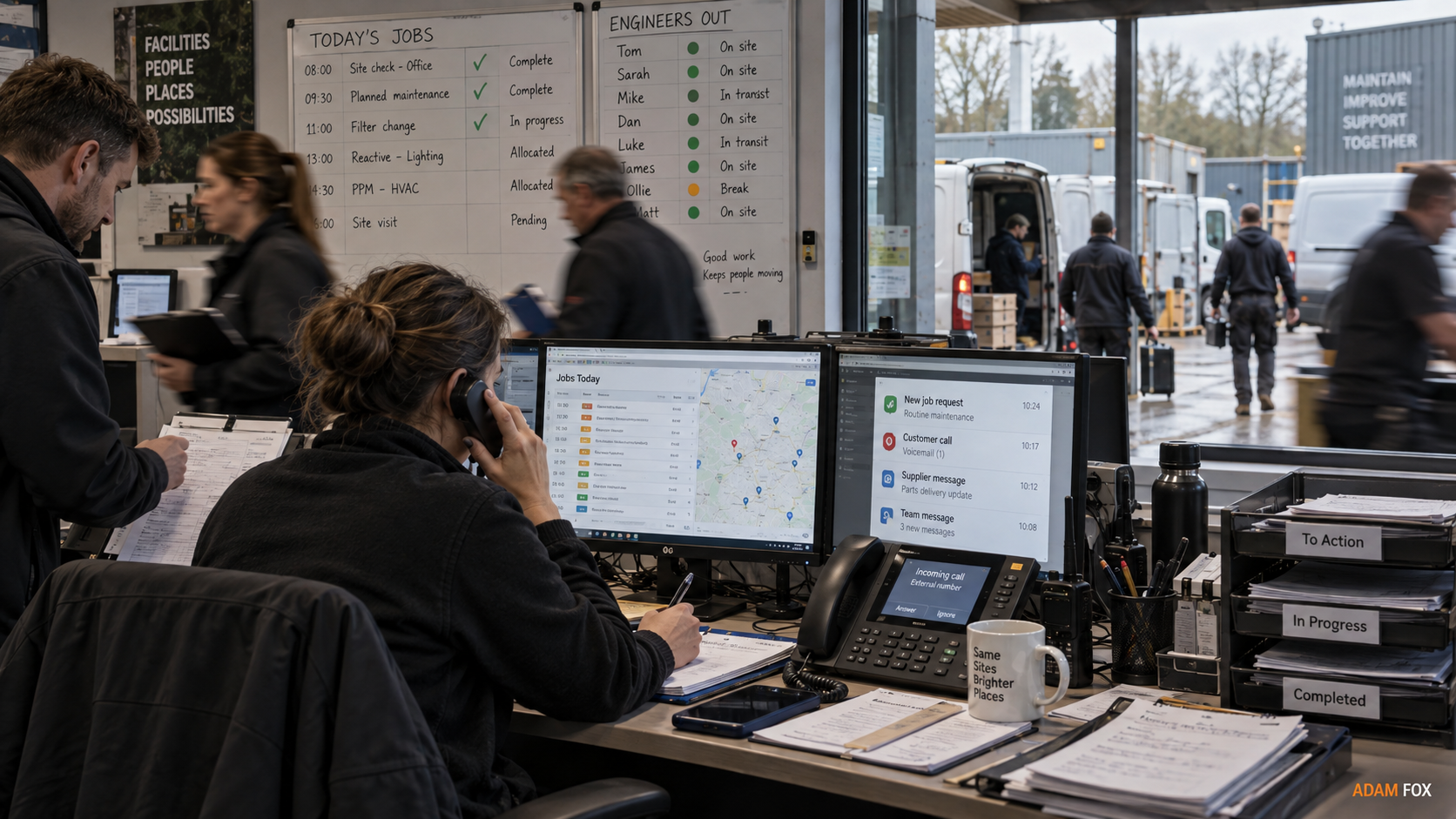
THE COST OF NOW: Why Does Everything Feel Urgent?
There are mornings when nothing is actually wrong.
Nobody is dying.
Nothing is on fire.
No building is collapsing.
No child is missing.
No business is about to disappear.
And yet by 9:17am it somehow feels as though the entire fucking world needs something.
Email.
Message.
Missed call.
Calendar reminder.
Someone chasing.
Someone waiting.
Something due.
Another message marked urgent.
A client asking whether you have had a chance to look at the thing they sent seventeen minutes ago.
A colleague standing beside your desk beginning with:
“Sorry, quick one…”
Your phone hasn't stopped.
Your brain is already three conversations ahead of your body.
And if somebody asks how your day is going, there is a reasonable chance you'll say:
“Absolutely manic.”
But what exactly is the emergency?
Often, there isn't one.
There are just lots of things.
Lots of expectations.
Lots of unfinished loops.
Lots of people carrying their own timelines into yours.
Lots of signals arriving close enough together that your nervous system stops distinguishing between:
This matters now.
and:
This exists now.
I think that distinction explains a huge amount about modern urgency.
We don't simply have more emergencies.
We have become surrounded by things that present themselves with the emotional texture of an emergency.
And once enough of them accumulate, the whole day starts to feel urgent.
Genuine urgency has consequences
Real urgency is surprisingly easy to define.
Something meaningful happens if we don't act quickly.
Safety risk.
Serious financial loss.
A person is harmed.
A legal deadline closes.
A production line stops.
A child needs help.
A critical system fails.
An opportunity genuinely disappears.
Time matters because the consequence changes as time passes.
That's urgency.
Now compare it with:
“I'd really like an answer today.”
Why?
Because I want to close this off.
Different.
“Can you get this over ASAP?”
Why?
Because I've got another meeting.
Different.
“I need this urgently.”
What happens if it's tomorrow?
“Nothing really. I'd just rather have it today.”
Different.
That isn't urgency.
That's preference.
Perfectly legitimate preference.
But preference wearing urgency's clothes.
Modern life has become extraordinarily poor at separating the two.
We have too few words for this
Maybe part of the problem is linguistic.
We use the same language for wildly different situations.
Urgent.
ASAP.
Need.
Important.
Priority.
Quick.
Now.
One person says:
“I need this today.”
Meaning:
“If we don't submit by 5pm, we lose the contract.”
Another says exactly the same words meaning:
“I would quite like this off my list.”
The receiver has to discover which version has arrived.
And because uncertainty is uncomfortable, the safest response is often to assume urgency.
Do it.
Reply.
Check.
Move.
That is how preference acquires power.
Not because everyone is deliberately manipulative.
Because we communicate our desired timing without communicating the consequence behind it.
Our brains are already vulnerable to urgency
We've encountered the mere urgency effect earlier in this series.
Meng Zhu, Yang Yang and Christopher Hsee found that people could prioritise objectively lower-value tasks simply because those tasks appeared more urgent.
The shorter completion window itself influenced choice.
Urgency acquired psychological weight beyond the actual outcome.
That matters enormously once you place a human brain inside a modern workplace.
Because workplaces manufacture urgency signals continuously.
Deadlines.
Notifications.
Unread markers.
Incoming messages.
Meetings.
People waiting.
Escalations.
Queues.
Countdowns.
Response-time targets.
A task doesn't need to be especially important.
It just needs a clock attached.
Meanwhile, some of the highest-value things you could do today have no clock at all.
Think.
Plan.
Prevent.
Train.
Reflect.
Exercise.
Rest.
Have an uninterrupted conversation.
Nobody chases you for those.
So the urgent things keep winning.
Eventually they create the sensation that everything is urgent because almost everything visible to you has arrived through an urgency-producing mechanism.
Urgency travels
This is the bit I find most interesting.
Urgency is not contained inside the person who feels it.
It moves between people.
There was a fascinating experiment published in Human Factors involving 312 participants working in a simulated clinical-team environment.
Researchers examined how people decided whether to interrupt someone else and how recipients decided whether to accept the interruption.
One finding was particularly relevant here.
People became more likely to accept an interruption as the other person's time pressure increased relative to their own.
In other words, the interrupter's urgency influenced the receiver's decision about what deserved attention.
That makes perfect sense.
If you walk calmly into my office and say:
“When you get a chance, could you look at this?”
I evaluate it one way.
If you rush in and say:
“Adam, I really need you right now.”
I evaluate it differently.
Your emotional state has become information.
Maybe correctly.
Maybe not.
But suddenly your time pressure is influencing my priorities.
This is how urgency propagates through organisations.
Someone becomes late.
They hurry the next person.
The next person senses the pressure and interrupts someone else.
That person reprioritises.
Another task slips.
Now somebody else becomes urgent.
Pressure moves through the system like electricity.
The original cause can disappear entirely.
All that remains is a building full of people moving quickly.
One person's urgency can become everybody's physiology
This isn't only metaphorical.
Human stress is socially transmissible.
A 2024 randomised controlled experiment investigated what happens when people directly observe another person undergoing a stressful experience.
Observers showed measurable physiological stress responses of their own.
The reaction was smaller than experiencing the stress directly, but observing someone else's stress could still activate major physiological stress systems.
Again, we should not leap from a laboratory stress paradigm to:
“Your stressed manager is literally poisoning you.”
That's nonsense.
But the broader point matters.
Humans read each other.
Tone.
Speed.
Facial expression.
Movement.
Language.
Urgency is communicated through more than deadlines.
You can feel it when someone enters a room.
Now place that effect inside a team.
Research published in 2024 examined 237 professional-services employees nested within 41 teams and found team-level emotional contagion influenced the relationship between individual work stress and wellbeing.
The researchers argue that stress and wellbeing should not be treated solely as individual phenomena because team dynamics matter too.
That is something every workplace recognises without needing a research paper.
One calm leader can change a room.
So can one frantic one.
The frantic manager
We've all met this person.
Everything is urgent.
Every email requires immediate attention.
Every customer request is escalated.
Every problem is discussed at speed.
Every deadline is described dramatically.
They walk fast.
Talk fast.
Interrupt.
Change direction.
Ask whether things are finished.
Ask again.
Their emotional state becomes the operating tempo of everyone around them.
Sometimes they are incredibly hardworking.
Often they care enormously.
They may genuinely believe they are driving performance.
But if the person with the most authority treats everything as urgent, nobody beneath them has permission to decide that something can wait.
That is how urgency becomes culture.
Not through policy.
Through behaviour.
If the managing director replies immediately to every email, constantly asks for updates and reacts visibly to delay, people learn the temporal rules.
Move.
Respond.
Don't leave things.
Be available.
Now imagine the same leader remains calm.
Distinguishes actual emergencies.
Says:
“Tomorrow is fine.”
Protects concentration.
Doesn't confuse silence with inactivity.
Doesn't create artificial deadlines.
Their team learns something completely different.
Leaders don't merely allocate work.
They teach people how quickly the organisation believes life should happen.
Organisations can develop an urgency culture
There is early research directly examining this.
A 2025 Academy of Management paper studied what the researchers call organisational temporality around urgency.
Using three-wave data from 358 full-time employees, they found organisational urgency was associated with employees deferring recovery in favour of additional work behaviours.
They also identified attentional tunnelling as a mechanism through which urgency appeared to undermine recovery.
This is preliminary conference research rather than a mature body of replicated evidence, so we shouldn't overstate it.
But the concept is incredibly useful.
An organisation can develop an implicit answer to:
How quickly should things happen here?
And once that answer becomes:
Immediately.
Immediately.
Immediately.
the environment itself changes.
People stop evaluating individual demands properly.
Urgency becomes the default setting.
When everything is urgent, judgement gets outsourced to noise
This is one of the biggest problems.
If everything is labelled urgent, people stop prioritising by consequence.
They prioritise by intensity.
Who is chasing hardest?
Which deadline is closest?
Which notification is newest?
Which customer sounds angriest?
Which manager is standing nearest?
Which problem is currently loudest?
That is not strategic prioritisation.
It is stimulus management.
And it can produce bizarre outcomes.
A trivial issue gets solved immediately because someone keeps asking.
A significant long-term risk remains untouched because nobody is chasing.
A loud customer jumps the queue ahead of a quiet one with a genuinely more serious problem.
A manager spends two hours responding to messages while avoiding thirty minutes of thinking that could remove the cause of half the messages.
Activity increases.
Judgement deteriorates.
Time pressure changes the way we think
Research into high-risk decision-making gives us reason to care about that.
A systematic review of 32 empirical studies examining trained professionals in areas including healthcare, aviation, firefighting, military work and oil installations found that time pressure, stress and uncertainty significantly shape decision strategies.
Under greater pressure, people may rely more heavily on rapid recognition-based approaches, while more analytical strategies are more common where time pressure is lower and people have greater opportunity to consider alternatives.
That is not necessarily bad.
If you're an experienced firefighter confronting something you've seen fifty times, rapid recognition can be exactly what you need.
The problem is treating routine knowledge work as though the building is burning.
Strategy benefits from alternatives.
Complex problems benefit from exploration.
Creative work benefits from wandering slightly.
Difficult decisions sometimes need the sentence:
“Let me think about that.”
Urgency tends to hate that sentence.
Perceived time pressure can matter even when time is available
This is where things get slightly absurd.
You don't necessarily need to be objectively short of time for time pressure to change your behaviour.
Classic experiments on what researchers called the hassled decision maker found that people who perceived themselves to be under time pressure generated fewer objectives, considered fewer alternatives and evaluated fewer consequences, even in settings where the time constraint did not necessarily make considered thought impossible.
The perception changes the process.
That means manufactured urgency can potentially produce some of the same cognitive narrowing as genuine urgency.
Tell people:
“We need to move quickly.”
And they do.
Sometimes that's useful.
But if there was no real reason to move quickly, you may have voluntarily purchased worse thinking.
Time pressure itself isn't uniformly harmful
We need the usual nuance.
Some people thrive under moderate pressure.
Deadlines can mobilise.
Urgency can cut through indecision.
Teams in genuinely time-sensitive situations can become highly focused.
A 2024 meta-analytic review specifically noted that research on time pressure and workplace outcomes has produced inconsistent conclusions rather than one universal effect.
Different levels of pressure, different jobs, different individual traits and whether pressure is experienced as a challenge or hindrance can all matter.
So the aim isn't to remove urgency.
That would be stupid.
The aim is to make urgency scarce enough to retain meaning.
A fire alarm works because it doesn't ring every twelve minutes to remind you that Sandra wants the spreadsheet.
We create urgency because it works
This is the uncomfortable bit.
Why do people mark things urgent?
Because urgent things get attention.
Why chase?
Because chasing works.
Why interrupt?
Because interruptions can move your problem up somebody else's queue.
Why send “ASAP”?
Because “whenever you have time” might mean Thursday.
Urgency is a resource-allocation strategy.
If I can make my need feel immediate enough, I improve the chance that your attention moves towards me.
This doesn't require conscious manipulation.
Often we're simply expressing how important something feels to us.
But that is exactly how urgency inflation develops.
If ordinary requests keep losing to urgent ones, ordinary requests begin adopting urgent language.
Then genuinely urgent requests need stronger language still.
URGENT.
URGENT PLEASE.
ACTION REQUIRED.
IMMEDIATE ACTION REQUIRED.
Suddenly we're in the linguistic equivalent of everyone driving with their horn permanently pressed.
The signal loses meaning.
We've created urgency inflation
This is perhaps the closest parallel.
Money loses purchasing power when too much is created.
Urgency loses attentional power when everything claims it.
The organisation responds by creating stronger urgency signals.
Escalation.
Red flags.
Priority one.
Executive escalation.
Critical.
High priority.
Then those become normal too.
Eventually the only way to get ordinary work done is to make it appear exceptional.
That's a broken system.
Because genuine emergencies now have to compete with emotionally enhanced administration.
The entire organisation becomes less capable of distinguishing what truly deserves rapid action.
Technology makes urgency extremely cheap to create
Historically, urgency had friction.
If you wanted to interrupt someone, you had to physically find them.
Or ring them.
There was a moment where you might think:
Do I really need to bother them?
Now:
Teams.
Slack.
WhatsApp.
Email.
Text.
Notification.
Mention.
Tag.
Task assignment.
Calendar invite.
One tap.
I can transfer my thought into your attention almost instantly.
The cost to the sender is tiny.
That asymmetry matters.
It is easier than ever to create urgency for somebody else.
And because communication is so cheap, we communicate more.
Every communication can contain a request.
Every request can contain timing.
Every timing expectation becomes another potential urgency signal.
We have industrialised the ability to say:
Think about this now.
There is a huge difference between speed and panic
High-performing organisations can move quickly without behaving frantically.
That distinction is vital.
Speed can come from:
clear ownership,
good systems,
prepared people,
fast information,
simple decisions,
appropriate authority,
strong communication,
technology,
practice.
Panic usually comes from:
uncertainty,
poor planning,
dependency,
fear,
lack of information,
conflicting priorities,
late decisions.
They can produce similar visible movement.
But the underlying systems are completely different.
This matters because organisations often mistake franticness for responsiveness.
Everyone rushing must mean everyone cares.
Not necessarily.
It might mean the system is shit.
Calm people can be incredibly fast
I have seen this repeatedly in genuinely competent environments.
Something serious happens.
The best person in the room does not necessarily become the loudest.
They become clearer.
What's happened?
What matters?
Who owns what?
What do we know?
What don't we know?
What happens next?
That's urgency with judgement intact.
Compare that with manufactured urgency.
Five people talking.
Three people emailing.
Someone calling for updates every ten minutes.
People duplicating effort because nobody knows who owns it.
Now everybody looks incredibly busy.
The problem isn't moving any faster.
Urgency without clarity creates activity.
Not necessarily progress.
We sometimes use urgency to avoid deciding what matters
This is another reason everything feels urgent.
Proper prioritisation requires exclusion.
If I say:
“This is the most important thing today,”
I am also saying:
“These other things are not.”
That's uncomfortable.
Someone may be disappointed.
Something may remain unfinished.
An email may sit unanswered.
A customer may wait.
So rather than choosing, we try to do everything quickly.
Urgency becomes an alternative to prioritisation.
Everything matters.
Everything now.
Run faster.
That feels fair because nobody's demand has been explicitly rejected.
It is also impossible.
Human capacity eventually performs the prioritisation anyway.
Through lateness.
Errors.
Exhaustion.
Forgotten commitments.
Or whichever demand screams loudest.
There is no such thing as avoiding prioritisation.
There is only deciding deliberately or allowing pressure to decide for you.
Anxiety can disguise itself as urgency
I think some modern urgency has very little to do with external consequence.
It is internal discomfort.
I sent the email.
Why haven't they replied?
I made the decision.
Has it worked?
I ordered something.
Where is it?
I delegated the task.
Is it done?
I asked the question.
I want the answer.
Waiting creates an unresolved loop.
Resolution feels good.
So we chase.
Not necessarily because anything bad happens if we wait.
Because we don't like the feeling of not knowing.
This is where urgency becomes emotional regulation.
I move the other person faster so I can stop feeling uncertain.
That's worth noticing.
Because it changes the moral equation.
What looks like:
“I need this urgently”
may actually mean:
“I would like you to act quickly so I can feel better.”
Again, perfectly human.
But that's a request.
Not an emergency.
Parents do this too
This isn't only about work.
“Shoes on. Come on. We're going to be late.”
Sometimes we genuinely are.
Sometimes we're forty minutes early and I've somehow decided everyone should move as though airport security closes in ninety seconds.
Families transmit tempo.
One person becomes stressed.
Talks faster.
Children move slower because now everyone is annoyed.
Stress increases.
Someone can't find a shoe.
Now we genuinely might be late.
Brilliant.
We manufactured the exact emergency we were worried about.
The social-contagion research matters here even though workplace studies should not be casually generalised to family life.
Humans respond to one another's emotional states.
We set tempo together.
A rushed household feels different from a calm one even if both leave the house at exactly the same time.
Urgency leaks between domains
Work stress doesn't necessarily remain at work either.
Research examining time-related work stress has linked tight deadlines and time pressure with poorer perceptions of work climate and with work concerns spilling into life outside work.
Again, nothing surprising.
You leave work physically.
But the deadline comes home.
Now you are shorter with people.
Checking messages.
Thinking ahead.
Moving faster.
The urgency generated in one system changes the emotional tempo of another.
This is one reason I care so much about this subject.
The cost of bad work design isn't confined to the employee.
Families can experience the leftover pressure.
Not always dramatically.
Sometimes just as a person who is technically home but still moving at work speed.
Urgency postpones recovery
This is where the emerging organisational-urgency research is particularly interesting.
If your environment consistently communicates that there is more to do now, recovery becomes easy to postpone.
I'll stop after this.
Reply to that first.
Just finish this.
Clear those.
Then I'll relax.
The problem is the queue never completes.
The 2025 Academy of Management study I mentioned earlier found organisational urgency associated with employees deferring recovery while engaging in extra work, with attentional tunnelling helping explain the relationship.
That feels important because recovery rarely arrives with urgency attached.
Nobody gets:
CRITICAL: SIT DOWN AND DO FUCK ALL FOR AN HOUR.
Rest is one of those quiet important things.
Which means urgency can continually defeat it.
Until the body eventually creates an urgent reason to stop.
Maybe that's why burnout feels sudden when it often isn't
Burnout can appear externally like an event.
Person coping.
Person coping.
Person coping.
Person no longer coping.
But the conditions can accumulate for a long time.
Demand.
Insufficient recovery.
Low control.
Persistent pressure.
Work bleeding into non-work.
The final moment may be dramatic.
The process often isn't.
This was part of what I eventually had to confront in my own working life.
For years, being the fixer meant urgency kept finding me.
I responded.
Solved.
Absorbed.
Kept going.
The fact that I could repeatedly cope with the immediate thing hid the cumulative cost of living inside an environment where something always needed dealing with.
Nothing had to be catastrophic on its own.
There simply had to be no meaningful end to the demands.
The problem isn't that modern life contains urgency
It should.
Urgency is information.
When used properly, it tells us:
Stop.
This matters more.
Attend here.
That's incredibly valuable.
The problem is signal pollution.
Too many things claiming the same status.
Too many people exporting their time pressure.
Too many systems rewarding immediate response.
Too many notifications converting arrival into demand.
Too many organisations treating capacity as infinite.
Too many of us relieving our own anxiety by creating haste for somebody else.
The alarm keeps ringing.
Eventually we stop asking what the alarm means.
We just run.
The cure is not moving slowly
I keep returning to this because I don't want the series misunderstood.
Slow is not automatically good.
Fast is not automatically bad.
I want ambulances fast.
I want dangerous product faults escalated immediately.
I want a client to tell me quickly if I've made a serious mistake.
I want urgent problems treated urgently.
What I want less of is fake equivalence.
A customer preference is not a safety issue.
A manager's anxiety is not a deadline.
A message arriving is not a command.
A problem being uncomfortable is not the same as it being consequential.
A person asking twice does not make something twice as important.
A red flag in software does not alter reality.
Urgency should describe the consequence of delay.
Not the emotional volume of the person requesting action.
We could ask one question
Perhaps organisations need a ridiculously simple test.
Whenever something is described as urgent:
What happens if this waits?
Not rhetorically.
Actually answer it.
What happens in ten minutes?
An hour?
Tomorrow?
If the answer is:
Someone gets hurt.
We lose the opportunity.
Production stops.
We breach something important.
A serious problem gets materially worse.
Fine.
Urgent.
If the answer is:
The client might prefer it.
The manager will feel more comfortable.
I'd like it cleared.
It would be convenient.
Someone might chase.
That's useful too.
But now we know what category we're actually dealing with.
Then ask where the urgency came from
Second question:
Why are we short of time?
Unexpected event?
Fine.
External deadline moved?
Fine.
Genuine crisis?
Fine.
Or:
late decision,
poor planning,
overloaded system,
insufficient staffing,
someone forgot,
someone procrastinated,
someone promised too much,
someone wants certainty?
The answer matters because otherwise every urgency gets treated at the point of impact.
We run faster.
And learn nothing.
Urgency needs a cost
At the moment, declaring something urgent is often free.
I can say:
“Need this today.”
You pay.
Your plan moves.
Your concentration breaks.
Your workload compresses.
What if urgency had to acknowledge the trade?
“This needs moving ahead of X because Y happens if we don't.”
Now we're making a decision.
Something else will wait.
That's important.
Because prioritisation always has a cost.
If this becomes first, something stops being first.
Organisations get into trouble when they pretend adding an urgent job changes the laws of arithmetic.
It doesn't.
Ten hours of work plus another urgent two hours still equals twelve hours of work.
Labelling the extra two “urgent” does not create hours eleven and twelve.
Calm is not the absence of ambition
This deserves saying because urgency culture often treats calmness with suspicion.
If you aren't rushing, do you care?
If you don't reply immediately, are you committed?
If your diary contains space, are you busy enough?
If your team isn't constantly stretched, are they productive?
We've somehow associated visible pressure with seriousness.
But perhaps calmness can be evidence that a system is working.
People know priorities.
Capacity roughly matches demand.
Emergencies stand out.
Employees can think.
Customers know what to expect.
Leaders don't export their anxiety.
There is slack for reality.
That is not laziness.
That's design.
Everything feels urgent because we've trained it to
There is no single villain here.
Technology made communication immediate.
Businesses competed on speed.
Customers adapted.
Employers increased responsiveness.
Employees demonstrated availability.
Managers chased.
Workers responded.
Notifications filled the gaps.
We rewarded the people who rescued problems.
Poor planning became rush work.
Faster systems raised expectations.
Then AI arrived and gave us the ability to make parts of the whole thing faster again.
Nobody sat down and designed this outcome.
We created it together.
Bit by bit.
One reasonable decision at a time.
Which means perhaps we can create something different the same way.
The first change is discrimination
Not discrimination between people.
Between demands.
This is urgent.
This is important but not urgent.
This is useful.
This is merely preferred.
This is somebody's anxiety.
This can wait.
This shouldn't be done at all.
Those categories matter.
Without them, everything joins one enormous queue of now.
And once everything becomes now, your attention is no longer being directed by importance.
It is being directed by whoever has become most effective at creating urgency around their request.
There will always be bells
That's the thing.
The world will not become quiet.
Customers will need things.
Children will interrupt.
Colleagues will ask.
Technology will notify.
Problems will occur.
People will be late.
Emergencies will happen.
The goal isn't to prevent demands.
It is to stop giving every demand the same temporal status.
Because a society in which everything feels urgent has not necessarily become more important.
It may simply have lost its ability to distinguish importance from immediacy.
And if everything is an emergency, eventually one of two things happens.
We live permanently as though we're responding to disaster.
Or we stop believing the alarm.
Neither is particularly useful.
Maybe the answer isn't learning to move faster.
Maybe it's becoming much harder to convince that everything deserves now.
Sources And Further Reading
Meng Zhu, Yang Yang and Christopher K. Hsee, “The Mere Urgency Effect”, Journal Of Consumer Research (2018).
Across five experiments, researchers found that people could prioritise lower-value tasks over objectively more valuable alternatives when the lower-value tasks carried spurious urgency, demonstrating that urgency itself can influence task choice independently of objective consequences.
Emma B. Knight, Hector Palada, Andrew Neal, Penelope Sanderson and Timothy Ballard, “Testing A Computational Model Of Interruptions: The Effects Of Time Pressure On Interruption And Response Decisions”, Human Factors (2026).
In an experiment involving 312 participants working in a simulated clinical team, participants were increasingly likely to accept interruptions when the interrupter's time pressure increased relative to their own. The research illustrates how another person's urgency can influence interruption and prioritisation decisions.
Alisa Auer et al., “Is Your Stress My Stress? A Standardized, Randomized-Controlled Paradigm To Study Physiological Stress Contagion Based On Direct Stress Observation”, Psychoneuroendocrinology (2024).
The experiment found that observing another person's stress could induce measurable physiological stress responses in observers, although reactions were less pronounced than first-hand stress exposure.
Aglae Hernandez Grande, Ben Farr-Wharton, Fleur Sharafizad, Simon Darcy and Mihajla Gavin, “Catching On: Work Stress, Employee Wellbeing, And The Moderating Role Of Team-Level Emotional Contagion”, Journal Of Management & Organization (2024).
Using data from 237 professional-services employees nested within 41 teams, the study found support for team-level emotional contagion influencing the relationship between individual work stress and wellbeing, emphasising the collective and social dimensions of workplace stress.
Didar Zeytun and Alicia A. Grandey, “Rush Or Rest: How Organizational Temporality Around Urgency Shapes Recovery”, Academy Of Management Proceedings (2025).
Using three-wave data from 358 full-time employees, this emerging research found organisational urgency associated with deferred recovery and extra work behaviour, with attentional tunnelling identified as a mechanism. As conference proceedings research, it should be treated as preliminary rather than established consensus.
Systematic Review, “Decision-Making During High-Risk Events” (2023).
A review of 32 empirical studies across healthcare, military, fire and rescue, aviation and other high-risk domains found time pressure, stress, uncertainty and experience to be important influences on decision strategy. More analytical approaches tended to appear in environments with less time pressure and explicit encouragement to consider alternatives.
Leon Mann and Charlotte Tan, “The Hassled Decision Maker: The Effects Of Perceived Time Pressure On Information Processing In Decision Making” (1993).
Experiments found that people experiencing perceived time pressure generated fewer objectives and alternatives and considered fewer consequences, helping establish that subjective time pressure itself can alter decision processing.
Yuan Yue, Wu Zhiming and Xie Qiushi, “The Effect Of Time Pressure On Individual Work Outcomes: A Meta-Analytic Review” (2024).
The review notes that decades of research have not produced one simple conclusion about time pressure. Outcomes depend on level and type of pressure, context and other moderating factors, reinforcing the distinction between useful challenge and damaging hindrance.
Rocco Palumbo, Damiano Petrolo and Mohammad F. Manesh, research on time-related work stress and work climate.
The research examines how tight deadlines and time pressure can influence perceptions of workplace climate and contribute to work concerns extending beyond the workplace into personal life.
Research Gaps
There is no single agreed academic construct called “urgency culture”.
This essay combines research on time pressure, organisational temporality, emotional contagion, interruptions, work stress and urgency effects. The idea that these combine into a recognisable social or organisational “urgency culture” is a useful synthesis rather than one universally established scientific category.
Genuine urgency and perceived urgency are difficult to separate experimentally.
Real workplaces contain consequences, hierarchy, customer relationships, deadlines and incomplete information. Laboratory studies can manipulate time pressure cleanly, but everyday workers often have good reasons to treat another person's urgency as meaningful.
The 2025 organisational-urgency research is preliminary.
The cited study on organisational temporality around urgency appears in Academy of Management conference proceedings. Its findings regarding deferred recovery and attentional tunnelling are highly relevant but need replication and peer-reviewed development before being treated as settled evidence.
Stress contagion should not be interpreted deterministically.
Research shows that observing or interacting with stressed people can influence observers physiologically or emotionally. This does not mean one stressed colleague automatically produces equivalent stress in everyone around them. Individual differences, relationship, context and organisational support matter.
The interruption study uses a simulated clinical environment.
The finding that recipients were more willing to accept interruptions as the interrupter's time pressure increased is valuable, but safety-critical team communication differs from routine offices, families or commercial businesses. Broader replication would strengthen the argument that urgency commonly propagates between people in other settings.
Time pressure can improve performance under some conditions.
Research does not support the conclusion that all time pressure is harmful. Moderate pressure can increase motivation or focus, particularly when people view it as a challenge and possess sufficient expertise and control. The argument is therefore for discriminating between useful and artificial urgency rather than eliminating pressure.
Emotional tempo in families is discussed primarily by analogy.
The essay suggests that stress and urgency can spread through households, but the workplace emotional-contagion studies cited should not be treated as direct evidence of identical mechanisms between parents and children.
Urgency inflation is a conceptual analogy rather than an established empirical effect.
The suggestion that widespread use of urgency labels causes stronger and stronger signals to be required is plausible and consistent with organisational experience, but direct longitudinal evidence measuring such an escalation was not identified for this essay.
Technology enables interruption but does not force it.
Messaging systems, notifications and digital collaboration tools dramatically reduce the friction involved in contacting other people. Whether that creates unhealthy urgency depends on notification design, organisational norms, individual behaviour and the purpose of communication.
Leadership effects need more direct causal evidence.
There is substantial research showing leaders shape workplace climate and norms, but the specific claim that a leader's personal pace teaches employees to perceive more tasks as urgent would benefit from direct longitudinal or experimental evidence.
Time pressure in high-risk environments differs from routine knowledge work.
Evidence from clinicians, firefighters, pilots and military personnel helps establish how humans make decisions under genuine pressure. Those findings should not automatically be applied to ordinary office deadlines where consequences and expertise differ significantly.
Workplace urgency may reflect real resource shortages rather than cultural behaviour.
Understaffing, unexpected demand, regulatory pressure, supply disruption and economic shocks can create genuinely persistent time pressure. Not every high-urgency workplace could solve the problem through calmer leadership or better communication alone.
Individual anxiety and organisational urgency should not be conflated.
The essay proposes that people sometimes create urgency in others to reduce their own uncertainty or discomfort. This is psychologically plausible, but no direct evidence cited here establishes that this mechanism explains a substantial proportion of everyday urgent requests.