
THE COST OF NOW: When Did Waiting Become Unacceptable?
I grew up waiting for things.
Not because anyone thought waiting was particularly good for me.
It was just how the world worked.
Children's television started at half three and finished at half five.
If I got home at half four because I'd been playing in the park, I had missed an hour of it.
That was it.
There was no catch-up.
No restart.
No recording.
No library containing every episode ever made.
The programme did not care that I had been somewhere else.
It had happened.
I hadn't been there.
Life continued.
If I wanted something from a shop and they didn't have it, I waited.
If someone wasn't home when I called their house, I called again later.
If I wanted photographs developed, I handed over a roll of film and waited to discover whether half of them contained someone's thumb.
If I was bored, there wasn't an object in my pocket capable of producing entertainment within three seconds.
I waited.
Or more accurately, I found something else to do.
None of this made my childhood morally superior.
It wasn't some golden age of human patience.
There were plenty of things about waiting that were fucking annoying.
If you told the twelve-year-old version of me that one day he could tap a screen and have almost anything delivered to his house tomorrow, he wouldn't have delivered a philosophical lecture about the developmental importance of delayed gratification.
He'd have said:
“Brilliant.”
And he'd have been right.
The problem isn't that we stopped waiting for things unnecessarily.
The question is what happened after we learned that we didn't have to.
Because I don't think we've simply reduced waiting.
I think we've changed what waiting means.
A delay that once felt completely normal can now feel like something has gone wrong.
And that is a much more interesting change.
Human beings were never naturally brilliant at waiting
We should probably clear this up first.
Technology did not invent impatience.
Amazon did not invent it.
Smartphones did not invent it.
Human beings have always had a tendency to value sooner over later.
Psychologists study this through something called delay discounting.
Put very simply, the value we place on a reward tends to decline when we have to wait for it.
Would you rather have £50 today or £55 in six months?
Would you rather have the thing now or the slightly better thing later?
There is an enormous body of research examining how people make those choices, and there are substantial differences between people, situations and types of reward. But the underlying preference for immediacy is hardly a modern invention.
That matters.
Because otherwise this essay becomes another lazy argument about how everyone used to have patience until phones destroyed civilisation.
I don't believe that.
What technology has done is far more subtle.
It has repeatedly changed the reference point against which we judge a wait.
We were already impatient.
Then we built a world exceptionally good at satisfying that impatience.
And every time it succeeded, our definition of fast moved.
Fast has a remarkably short shelf life
Amazon Prime provides an almost perfect illustration.
When Prime launched in the United States in 2005, unlimited two-day shipping was presented as something extraordinary.
Amazon itself described it as making two-day delivery an “everyday experience rather than an occasional indulgence.”
In Britain, Prime launched in 2007 with unlimited one-day delivery.
One day.
Think about how extraordinary that would once have sounded.
Order something from your sofa and it appears at your house tomorrow.
Yet by 2025, Amazon reported that more than 1.6 billion UK Prime items had arrived either the same day or the next day, with same-day delivery available on more than a million products across over 80 UK towns and cities.
In parts of London, Amazon now offers fresh groceries alongside other products for delivery within hours.
This is not criticism of Amazon.
Quite the opposite.
It is extraordinary logistics.
Thousands of people, warehouses, systems, vehicles, forecasting tools, distribution networks and pieces of software coordinating so efficiently that I can realise at lunchtime that I need something and potentially have it before dinner.
That's remarkable.
But psychologically, something happens when remarkable things happen often enough.
They stop being remarkable.
Two-day delivery becomes normal.
Then one day.
Then same day.
Then a few hours.
And eventually the interesting question is no longer:
“How can they possibly get this to me tomorrow?”
It becomes:
“Why can't they get this to me today?”
Nothing about the underlying achievement became less impressive.
Our reference point moved.
The wait is partly in our heads
Research into waiting has been telling us this for decades.
The amount of time we objectively wait matters.
Obviously.
Forty minutes is generally more inconvenient than four.
But objective duration is only part of the experience.
Researchers Ad Pruyn and Ale Smidts studied people waiting in Dutch hospital clinics and found that satisfaction was influenced substantially by people's perception and appraisal of the wait, not merely the number of minutes involved.
One particularly important variable was what people regarded as an acceptable waiting time.
Once the wait crossed that internal reference point, emotional responses became much stronger.
That is fascinating.
Because “acceptable” isn't written into physics.
There isn't some universal law stating that eleven minutes is reasonable but seventeen minutes is offensive.
We learn what to expect.
A more recent study published in the Journal of Retailing examined what happens when customers wait for shorter or longer than expected.
Again, expectation mattered enormously.
People responded very positively when the wait was shorter than expected. They could tolerate a wait that ran somewhat longer than expected, but dissatisfaction increased when the discrepancy became substantial.
In other words, we're not simply carrying stopwatches around in our heads.
We are comparing reality with a benchmark.
How long did I think this should take?
And that creates an extraordinary possibility.
You can improve a service dramatically without improving customer satisfaction forever.
Because once customers adapt to the improvement, the improvement becomes the new expectation.
The goalposts move.
Yesterday's miracle becomes today's minimum
Think about broadband.
Remember waiting for a webpage?
Actually waiting.
Watching elements gradually appear.
Click.
Nothing.
Little loading symbol.
Wait.
Image.
More waiting.
Then eventually the whole thing existed.
Now let a website hesitate for a couple of seconds and notice what happens inside your body.
For fuck's sake.
What's wrong with this?
Maybe refresh it.
Perhaps the Wi-Fi has gone.
Perhaps the site is broken.
The timescale that triggers irritation has collapsed.
The same thing happens with communication.
A letter might reasonably take several days to arrive.
An email arrives effectively instantly.
WhatsApp arrives instantly and tells you it arrived.
Then tells you whether it was read.
Sometimes it tells you that the other person is currently composing their response.
Each layer removes uncertainty.
Which is useful.
But it also removes excuses for delay.
Before:
“They probably haven't received it yet.”
Then:
“They've received it.”
Then:
“They've seen it.”
Then:
“They're fucking typing.”
Waiting has become increasingly visible.
And visibility changes the experience.
Perhaps uncertainty is what we really hate
One of the most consistent findings in waiting research is that uncertainty makes waiting worse.
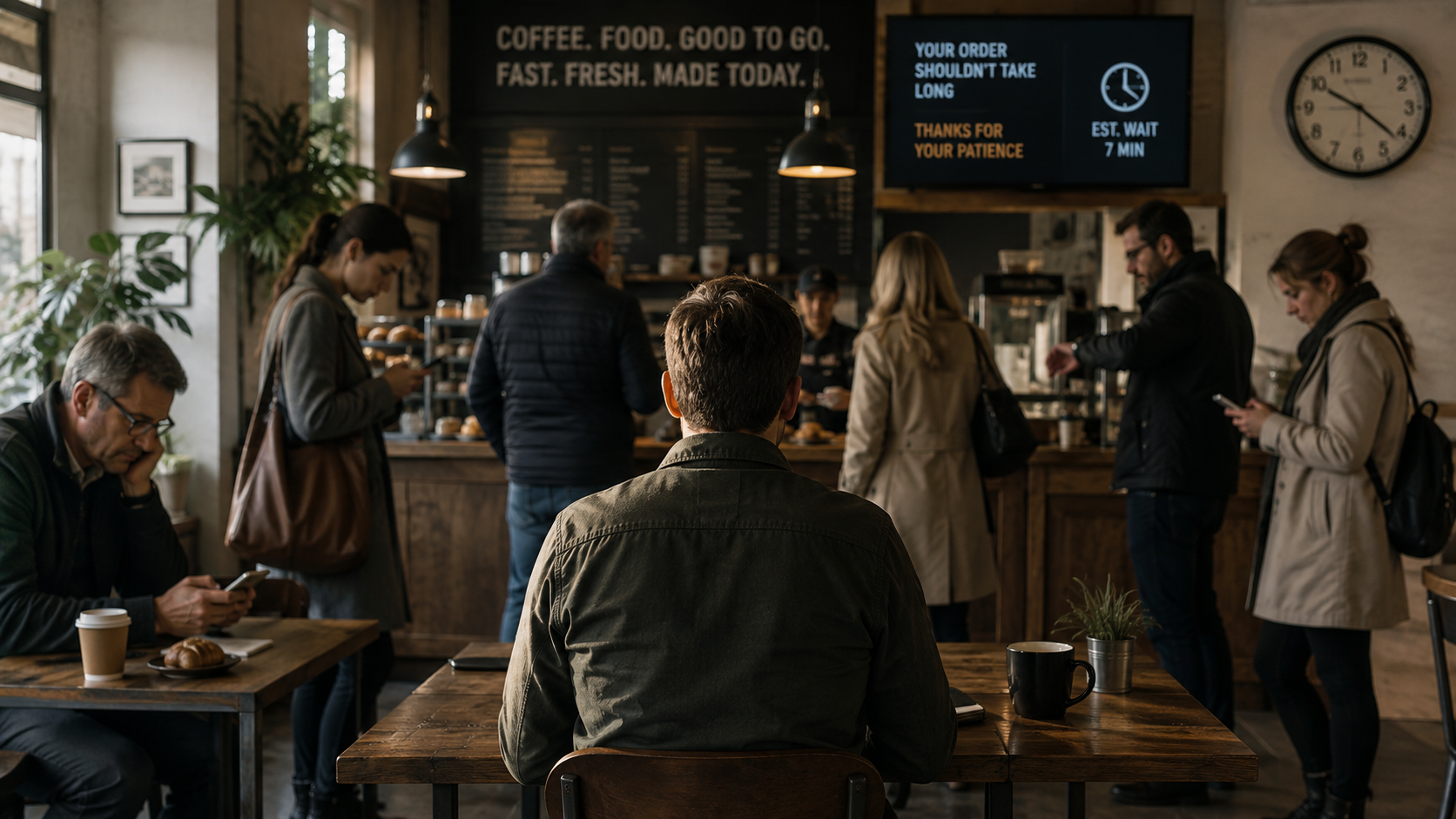
Tell someone there will be a twenty-minute delay and they may be irritated.
Tell them nothing and allow them to stand wondering whether the delay will be five minutes or fifty and the experience can be considerably worse.
Research into service systems has therefore spent years examining how information about delays changes customer behaviour and satisfaction. A review of delay announcements found that providing information can reduce uncertainty and improve customer satisfaction, while also affecting whether people choose to join or abandon queues.
Hospital research has found similar effects.
Patients who understand the likely duration of a wait can adjust expectations, and information about delays can improve satisfaction even though it doesn't magically make the clock move faster.
That's important because it suggests we don't always demand instant results.
Sometimes we demand certainty.
Tell me when.
Tell me you've received it.
Tell me where I am in the queue.
Tell me my parcel is eight stops away.
Tell me the driver is called Steve.
Show me Steve on a map.
Now show me that Steve has somehow been parked outside number 34 for seven fucking minutes.
We have built extraordinary systems for making waiting legible.
And generally, that is useful.
But again there is a secondary effect.
Once uncertainty becomes unusual, we become less comfortable when it returns.
“Your order will arrive at some point next week” sounds almost prehistoric now.
Not necessarily because next week is intolerably far away.
Because some point is intolerably vague.
We used to have dead time
I think this part matters just as much.
When I was growing up, waiting frequently contained nothing.
Nothing.
You stood at a bus stop.
You sat in a waiting room.
You queued.
You waited for your mum to finish talking to someone.
You waited for dinner.
You waited for your mate to come out of his house.
You waited in the car.
You stared out of the window.
Maybe there was a magazine.
Maybe there wasn't.
Now those spaces are fillable instantly.
Phone out.
Scroll.
Message.
Email.
News.
Weather.
Video.
Podcast.
Game.
Anything.
There is virtually no gap so small that technology cannot occupy it.
Again, I'm not convinced that's inherently terrible.
If I have thirty minutes on a train, listening to a podcast is hardly evidence of civilisational collapse.
But there is a difference between choosing to use a gap and becoming unable to tolerate one.
My childhood gave me an enormous amount of unoccupied time simply because the surrounding environment couldn't instantly fill it for me.
Boredom wasn't treated as an emergency.
If I was bored, I eventually generated something myself.
I made things.
Invented games.
Went outside.
Annoyed my brother.
Built ridiculous imaginary worlds.
Boredom forced me to produce rather than merely consume.
That experience became part of how I later came to think about agency.
My attention was mine because relatively little around me had the capability to claim it instantly.
Children today are not biologically different.
But the environment is.
We have built an almost perfect escape route from every tiny period of nothing.
And I wonder whether that changes our relationship with waiting.
Not because waiting automatically builds character.
But because we rarely practise it anymore.
There is some evidence here, but we need to be careful
Studies have found associations between heavier mobile-device engagement and a stronger preference for immediate rewards.
One study involving measures of mobile technology use, impulse control and intertemporal choice found heavier device involvement was correlated with weaker delay of gratification and greater impulsivity.
Follow-up research has explored similar relationships between mobile technology engagement, intertemporal preference and neural connectivity.
It's tempting to jump from that to:
Phones destroy patience.
We shouldn't.
Correlation is not causation.
It could be that naturally more impatient people use their phones differently.
It could be that particular uses of technology reinforce impatience.
It could be reciprocal.
It could depend enormously on age, context, personality, platform and behaviour.
The research itself warns against taking familiar claims about technology creating an “instant gratification generation” as established causal fact.
But I don't actually need phones to have biologically rewired humanity for the larger argument to work.
The social environment has changed regardless.
A world where most delays can be filled, tracked, shortened or avoided is objectively different from one where waiting was unavoidable.
Even if the underlying human animal remains much the same.
Convenience changes the comparison
This is where convenience becomes complicated.
Imagine two restaurants.
Both serve excellent food.
Restaurant A normally brings your meal within fifteen minutes.
Restaurant B normally takes forty.
You visit Restaurant B first.
Forty minutes.
Meal arrives.
Lovely.
A week later, Restaurant A.
Fifteen minutes.
Brilliant.
Then you visit Restaurant A again.
This time it takes thirty.
How does thirty minutes feel?
Objectively, it is still ten minutes faster than Restaurant B.
But that probably isn't the comparison your brain makes.
It compares Restaurant A today with Restaurant A last time.
It feels slow.
That's expectation.
And technology allows this effect to scale across entire industries.
Once one company proves something can be done in twenty-four hours, customers know twenty-four hours is possible.
Competitors adapt.
Then somebody does twelve.
Then four.
The remarkable service doesn't merely attract customers.
It helps redefine what customers believe the category should deliver.
Competition drives improvement.
That is one of the great benefits of markets.
But relentless competition around speed can create an arms race in which nobody is allowed to remain merely good.
Because good yesterday becomes slow tomorrow.
The result isn't necessarily that consumers consciously become nastier or more entitled.
Our benchmarks simply keep moving.
We stopped designing around delay
There was another form of patience that older systems imposed on us.
You had to plan.
If shops closed at five, you needed what you needed before five.
If the bank wasn't open on Sunday, Sunday was not banking day.
If a catalogue order took two weeks, you ordered it two weeks before you needed it.
If you couldn't instantly contact someone, you made arrangements.
The constraint shaped behaviour.
Remove the constraint and behaviour changes.
Again, mostly for the better.
I have absolutely no desire to return to organising my week around whether the bank manager is available.
But when the world becomes increasingly responsive, we can stop building delay into our expectations.
We order later.
Ask later.
Decide later.
Because the system has demonstrated an extraordinary capacity to rescue us.
And then when it cannot, the failure feels like the system's.
Not ours.
“I need it tomorrow.”
When did you know you needed it?
Last Tuesday.
That's interesting.
Perhaps some of our intolerance of waiting isn't simply that businesses have become slower than we expect.
Perhaps we've become worse at leaving room for things to take time.
That thought will matter later in this series when we look at poor planning becoming somebody else's emergency.
Waiting can also be valuable
This is the part I wasn't expecting when I started looking at the research.
Waiting isn't always psychologically destructive.
Sometimes it changes what follows.
Research by Xianchi Dai and Ayelet Fishbach found that under certain conditions, waiting before making a choice could actually increase patience.
People who had already waited sometimes became more willing to choose a larger later reward over a smaller sooner one, partly because the waiting changed their perception of value.
That's interesting because it disrupts the simple story.
Waiting doesn't merely frustrate us.
Context matters.
What we're waiting for matters.
Whether the wait feels fair matters.
Whether we understand it matters.
Whether we chose it matters.
What we do during it matters.
What we expect matters.
There is no scientifically defensible argument that waiting is universally good or universally bad.
Which is exactly why eliminating all of it without thinking may be a mistake.
Some waits are pure waste.
Some are unavoidable.
Some protect quality.
Some create anticipation.
Some force planning.
Some create space.
Some allow us to change our minds.
Some are simply the time reality requires.
We increasingly treat all of those categories as though they are the same thing.
Friction.
And friction must go.
Not everything should be instant
There are things I actively don't want rushed.
I don't want my surgeon incentivised to achieve same-day throughput.
I don't want an engineer approving something safety-critical because the client has become accustomed to instant answers.
I don't want someone giving me important advice before they've thought properly.
I don't want a teacher making an immediate judgement about my daughter because another parent demanded an answer before lunchtime.
I don't want strategy produced at delivery speed.
I don't want research compressed until certainty exceeds evidence.
I don't want meaningful writing produced simply because someone discovered AI can generate 2,000 words in thirty seconds.
There are processes where speed is evidence of excellence.
There are others where time is part of the process.
But when a culture becomes trained to interpret waiting as failure, those distinctions become harder to defend.
The question changes from:
“How long should this reasonably take?”
to:
“How quickly can you possibly do it?”
Those are not the same question.
The first is about judgement.
The second is about maximum velocity.
Maybe we haven't lost patience
Perhaps we've done something slightly different.
Maybe our species isn't dramatically more impatient than it was thirty years ago.
Maybe we have simply recalibrated what counts as a delay.
That explanation fits the evidence more comfortably.
Human beings already preferred sooner.
Businesses became extraordinarily good at supplying sooner.
Consumers rewarded them.
Competitors followed.
Technology removed uncertainty.
Communication became immediate.
Dead time became fillable.
Then each generation of improvement created a new reference point.
A minute started feeling like ten because something else now takes seconds.
A day started feeling slow because tomorrow became normal.
A week became unacceptable because next day became available.
Not everywhere.
Not for everything.
Not for everyone.
But often enough to change the cultural atmosphere.
And that distinction matters because if technology literally destroyed our capacity for patience, the problem is enormous.
If expectations moved, something else is possible.
Expectations can move again.
Perhaps waiting needs a reason
I don't think the answer is deliberately making life slower.
That would be ridiculous.
I'm not going to choose five-day delivery when tomorrow is available simply to cultivate moral fibre.
I'm not going to ask my bank to hold a transfer for three working days so I can reconnect with 1997.
Progress is progress.
But maybe we need to stop treating the absence of maximum speed as evidence that something has failed.
Maybe some things deserve a slightly more generous clock.
Maybe a person not replying immediately isn't ignoring us.
Maybe a business taking two days isn't incompetent.
Maybe being unable to track every stage of a process isn't automatically intolerable.
Maybe waiting twenty minutes without filling every second isn't a problem requiring a solution.
Maybe a child saying “I'm bored” doesn't require an adult to instantly produce entertainment.
Maybe uncertainty can occasionally remain unresolved.
Maybe anticipation has value.
And maybe a world in which everything happens instantly isn't automatically a world with more time.
Because we already know what happens when time is saved.
We fill it.
Then we accelerate the next thing.
Then we reset the expectation.
Then we wonder why we're still rushing.
So when did waiting become unacceptable?
There isn't a date.
There isn't a villain.
There wasn't a meeting.
Nobody woke up one morning and decided we were finished with patience.
We removed one wait.
Then another.
Then another.
Each removal was useful.
Each improvement was rational.
Each innovation made life slightly easier.
Then those improvements accumulated.
And somewhere along the way, the extraordinary became ordinary.
The optional became expected.
The expected became standard.
And sometimes the standard became entitlement.
Waiting didn't disappear.
It changed category.
Instead of being an ordinary feature of life, it increasingly became evidence of inefficiency.
Something to explain.
Something to apologise for.
Something to engineer away.
Perhaps that is the real shift.
Not that we suddenly became incapable of waiting.
But that we stopped believing we should ever have to.
And I wonder what else disappeared with it.
Sources and Further Reading
Schubert, Teresa. “Delay discounting across contexts.” Nature Reviews Psychology (2022).
Useful overview of intertemporal choice and the established human tendency to discount delayed rewards.
Bailey, Allison J. et al. “The problems with delay discounting: a critical review of current practices and clinical applications.” Psychological Medicine (2021).
A useful caution against oversimplifying delay discounting or treating it as a single straightforward measure of impatience.
Pruyn, Ad and Ale Smidts. “Effects of waiting on the satisfaction with the service: Beyond objective time measures.” International Journal of Research in Marketing (1998).
Research showing the importance of perceived waiting time, acceptable waiting time and the experience of the waiting environment rather than objective duration alone.
Giebelhausen et al. “The clock is ticking, or is it? Customer satisfaction response to waiting shorter vs. longer than expected during a service encounter.” Journal of Retailing (2023).
Evidence that expectations provide an important reference point for customers evaluating waits.
Ibrahim, Rouba. “Sharing delay information in service systems: a literature survey.” Queueing Systems (2018).
Review of research examining how information about expected delays can reduce uncertainty and affect satisfaction and customer behaviour.
Wilmer, Henry H. and Jason M. Chein. “Mobile technology habits: patterns of association among device usage, intertemporal preference, impulse control, and reward sensitivity.” Psychonomic Bulletin & Review (2016).
Found associations between greater mobile technology engagement, weaker delay of gratification and greater impulsivity, while not establishing that device use causes impatience.
Dai, Xianchi and Ayelet Fishbach. “When waiting to choose increases patience.” Organizational Behavior and Human Decision Processes (2013).
Evidence that under some conditions waiting itself can increase subsequent patience, demonstrating that waiting does not have one simple psychological effect.
Amazon UK historical and current delivery information.
Amazon Prime launched in Britain in 2007 with unlimited one-day delivery. Amazon reported in 2026 that 1.6 billion UK Prime items arrived same day or next day during 2025, with same-day delivery available across more than 80 towns and cities. These figures illustrate the dramatic acceleration of delivery capability, but do not themselves demonstrate a causal effect on consumer psychology.
Adam Fox, Before They're Hooked author biography and lived-experience reference material.
Source material for the childhood descriptions of scheduled television, boredom, self-directed play and the idea that attention once contained far fewer external claims.
Research Gaps
There is no defensible date when waiting “became unacceptable”.
The historical progression described in this essay is cumulative rather than a claim that one company, technology or event created modern impatience. A fuller historical treatment would need to examine earlier accelerations including railways, telegraphy, telephones, air travel, supermarkets, credit systems and other technologies long before smartphones or ecommerce.
Evidence that technology directly causes reduced patience remains limited and mixed.
There are correlations between patterns of mobile-device use, impulsivity and delay discounting, but these do not establish direction of causation. More impatient people may use technology differently, technology may influence impatience, or both may interact.
Consumer expectation is difficult to separate from genuine service improvement.
Faster delivery and communication often provide real economic and practical benefits. Research showing that expectations adapt does not demonstrate that increasingly rapid service is socially harmful overall.
Most waiting research examines bounded service environments.
Hospitals, queues, telephone services and retail encounters provide relatively measurable waiting situations. More research would be needed before assuming that identical psychological mechanisms govern waiting for messages, relationships, career progression, creative work, children, long-term goals or everyday boredom.
The developmental effect of reduced everyday waiting remains uncertain.
It is plausible that children growing up with fewer unavoidable periods of boredom and delay encounter different opportunities to practise self-generated attention and patience. However, the autobiographical comparison in this essay should not be treated as evidence that contemporary children have universally poorer patience or agency.
Waiting can involve inequality and exclusion as well as patience.
Long waits for healthcare, government services, transport, housing or essential support are not merely opportunities to develop tolerance. They can impose substantial costs, particularly on people with the least control over their time. Future treatment of waiting should distinguish optional friction from delays created by scarcity, underinvestment or unequal power.
Cultural differences require further examination.
Expectations about queuing, punctuality, customer service and acceptable delays vary significantly across countries and social contexts. Much of the research cited here comes from Western consumer and service environments and should not automatically be universalised.
The labour required to create instant service sits largely outside this essay.
Faster consumer fulfilment requires logistics, staffing, warehousing, scheduling and increasingly complex systems behind the scenes. The consequences for the people whose labour creates our convenience belong primarily in the later essay “Convenience Has a Human Cost.”