
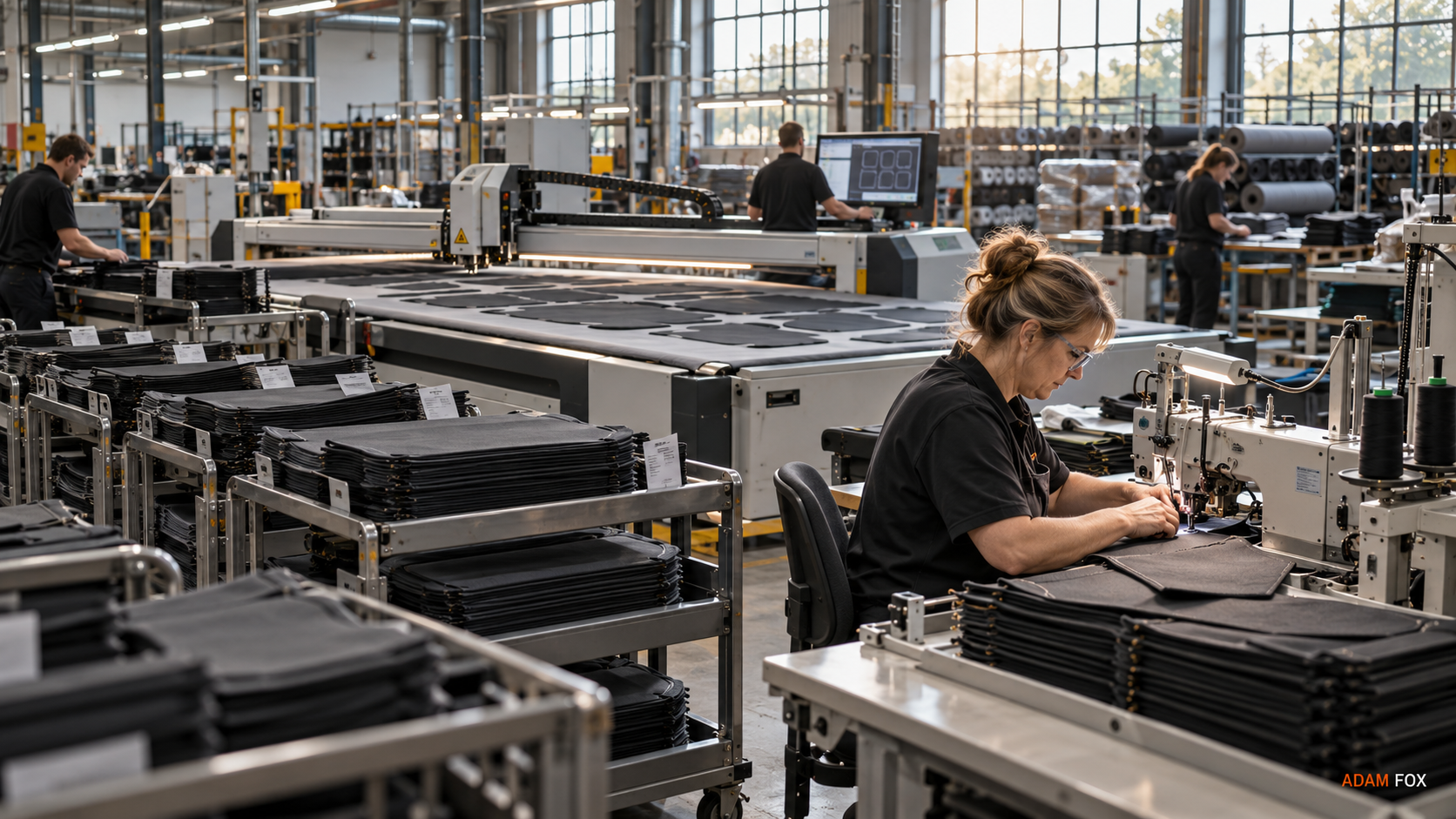
THE COST OF NOW: The Faster We Go, The Less Time We Have
We have spent centuries inventing things to save time.
Washing machines.
Dishwashers.
Cars.
Planes.
Microwaves.
Computers.
Email.
Online banking.
Sat-nav.
Search engines.
Smartphones.
Automation.
Every generation gets handed technologies that make things quicker than they were before.
And every generation appears to reach approximately the same conclusion.
I haven't got enough fucking time.
That is an extraordinary achievement when you think about it.
Something that once took an afternoon now takes twenty minutes.
Something that took twenty minutes now takes thirty seconds.
Something that required travelling somewhere can be done from the sofa.
Something that required three people can be automated.
Something that took two days can happen instantly.
Yet nobody seems to be wandering around marvelling at the vast empty spaces now appearing in their diary.
We saved the time.
Where did it go?
I think the answer is uncomfortable.
We didn't lose it.
We spent it.
And then, once we'd proved that more could fit into the same hour, we started treating the additional capacity as normal.
Imagine I give you an hour back
Suppose something you do every day takes two hours.
Technology arrives and reduces it to one.
Brilliant.
You have gained an hour.
What happens next?
There are several possibilities.
You finish work an hour earlier.
Go for a walk.
Read.
See your children.
Cook properly.
Exercise.
Sit in the garden.
Do absolutely nothing.
That would be a genuine time saving.
The task got faster.
Your life got slower.
But there is another possibility.
You do two of them.
Now output doubled.
No time was saved.
Productivity increased.
Or perhaps you do the original task and then fill the spare hour with something else.
Another meeting.
Another client.
More admin.
More communication.
More work.
Again, the technology performed exactly as promised.
It saved an hour.
We simply didn't keep it.
That distinction sits at the centre of almost everything I write about productivity.
Efficiency does not automatically produce freedom.
It produces capacity.
What happens to the capacity is a separate decision.
And modern organisations are extremely good at finding uses for capacity.
Hartmut Rosa saw the paradox
The sociologist Hartmut Rosa developed one of the most influential theories of social acceleration.
He distinguishes between several connected forms of acceleration.
Technological acceleration: things such as transport, production and communication getting faster.
Acceleration of social change: technologies, institutions, relationships and expectations changing more rapidly.
And acceleration in the pace of life: attempting to perform more actions and experiences within the same period.
The paradox is obvious.
Technological acceleration should theoretically reduce the time required to perform tasks.
Yet modern people can still experience time scarcity.
Why?
Because the number of things performed or expected within the available time can increase faster than the time saved.
Researchers testing Rosa's framework in working life found that employees in office and aviation-service settings could meaningfully distinguish between demands relating to technological acceleration, changing social expectations and an increasing pace of work.
That doesn't prove every human life everywhere is objectively accelerating.
We'll come back to that because newer evidence complicates the picture.
But Rosa gives us an extremely useful question:
What if the problem is not that tasks take too long, but that every improvement in speed increases the amount we expect to do?
That feels uncomfortably familiar.
Email is probably the perfect example
Imagine running a business in 1985.
You need to send information to ten clients.
Letters.
Type them.
Print them.
Put them in envelopes.
Address them.
Stamp them.
Post them.
Wait.
The physical friction naturally limits how much communication you produce.
Email destroys almost all of that friction.
Brilliant.
Sending ten messages takes minutes.
So what happens?
We do not generally continue sending ten communications and then use the remaining afternoon for quiet contemplation.
We send dozens.
Receive dozens.
Copy more people in.
Forward.
Reply.
Reply all.
Follow up.
Chase.
Attach.
Clarify.
Schedule.
Invite.
Remind.
The cost of each communication collapsed.
So the volume communication systems could sustain exploded.
This is a recurring pattern.
Reduce the cost of an action and people often perform more of the action.
The technological improvement is real.
So is the increased demand it enables.
Faster creates a new definition of normal
This is where the previous essays in this series connect.
If a report once took three days and software allows it to be completed in one, one day initially feels extraordinary.
Then someone plans around one day.
Now it isn't extraordinary.
It's the expected turnaround.
Eventually someone creates a process that completes it in four hours.
Excellent.
Until four hours becomes expected too.
Time-saving innovations tend to arrive as advantages.
Then the surrounding system adapts.
The advantage becomes capacity.
Capacity becomes expectation.
Expectation becomes workload.
And once expectation changes, going back becomes extremely difficult.
You cannot easily tell a customer:
“We've decided to return to our 2004 delivery speed because everyone needs to chill out.”
Competition doesn't work like that.
Nor do organisations.
Once speed becomes technically possible and commercially valuable, it becomes very difficult not to use it.
There is a name for the broader problem: intensification
Work does not need to become longer to become more demanding.
You can keep exactly the same working day and increase the amount happening inside it.
That is work intensification.
A systematic review published in 2024 examined 74 quantitative studies from literature spanning 1989 to 2022.
The authors found work intensification commonly conceptualised through factors including increased workload, longer hours and greater time pressure, with a substantial body of research connecting intensified demands to both positive and negative organisational and employee outcomes.
The important point for this essay is simple.
You don't need to add hours to make work bigger.
You can increase density.
More activity.
More decisions.
More communications.
More outputs.
Fewer gaps.
Faster transitions.
The clock remains unchanged.
The experience inside it doesn't.
Ten hours spent doing six substantial things is not psychologically identical to ten hours spent doing sixty fragmented things.
Quantity of time is only part of the story.
There is also the density of demands inside it.
Digitalisation can save time and intensify work simultaneously
This sounds contradictory until you experience it.
A technology saves ten minutes from one process.
Excellent.
Then the organisation tightens the schedule because the process is now ten minutes faster.
The employee does not receive ten minutes.
The workflow does.
Recent qualitative research from Denmark's public employment services looked specifically at technologies introduced with the intention of saving frontline workers time.
The researchers found that supposedly time-saving digital systems could also reinforce tight schedules and require workers to continuously adjust their rhythms as technological time savings and delays interacted with the unpredictable reality of human service work.
That is such an important distinction.
A system can save time at the task level while simultaneously increasing pressure at the job level.
Those statements are not contradictory.
The software genuinely made something quicker.
Management genuinely filled the resulting gap.
Both happened.
We have confused faster with free
This may be the biggest mistake.
A minute saved is not automatically a minute liberated.
It is simply a minute no longer required for the original activity.
Someone then decides what the minute becomes.
At home, perhaps you decide.
At work, maybe your employer does.
In business, perhaps the market does.
Sometimes the customer does.
Sometimes habit does.
Sometimes another piece of technology immediately occupies it.
That is why the phrase time-saving technology is slightly misleading.
Technology cannot really save time for you.
It can reduce the duration of an activity.
Whether that becomes free time is a behavioural, economic and cultural question.
There is actual research into what has been called a time rebound effect.
A 2022 study using Japanese household data examined what happened when time-saving goods and services released time from particular household activities.
The researchers found evidence that some saved time was subsequently used on other activities. The measured rebound in their energy-focused model was relatively small, but the principle is important: reducing the time required for one activity can change what people do elsewhere rather than simply producing equivalent leisure.
Saving time changes behaviour.
It does not freeze the rest of life.
Even a robot vacuum doesn't simply hand the minutes back
A small 2026 UK study gives us a wonderfully ordinary example.
Researchers followed ten households using automated floor-cleaning technology over 15 to 18 months.
As you would expect, manual cleaning time fell.
By 45 per cent during the trial.
Lovely.
But something else happened.
Cleaning frequency increased.
And total cleaning duration, including the automated activity, increased substantially.
The households didn't simply perform exactly the old amount of cleaning with less human effort.
The technology changed the practice itself.
Now, ten households is tiny.
This isn't proof of a universal law.
But it illustrates the mechanism beautifully.
Make something easier and people may do more of it.
The saved effort can raise the standard.
This has happened throughout history.
Machines make washing easier.
We wash clothing more often.
Communication becomes easier.
We communicate more.
Photographs become effectively free.
We take thousands.
Information becomes abundant.
We consume more.
Content becomes instantaneous.
We fill every spare minute with it.
Efficiency changes behaviour.
That should be obvious.
Yet productivity discussions often act as though time savings enter a little savings account somewhere.
They don't.
Standards rise alongside capability
Imagine washing clothes without a washing machine.
Properly.
By hand.
It is labour intensive.
So perhaps you tolerate clothing being worn longer.
You own fewer items.
Your standards reflect the effort required to maintain them.
Introduce washing machines.
The workload falls dramatically.
But society doesn't necessarily say:
“Excellent. We'll maintain exactly the previous washing frequency and spend the remaining hours reading poetry.”
Standards change too.
Clothes can be washed more frequently.
People can own more.
Expectations of cleanliness rise.
Research using historical time-use diaries has challenged the old claim that domestic appliances failed to reduce housework. Women's core cooking and cleaning time did decline substantially over the twentieth century, although some of that shift was offset by increases in activities such as childcare and shopping.
That's an important correction.
Technology really did save human effort.
But life reorganised around the new capability.
That is the pattern.
The savings are real.
So is what comes afterwards.
This is why productivity can become a trap
I built DROP because I needed control.
At one point my working life had become dominated by long hours, constant availability, firefighting and a head full of things I was frightened of forgetting.
I learned systems because the alternative was being buried by the volume.
And they worked.
I became considerably better at controlling tasks.
Organising work.
Delegating.
Planning.
Getting things out of my head.
But there is a danger in any productivity system.
The better you become at carrying weight, the more tempting it becomes to carry.
That is why I have become increasingly uncomfortable with productivity being sold purely as a route to output.
If the reward for becoming twice as efficient is simply twice as much work, I'm not sure what we achieved.
My own change mattered because efficiency eventually created presence.
Working less.
Thinking better.
Being around for my wife and daughters.
Reclaiming the time rather than simply selling it back into the system.
That is a completely different definition of productivity.
The output isn't another task.
Sometimes the output is an hour that stays empty.
Empty time looks suspicious now
This is where modern life gets weird.
Imagine telling someone:
“I've managed to save five hours a week.”
Their immediate question will probably be:
“What are you going to do with it?”
Why does it need doing with?
Why can't saved time remain saved?
We seem deeply uncomfortable with unused capacity.
At work, empty diary space looks underutilised.
At home, boredom looks wasteful.
On the train, an empty twenty minutes gets filled with a phone.
Waiting becomes podcast time.
Walking becomes audiobook time.
Cooking becomes content time.
Television becomes television-plus-phone time.
We have become astonishingly good at layering activity.
And a qualitative study published in 2025 interviewed 300 people across six European countries, including the UK, about their experience of digital technology and time.
Participants repeatedly described digital technology as encouraging them to fill empty time, lose track of time and experience guilt or regret about how time had been used.
Again, that doesn't mean digital time is inherently wasted.
Watching a brilliant film on an iPad is not spiritually inferior to watching it on a television.
Talking to your best mate online is still talking to your best mate.
But the instinct to fill every gap deserves attention.
Because if no saved minute is allowed to remain unoccupied, perhaps the problem isn't that technology failed to save time.
Perhaps we have lost tolerance for possessing time without immediately converting it into something.
We even multitask our leisure
There is a bizarre version of efficiency that has escaped work entirely.
Listen to a podcast while walking because walking alone feels insufficient.
Check your phone while watching television.
Scroll while eating.
Answer messages while playing with the kids.
Watch a video while cooking.
We optimise leisure.
I do versions of this too.
I'm not standing outside the problem.
But think about what has happened.
We have applied industrial logic to downtime.
Two activities at once.
Maximise the hour.
Don't waste the journey.
Use the gap.
Consume while moving.
And then we wonder why rest sometimes doesn't feel particularly restful.
The goal stopped being:
experience this hour.
It became:
extract maximum value from this hour.
That's quite a different relationship with life.
Businesses cannot easily choose not to accelerate
This is where the individual advice gets inadequate.
“Just slow down.”
Fine.
Now tell a company competing in a market where everyone else is getting faster.
If your competitor replies in one hour and you reply in two days, customers notice.
If they produce twice as much with the same team, shareholders notice.
If they use automation and you don't, margins notice.
Technological acceleration creates competitive pressure.
Rosa and colleagues describe modern societies in terms of dynamic stabilisation: systems that require continued growth, innovation and acceleration simply to maintain their position rather than necessarily to move towards some final point of sufficiency.
You can debate the broader theory.
But any business owner recognises the local version.
Standing still rarely means standing still.
If competitors improve and you don't, you move backwards relative to them.
So organisations keep adopting.
Improving.
Automating.
Accelerating.
That can create extraordinary prosperity.
It can also create a treadmill.
We become more capable merely to remain competitive.
Then need another capability increase to remain competitive again.
Where exactly is the point where we say:
“That's enough efficiency now. Everyone go home”?
Markets don't naturally contain that instruction.
Humans have to provide it.
There is a reason wages and output are not the whole story
We normally evaluate technology economically.
Did productivity increase?
Did output rise?
Did costs fall?
Did GDP grow?
Did customers get more?
Reasonable measures.
But if a technology allows one employee to produce 30 per cent more in the same day, there is another question.
Who receives the gain?
Maybe the employee earns more.
Maybe prices fall.
Maybe profits rise.
Maybe the employee gets shorter hours.
Maybe jobs change.
Maybe everyone gets some combination.
Technology does not decide.
Institutions do.
Markets do.
Power does.
Culture does.
This is why productivity improvement and time sovereignty are not the same thing.
A society can become dramatically more productive without every individual feeling dramatically richer in time.
The machine doesn't choose whether the efficiency dividend becomes money, output or leisure.
We do.
We should be slightly cautious about the “everything is speeding up” story
There is an important research gap emerging here.
Rosa's theory is powerful.
It feels true.
And some empirical studies support acceleration-related demands in working life.
But a 2026 paper using US and European evidence directly challenged the assumption that the overall pace of daily life is universally accelerating.
Using US time-use data from 2003 to 2019, the researchers reported decreases in activity variety, location switching and time fragmentation, alongside increased sleep.
The proportion of Americans reporting that they always felt rushed also fell in the period examined.
Cross-national patterns varied, with some countries showing faster perceived work pace and others slower.
That matters.
We should not turn a compelling cultural feeling into a universal empirical fact.
It may be that certain domains are accelerating enormously while others are not.
Communication can accelerate while travel time falls.
Work can intensify for one occupational group while another gains flexibility.
Someone can feel digitally pressured while objectively performing fewer activities.
Society is messy.
So perhaps the better claim is not:
Life is definitely getting faster everywhere.
It is:
Our technologies have dramatically increased the speed and quantity of many things we are capable of doing, and institutions frequently convert that capability into new expectations.
That claim is both more defensible and, I think, more interesting.
Because capability is the dangerous word
Imagine AI makes me ten times faster at producing a particular type of report.
That is a capability increase.
What happens next is the question.
Do I produce the same number of reports and gain time?
Do I reduce the price?
Take more clients?
Produce ten times as many?
Improve quality?
Work fewer hours?
Does the client expect delivery tomorrow instead of next week?
Does the market price collapse?
Do competitors produce more?
Does my old turnaround become commercially unacceptable?
Nothing about the technology itself answers those questions.
And this is exactly why the next essay in this series matters.
AI may represent one of the largest reductions in the time required for certain knowledge-work tasks that we've ever experienced.
People keep talking about how much time it will save.
I believe them.
What I don't yet believe is that we'll keep the savings.
Early research is already finding the relationship between generative AI and workload to be complicated rather than universally liberating.
A systematic review published in 2026 examined 30 empirical studies of generative AI and academic workload in higher education.
It found genuine evidence of time savings in some activities but also new workload associated with verification, integration, learning, governance and rising performance expectations.
That deserves its own essay.
But it is the same old question in new clothes.
If I can now do more, who says I get to do less?
This isn't an argument against efficiency
Absolutely not.
Efficiency is one of the reasons modern life is as extraordinary as it is.
I don't want slower medical diagnosis.
Slower manufacturing.
Slower communication during emergencies.
Slower transport.
Slower scientific progress.
I don't want anyone removing the washing machine to protect my relationship with time.
I want better technology.
Better processes.
Better automation.
AI.
Robotics.
Whatever genuinely removes unnecessary labour from human life.
But I want us to stop confusing the ability to save time with the decision to give that time back to people.
Those are separate achievements.
We are extremely good at the first.
I'm not convinced we're particularly good at the second.
Productivity should eventually produce something other than productivity
This may be where I differ most from the conventional productivity industry.
There has to be a point.
Why do you want to be more productive?
If the answer is:
To become more productive again.
Then what?
More?
Then more?
For what?
I don't want efficiency for its own sake.
I want it because inefficient work consumes resources that could have been used for something better.
Time.
Thought.
Health.
Family.
Opportunity.
Presence.
Money.
Those are the dividends.
My agency work eventually led me to a broader definition of profit.
Profit isn't only financial.
It includes time.
Presence.
Health.
Family.
Thinking.
Research.
Writing.
Space.
If efficiency increases financial output while consuming every other form of profit, we should at least ask whether the system is performing as well as the spreadsheet says it is.
Maybe the radical act is keeping the hour
Let's go back to the beginning.
Technology saves you an hour.
There it is.
Sixty minutes.
Nothing scheduled.
Nothing owed.
Nobody has claimed it yet.
What do you do?
Modern productivity culture asks:
How can I use this?
Perhaps the better question is:
Do I need to?
Maybe you leave work.
Maybe you sit with someone.
Maybe you think.
Maybe you walk without listening to anything.
Maybe the hour remains deliberately inefficient.
The world will survive.
That sounds trivial.
I don't think it is.
Because the system surrounding you has countless ways to absorb available capacity.
Work will take it.
Messages will take it.
Content will take it.
Admin will take it.
Consumption will take it.
Other people's priorities will take it.
An empty hour does not stay empty accidentally anymore.
You have to defend it.
The faster we go, the less time we have
That title is deliberately paradoxical.
Going faster doesn't literally remove hours from the day.
Technology has genuinely saved people enormous amounts of labour and inconvenience.
We should celebrate that.
The problem appears when every improvement in speed raises the expected rate of activity.
Then acceleration does not feel like freedom.
It feels like keeping up.
You answer faster because everyone answers faster.
Produce faster because everyone produces faster.
Travel faster and therefore live further away.
Communicate faster and therefore communicate more.
Automate tasks and therefore raise output.
Save minutes and immediately give them another job.
Eventually you can become extraordinarily efficient at moving through a life that never seems to contain any spare time.
That is not a technological failure.
It is a human choice embedded inside economic and social systems.
And perhaps that is where the solution has to begin.
Stop asking only:
How much time will this save?
Ask the next question too.
Who gets the time?
Because if the answer is always another task, another customer, another output, another notification or another expectation, we haven't really saved it.
We've simply increased the speed at which we give it away.
Sources And Further Reading
Heike Ulferts, Christian Korunka and Bettina Kubicek, “Acceleration In Working Life: An Empirical Test Of A Sociological Framework”, Time & Society (2013).
Two studies in office work and aviation-service work tested Hartmut Rosa's social-acceleration framework and found evidence that employees distinguish demands relating to technological acceleration, acceleration of social change and acceleration in the pace of life.
Hartmut Rosa, Klaus Dörre and Stephan Lessenich, “Appropriation, Activation And Acceleration: The Escalatory Logics Of Capitalist Modernity And The Crises Of Dynamic Stabilization” (2017).
Develops the concept of dynamic stabilisation: the idea that modern societies may require continuing growth, technological augmentation and cultural innovation to reproduce their existing structures.
Aiman Niazi et al., “Work Intensification: A Systematic Review Of Studies From 1989 To 2022”, Work (2024).
A PRISMA-based review that screened 2,823 records and analysed 74 quantitative studies. Work intensification was commonly conceptualised through workload, working hours and time pressure, with a substantial literature examining its organisational and employee consequences.
Louise Jørring, Lise Justesen and Ursula Plesner, “Tensions In Time-Saving Technologies: Adjusting Work Rhythms In The Digitalized Public Sector Frontline”, Government Information Quarterly (2025).
Qualitative fieldwork in Danish public employment services found that technologies introduced partly to save time could coexist with tighter schedules and require frontline workers to continually adjust their work rhythms around technological gains, delays and unpredictable human demands.
Research on the “time rebound effect” in household energy use (2022).
Using Japanese household data, researchers developed and tested a model in which time-saving products and services alter time allocation to other activities. They found empirical evidence of small time-rebound effects in the activities studied, illustrating that saved time can change subsequent behaviour rather than appearing automatically as equivalent leisure.
Emilie Vrain, Jan Bieser and Charlie Wilson, “How Home Automation Reshapes Household Time Use And Energy Demand” (2026).
A longitudinal mixed-method study of ten UK households using automated floor cleaning found reduced manual cleaning time alongside increased cleaning frequency and total cleaning duration, demonstrating how automation can change practices rather than merely replace an identical amount of human labour.
Jonathan Gershuny and Teresa Harms, “Housework Now Takes Much Less Time: 85 Years Of US Rural Women's Time Use”, Social Forces (2016).
Analysis of historical time-use diaries challenged the longstanding claim that domestic technologies failed to reduce housework. Women's core cooking and cleaning time declined substantially, although increases in childcare and shopping partially offset the reduction in total domestic workload.
Vanda Černohorská et al., “How Digital Technology Can Steal Your Time”, Computers In Human Behavior (2025).
Interviews with 300 people across Spain, Poland, Czechia, Germany, Switzerland and the UK found participants describing digital technology as encouraging the filling of empty time, time loss and reduced control, alongside guilt and regret. The study is qualitative and examines subjective experience rather than objectively measuring whether technology reduces available time.
Research review on ICT adoption and time-use rebound effects (2025).
A systematic review of recent ICT and time-use research found complex behavioural rebound effects, with time saved in one domain sometimes reallocated into additional activities elsewhere. Effects varied substantially by technology and context.
“The Pace Of Life Is Not Getting Faster”, Humanities And Social Sciences Communications (2026).
A recent empirical challenge to the universal acceleration thesis. Analysis of US time-use data found reductions in activity variety, location switching and fragmentation from 2003 to 2019, alongside increased sleep and lower reported feelings of always being rushed. Cross-national evidence showed mixed trends rather than uniform acceleration.
Feiya Su, Wen Fen Beh and Kenny S. L. Cheah, “Efficiency Or Intensification? A Systematic Review Of Generative AI And Academic Workload In Higher Education”, Acta Psychologica (2026).
A review of 30 empirical studies found a mixed picture: generative AI could reduce time spent on some tasks while creating new work involving verification, learning, integration, governance and changing performance expectations.
Research into AI, digitalisation and occupational wellbeing (2026).
A scoping review of 43 scientific and institutional sources found digitalisation frequently associated with both new efficiencies and psychosocial risks including work intensification, technostress, cognitive overload and blurred work-life boundaries. The authors emphasise that the evidence remains fragmented and heterogeneous.
Adam Fox, The True Story Behind The DROP System.
Source material for the lived experience described in this essay: using systems to reduce working hours and regain control, with the intended benefit ultimately being presence and life outside work rather than simply increasing output.
Adam Fox, The Adam Fox Agency & Work Ethic Biography.
Source material for the wider concept of “whole-life profit”: treating time, presence, health, family, thinking, research, writing and space as meaningful outputs alongside money.
Research Gaps
The claim that the overall pace of life is accelerating is contested.
Rosa's theory remains highly influential and has empirical support in some working environments, but recent time-use research challenges any universal claim that people objectively perform more activities, switch locations more often or feel more rushed over time. This essay therefore argues that many technologies and expectations are accelerating rather than claiming every dimension of life is universally faster.
Time saved from a task does sometimes become genuine leisure.
The central argument concerns a tendency for capacity to be reallocated, not an iron law. Labour-saving technology has genuinely reduced human effort in many domains and can create more leisure, shorter working hours or greater flexibility depending on how individuals and institutions use the gains.
The “time rebound effect” remains an emerging research area.
Energy and sustainability researchers have begun examining how time savings alter behaviour elsewhere, but the empirical evidence remains much thinner than conventional economic rebound research. Findings from dishwashers, online shopping or household automation should not automatically be generalised to knowledge work.
Household and workplace mechanisms differ.
A person deciding what to do with time saved by a dishwasher has substantially more autonomy than an employee whose organisation decides how a faster software process changes workload. Treating both as one identical mechanism would hide important differences in power and control.
Work intensification has multiple causes.
Technology can contribute to increased workload and time pressure, but intensification can also result from staffing levels, management strategy, competition, labour-market conditions, restructuring and changing consumer demand. Digitalisation should not be treated as the single cause.
Historical technology has produced major reductions in human labour.
Claims that labour-saving technology never actually saves labour are not supported by the historical evidence. Research on housework, manufacturing and other domains documents genuine reductions in effort and duration. The argument here concerns what societies subsequently do with the released capacity.
Subjective time pressure and objective time use are different.
People can feel intensely rushed without objectively performing more activities, while others can perform many activities without reporting high time pressure. Future research needs to keep subjective experience, activity density and measured working time separate.
Multitasking is discussed conceptually rather than as a universal cause of time scarcity.
People frequently layer media and other activities, but this essay does not establish that multitasking necessarily reduces wellbeing or makes all leisure less restorative. Effects depend on activity, motivation and individual preference.
The relationship between productivity growth and leisure is politically and economically complex.
Whether productivity gains become wages, lower prices, profits, employment changes or shorter hours depends on labour institutions, bargaining power, regulation, market structure and organisational choices. A complete analysis would require substantially more economic evidence than this essay provides.
The 2026 household-automation study is extremely small.
The longitudinal design provides useful detail but included only ten UK households. Its finding that automated cleaning altered cleaning frequency and duration is illustrative rather than representative of all households or automation technologies.
Digital time is not inherently inferior to offline time.
The 2025 qualitative study reports that participants often perceived digital time as wasted or less authentic, but these are subjective evaluations. Digital activities can provide genuine connection, knowledge, entertainment, creativity and rest.
Cross-national differences require much deeper study.
Working-time norms, technology adoption, productivity, leisure, labour protections and cultural expectations vary substantially between countries. Evidence from the US, UK, Japan and European workplaces cannot establish one universal trajectory.
AI may produce a qualitatively different productivity shock.
Existing research is developing rapidly. Early evidence already shows both efficiency and workload-intensification effects, but the long-term distribution of AI-derived time savings cannot yet be known. That uncertainty is the subject of the next essay rather than something this essay attempts to resolve.