
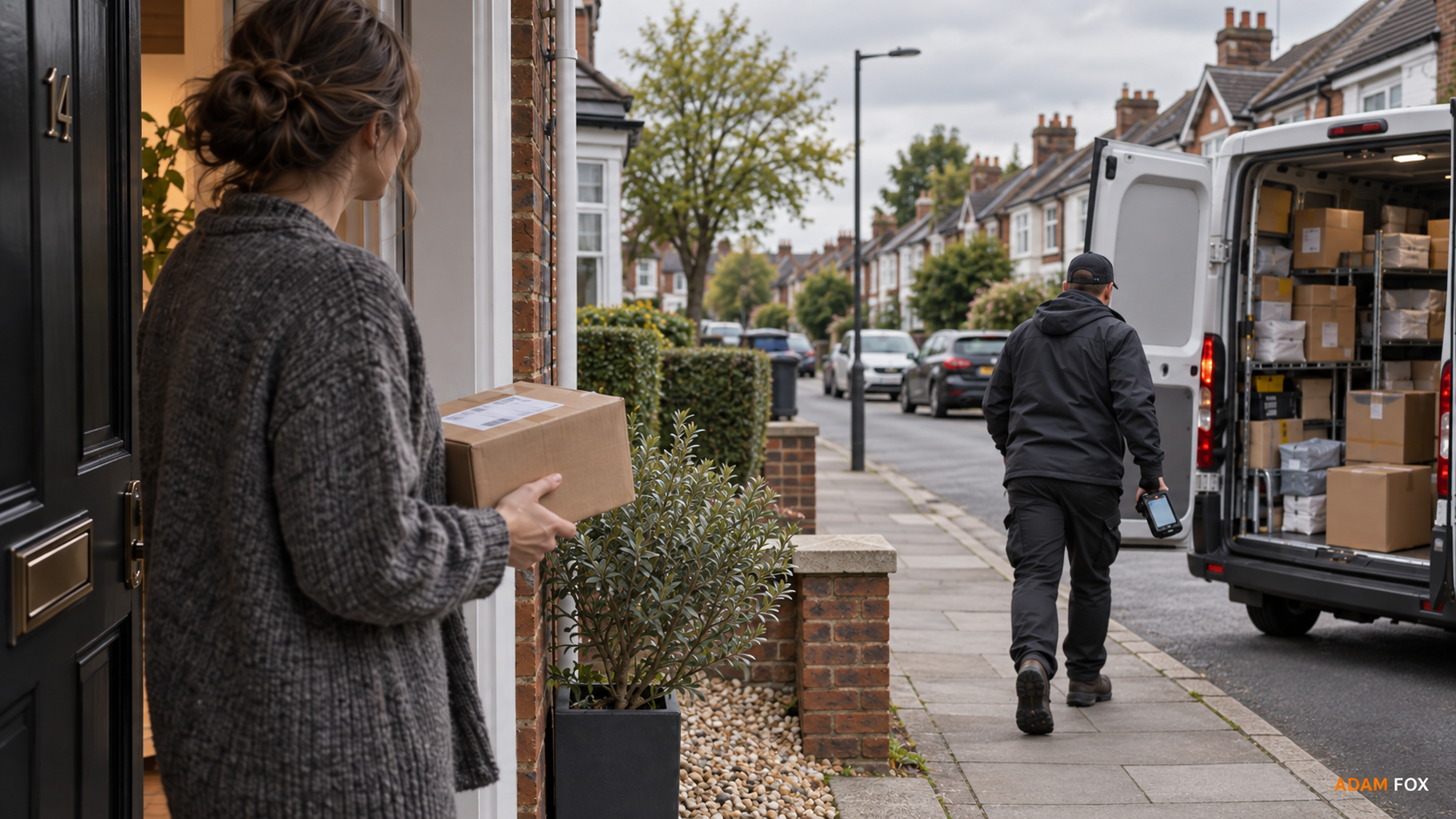
THE COST OF NOW: Convenience Has A Human Cost
I love convenience.
Let's establish that before this gets mistaken for an argument that everyone should start washing their clothes in a river.
I like ordering something at ten o'clock at night and having it turn up the following morning.
I like tapping my phone and moving money instantly.
I like booking things online.
I like not queueing in banks.
I like being able to find an answer in seconds rather than driving to a library and spending Saturday afternoon looking through an encyclopaedia.
I like takeaway food arriving at my front door.
I like click and collect.
I like automatic payments.
I like being able to sort something at 6am because that's when it suits me.
Convenience is fucking brilliant.
Human beings have spent thousands of years removing unnecessary effort from life.
We built wheels because dragging things was inefficient.
Washing machines because washing everything by hand was tedious.
Cars because walking twenty miles takes a while.
Computers because repeating calculations manually is ridiculous.
Progress involves removing friction.
The mistake is assuming the friction disappears.
Quite often, it doesn't.
It moves.
And because modern convenience is deliberately designed to make that movement invisible, we rarely see where it went.
Click
Consider how little effort sits on my side of a modern purchase.
I open an app.
Search.
Tap.
Tap again.
Done.
Maybe fifteen seconds.
Tomorrow, something appears outside my house.
From my perspective, almost nothing happened.
But something obviously did.
The product had to exist somewhere.
Inventory had to know it existed.
A system had to identify it.
Someone or something had to retrieve it.
It had to be packed.
Labelled.
Sorted.
Moved.
Possibly moved again.
Loaded.
Routed.
Driven.
Located.
Delivered.
All before a deadline I barely even thought about when I pressed the button.
That is one of the extraordinary achievements of modern logistics.
The customer experience has become simpler precisely because everything behind it has become more sophisticated.
The friction hasn't disappeared.
The customer just doesn't encounter most of it anymore.
And that changes our relationship with the people absorbing it.
The easier something feels to buy, the easier it becomes to underestimate what it takes to provide
This is not unique to parcels.
Tap a button and a car comes.
Someone is driving it.
Order dinner.
Someone cooks it.
Someone packages it.
Someone collects it.
Someone rides or drives it across town.
Message customer support.
Someone is on the other end.
Book a hotel at midnight.
Someone will prepare the room.
Expect a supermarket to stay open late.
Someone is working late.
Want twenty-four-hour access?
Somewhere in the system, somebody's twenty-four hours have been divided differently to make yours more convenient.
That does not automatically mean anyone is being exploited.
People choose shift work.
Technology removes genuinely miserable tasks.
Automation can make jobs safer.
Efficient logistics can reduce wasted journeys.
Flexible platform work can suit people extremely well.
Good businesses can provide extraordinary convenience while providing excellent employment.
This is not a moral equation where convenience sits on one side and suffering automatically appears on the other.
But there is always a system underneath the convenience.
And systems have costs.
Time.
Labour.
Capital.
Energy.
Attention.
Capacity.
Risk.
Someone or something has to absorb them.
“Free next-day delivery” is an extraordinary phrase
Think about those words.
Free next-day delivery.
The delivery is obviously not free.
Vans cost money.
Fuel costs money.
Warehouses cost money.
Packaging costs money.
Drivers need paying.
Technology costs money.
Buildings need heating, lighting and maintaining.
Someone has simply decided that I won't experience the cost as a separate line on the checkout page.
The economics have been moved elsewhere.
Into the product margin.
The membership fee.
The operating model.
Scale.
Supplier terms.
Automation.
Route efficiency.
Labour productivity.
Some combination of all of them.
“Free” describes my experience.
Not the underlying reality.
Convenience works the same way.
It can feel effortless to me without being effortless to provide.
That distinction becomes increasingly important as businesses compete to remove every visible sign of effort from the customer journey.
Speed has to come from somewhere
Same-day delivery sounds like a customer-service promise.
Operationally, it is a time constraint imposed across an entire chain.
Research into same-day delivery describes precisely that problem.
Online retailers need to balance attractive delivery guarantees against supply-side costs, routing constraints and the operational consequences of promising a particular delivery window. Faster guarantees can increase the likelihood of a customer purchasing, but the promise has to be fulfilled somewhere in the physical system.
That sounds obvious.
Yet psychologically, I think we forget it.
“Arrives today” appears on my screen as a feature.
For everybody behind the screen, it becomes a deadline.
Inventory must be positioned correctly.
Orders must be processed quickly enough.
Routes must work.
Capacity must exist.
Failures have less time to be corrected.
The shorter the customer-facing window becomes, the less slack exists behind it.
Again, clever systems can absorb a huge amount of that compression.
But systems eventually meet humans.
And that is where convenience can become temporal pressure.
We have built management systems capable of chasing people for us
This is one of the more uncomfortable parts of the research.
Modern logistics increasingly uses what researchers call algorithmic management.
Algorithms can allocate work.
Sequence tasks.
Schedule workers.
Measure output.
Monitor performance.
Optimise routes.
Direct people towards the next action.
There are obvious benefits.
A joint International Labour Organization and European Commission Joint Research Centre study found algorithmic management being used across conventional workplaces including logistics and healthcare, with potential benefits including streamlined processes, greater efficiency and improved service quality.
It also identified potential risks around job quality, surveillance and worker autonomy. Importantly, the effects were not identical everywhere. Working conditions depended significantly on how the technologies were implemented and on the surrounding regulatory and institutional environment.
That nuance matters enormously.
The algorithm is not inherently evil.
An algorithm telling someone the most efficient route around a warehouse may remove pointless walking.
A system allocating work intelligently might reduce errors.
Automation might remove physically punishing or monotonous tasks entirely.
Brilliant.
But the same ability to optimise can be used to tighten.
And tighten.
And tighten again.
Until efficiency no longer means removing waste.
It means removing every spare second.
There is a difference between removing wasted time and removing human time
This distinction deserves far more attention.
Suppose a warehouse process takes ten minutes.
Three minutes are wasted because the worker has to walk unnecessarily between badly positioned shelves.
Redesign the layout.
Now it takes seven.
Excellent.
Nobody has lost anything useful.
You removed waste.
Now imagine management notices seven minutes is possible and sets the target at six and a half.
Then six.
Then five forty-five.
The process is still becoming “more efficient”.
But something different is happening.
You are no longer necessarily removing wasted motion.
You may be compressing human motion.
Recent research examining algorithmic management in logistics found that its health effects depend heavily on organisational practice. A 2025 comparative case study reported concerns including lower autonomy and increased strain in some ecommerce environments, while explicitly warning against treating algorithmic management as inherently harmful.
Another 2025 study of logistics workers found associations between greater exposure to algorithmic management and psychological distress, musculoskeletal pain and occupational accidents. Because that study was cross-sectional, it cannot prove the management systems caused those outcomes, but the associations are important enough to take seriously.
The European Parliament has similarly identified potential risks where algorithmic systems contribute to increased time pressure, performance pressure, work intensification, surveillance and reduced autonomy, while also acknowledging that these technologies can improve productivity, safety and working conditions when designed differently.
That is the trade-off.
Technology can remove friction.
Or it can give organisations better tools for discovering exactly how little friction a human being can tolerate.
Those are not the same form of progress.
The customer never sees the timer
One of the oddest features of convenience is the separation between the experience of the customer and the experience of the worker.
I order food.
The app shows me a pleasant little map.
Estimated arrival: 28 minutes.
To me, the countdown is information.
To the person delivering it, time may be part of how their performance and earning opportunity are structured.
Research on food-delivery platforms repeatedly describes workers operating inside systems where algorithms match orders, monitor behaviour, allocate opportunities and influence timing.
A 2025 study of Chinese food-delivery riders went further, finding links between algorithmic platform management and rider risk-taking. The researchers describe both active risk-taking to earn more and passive risk-taking associated with time pressure, penalties and the demands of completing orders on schedule. The study was conducted in one Chinese city, so it should not be lazily generalised to every rider or platform worldwide, but it demonstrates a mechanism worth understanding.
My takeaway is not:
Stop ordering food.
It is much simpler.
When my food is ten minutes late, I am experiencing ten minutes.
The person producing those ten minutes may be experiencing a much more complicated system of traffic, restaurant delays, route allocation, customer expectations, earnings and performance measures.
The inconvenience is visible to me.
The pressure behind it is mostly invisible.
That asymmetry shapes behaviour.
Convenience can make ordinary people behave like tiny tyrants
Not because we're horrible.
Because the system hides almost everything except our unmet expectation.
I ordered this for six.
It is 6:15.
From my side, the situation is incredibly simple.
Promise.
Time.
Failure.
Someone else's reality doesn't appear on my screen.
Kitchen short-staffed.
Previous customer took too long answering the door.
Road closed.
Restaurant handed the order over late.
System miscalculated.
Driver needed the toilet.
Someone fell over.
Life happened.
I don't see any of that.
I see:
Delayed.
When complexity is hidden, blame becomes easy.
Customer-service workers experience this constantly.
A systematic review of research into customer incivility found substantial evidence of negative effects on service employees, including stress, emotional exhaustion and impaired aspects of performance. The literature also describes how increasingly demanding or unrealistic service expectations can contribute to difficult customer behaviour.
A 2024 study involving more than 1,000 frontline workers across retail, banking and hospitality similarly linked customer incivility with forms of emotional labour employees then had to perform while continuing to serve customers.
Again, most customers aren't abusive.
Most delayed parcels don't trigger riots.
But convenience creates a benchmark.
And the cleaner the system normally feels, the more jarring it becomes when a human being suddenly appears inside it.
Humans are increasingly experienced as friction
That sentence bothers me.
But I think there's something in it.
The website works immediately.
The payment goes through immediately.
The confirmation arrives immediately.
The tracking updates automatically.
Then you need something slightly unusual.
Now you need a person.
Please hold.
Four minutes.
Seven.
Twelve.
“Why is this taking so fucking long?”
Because now we've encountered the bit that cannot be infinitely replicated.
A human being.
Humans have conversations.
Need information.
Ask questions.
Make judgements.
Go to lunch.
Get tired.
Deal with one person at a time.
Sometimes misunderstand things.
Sometimes need another human being before they can answer.
Technology has trained us to move through enormous parts of systems with almost zero resistance.
That makes the human part feel comparatively slow.
But perhaps slow is the wrong word.
Maybe human speed has simply become more visible because machine speed surrounds it.
We should be careful what we optimise for
This matters beyond warehouses and delivery.
Every organisation has metrics.
Call handling time.
Response time.
Tickets closed.
Units picked.
Deliveries completed.
Customers served.
Cases processed.
Jobs finished.
Output per hour.
Metrics are useful.
If you cannot measure anything, managing a complex organisation becomes guesswork.
But metrics also communicate priorities.
If a customer-service agent knows success is primarily measured by getting me off the phone quickly, my “convenient” service experience may depend on someone balancing two competing demands:
Help Adam properly.
And make Adam disappear.
If the delivery driver is rewarded for more deliveries per hour, speed becomes economically meaningful.
If the warehouse worker's performance is constantly visible, pace becomes meaningful.
If the restaurant is judged by delivery time, kitchen behaviour changes.
Every customer-facing promise creates operational incentives behind it.
That doesn't make the promise wrong.
It means we should understand the full system we are optimising.
The really strange part: we may not even value the speed as much as businesses think we do
This might be my favourite piece of research in this essay.
A 2024 study examined how much ecommerce customers actually valued faster and more precisely scheduled home delivery.
There was enormous variation.
But the median willingness to pay to save one day of delivery time was surprisingly low.
Most participants were unwilling to pay even ten per cent of the stated delivery charge simply to save a single day.
The researchers argued that some customers do not value shorter lead times or narrower delivery slots nearly as highly as the market's relentless pursuit of speed might suggest.
Think about that.
Businesses may be engaged in extraordinarily complicated logistical competition to give customers something many of those customers would not actually pay very much for.
Why?
Because speed itself has become a signal.
Fast looks good.
Fast converts.
Fast differentiates.
Fast can become expected even if the actual value of another saved twelve hours is tiny.
That is how arms races work.
One company improves.
Another cannot look worse.
Everyone accelerates.
Customers adapt.
The improvement becomes baseline.
Then the cycle starts again.
Nobody necessarily decided that a toothbrush needed to arrive before sunset.
The system gradually discovered that “arrives today” performs better on the page than “arrives Thursday”.
Then the organisation underneath has to make the words true.
Some inconvenience may actually be cheaper than eliminating it
This creates an interesting economic question.
If I don't genuinely care whether something arrives Tuesday or Wednesday, why should the supply chain behave as though I do?
There may be circumstances where slower delivery allows orders to be consolidated.
Routes can be planned more efficiently.
Vehicles can carry more.
Workers can have greater scheduling flexibility.
The consumer may lose almost nothing meaningful.
Research into on-demand same-day delivery has long highlighted trade-offs involving transport costs, route efficiency and emissions. Faster delivery can require fundamentally different logistical models, and some approaches can increase fuel use and detours.
A 2024 consumer study found delivery speed remained an important preference, so we should not pretend customers don't care about it. They do. But consumer preferences also include sustainability and other service attributes, and different people value them differently.
Maybe the answer isn't:
Slow everything down.
Maybe it is:
Stop assuming maximum speed is the only definition of better.
That principle appears everywhere in my work.
Better is not automatically quicker.
Sometimes quicker is better.
Sometimes it isn't.
Agency requires asking which one we actually mean.
Convenience can improve autonomy too
There is another side to this that deserves defending.
Convenience can give people enormous freedom.
Home delivery can be transformative for someone with limited mobility.
Online banking can remove an enormous burden from someone who struggles to travel.
Remote appointments can help carers.
Digital services can provide access to rural communities.
Food delivery might help an exhausted parent get through a particularly difficult evening.
Flexible platform work can genuinely suit someone who values being able to choose when they work.
Automation can eliminate dangerous jobs.
Algorithms can remove pointless administration.
The same logistics technology capable of intensifying work can also reduce physical effort, improve routing and prevent errors.
The ILO's research is useful precisely because it refuses the simplistic conclusion that algorithmic management is automatically good or bad. Outcomes differ enormously depending on design, implementation, regulation and worker involvement.
We should keep that complexity.
The problem is not convenience.
The question is who gets it, and who pays for it.
Not merely in pounds.
In time.
Control.
Attention.
Predictability.
Pressure.
Physical effort.
Risk.
Sometimes we knowingly make the trade
There are jobs built around immediacy.
Emergency medicine.
Fire services.
Breakdown recovery.
Security.
On-call engineering.
Certain forms of IT support.
Some logistics.
That urgency is part of the role.
People can be paid and scheduled accordingly.
Businesses can build redundancy.
Rotas.
Shift patterns.
On-call premiums.
Rest.
Capacity.
The existence of fast service doesn't automatically require someone to sacrifice their entire life.
Good systems anticipate demand.
The problem comes when businesses promise convenience without building the capacity required to produce it sustainably.
Then the gap gets closed by people.
Work faster.
Stay later.
Take another order.
Answer another call.
Skip the break.
Squeeze this in.
Can you just…
The customer sees a seamless experience.
The employee experiences the seam being pulled shut.
Convenience is often another person's invisible urgency
That might be the clearest connection to this series.
I want something now.
The business promises me now.
Somewhere downstream, now becomes somebody's workload.
Not always.
Automation can absorb it.
Inventory can be positioned differently.
Processes can genuinely become more efficient.
But eventually, somewhere, demand has to meet capacity.
When demand exceeds capacity, businesses have choices.
Tell the customer to wait.
Increase capacity.
Raise the price.
Reduce demand.
Change the promise.
Or push harder on the existing system.
Modern customer culture is extremely reluctant to choose the first option.
Waiting looks like failure.
So pressure moves backwards through the chain.
The customer wants the parcel.
The retailer needs fulfilment.
The warehouse needs picking.
The carrier needs sorting.
The route needs completing.
The driver needs moving.
Each layer inherits a little of the urgency created at the layer above.
By the time it reaches the person doing the physical work, my casual preference may have become a clock.
We have removed the people from the language
Listen to how we describe services.
My parcel is coming.
My food is coming.
My order is being processed.
My ticket is being handled.
My query is in the queue.
The grammar removes the people.
Sometimes there genuinely aren't people directly involved anymore.
Machines are doing extraordinary amounts of work.
But where people remain, abstraction can make them easy to forget.
“The delivery is late.”
Not:
A human being driving several dozen individual objects to several dozen different people through actual roads in actual traffic is running fourteen minutes behind the prediction made by a computer.
That sounds different.
“The call centre is useless.”
Maybe.
Or maybe one person is simultaneously navigating six systems while talking to their fourth angry customer of the hour.
Again, poor service exists.
Bad businesses exist.
Employees sometimes don't care.
Customers are entitled to expect what they paid for.
I don't want to excuse incompetence through performative empathy.
I want us to remember that service systems terminate in reality.
And reality contains humans.
The better question might be: how fast does this actually need to be?
That question could remove an extraordinary amount of unnecessary pressure.
Not:
How fast can we do it?
Not:
How fast does the competitor do it?
Not:
How fast can technology make it?
How fast does this actually need to be?
Emergency prescription?
Very fast.
Replacement part stopping a factory production line?
Probably very fast.
Birthday present you remembered three weeks in advance?
Perhaps tomorrow isn't essential.
Another T-shirt?
Maybe Thursday is survivable.
Business report nobody will read until next Tuesday?
Why is someone working tonight?
Customer email received at 4:55pm?
Does it genuinely need answering before breakfast?
There is a difference between removing meaningful friction and developing an intolerance of all friction.
We have become exceptionally good at the first.
I'm increasingly worried about the second.
There are two ways to save time
We can save our time.
Or we can save time in the system.
Those are not necessarily the same.
Self-checkout saves a retailer labour and may save me queueing time, but part of the work has moved to me.
Online forms save administrative processing, but I now enter the data.
Same-day delivery saves me waiting, but the supply chain has less time.
Automated customer service saves staffing capacity, but if it fails, I may spend twenty minutes fighting a chatbot before reaching a person.
Efficiency frequently redistributes effort.
Again:
Friction moves.
This isn't automatically wrong.
I am perfectly happy scanning my own shopping sometimes.
The arrangement can benefit everyone.
But we should stop pretending that whenever something becomes effortless in one place, effort ceased to exist.
Usually it was redesigned.
Automated.
Concentrated.
Transferred.
Or hidden.
What would humane convenience look like?
Probably not inconvenience.
That's important.
The answer isn't deliberately making services worse.
It might mean giving customers real choices.
Need it today?
Fine.
Pay for the additional capacity required.
Don't care?
Choose slower consolidated delivery.
Need a human immediately?
Perhaps genuinely urgent support gets prioritised while routine enquiries wait.
Want employees to offer extraordinary customer service?
Give them enough time and autonomy to actually provide it.
Use algorithms to remove waste rather than simply tighten pace.
Measure quality alongside throughput.
Build slack where reality is unpredictable.
Let technology serve humans instead of using humans to satisfy technology's theoretical optimum.
And perhaps most importantly:
Stop promising customers a level of convenience that can only be sustained by making somebody else's working life permanently inconvenient.
The customer does not see the cost
That is the central problem.
Modern convenience is excellent at hiding what makes it possible.
We see the interface.
Not the warehouse.
We see the map.
Not the rider's timer.
We see “same day”.
Not the scheduling system.
We see “live chat”.
Not the person moving between conversations.
We see “free delivery”.
Not the infrastructure.
We see our saved time.
Not necessarily the time compressed elsewhere.
Maybe that is why we need to think about convenience differently.
Not reject it.
Not feel guilty every time we order something.
Not romanticise a slower and objectively less useful world.
Just recognise that convenience is not magic.
Somebody designed a system that moved the difficulty away from us.
The moral question begins after that.
Where did they put it?
Into better technology?
Better processes?
Automation?
Scale?
Smarter infrastructure?
Excellent.
Or did they put it into another human being's next hour?
Because if my increasingly frictionless life depends on someone else living permanently against the clock, then the friction didn't disappear.
I just stopped being able to see it.
And perhaps that's the real cost of now.
Not that everything arrives faster.
But that we have become so accustomed to the speed that we rarely ask who had to hurry.
Sources And Further Reading
International Labour Organization and European Commission Joint Research Centre, “Algorithmic Management Practices In Regular Workplaces: Case Studies In Logistics And Healthcare” (2024).
A comparative investigation of algorithmic management across logistics and healthcare in France, Italy, India and South Africa. The research identifies potential efficiency and service-quality benefits alongside concerns including surveillance, job quality and work intensity, with effects varying considerably according to implementation and institutional context.
“Algorithmic Management And Occupational Health: A Comparative Case Study Of Organizational Practices In Logistics”, Safety Science (2025).
Examines algorithmic management in logistics and reports differing outcomes according to organisational context, including concerns around autonomy, strain and insecurity in some ecommerce settings. Importantly, the authors do not conclude that algorithmic management is inherently harmful.
Karin Hennum Nilsson et al., “Algorithmic Management Is Associated With Psychological Distress, Musculoskeletal Pain, And Occupational Accidents: A Cross-Sectional Study In Logistics” (2025).
Reports associations between exposure to algorithmic-management practices and several occupational-health outcomes. As a cross-sectional study, it establishes correlation rather than causation.
International Labour Organization, research on technology and job quality.
ILO analysis highlights that technological augmentation can automate routine work and create more engaging roles, but can also limit worker agency or intensify work where algorithms increase task volume or reduce the time allocated to tasks.
European Parliament, recommendations concerning digitalisation, AI and algorithmic management in the workplace (2025).
Identifies both potential benefits and risks of algorithmic management, including improved productivity and safety on one side and possible work intensification, performance pressure, surveillance and reduced autonomy on the other.
“Same-Day Delivery Time-Guarantee Problem In Online Retail”, Communications In Transportation Research (2023).
Examines delivery-time guarantees as a strategic variable influencing customer purchasing while also creating supply-side costs and operational constraints.
“Do People Really Want Fast And Precisely Scheduled Delivery? E-Commerce Customers' Valuations Of Home Delivery Timing”, Journal Of Retailing And Consumer Services (2024).
Found substantial variation in customer preferences for delivery speed. Most participants were unwilling to pay even a small proportion of the stated delivery fee simply to reduce delivery time by one day, suggesting that maximal delivery speed may not be equally valuable to all customers.
Research into home-delivery preferences and sustainability (2024).
A study combining industry interviews with a consumer choice experiment found delivery speed to be a highly valued attribute, while consumers also cared about delivery method, packaging and vehicle sustainability. The findings illustrate that convenience preferences are multidimensional rather than reducible to speed alone.
Research into on-demand same-day package delivery.
Modelling work has highlighted trade-offs between delivery speed, transportation costs, route structures, fuel consumption and emissions, illustrating that shorter fulfilment windows can alter the economics and environmental performance of the delivery system.
Research on food-delivery platform work and algorithmic management.
Studies have examined how algorithmic systems match orders, monitor worker performance and shape the scheduling and autonomy of delivery workers. Recent research has also investigated relationships between algorithmic time pressure and risk-taking behaviour among riders, although findings from individual countries or cities should not be universalised.
Ranjan Chaudhuri et al., “How Customer Incivility Affects Service-Sector Employees: A Systematic Literature Review And Bibliometric Analysis”, Journal Of Business Research (2023).
Reviews the literature on customer incivility and its effects on frontline service workers, including stress, emotional exhaustion and service performance.
Pengfei Cheng and Zhuangzi Liu, research on customer incivility and frontline emotional labour (2024).
A study of 1,040 frontline workers across retail, banking and hospitality examining how customer incivility influences forms of emotional labour.
Research Gaps
Convenience does not automatically create poor working conditions.
Many of the technologies discussed in this essay can reduce physical effort, improve safety, eliminate repetitive work, provide greater flexibility and increase productivity. Research repeatedly shows that outcomes depend on implementation, regulation, organisational design and worker involvement. The argument here is therefore about where the cost of convenience is placed, not that convenience itself is exploitative.
Evidence from individual logistics markets should not be universalised.
Studies involving warehouses or delivery riders in China, India, France, South Africa or other specific countries operate within different labour markets, regulations, infrastructures and cultural conditions. They demonstrate possible mechanisms rather than proving that every delivery worker experiences identical pressure.
Associations between algorithmic management and health outcomes do not always establish causation.
Some important recent research is cross-sectional. Poorer working conditions may correlate with more intensive algorithmic management without the available study design proving that the technology itself caused every observed outcome.
The relationship between faster service and work intensity needs more direct study.
There is strong operational evidence that shorter delivery windows constrain logistics systems, and separate evidence that some forms of algorithmic management can intensify work. More direct research is needed to quantify how much specific customer-facing promises such as same-hour or same-day delivery translate into changes in worker pace, staffing, breaks or safety.
Customer demand for maximum speed is heterogeneous.
Some consumers highly value rapid delivery, while others place very little monetary value on shortening a delivery window further. More research is needed to distinguish actual consumer need from expectations created by competition, marketing and the availability of fast options.
“Human cost” extends far beyond logistics.
This essay concentrates heavily on delivery, warehousing, platform work and frontline service because these areas provide comparatively visible examples and useful research. Healthcare, hospitality, retail, call centres, professional services, manufacturing and many other sectors may experience different forms of transferred convenience pressure and deserve separate examination.
The benefits of convenience are unevenly distributed.
Home delivery, digital access and remote services may provide disproportionately high value to disabled people, carers, rural communities, people without transport and others for whom traditional service models create significant barriers. Any broader critique of convenience needs to account for accessibility rather than treating all convenience as discretionary consumption.
Automation may fundamentally change where the cost sits.
As robotics and AI absorb more picking, routing, customer-service and administrative work, some forms of human time pressure may decrease while others emerge. Current research cannot establish what the long-term balance will be.
Environmental cost is touched on but not fully examined.
Research suggests delivery speed and routing models can affect fuel use, consolidation and emissions, but sustainability effects depend on vehicle type, customer travel avoided, delivery density, failed deliveries and many other variables. A complete environmental assessment is outside the scope of this essay.
The idea that efficiency can shift from removing waste to compressing human time is partly interpretive.
Research supports concerns around work intensification and reduced task time under some forms of algorithmic management, but there is no universal threshold at which an efficiency improvement becomes unreasonable work compression. That remains an organisational, ethical and contextual judgement.