
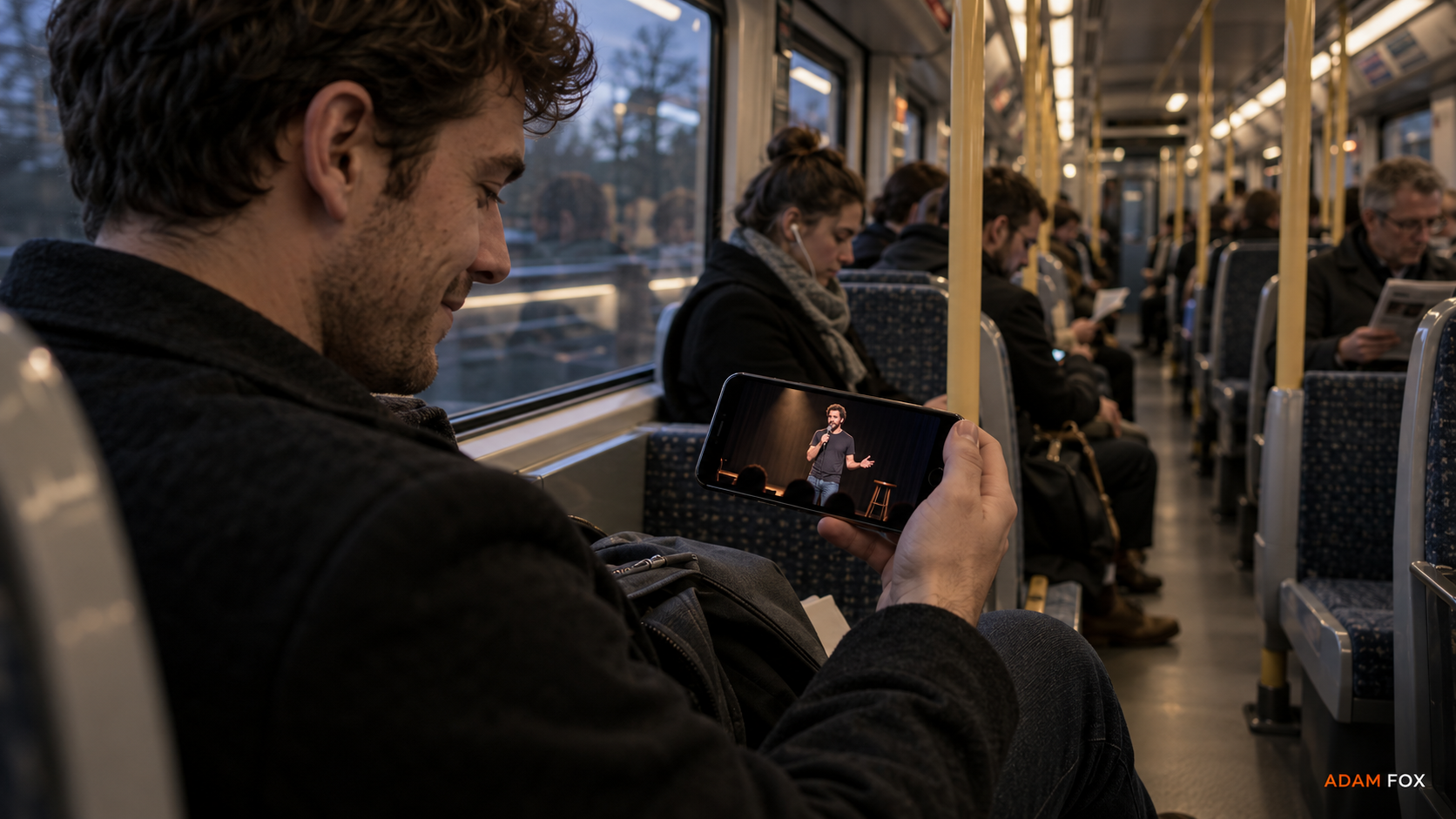
The Contempt Economy: The Joke Escaped the Theatre
The problem isn't that everybody can watch Jimmy Carr. It's that nobody has to choose to anymore.
And I can't help wondering what that's doing to us.
I find Jimmy Carr fucking hilarious. Ricky Gervais too. Frankie Boyle has spent years saying things that would get most ordinary people thrown out of a family gathering.
That's comedy. It's deliberately provocative, frequently offensive and often brilliant precisely because it crosses boundaries that the rest of us wouldn't ordinarily dare approach.
I don't want those comedians silenced. I don't want their material sanitised. And I certainly don't want to live in a world where the possibility of offending somebody is enough to make a joke unacceptable.
But something has changed.
Not necessarily the comedy.
The amount of it we're consuming, the way we're consuming it, and the fact that we no longer have to make a conscious decision to consume it in the first place.
And I think we're underestimating the potential consequences.
When entertainment was something we chose
Think back ten or fifteen years.
If you wanted to spend an evening watching Jimmy Carr, you made a decision.
You bought a ticket to see him perform. You purchased a DVD. You watched a televised special or chose to stream one of his performances.
You deliberately allocated a chunk of your life to that particular form of entertainment.
And when it finished, it finished.
You moved on.
There were hundreds of other things competing for your attention. Films, documentaries, box sets, news, sport, books, music, conversations with the people you lived with.
Offensive comedy was one option among many.
It occupied a particular place in your life, at a particular time, within a recognisable context.
Of course, clips existed online. YouTube was already enormous. Nobody needed to physically visit a theatre to experience provocative comedy.
But there was still a meaningful difference between seeking something out and having it repeatedly placed in front of you.
Today, that distinction has become increasingly blurred.
You pick up your phone and open Facebook.
Why?
Perhaps you want to see what your mates have been doing. Maybe somebody's posted pictures from a holiday. Perhaps you want to catch up with family members you haven't spoken to recently.
After all, it's called social media.
Connecting people was the proposition on which platforms like Facebook originally built their appeal.
But increasingly, the content we're presented with has very little to do with the people we actually know.
Instead, we're watching whatever the platform has calculated we're most likely to find interesting.
And the difference between those two things is enormous.
You didn't ask for another joke
Watch a couple of Ricky Gervais clips.
Laugh at one. Watch another all the way through. Perhaps send a third to a mate.
Congratulations.
You've now provided the recommendation system with several useful clues about what holds your attention.
Meta openly acknowledges that its systems use viewing behaviour, interactions and thousands of other signals to predict what people want to see.
It also recommends enormous quantities of material from accounts that users haven't chosen to follow.
The technology is astonishingly sophisticated.
And from a commercial perspective, I understand exactly why it exists.
If somebody enjoys watching a particular type of content, showing them more of it seems entirely logical.
It's helpful. It's personalised. It removes the inconvenience of having to search for something.
Except there's a rather important difference between enjoying something and wanting to consume it repeatedly throughout your day.
I enjoy chocolate.
That doesn't mean I want somebody shoving another bar into my hand every time I open the fridge.
Yet that's effectively what our digital entertainment environment has become.
A system that interprets demonstrated interest as an invitation to provide more.
And more.
And more.
It doesn't necessarily understand the distinction between something you enjoy occasionally and something you'd genuinely like to become a substantial part of your everyday experience.
More importantly, it doesn't understand the broader social implications of repeatedly presenting particular forms of behaviour as entertainment.
Because it isn't simply recommending jokes.
It's repeatedly exposing us to examples of how human beings treat one another.
And that's an entirely different proposition.
The content hasn't necessarily changed. The dose has.
In December 2025, Ofcom reported that UK adults were spending an average of four and a half hours online every day.
That doesn't mean four and a half hours watching comedy or scrolling through Facebook. Online time encompasses a huge range of activities.
But it demonstrates just how much of our lives now takes place within digital environments.
And those environments are increasingly shaped by systems deciding what deserves our attention.
In September 2026, Ofcom reported that people frequently encountered sensitive or harmful material unexpectedly, through personalised feeds, recommendations and comments, rather than deliberately searching for it.
That distinction matters.
Because much of the debate surrounding offensive entertainment has traditionally focused on the content itself.
Should comedians be allowed to say that?
Has political correctness gone too far?
Are people becoming too easily offended?
Should platforms remove particular jokes?
I think those arguments are distracting us from a potentially much more consequential question.
What happens when occasional exposure becomes constant exposure?
We understand this principle in all sorts of other areas of life.
The difference between an occasional stressful experience and living under chronic stress.
The difference between hearing an unpleasant noise once and being subjected to it throughout the day.
The difference between having an argument and existing in an environment where confrontation is normal.
Frequency matters.
Duration matters.
Context matters.
Cumulative exposure matters.
Yet when it comes to entertainment, we frequently behave as though the only relevant question is whether the individual piece of content is acceptable.
We evaluate the joke.
We rarely evaluate the environment created by thousands of jokes, clips, comments and reactions accumulating over time.
And that's where I think we're missing something.
When the exception becomes ordinary
Consider what makes a Jimmy Carr performance entertaining.
Part of the appeal is that he says things most people wouldn't ordinarily say.
That's the point.
He deliberately violates social expectations.
The audience understands that. The setting establishes it. The performance depends on it.
If everyone behaved like Jimmy Carr at a wedding, we'd probably spend most of the reception wanting to punch somebody.
But put him on a stage and those same comments become entertainment.
The difference isn't simply what he's saying.
It's the context in which he's saying it.
Now remove the theatre.
Remove the ticket.
Remove the deliberate decision to participate.
Take the most outrageous thirty seconds of the performance and place it between somebody's holiday photographs and a video of a Labrador doing something ridiculous.
Repeat that process several times throughout the day.
Then fill the comments with people celebrating the brutality of the insult.
Then recommend similar material from other comedians, amateur creators, influencers and ordinary people who've discovered that humiliating somebody can attract an audience.
Eventually, I have to wonder whether the extraordinary stops feeling extraordinary.
Whether behaviour that once depended on violating social expectations begins to influence those expectations instead.
And whether some people gradually lose the distinction between something being funny in a performance and something being acceptable in an ordinary interaction.
I'm not suggesting that everyone who watches offensive comedy becomes a bully.
That's ridiculous.
People are capable of understanding context, interpreting humour and separating entertainment from their own conduct.
But people differ enormously in their emotional maturity, social awareness, empathy and ability to recognise boundaries.
And I find it difficult to believe that repeated exposure to particular behaviours has absolutely no influence on how at least some of those people understand the world.
We learn by observing.
We learn by repetition.
We learn by watching which behaviours receive approval.
We learn from the people around us.
So why would we suddenly become immune to those influences simply because the people we're observing happen to be on a screen?
The research doesn't tell the whole story
There is an interesting body of research concerning something psychologists call social norms.
Essentially, we develop an understanding of acceptable behaviour partly through observing what others appear to do.
In 2024, researchers Claire Robertson, Kareena Del Rosario and Jay Van Bavel examined how social media can distort those perceptions.
They argued that behaviour presented online is often more extreme than behaviour encountered offline, potentially producing misleading impressions of what's normal.
That's fascinating.
Because it suggests that social media might influence us even when the behaviour we encounter isn't representative of wider society.
The internet doesn't need to reflect reality accurately to influence our understanding of it.
And there's another piece of research that caught my attention.
In 2021, researchers at Yale examined more than 12 million tweets and conducted experiments investigating how people learn to express outrage online.
They found that positive social feedback could encourage people to express more outrage in subsequent posts.
Now, outrage isn't the same as comedy. Nor does that research demonstrate that watching provocative comedians causes people to become hostile in everyday life.
But the underlying mechanism is interesting.
People observe behaviour.
They see it rewarded.
And their own behaviour can change accordingly.
Put those two findings alongside what we know about recommendation algorithms and an interesting possibility begins to emerge.
We have systems capable of repeatedly exposing people to particular kinds of behaviour.
We have evidence that online environments can distort perceptions of social norms.
And we have evidence that visible social rewards can influence how people subsequently express themselves.
What happens when all three mechanisms operate together, repeatedly, over years?
That's the kind of connection I find more interesting than any single statistic.
And it's precisely the kind of question that can be difficult to answer through research designed to investigate each mechanism separately.
It doesn't mean the relationship is proven.
It means there's a bigger question worth investigating.
The comedian understands the contract. Does the audience?
There's another part of this that bothers me.
Professional comedians spend years learning their craft.
Timing.
Delivery.
Reading a room.
Understanding an audience.
Knowing how far to push a joke and, crucially, recognising the boundaries of the performance.
Some are better at it than others, obviously.
But what we're increasingly exposed to online isn't necessarily the complete performance.
It's the punchline.
The most offensive remark.
The moment somebody gets absolutely destroyed.
Stripped of its original context and repackaged for maximum attention.
And the person watching might not appreciate everything that made the original joke work.
They just see somebody deliver an outrageous insult and receive an enormous reaction.
So they imitate it.
At school.
At work.
In a pub.
In a comment section.
In an argument with a complete stranger.
Except they're not a comedian performing for an audience that has deliberately chosen that experience.
They're simply somebody being offensive and expecting everyone else to appreciate their wit.
And when somebody doesn't appreciate it?
Well, apparently nobody can take a joke anymore.
Everybody's woke.
Everybody's offended.
Everybody's too sensitive.
It's an extraordinarily convenient way to avoid taking responsibility for how you treat people.
And perhaps that's part of the problem.
We've become so accustomed to celebrating people for crossing boundaries that some of us have forgotten why those boundaries existed in the first place.
The hostility doesn't stay on the screen
This is where my concern extends beyond the entertainment itself.
Because I don't think the changes we're seeing are confined to social media.
I see an increasing lack of consideration in ordinary life.
People appearing quicker to anger. Less patient with strangers. More willing to humiliate somebody publicly. More comfortable treating other people's discomfort as entertainment.
Of course, that's an observation.
I'm not pretending I have a dataset capable of establishing that every measure of hostility has increased across society.
Some forms of violence have declined over the long term. Some forms of abuse have increased. And much of the everyday behaviour I'm describing is almost impossible to measure accurately.
How do you quantify the cumulative impact of people being unnecessarily cruel?
How do you record the stranger made to feel small by a humiliating remark?
How do you measure the patience that somebody no longer possesses?
Or the consideration that would once have stopped them saying something completely unnecessary?
Most of these interactions never appear in official statistics.
Yet they shape our everyday experience of other people.
And I can't help wondering whether the behaviours we're repeatedly exposed to online are gradually following us into the physical world.
Not as a single dramatic transformation.
But through thousands of tiny changes.
A slightly sharper response.
A little less restraint.
Another unnecessary insult.
Another situation where somebody decides that getting a laugh matters more than treating another person decently.
Individually, those things might seem insignificant.
Collectively?
I suspect they matter enormously.
This isn't an argument against comedy
I want to be absolutely clear about something.
I don't blame Jimmy Carr.
I don't blame Ricky Gervais.
I don't blame Frankie Boyle.
They're performers creating entertainment for people who enjoy their material.
And I want them to continue doing exactly that.
Nor am I suggesting that social media is inherently bad. These platforms have brought enormous benefits, created opportunities and connected people who would otherwise have remained strangers.
I use them myself.
But I do question the responsibility of companies that have built extraordinarily profitable systems around identifying what holds our attention and then repeatedly delivering more of it.
Because there's a fundamental difference between making content available and actively encouraging people to consume more of it.
One provides access.
The other influences exposure.
And I don't believe we can discuss the social consequences of modern entertainment without acknowledging that distinction.
The commercial incentives aren't especially complicated.
Attention creates opportunities to generate revenue.
Content that holds attention has commercial value.
And content that provokes an emotional reaction can be particularly effective at attracting engagement.
That doesn't mean every algorithm favours offensive material, or that every company deliberately promotes hostility.
But it raises legitimate questions about what happens when engagement becomes one of the dominant measures of success.
Especially when the consequences of that engagement may not become apparent for years.
What are we becoming accustomed to?
I don't have a study that proves repeated exposure to offensive comedy is making society more hostile.
I'm not even sure how you'd design one capable of separating that influence from every other social, economic, cultural and psychological change taking place simultaneously.
But I don't think that means we should stop asking the question.
My work has never been about simply repeating what researchers have already discovered.
It's about observing the world around me, recognising patterns, examining possible relationships and asking whether our current understanding goes far enough.
Sometimes research confirms those observations.
Sometimes it challenges them.
And sometimes it reveals something that raises an entirely new question.
That's the point.
I look at how entertainment has changed.
I look at how algorithms increasingly determine what people consume.
I look at what we know about social norms, reinforcement, repetition and human behaviour.
And then I look at the world around me.
I see a society in which public humiliation has become entertainment, outrage has become content and ordinary human interactions increasingly seem to be judged by their potential to provoke a reaction.
Perhaps those developments aren't as closely connected as I suspect.
Perhaps other influences explain more of the changes I'm observing.
But I think dismissing the possibility simply because the entire relationship hasn't been conclusively demonstrated would be a mistake.
Because the question isn't whether one offensive joke can damage society.
It's whether an environment saturated with particular forms of behaviour can gradually alter what people consider ordinary.
And that brings me back to the theatre.
There was a time when watching somebody deliberately cross social boundaries was a particular form of entertainment.
Something we chose.
Something that occupied a specific place in our lives.
Something that ended when the performance finished.
Now that performance follows us around in our pockets.
It appears between conversations with friends, photographs of our children, news about our communities and updates from people we love.
The stage has become almost impossible to avoid.
The audience no longer has to buy a ticket.
And the performance never really ends.
The joke escaped the theatre.
I wonder whether some of our social boundaries escaped with it.
Independent research and sources
- Ofcom (2025) — Online Nation 2025. UK adults' online consumption, digital habits and public attitudes towards the internet.
https://www.ofcom.org.uk/media-use-and-attitudes/online-habits/from-apps-to-ai-search-how-the-uk-goes-online-in-2025 - Meta (2023) — The AI Behind Unconnected Content Recommendations on Facebook and Instagram. How viewing behaviour and engagement shape recommendation systems.
https://ai.meta.com/blog/ai-unconnected-content-recommendations-facebook-instagram/ - Meta (2026) — Your Algorithm, Your Words. Updated personalised ranking and recommendation mechanisms.
https://about.fb.com/news/2026/10/introducing-your-algorithm-facebook/ - Ofcom (2026) — Understanding People's Experiences of Distressing and Harmful Content Online. Research on unexpected exposure through feeds, recommendations and comments.
https://www.ofcom.org.uk/online-safety/illegal-and-harmful-content/understanding-peoples-experiences-of-distressing-and-harmful-content-online - Robertson, Del Rosario & Van Bavel (2024) — Inside the Funhouse Mirror Factory: How Social Media Distorts Perceptions of Norms. Current Opinion in Psychology.
https://pubmed.ncbi.nlm.nih.gov/39369456/ - Brady, McLoughlin, Doan & Crockett (2021) — How Social Learning Amplifies Moral Outrage Expression in Online Social Networks. Science Advances.
https://pmc.ncbi.nlm.nih.gov/articles/PMC8363141/
Research gaps and questions for further investigation
- Reliable historical comparisons quantifying changes in exposure to provocative comedy, humiliation-based entertainment and offensive short-form content over the past decade.
- Longitudinal research examining whether repeated, algorithmically recommended exposure to disparaging humour alters perceived social norms or offline interpersonal behaviour.
- Research separating the influence of deliberately selected entertainment from material encountered incidentally through personalised recommendations.
- Studies investigating whether repeated exposure has different consequences according to emotional maturity, empathy, age, social awareness and existing attitudes.
- Evidence capable of distinguishing actual changes in everyday hostility from changes in how frequently people observe, record and remember hostile behaviour.
These remain legitimate areas of uncertainty. The relationships explored in this essay are reasoned hypotheses informed by existing research, not established claims of causation.