
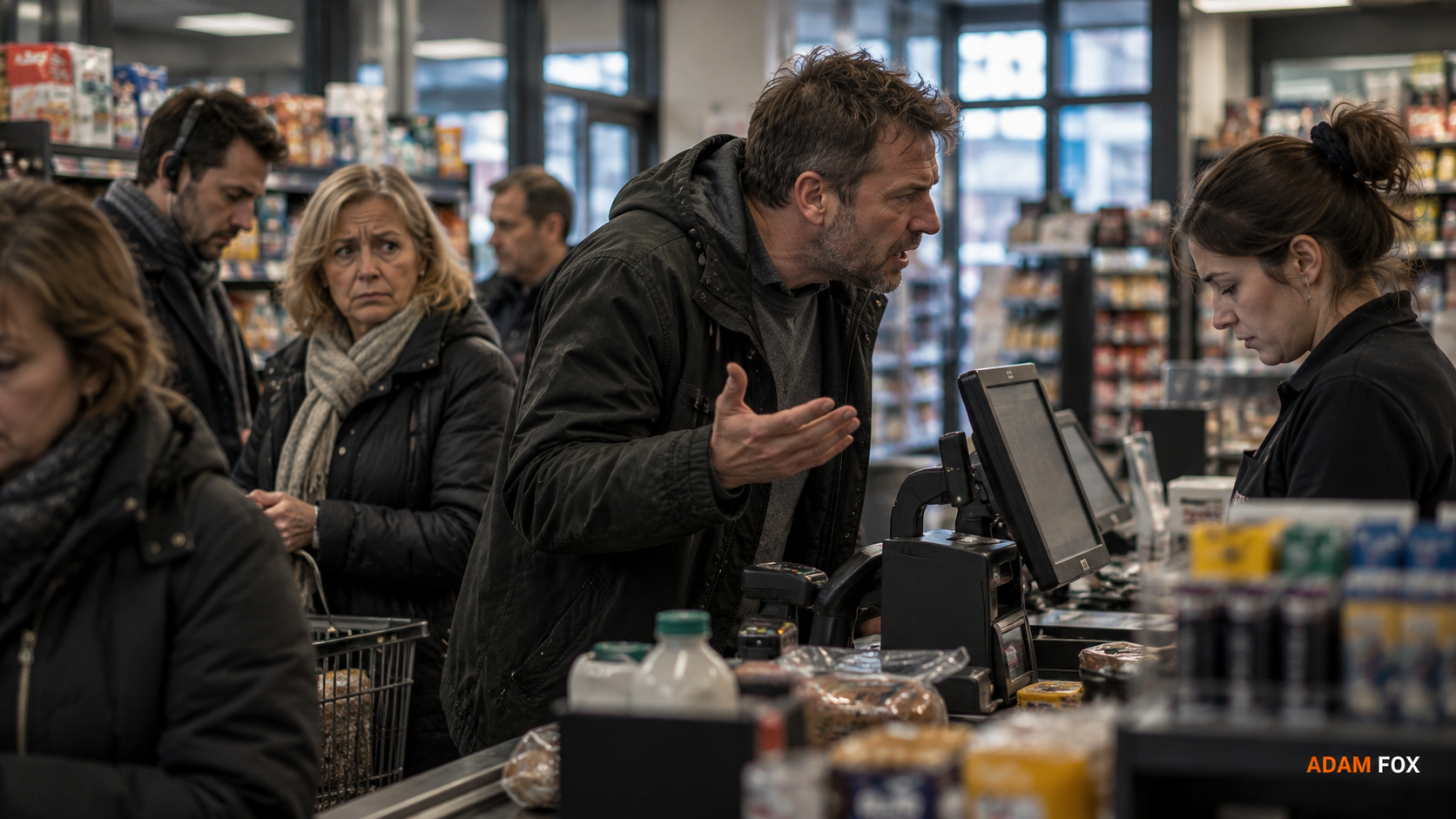
The Contempt Economy: The Hostility Has Left the Screen
You can switch your phone off. Unfortunately, you can't switch off the arsehole standing next to you.
And increasingly, I wonder whether we're becoming surrounded by more of them.
Not necessarily more fundamentally unpleasant people.
Not an entirely new generation of human beings who have somehow evolved without empathy, consideration or the ability to behave reasonably.
But more people who seem comfortable expressing their frustration, aggression and contempt in situations where those behaviours might previously have remained unspoken.
The impatient driver.
The aggressive customer.
The passenger who becomes confrontational when somebody asks them to move their bag.
The parent who launches into a teacher because their child hasn't received the answer they wanted.
The person who treats a minor inconvenience as though somebody has deliberately set out to ruin their day.
I notice these things.
And I suspect I'm far from alone.
There's a particular kind of hostility that doesn't necessarily involve violence, threats or anything sufficiently serious to attract the attention of the police.
It's simply the gradual disappearance of ordinary consideration.
The little social compromises that allow millions of people with different personalities, priorities and frustrations to share the same physical spaces.
And I think those compromises are coming under increasing pressure.
The interesting thing is that we have quite a lot of research examining how people behave online.
We can measure comments.
Analyse language.
Track engagement.
Identify patterns of abuse.
Observe how arguments spread.
And examine how algorithms influence the content people consume.
But measuring whether somebody has become less patient with strangers is considerably harder.
How do you quantify the person who responds aggressively to a perfectly reasonable request?
How do you record the customer who humiliates a young employee because their order is taking too long?
How do you measure the cumulative effect of thousands of unnecessary confrontations that never become serious enough to appear in official statistics?
And perhaps most importantly, how do you establish whether any of that behaviour has been influenced by the extraordinary changes in what people repeatedly consume through their phones?
It's a complicated question.
But I think the consequences are becoming increasingly difficult to ignore.
Because whatever is happening online, the behaviour I'm concerned about isn't staying there.
It's happening in the world we physically share.
Move your fucking bag
There's something about travelling on public transport that provides a remarkably revealing insight into human behaviour.
You put a collection of strangers into a confined space.
Give them different destinations, priorities, levels of patience and expectations of personal space.
Then ask them to spend an hour or two accommodating one another.
Most people manage perfectly well.
They take their seats.
Read a book.
Listen to music.
Look out of the window.
Perhaps exchange a few words with somebody.
And generally get on with their journey.
But there's always somebody who seems to regard the entire experience as an extraordinary inconvenience imposed upon them by everyone else.
The person whose bag occupies a seat while other passengers are standing.
The person broadcasting a video through their phone speakers.
The person conducting a loud conversation without the slightest awareness that everybody else can hear it.
And occasionally, the person who becomes irritated when somebody politely challenges them.
That last part is what interests me.
Because the original behaviour is often relatively minor.
Someone has left a bag on a seat.
Fine.
Perhaps the train was empty when they boarded.
Perhaps they simply haven't noticed that it's becoming busy.
No great crime has been committed.
But when another passenger asks whether they can sit down, the reasonable response is fairly obvious.
Move the bag.
Job done.
Instead, some people respond as though they've suffered an outrageous personal intrusion.
The look.
The sigh.
The exaggerated inconvenience of having to move something that shouldn't have been occupying the seat in the first place.
Occasionally, the unnecessary argument.
And I'm left wondering what happened to the simple recognition that other people exist.
Because nobody is asking for some extraordinary act of generosity.
Nobody is demanding that you sacrifice your journey for the greater good.
They're asking you to move a fucking bag.
Yet even that can become an exercise in confrontation.
Now, this isn't evidence that society is collapsing.
Inconsiderate passengers existed long before smartphones.
But I think these ordinary interactions reveal something about the social expectations we carry into shared spaces.
Do we understand that sharing a space requires accommodation, or do we increasingly regard accommodation as an unreasonable demand?
And if that expectation is changing, where is the change coming from?
The numbers are telling us something
Let's move beyond personal observations for a moment.
Because there is evidence that certain kinds of hostility in the physical world have become a substantial and, in some cases, growing problem.
In February 2026, the British Retail Consortium published its latest crime report.
During the reporting period covering September 2024 to August 2025, retailers recorded approximately 1,600 incidents of violence and abuse against shopworkers every day.
That's an improvement on the previous year, when the figure exceeded 2,000 incidents a day.
Good.
We should recognise improvements when they happen.
But here's the part that caught my attention.
Before the pandemic, in 2019–20, the equivalent figure was approximately 455 incidents per day.
Four hundred and fifty-five.
Compared with sixteen hundred.
Even allowing for changes in reporting, methodology and the composition of the survey, that's an extraordinary difference.
And we're talking about people going to work in shops.
Not police officers confronting violent offenders.
Not people deliberately entering dangerous situations.
Ordinary employees.
Stacking shelves.
Operating tills.
Helping customers.
Trying to earn a living.
The report also recorded approximately 118 incidents involving physical violence against retail workers every day.
And around 36 incidents per day involving a weapon.
Think about that for a moment.
These aren't people arguing in comment sections.
These are human beings being threatened, abused and assaulted while doing their jobs.
The British Retail Consortium's separate polling also suggested that approximately one in five members of the public had witnessed violence or abuse against retail workers over the previous year.
That's not simply a story about what employees are reporting.
It's becoming part of the experience of ordinary shoppers too.
Now, I don't believe for a second that Facebook is responsible for every aggressive customer.
Retail crime is influenced by a huge number of factors.
Theft.
Economic pressure.
Staffing.
Security.
Policing.
Alcohol and drugs.
Enforcement.
The circumstances surrounding particular incidents.
It would be ridiculous to pretend otherwise.
But neither do I think we should ignore the scale of the problem simply because establishing the exact causes is complicated.
Something is happening in particular public-facing environments.
And it deserves considerably more attention.
It's happening on the railways too
In September 2026, the Office of Rail and Road published its annual safety statistics covering April 2025 to March 2026.
The figures were concerning.
Reported assaults against passengers and members of the public on Britain's mainline railway increased by 36% compared with the previous year.
There were 13,464 reported incidents.
The highest number recorded since that particular statistical series began in 2004.
Reported assaults against railway workers increased by 12%, reaching 11,289 incidents.
That workforce figure included verbal abuse, threats and physical assaults.
Again, there's an important distinction between recorded incidents and the underlying prevalence of aggression.
Reporting practices can change.
People may become more willing to report incidents.
Organisations may improve how they record them.
And increased awareness can produce higher figures even without an equivalent increase in actual behaviour.
But the scale is still deeply concerning.
Because behind those statistics are people trying to travel.
Trying to work.
Trying to get home.
People who haven't agreed to participate in anybody else's anger.
And I can't help wondering how much of this behaviour begins with relatively ordinary frustrations.
A delayed train.
A disagreement over a ticket.
Somebody asking another passenger to be considerate.
An employee explaining that a particular rule has to be followed.
How often does an entirely manageable inconvenience become a confrontation because somebody lacks the willingness to control their immediate reaction?
And how often might that willingness be influenced by wider expectations about how people behave?
Those aren't questions the assault statistics can answer.
But they're questions I think we should be asking.
Because if we're only examining the final act of aggression, we may be overlooking the behavioural processes that preceded it.
One in four NHS workers
There's another environment where the evidence is difficult to ignore.
Healthcare.
The 2025 NHS Staff Survey found that 25.25% of respondents had experienced harassment, bullying or abuse from patients, service users, relatives or other members of the public during the preceding twelve months.
Approximately one in four.
The same survey found that 14.47% had experienced at least one incident of physical violence from those groups.
Now, healthcare is a complicated environment.
People are frightened.
They're unwell.
They're exhausted.
They're worried about loved ones.
They're sometimes dealing with extraordinary emotional pressure.
And some incidents involve patients whose medical conditions affect their behaviour or awareness.
We cannot simply lump every incident together and declare that a quarter of NHS staff are being abused by selfish people.
That would be unfair.
But neither should the complexity of the environment obscure what those employees experience.
Because doctors, nurses, receptionists, healthcare assistants and other staff shouldn't have to accept aggression as an ordinary consequence of turning up to work.
And the figures reveal something else important.
The level of reported abuse from patients and the public was almost unchanged from the previous year.
It hasn't suddenly exploded.
It's persistently high.
That's a different problem.
And potentially a more revealing one.
Because it raises the possibility that some forms of hostility have become so embedded in particular environments that they're almost treated as occupational hazards.
Something staff are expected to manage.
Something organisations develop procedures around.
Something people learn to anticipate before their working day has even begun.
And I think there's something deeply troubling about the prospect of ordinary abuse becoming an accepted component of ordinary employment.
Not because everyone behaves badly.
Most people don't.
But because enough people do that organisations are forced to develop increasingly sophisticated ways of protecting employees from the public they're trying to serve.
But there's a problem with my argument
Here's where things become more complicated.
And I think it's important to confront this rather than conveniently ignore it.
On 22 October 2026, the Office for National Statistics published its latest Crime Survey for England and Wales figures.
The findings don't support a simplistic claim that society is becoming more violent across the board.
Quite the opposite in some respects.
The survey estimated approximately 939,000 incidents of violence with or without injury during the year ending June 2026.
There was no statistically significant change compared with the previous year's survey.
And that figure was approximately 36% lower than a decade earlier.
More strikingly, it was 79% below the estimated peak in 1995.
Seventy-nine per cent.
That's not a trivial reduction.
It's an enormous long-term improvement.
And if we're serious about understanding changes in society, we can't simply dismiss those figures because they complicate an argument.
So how do we reconcile them with the apparent increase in hostility experienced by retail workers, rail passengers and people in other public-facing environments?
The answer, I suspect, lies partly in recognising that we're measuring different things.
Violent crime isn't the same as everyday hostility.
A criminal assault isn't the same as an unnecessarily aggressive response.
Harassment isn't identical to poor manners.
And somebody refusing to show consideration on a train isn't necessarily engaging in conduct that would ever appear in official crime statistics.
We need to stop treating all these behaviours as though they're interchangeable.
Because it's entirely possible for serious violence to decline over the long term while particular forms of abuse, intimidation or antisocial behaviour increase.
It's also possible for people to experience society as increasingly hostile without that experience being reflected in every conventional measure of crime.
Both things can be true.
And that distinction is central to what I'm trying to understand.
Perhaps we're measuring whether people are becoming more dangerous when the question we're actually asking is whether they're becoming less considerate.
Those aren't the same thing.
And they shouldn't be treated as though they are.
What about antisocial behaviour?
There's another finding in the latest ONS release that deserves attention.
For the year ending June 2026, 41.4% of respondents reported experiencing or witnessing antisocial behaviour in their local area.
That compared with 36.7% the previous year.
An increase.
Now, before somebody gets carried away, the ONS also explained that changes to its survey questions from April 2025 had inflated the results to some extent.
However, its methodological analysis suggested that most of the increase was genuine.
That's important.
Because unlike some recorded crime statistics, this measure asks people about their experiences within the communities where they live.
It captures a different dimension of everyday life.
Although antisocial behaviour encompasses a wide range of activities, including things such as noise, vandalism and drug-related problems, it also speaks to the broader experience of sharing space with other people.
And I find it interesting that while many serious crime measures show long-term improvements, significant numbers of people still report encountering behaviour that makes their immediate environment less pleasant.
There's another complication.
Police-recorded antisocial behaviour incidents remained around one million.
Relatively stable.
So we have survey evidence suggesting that more people are encountering or witnessing antisocial behaviour, while police-recorded incidents aren't showing the same increase.
That's not necessarily contradictory.
People don't report every unpleasant interaction to the police.
Some behaviours don't warrant police involvement.
Others are tolerated, ignored or dealt with informally.
And survey responses are influenced by what individuals notice, remember and interpret as antisocial.
But the differences highlight precisely why this subject is difficult to measure.
There's no single statistic that captures the entire experience of living alongside other people.
And perhaps there never will be.
The things nobody records
Imagine walking into a coffee shop.
A customer is getting increasingly irritated because their order is taking longer than expected.
The employee apologises.
Explains that they're busy.
Tries to resolve the situation.
The customer responds with unnecessary sarcasm.
Then another remark.
Then a dismissive comment about the employee's competence.
Eventually, the drink arrives.
The customer leaves.
No crime has been committed.
Nobody reports anything.
The police aren't interested.
The incident might not even be mentioned to the manager.
But the employee has still experienced an unpleasant interaction.
And if something similar happens several times throughout the day, those experiences accumulate.
Now imagine being the next customer.
You arrive perfectly cheerful.
The employee seems distracted.
Perhaps a little defensive.
Maybe less enthusiastic than you'd expect.
You interpret that as poor service.
And suddenly, another interaction begins with a degree of irritation that neither person originally intended.
There's research suggesting that these kinds of effects are plausible.
In 2016, Trevor Foulk, Andrew Woolum and Amir Erez published a series of studies examining how rudeness can spread through workplaces.
They found that exposure to rude behaviour could influence how people interpreted subsequent interactions and, in some circumstances, encourage similarly negative responses towards others.
The researchers described a process in which relatively minor acts of rudeness could have consequences beyond the original exchange.
That's fascinating.
Because it suggests that hostility doesn't always remain confined to the person who initiated it.
It can influence the next interaction.
And potentially the next.
Now, we can't automatically transfer findings from controlled organisational research to every situation in public life.
But the underlying idea makes intuitive sense.
We've all experienced it.
Somebody puts you in a foul mood.
And suddenly everybody else seems slightly more irritating.
The difference is whether you recognise what's happening and choose not to pass the frustration along.
And I wonder whether an increasingly hostile information environment makes that task more difficult for some people.
Because if you've spent half an hour watching arguments, insults and confrontation before leaving the house, perhaps you arrive in the physical world already expecting unpleasantness.
Perhaps ordinary inconveniences seem more provocative.
Perhaps ambiguous comments seem more hostile.
Perhaps you're less inclined to give somebody the benefit of the doubt.
And perhaps your reaction then influences how that person behaves towards somebody else.
I'm not claiming that we've proved this happens at a societal level.
But I think the potential connection deserves considerably more attention.
Especially when we consider just how much emotionally charged content people can encounter throughout an ordinary day.
The world we expect changes the world we experience
There's another body of research that connects to this.
In 2023, researchers led by William Brady published a study in Nature Human Behaviour examining how people interpret moral outrage expressed online.
They found that observers often perceived more outrage in social media posts than the people who wrote those posts reported actually feeling.
That effect was particularly pronounced among people who used social media frequently for political information.
And the researchers found that these exaggerated perceptions could influence beliefs about how hostile other groups were.
Think about what that means.
People weren't simply encountering hostility.
They were sometimes interpreting other people's emotional responses as more hostile than those people themselves reported experiencing.
And those interpretations influenced how they understood the wider social environment.
Now, the research concerned online political expression, not someone asking another passenger to move a bag.
But the broader psychological question is interesting.
What happens when people become accustomed to interpreting the behaviour of strangers through a lens of expected hostility?
Imagine somebody who regularly watches videos of customers arguing with shop assistants.
They see confrontations on trains.
They read endless comment sections full of people attacking one another.
They encounter stories about road rage.
Public arguments.
Humiliation.
Outrage.
What if they gradually begin expecting those behaviours when interacting with strangers?
Not necessarily because most strangers behave that way.
But because the examples they've repeatedly encountered have created a distorted impression.
Now consider the potential consequences.
A driver makes an innocent mistake.
It's interpreted as deliberate aggression.
A colleague sends a brief email.
It's interpreted as criticism.
A stranger asks a reasonable question.
It's interpreted as confrontation.
And somebody responds accordingly.
Suddenly, an interaction that might have been perfectly ordinary becomes genuinely unpleasant.
Not because either person set out to create a problem.
But because one or both arrived expecting one.
What if we're increasingly responding to the hostility we expect rather than the behaviour we're actually experiencing?
That's a rather uncomfortable possibility.
Because if it's happening, our perceptions could be contributing to the very environment we're becoming concerned about.
And that would make the relationship between online and offline behaviour considerably more complicated than simple imitation.
We're seeing a distorted version of humanity
In 2024, researchers Claire Robertson, Kareena Del Rosario and Jay Van Bavel published an analysis examining how social media can distort perceptions of social norms.
They described the online environment as something resembling a funhouse mirror.
A version of society in which particular behaviours are exaggerated, disproportionately visible and capable of creating misleading impressions about what other people consider acceptable.
I think that's an extraordinarily useful way of understanding the problem.
Because when I walk through my village, most people I encounter are perfectly pleasant.
People say good morning.
They hold doors open.
They allow other drivers through.
They help somebody who's struggling.
They generally get on with their lives without making everybody else's existence unnecessarily difficult.
And that's worth remembering.
Because those interactions aren't particularly entertaining.
Nobody's recording them.
Nobody's uploading a video of somebody politely waiting their turn in a supermarket.
Nobody's achieving a million views because a stranger held a door open.
Nobody's watching an elderly gentleman cross the road safely and thinking, "Fuck me, that was some extraordinary content."
But two people having a screaming argument?
That's entertainment.
Someone humiliating a shop assistant?
Potentially entertainment.
A passenger getting into a confrontation because somebody asked them to move?
Another video.
Another audience.
Another comment section.
And if the most confrontational examples of human behaviour are disproportionately represented in the content we consume, we could develop a very misleading understanding of how people generally behave.
That's the danger.
Not necessarily that everyone becomes more aggressive.
But that some people become more aggressive while others begin assuming aggression is more common than it really is.
And those expectations can influence subsequent behaviour.
It's a potentially self-reinforcing relationship.
One that doesn't require every person involved to understand what's happening.
The camera has changed the confrontation
There's another development I think deserves investigation.
The presence of cameras.
Or perhaps more accurately, the knowledge that almost every person around us possesses one.
Historically, an argument in a supermarket was generally an argument in a supermarket.
Unpleasant.
Possibly embarrassing.
Occasionally serious.
But usually confined to the people who witnessed it.
Today, almost any interaction can become a piece of publicly distributed content.
Somebody starts filming.
Another person notices.
The situation escalates.
Perhaps the person being filmed becomes more defensive.
Perhaps the person recording becomes more provocative.
Perhaps somebody starts behaving differently because they know there's an audience.
And perhaps the entire encounter becomes less about resolving the original problem and more about controlling how the interaction will look when somebody else watches it.
I find that possibility fascinating.
Because a camera can serve an important protective purpose.
It can record genuine misconduct.
Provide evidence.
Challenge false accusations.
And protect people who might otherwise struggle to establish what happened.
Those are valuable benefits.
But the camera can also introduce a performative dimension into an interaction.
People might become more concerned with appearing right than resolving the disagreement.
They might start delivering remarks intended for the eventual audience rather than the person standing in front of them.
And they may feel increasingly pressured to respond because walking away could be interpreted as losing.
Not every recording creates those effects.
Sometimes filming makes people considerably more restrained.
But I suspect the awareness of a potential audience is changing some face-to-face interactions in ways we haven't properly investigated.
Because once an argument becomes content, the incentives can change.
Resolving the issue might end the entertainment.
Escalating it might create a much more engaging video.
And that's an extraordinarily uncomfortable distinction.
The next person pays for the last person's behaviour
There's another aspect of hostility that I don't think we discuss enough.
Its cumulative impact on people who spend their working lives dealing with the public.
Imagine working behind a counter.
Most customers are absolutely fine.
Some are lovely.
Some are merely transactional.
Some are slightly impatient.
And occasionally, somebody is a complete nightmare.
They arrive angry.
They're dismissive.
They treat you as though you're personally responsible for every inconvenience they've encountered throughout their day.
Now imagine dealing with that repeatedly.
Day after day.
Week after week.
At some point, it must become harder not to anticipate the next unpleasant interaction.
You might become more guarded.
More defensive.
Less trusting.
Less enthusiastic.
Not because you dislike people.
But because you've learned that some people can make your working day considerably more difficult than it needs to be.
And here's where the problem becomes particularly interesting.
That change in behaviour can affect the experience of perfectly reasonable customers.
People who've done absolutely nothing wrong.
They might receive a slightly more guarded response.
Perhaps they interpret it as poor service.
Perhaps they become irritated themselves.
And suddenly the consequences of one person's aggression begin extending beyond the original interaction.
That's what concerns me about normalising hostility.
Not simply the damage caused to the immediate recipient.
But the possibility that repeated negative encounters gradually influence how people approach others.
They start expecting confrontation.
They develop defensive habits.
They become less trusting.
And perhaps they become less inclined to extend the small gestures of goodwill that make ordinary life pleasant.
The danger isn't necessarily that everyone becomes cruel.
It's that enough people become defensive that ordinary kindness starts feeling like a risk.
And I think that's a much more significant social consequence than we tend to appreciate.
We can't blame everything on social media
I want to be particularly clear about something.
I don't believe the changes we're observing can be explained by social media alone.
Economic pressure matters.
Housing costs matter.
Workplace stress matters.
Public services matter.
The aftermath of the pandemic matters.
Changes in policing, education, community relationships and social expectations all potentially matter.
And human behaviour is influenced by things that are enormously difficult to separate.
Someone shouting at a shop assistant might be under extraordinary financial pressure.
They might be exhausted.
They might be intoxicated.
They might have experienced a genuinely unreasonable situation.
They might simply be somebody who regularly behaves unpleasantly towards others.
Or several influences might be operating simultaneously.
There's no credible way to look at an individual incident and declare that Facebook caused it.
But I don't think we need to make that claim.
Because social media doesn't exist separately from the rest of our lives.
It's woven through them.
It influences what we encounter.
What we discuss.
What we notice.
What we believe other people think.
And potentially how we interpret the behaviour of those around us.
So perhaps the more useful question isn't whether social media causes hostility.
Perhaps it's whether the way we consume content can amplify existing frustrations, reinforce particular expectations and influence how some people respond to ordinary situations.
That wouldn't make social media the sole cause.
It would make it one influence among many.
And considering how much time people spend in these environments, I think that's a perfectly reasonable possibility to investigate.
The danger of mistaking observation for proof
There's something I have to acknowledge here.
I pay attention to human behaviour.
Probably more than most people.
I notice how people interact.
I notice how they respond to inconvenience.
I notice when somebody displays consideration and when they don't.
And I spend an enormous amount of time thinking about why people behave the way they do.
That's part of what drives my writing.
I observe something.
I recognise a potential pattern.
I examine the wider context.
I look at the research.
And I start asking whether seemingly unrelated developments might actually be connected.
But the fact that I observe a pattern doesn't automatically establish its cause.
Sometimes the research challenges what I think I'm seeing.
Sometimes a particular statistic reveals something unexpected.
And sometimes the available evidence simply isn't capable of answering the question.
That doesn't make observation worthless.
Quite the opposite.
Observation is often where the most interesting questions begin.
But it does mean we need to distinguish between what we know, what we suspect and what we haven't yet established.
And in this case, I think that distinction makes the argument stronger.
Because we do know that serious violence has declined substantially over the long term.
We also know that certain public-facing environments are experiencing significant problems with abuse and aggression.
We know that substantial numbers of people report encountering antisocial behaviour in their local communities.
We know that rudeness can influence subsequent interpersonal interactions.
And we know that online environments can distort people's perceptions of how hostile other people are.
Those findings come from different areas of research.
They weren't all designed to investigate the same question.
But I think there may be an important relationship between them.
And that's the relationship I want to explore.
Not because a single study has proven it.
But because understanding modern human behaviour requires us to consider how different influences interact.
And sometimes the most interesting questions exist in the spaces between the individual studies.
What if hostility is becoming a self-fulfilling expectation?
This is the possibility I keep coming back to.
Imagine a society in which some forms of hostile behaviour genuinely become more common.
At the same time, people spend increasing amounts of time consuming online content that disproportionately features confrontation, outrage and public humiliation.
Those experiences influence their expectations.
They begin anticipating hostility.
They interpret ambiguous interactions more negatively.
Some become more defensive.
Others become quicker to react.
And those responses make ordinary interactions more unpleasant.
Which reinforces the original expectation.
Now, not everybody will respond that way.
Some people may become more empathetic.
Some may actively challenge poor behaviour.
Others may recognise the distortion and deliberately reject it.
And many will simply continue behaving reasonably, regardless of what appears on their screens.
But if enough people begin responding defensively to the hostility they expect, perhaps the effect becomes socially significant.
Even without a dramatic increase in the number of people who are fundamentally aggressive.
Perhaps we begin creating the environment we've been conditioned to anticipate.
One unnecessarily sharp response at a time.
One misinterpreted interaction.
One preventable confrontation.
One person passing their frustration on to somebody who had nothing to do with creating it.
And collectively, those experiences begin influencing how people feel about the society they live in.
That's a hypothesis.
Not a proven description of what's happening across Britain.
But I think it's a hypothesis worth taking seriously.
Because it connects several observations that otherwise appear unrelated.
The way social media presents human behaviour.
The way people interpret that behaviour.
The way expectations influence interactions.
And the possibility that repeated unpleasant experiences contribute to further unpleasant experiences.
It's not simply about people copying what they watch.
It's about people potentially carrying an increasingly hostile interpretation of the world into the world itself.
And then responding accordingly.
Consideration is still everywhere. We just don't make content out of it.
There's something important I don't want this essay to lose.
Despite everything I've discussed, I still encounter considerably more decent people than unpleasant ones.
I see strangers helping one another.
Drivers giving way.
People being patient with overwhelmed employees.
Passengers making room for others.
People apologising when they get something wrong.
And ordinary acts of kindness that nobody thinks are particularly remarkable.
Because they shouldn't be remarkable.
They're how civilised people coexist.
I think we need to remember that.
Because if we become so focused on identifying hostility that we stop recognising consideration, we'll be contributing to the distorted perception we're trying to understand.
Not everybody is angry.
Not everybody is selfish.
Not everybody wants an argument.
And not everybody is becoming less considerate.
But perhaps those aren't the only questions that matter.
Perhaps we should also be asking whether the people who do behave badly are becoming more comfortable doing so.
Whether their behaviour is affecting more people.
Whether repeated exposure is making certain forms of hostility feel increasingly ordinary.
And whether the rest of us are becoming more likely to anticipate unpleasantness as a result.
Because the social consequences don't require every person to change.
They only require enough people to behave differently that the experience of ordinary life begins to shift.
And that shift might be particularly noticeable in environments where strangers are required to accommodate one another.
Shops.
Trains.
Roads.
Schools.
Restaurants.
Workplaces.
The places where society actually happens.
Not on a screen.
In front of us.
The world beyond the screen is where the consequences matter
I don't believe we can demonstrate that algorithmically delivered offensive entertainment is responsible for the increases in hostility recorded in particular sectors.
The evidence doesn't establish that.
And I wouldn't insult the reader's intelligence by pretending otherwise.
But I also don't believe we should dismiss the potential relationship simply because it's difficult to quantify.
We know that human beings learn through observation.
We know that repeated experiences influence expectations.
We know that social feedback can reinforce behaviour.
We know that online environments can present distorted impressions of what other people consider normal.
And we know that some forms of real-world hostility are creating substantial problems.
I think it's reasonable to investigate how those things might interact.
Not by blaming comedians.
Not by demanding censorship.
Not by pretending every unpleasant person has been corrupted by social media.
But by asking what happens when people spend increasing portions of their lives consuming content that presents confrontation, humiliation and hostility as entertainment.
And then return to a physical world that depends on cooperation, patience and restraint.
Because the real world isn't personalised around our individual preferences.
The person ahead of us in the queue has just as much right to be there as we do.
The employee behind the counter isn't responsible for every inconvenience we've experienced.
The passenger beside us hasn't agreed to participate in our entertainment.
And the stranger who makes an innocent mistake doesn't automatically deserve to be publicly humiliated.
These aren't complicated ideas.
They're the foundations of ordinary consideration.
And I suspect that the more accustomed we become to environments where immediate reactions are rewarded, the more deliberately we may need to preserve those foundations.
Because society doesn't function simply because most people avoid committing crimes.
It functions because millions of people make small, considerate decisions every day.
They wait.
They accommodate.
They apologise.
They give somebody the benefit of the doubt.
They choose not to react.
They recognise that other people have lives every bit as important to them as their own.
And perhaps that's the part of the conversation we've been missing.
We spend so much time discussing whether people are becoming more violent that we risk overlooking whether they're becoming less willing to make those ordinary compromises.
Yet those compromises are what make the physical world bearable.
We can analyse online comments.
Measure engagement.
Investigate recommendation algorithms.
And study how hostility spreads through digital networks.
But ultimately, the consequences of our social behaviour are experienced by real people.
The employee who dreads another difficult customer.
The passenger who feels uncomfortable asking somebody to move their bag.
The teacher who anticipates another aggressive confrontation.
The stranger who decides not to challenge poor behaviour because they don't know how the other person might respond.
And the ordinary person who increasingly expects an unpleasant interaction before one has even begun.
Those experiences deserve attention.
Even when they're difficult to measure.
Even when the causes are complicated.
And even when the evidence doesn't provide the neat, conclusive answer we'd prefer.
Because perhaps the most troubling possibility isn't that the internet has created a society full of hostile people.
Perhaps it's that our increasingly hostile digital experiences are influencing how some of us behave towards the perfectly ordinary, generally decent human beings we encounter in everyday life.
And in doing so, we may be making the physical world more unpleasant than it needs to be.
You can switch your phone off.
But if the behaviour we've become accustomed to watching has started influencing the way we treat one another, switching off the screen won't necessarily switch off the consequences.
The hostility has left the screen.
And the people standing in front of us are the ones who may be paying the price.
Independent research and sources
1. Office for National Statistics (2026). Crime in England and Wales: Year Ending June 2026.
Published 22 October 2026. The latest national crime survey reported approximately 939,000 incidents of violence with or without injury, 79% below the 1995 peak, alongside an increase in experienced or witnessed antisocial behaviour to 41.4%, compared with 36.7% the previous year. The ONS cautioned that questionnaire changes inflated the antisocial behaviour increase to some extent.
2. Office for National Statistics (2026). How a Change in the Crime Survey for England and Wales Questionnaire in April 2025 Affected Responses to Questions on Anti-Social Behaviour.
Methodological analysis distinguishing changes caused by survey design from genuine increases in reported experiences of antisocial behaviour. The research concluded that most of the earlier reported increase appeared genuine, although the revised survey questions contributed to the measured change.
3. British Retail Consortium (2026). BRC Crime Report 2026.
Industry survey covering September 2024 to August 2025. Recorded approximately 1,600 daily incidents of violence and abuse against retail workers, down from more than 2,000 the previous year but substantially higher than the pre-pandemic figure of approximately 455 per day.
https://brc.org.uk/news-and-events/news/operations/2026/ungated/brc-crime-report-2026/
4. British Retail Consortium (2026). One in Five Witness Retail Violence or Abuse.
Public polling conducted with Opinium found that approximately 21% of respondents had witnessed violence or abuse against retail workers over the preceding year, demonstrating how abuse towards frontline staff extends into the experiences of ordinary customers.
5. Office of Rail and Road (2026). Mainline Rail Assaults Rise in Latest Annual Safety Statistics.
Published 24 September 2026. Official figures for April 2025 to March 2026 recorded 13,464 reported assaults against passengers and members of the public, an increase of 36%, and 11,289 reported assaults against railway workers, an increase of 12%.
https://www.orr.gov.uk/search-news/mainline-rail-assaults-rise-latest-annual-safety-statistics
6. NHS England (2026). Violence Prevention and Reduction.
NHS England's summary of the 2025 NHS Staff Survey. Approximately 25.25% of respondents experienced harassment, bullying or abuse from patients, service users, relatives or members of the public, while 14.47% reported experiencing physical violence from those groups.
7. Foulk, T., Woolum, A., & Erez, A. (2016). Catching Rudeness Is Like Catching a Cold: The Contagion Effects of Low-Intensity Negative Behaviors. Journal of Applied Psychology, 101(1), 50–67.
Three studies demonstrating that experiencing rudeness can influence how people interpret later interactions and contribute to the spread of negative behaviour within organisational environments.
https://doi.org/10.1037/apl0000037
8. Brady, W. J., McLoughlin, K. L., Torres, M. P., et al. (2023). Overperception of Moral Outrage in Online Social Networks Inflates Beliefs About Intergroup Hostility. Nature Human Behaviour, 7, 917–927.
Research demonstrating that people can overestimate the intensity of outrage expressed online and that those interpretations can influence perceptions of wider social hostility.
https://doi.org/10.1038/s41562-023-01582-0
9. Robertson, C. E., Del Rosario, K. S., & Van Bavel, J. J. (2024). Inside the Funhouse Mirror Factory: How Social Media Distorts Perceptions of Norms. Current Opinion in Psychology, 60, 101918.
An interdisciplinary review examining how social media can disproportionately represent extreme behaviours, creating misleading impressions of wider social norms and expectations.
https://doi.org/10.1016/j.copsyc.2024.101918
Research gaps and questions for further investigation
Measuring everyday hostility: Conventional crime statistics capture serious incidents but do not comprehensively measure routine interpersonal incivility, impatience, dismissiveness or failures of social consideration. Longitudinal research designed specifically around these behaviours would provide a more useful measure of the changes explored in this essay.
Distinguishing actual increases from reporting changes: Evidence of increasing violence and abuse in public-facing sectors must be interpreted alongside changes in incident recording, willingness to report, enforcement, staffing and survey methodology. Independent analysis is needed to establish how much of the recorded change reflects underlying behaviour.
Digital-to-physical behavioural transfer: Existing research demonstrates mechanisms through which online experiences can influence attitudes, perceptions and behaviour. However, longitudinal studies specifically isolating the effect of repeated exposure to online hostility on face-to-face interactions remain limited.
Perceived hostility versus actual hostility: More research is required to distinguish genuine changes in interpersonal behaviour from increasing expectations of hostility caused by selective exposure, heightened awareness or distorted online social norms.
The role of economic and social pressures: Research should examine how financial stress, working conditions, public-service pressures, community relationships and post-pandemic experiences interact with digital exposure, rather than treating any single influence as sufficient to explain wider behavioural changes.
Escalation mechanisms: Further investigation could examine whether exposure to online confrontation increases the likelihood of interpreting ambiguous physical-world interactions as hostile, and whether those interpretations contribute to unnecessary escalation.
Protective social behaviours: Most research into incivility focuses on negative interactions. Additional investigation is needed into everyday consideration, cooperation, spontaneous assistance and restraint, including whether these behaviours are genuinely declining or merely receiving less public attention.
Audience awareness and recording: Research should examine whether the expectation of being filmed influences how people behave during public disagreements, including whether recording encourages restraint, escalation or performative responses.
The central argument of this essay is that some forms of real-world hostility are measurably concerning, while the broader experience of declining consideration may involve behavioural changes that conventional crime statistics are poorly equipped to capture. The proposed relationship between digitally reinforced hostility, changing social expectations and ordinary face-to-face interactions remains a reasoned hypothesis rather than an established causal conclusion.