
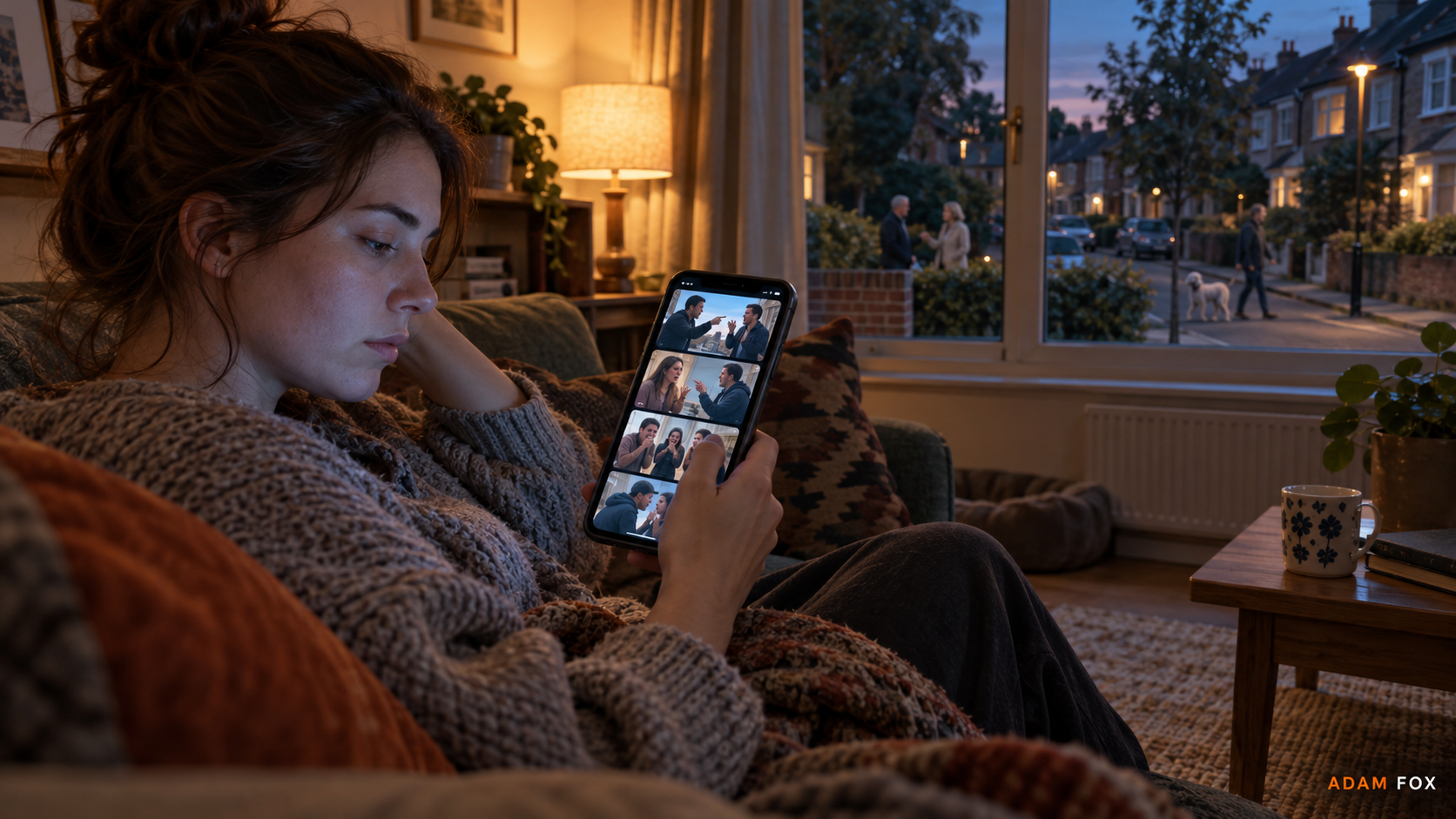
The Contempt Economy: The Feed That Made Cruelty Familiar
The most dangerous thing about cruelty isn't necessarily that it shocks us. It's that eventually, it might stop shocking us altogether.
And I wonder whether we're already much further down that road than we realise.
Think about the last time you opened Facebook.
Not because you wanted to watch somebody being humiliated.
Not because you were searching for an argument.
Not because you particularly fancied spending twenty minutes watching strangers tear strips off one another.
You probably opened it out of habit.
Perhaps you wanted to see what your friends had been doing. Maybe you were waiting for something, had a few minutes to spare, or simply picked up your phone without giving it much thought.
And somewhere between somebody's holiday photographs and a video of a dog doing something ridiculous, you encountered another person being made to look like a complete fucking idiot.
Maybe it was a comedian roasting somebody.
Perhaps it was a stranger being mocked for their appearance.
Maybe it was a video of an argument in a supermarket, with thousands of people cheering on whichever participant delivered the most devastating insult.
Or perhaps it was simply a comment section full of people being unnecessarily unpleasant to somebody they'd never met.
You watched.
Maybe you laughed.
Maybe you thought it was a bit harsh.
Maybe you barely registered it.
Then you scrolled.
And thirty seconds later, you'd forgotten the entire interaction.
That's the bit I keep coming back to.
Not necessarily the cruelty itself.
The ease with which we've become accustomed to encountering it.
Because I think there's a possibility that our relationship with human hostility is changing in ways we're only beginning to understand.
And the consequences could extend considerably further than the screens through which we're consuming it.
The extraordinary has become ordinary
There was a time when witnessing somebody being publicly humiliated was an event.
Not necessarily a pleasant one.
But something sufficiently unusual that it stood out.
You might have witnessed a confrontation in a pub. Someone might have made an unnecessarily cruel remark at a family gathering. Perhaps somebody at work had been publicly embarrassed by a colleague.
You noticed.
You remembered.
You might have discussed it afterwards.
Sometimes you might even have intervened.
Now consider the sheer quantity of unpleasant human interactions somebody can encounter during an ordinary day on social media.
Arguments.
Insults.
Public humiliation.
Mockery.
Confrontation.
People deliberately provoking strangers.
People recording other people's worst moments and uploading them for entertainment.
None of these behaviours is new.
Human beings have always been capable of extraordinary cruelty.
What has changed is our ability to witness enormous quantities of that behaviour without ever leaving our homes.
And increasingly, without actively looking for it.
In September 2026, Ofcom published research examining how people encounter distressing and harmful material online.
One finding particularly interested me.
People frequently described encountering such material unexpectedly through personalised feeds, recommendations and comment sections rather than deliberately searching for it.
In Ofcom's related research on online hate, more than three-quarters of those who had encountered hateful content reported seeing it while simply scrolling.
Think about what that means.
People aren't necessarily choosing to immerse themselves in unpleasant behaviour.
They're encountering it as part of the ordinary experience of using digital platforms.
Of course, hatred and an offensive joke aren't the same thing. Nor should every sharp remark or uncomfortable interaction be categorised as harmful content.
But the mechanism of exposure is relevant to both.
Material that once required a conscious decision to seek out can now appear repeatedly within an otherwise unrelated stream of entertainment.
And I think we're paying insufficient attention to what that repeated exposure might do to our perception of normal behaviour.
Familiarity doesn't require agreement
There's a distinction I think is fundamental to this entire discussion.
You don't have to approve of something for it to become familiar.
Think about living near a busy road.
When you first move in, you notice every passing lorry.
The engines.
The vibrations.
The constant interruption.
Over time, something changes.
The road hasn't become quieter.
The lorries haven't disappeared.
But you stop noticing them in quite the same way.
What once demanded your attention gradually becomes part of the background.
Now, human behaviour isn't traffic noise, and our emotional responses are considerably more complicated than that analogy suggests.
But it illustrates something important about the way we adapt to repeated experiences.
We cannot consciously process everything we encounter with the same intensity forever.
Our attention is selective.
Our responses change.
And familiarity can alter what we regard as unusual.
I wonder whether something similar is happening with our exposure to contempt.
The first time you watch somebody being publicly humiliated, you might feel uncomfortable.
The tenth time, you might recognise the format.
By the hundredth time, perhaps it's simply another video.
Not necessarily because you've become a crueler person.
Not because you consciously believe humiliation is acceptable.
But because the behaviour no longer feels particularly extraordinary.
And once something stops feeling extraordinary, I suspect our relationship with it begins to change.
There's a difference between recognising something as wrong and experiencing it as sufficiently unusual to demand our attention.
You can still know that a particular behaviour is unacceptable while becoming increasingly accustomed to witnessing it.
And I think that distinction matters enormously.
Because social boundaries don't depend solely on what people believe.
They also depend on what people notice.
What they challenge.
What they tolerate.
And what they gradually learn to expect.
The research is more interesting than a simple yes or no
Psychologists have investigated the effects of repeated exposure to hostile language for years.
In 2018, researchers Wiktor Soral, Michał Bilewicz and Mikołaj Winiewski published research examining whether repeated exposure to hate speech could increase prejudice through desensitisation.
Across three studies, they found evidence supporting a relationship between exposure to hateful language, reduced sensitivity and more negative attitudes towards targeted groups.
A subsequent study, published in Aggressive Behavior in 2024, examined physiological responses rather than relying entirely on what participants said they felt.
The researchers measured heart-rate responses after participants encountered hateful comments.
Those previously exposed to hate speech responded differently from participants who hadn't experienced the same prior exposure.
The study was small, involving 56 participants, and physiological changes alone cannot tell us everything about somebody's empathy or subsequent behaviour.
Nevertheless, it provided additional evidence that prior exposure can influence how people respond to hostile language.
Now, I want to be careful here.
Hate speech is not the same as provocative comedy.
And evidence that repeated exposure to discriminatory language can alter attitudes doesn't automatically establish that watching hundreds of Jimmy Carr clips will make somebody less considerate.
That would be an enormous leap.
But the research does establish something worth taking seriously.
Under some conditions, repeated exposure to hostile content can alter our responses to it.
And that raises a broader question.
What other forms of unpleasant behaviour might be affected by repeated exposure?
Mockery?
Humiliation?
Casual cruelty?
The normalisation of speaking to other human beings like shit?
We don't have definitive answers to those questions.
But there's enough here to justify asking them.
And perhaps even more importantly, the evidence isn't entirely one-directional.
In March 2025, researchers Rinat Meerson, Kevin Koban and Jörg Matthes published a longitudinal study examining exposure to different forms of online hostility.
They investigated incivility, intolerance and threats.
Their findings challenged the simplistic assumption that more exposure inevitably produces less sensitivity.
People who encountered hostile content more frequently were, in some circumstances, more likely to intervene directly.
They weren't simply becoming passive spectators.
However, the research also identified a more subtle distinction.
Greater exposure to ordinary incivility was associated with reduced support for certain forms of platform moderation, even while people became more willing to intervene themselves.
That's fascinating.
Because it suggests our responses depend partly on the type of hostility we're encountering.
Repeated exposure doesn't necessarily make people less concerned about everything.
Some behaviour may become more recognisable as unacceptable.
Other behaviour may become something people increasingly regard as part of ordinary online interaction.
And that's where I think the really interesting question lies.
What if we aren't becoming desensitised to cruelty in general, but are gradually recalibrating which forms of cruelty we consider worth challenging?
That possibility deserves considerably more investigation.
The feed is not a reflection of society
Here's something else that I think makes the problem more complicated.
We tend to assume that the behaviour we regularly encounter gives us a reasonably accurate impression of how people behave.
In everyday life, that assumption often serves us quite well.
If you regularly encounter polite, considerate people, you might reasonably conclude that most people are generally decent.
If you regularly encounter aggression, hostility and confrontation, you might develop a different impression.
Our experiences influence our expectations.
But social media introduces a rather significant complication.
The people and behaviours we're shown aren't necessarily representative of the population around us.
They're selected.
Ranked.
Recommended.
Prioritised.
And increasingly personalised according to what the platform predicts will hold our attention.
In October 2026, Meta announced further changes to Facebook's recommendation systems, including AI-powered tools designed to refine what people see in their feeds and Reels.
The company explained that its systems draw on thousands of signals, including what users watch, like and comment on.
That's impressive technology.
But it also means that the behaviour we encounter online isn't simply a random sample of humanity.
It's a carefully constructed selection.
And that matters because what attracts attention isn't necessarily what happens most frequently in ordinary life.
An elderly gentleman patiently helping somebody carry their shopping doesn't necessarily generate the same reaction as two strangers having an almighty argument outside Tesco.
A couple quietly enjoying a meal together is unlikely to attract the same engagement as somebody publicly humiliating their partner.
A perfectly reasonable disagreement between two colleagues is generally less entertaining to watch than somebody absolutely losing their shit in a meeting.
One represents ordinary human cooperation.
The other offers spectacle.
And spectacle has value in an attention economy.
I'm not suggesting that platforms exclusively promote hostility or that every recommendation system deliberately rewards cruelty.
But I am questioning the consequences of repeatedly prioritising whatever is most effective at capturing attention.
Because the most engaging examples of human behaviour are not necessarily the most representative.
And if we repeatedly consume an unrepresentative version of humanity, what does that do to our understanding of humanity itself?
The funhouse mirror
In 2024, researchers Claire Robertson, Kareena Del Rosario and Jay Van Bavel published an analysis in Current Opinion in Psychology exploring how social media distorts perceptions of social norms.
They compared the online environment to a funhouse mirror.
A distorted reflection of society.
Their argument was that a relatively small number of highly active, often extreme voices can create misleading impressions of what the wider population believes and considers normal.
That struck me as particularly relevant.
Because consider what happens when the same general type of behaviour appears repeatedly in your feed.
You see somebody being publicly ridiculed.
You see thousands of people celebrating the ridicule.
You see another clip.
Another argument.
Another insult.
Another audience roaring with laughter.
Eventually, the behaviour may begin to look considerably more common than it really is.
And here's where things become genuinely interesting.
You don't even need to participate.
You don't have to make a comment.
You don't have to share the video.
You don't have to approve of anything.
Simply witnessing the behaviour repeatedly may contribute to the impression that this is how people generally interact.
Now imagine millions of people developing those impressions independently.
What happens when the loudest, most provocative and least considerate members of society become disproportionately visible?
Do we start believing that other people are generally more hostile than they really are?
Do we become more defensive?
More suspicious?
Less patient?
Do we enter ordinary social interactions anticipating confrontation?
And might those expectations then influence the way we behave?
That's the possibility I find particularly concerning.
Because now we're no longer simply discussing whether people imitate what they watch.
We're discussing whether their entire understanding of other people is being influenced by an environment that doesn't accurately represent the world.
What if the world looks worse than it is?
There's an uncomfortable complication in my own argument.
I've spoken about noticing what feels like increasing hostility and impatience in everyday life.
And I stand by those observations.
I see behaviour that concerns me.
I notice a lack of consideration in public spaces.
I encounter interactions that make me wonder whether people have become less willing to accommodate one another.
But I also have to acknowledge something.
My own perceptions are not immune to the influences I'm investigating.
Neither are yours.
In 2023, William Brady and colleagues published research in Nature Human Behaviour examining how people interpret moral outrage expressed online.
They found that observers tended to perceive more outrage in social media posts than the people who wrote those posts reported actually feeling.
That effect was particularly pronounced among people who spent more time using social media to learn about politics.
Experiments also found that overestimating individual expressions of outrage could increase perceptions of hostility between groups.
Think about the implications.
People weren't simply encountering hostility.
They were sometimes interpreting the hostility they encountered as more intense than it actually was.
And those interpretations influenced their understanding of wider society.
That creates a rather uncomfortable possibility.
The internet might be making some people more hostile while simultaneously making other people believe the world is more hostile than it really is.
Those outcomes could coexist.
And distinguishing between them is exceptionally difficult.
Perhaps some of the increasing hostility I notice in everyday life reflects genuine behavioural change.
Perhaps some reflects heightened awareness.
Perhaps I'm more sensitive to particular behaviours because I've spent years examining attention, distraction and social consideration.
Or perhaps several of those influences are operating together.
I don't think acknowledging that possibility weakens the argument.
I think it makes the investigation more useful.
Because if we want to understand what's happening to society, we need to examine not only how people are behaving but how we're learning to interpret their behaviour.
And what happens when those two processes begin influencing each other.
The danger of learning the wrong normal
Consider a child growing up in this environment.
Not a child deliberately searching for offensive material.
Just a child gradually becoming exposed to the kinds of interactions that circulate through online entertainment.
People insulting strangers.
People deliberately embarrassing their friends.
People making cruel remarks and receiving enthusiastic approval.
People turning ordinary disagreements into public performances.
Again, some of this will be recognised as comedy.
Some will be dismissed as harmless banter.
Some will be genuinely funny.
And some will be unnecessarily cruel.
But what does the cumulative experience teach?
Children don't arrive in the world with a complete understanding of social expectations.
They learn them.
From their parents.
From teachers.
From friends.
From experience.
And increasingly, from enormous quantities of content created by people they will never meet.
They observe what attracts approval.
They notice who gets laughed at.
They see which behaviours make somebody popular.
And they gradually build an understanding of the social world.
Now imagine that understanding being influenced by an environment in which humiliation repeatedly attracts attention.
What if a child starts to interpret mockery as a normal component of friendship?
What if they learn that embarrassing somebody is an effective way to entertain a group?
What if they begin to associate confidence with the willingness to say something cruel?
Or what if they become so accustomed to witnessing unkindness that they simply stop recognising certain behaviours as particularly unusual?
None of those outcomes is inevitable.
Children differ enormously in temperament, empathy, social awareness and the guidance they receive.
Some may recognise the cruelty immediately.
Some may reject it.
Some may become more motivated to defend the people being targeted.
But others might interpret the same material very differently.
And that's what concerns me.
Not that every child will be negatively influenced.
But that we're exposing children to an unprecedented volume of social behaviour without necessarily helping them understand the context, consequences or incentives behind what they're seeing.
We spend an enormous amount of time worrying about what children watch.
Perhaps we should spend more time considering what they're learning about how human beings are supposed to treat one another.
The difference between seeing and accepting
I think we need to recognise another important distinction.
Normalisation isn't necessarily the same as approval.
Somebody might witness a cruel interaction, recognise that it's wrong, and still do nothing.
Why?
Perhaps they don't want to get involved.
Perhaps they believe somebody else will intervene.
Perhaps they're tired of seeing it.
Perhaps they've become so accustomed to encountering similar behaviour that this particular example no longer feels worth the effort.
Or perhaps they're simply having a bad day and haven't got the energy.
We shouldn't assume every failure to intervene demonstrates indifference.
But there's something important about the cumulative effect of people choosing not to respond.
Imagine somebody making an unnecessarily cruel remark in a room full of people.
Nobody challenges them.
A couple of people laugh.
The recipient says nothing.
The interaction ends.
What has everyone learned?
The person making the remark may conclude that their behaviour was acceptable.
The people watching may conclude that nobody else considered it particularly serious.
The recipient may conclude that challenging it would achieve nothing.
And the next time something similar happens, those expectations may influence how everybody responds.
This is how social norms can become self-reinforcing.
Not necessarily through explicit agreement.
Through repeated observation of what happens and what doesn't.
Which brings me back to the digital environment.
When somebody is publicly humiliated online, we can see the likes.
We can see the laughter.
We can see the approving comments.
But we cannot see everybody who felt uncomfortable and simply carried on scrolling.
We cannot see the people who disapproved but didn't want an argument.
We cannot see those who thought the joke was unnecessarily cruel but couldn't be bothered to say so.
Their silence is invisible.
The applause isn't.
And that creates an extraordinarily distorted picture of social approval.
A thousand people laughing at something doesn't mean the other hundred thousand people who saw it thought it was funny.
But the visible response can make it look that way.
The algorithm doesn't know the difference between fascination and approval
There's another uncomfortable piece of research worth considering.
In March 2025, researchers published a study in PNAS Nexus examining engagement-based ranking on Twitter, now X.
They compared the material selected by the platform's engagement-driven algorithm with content presented through other ranking approaches.
They found that engagement-based ranking amplified emotionally charged, politically hostile content.
Perhaps more interestingly, the material selected by the algorithm wasn't necessarily what users said they preferred to see.
Think about that.
The system identified content that successfully generated engagement.
But engagement and genuine preference weren't always aligned.
That's a distinction I've been questioning for years.
Because we can be drawn towards things we don't actually enjoy.
We can watch an argument because we're fascinated by how ridiculous it is.
We can read an offensive comment because we can't believe somebody would say something so unpleasant.
We can watch a humiliating video precisely because it makes us uncomfortable.
And every one of those interactions can provide information to a recommendation system.
A system designed to predict engagement may interpret sustained attention as a valuable signal even when the experience itself wasn't particularly positive.
Of course, platforms use many signals, including negative feedback and systems intended to reduce harmful material.
They're considerably more sophisticated than simply recommending everything we watch.
But the underlying problem remains.
What captures our attention isn't necessarily what we want more of in our lives.
And when a system repeatedly supplies whatever captures attention, it can produce an environment that feels increasingly divorced from our actual preferences.
This is particularly interesting when we consider offensive entertainment.
You might find one outrageous joke hilarious.
That doesn't mean you want your entire digital environment saturated with similar material.
You might watch a particularly unpleasant confrontation because you're curious about what happened.
That doesn't mean you want to encounter more confrontations.
But without sufficient context, those distinctions can be difficult for an automated system to interpret.
And the cumulative consequences deserve more scrutiny than they're currently receiving.
The slow erosion of what we notice
There's something I want to bring this back to.
Ordinary life.
Not research papers.
Not algorithms.
Not theoretical models of human behaviour.
Just the experience of being around other people.
I notice when somebody plays videos at full volume in a shared space.
I notice when people interrupt conversations to show somebody a clip they haven't asked to see.
I notice when a person is unnecessarily dismissive towards somebody serving them.
I notice when somebody seems to take pleasure in embarrassing another person.
And I notice how frequently those behaviours appear to be accepted as simply part of everyday life.
Now, none of those examples proves a relationship with social media.
Playing videos aloud isn't the same thing as bullying.
Poor manners aren't necessarily evidence of growing hostility.
And one inconsiderate person doesn't tell us very much about society as a whole.
But I think these behaviours connect through a broader question.
How much consideration do we feel obliged to show the people around us?
And what happens when our everyday entertainment increasingly presents other people's discomfort as something to be consumed?
Perhaps the connection is weaker than I suspect.
Perhaps the influences are more complicated.
But I struggle to believe that our understanding of acceptable behaviour develops independently of the examples we're constantly exposed to.
We are social creatures.
We learn from observation.
We adapt to environments.
We develop expectations through repetition.
And the environments in which we spend enormous portions of our lives are increasingly selected by systems designed to hold our attention.
That's not a trivial change.
It's a fundamental alteration in how we experience other people.
And I think the consequences could be accumulating so gradually that we struggle to recognise them.
I don't want to become the person I'm describing
There's an uncomfortable contradiction in all of this that I think is worth acknowledging.
I write provocative material.
I challenge accepted thinking.
I swear.
I deliberately use language that grabs attention and occasionally makes people uncomfortable.
I'm not interested in producing bland, sanitised commentary that avoids anything remotely controversial.
And I certainly don't believe that being considerate requires everybody to speak in carefully polished, inoffensive sentences.
But there's a distinction I try to maintain.
I want to challenge behaviours, ideas and systems.
Not humiliate ordinary people simply because doing so might generate a reaction.
I'm perfectly comfortable making somebody uncomfortable with an argument.
I'm considerably less comfortable making somebody feel small for the entertainment of others.
And I think that difference is important.
Because if we're going to challenge the normalisation of contempt, we need to be able to distinguish between confrontation that serves a purpose and cruelty that exists simply because it attracts attention.
Otherwise, we risk becoming exactly what we're criticising.
And that applies to me as much as anybody else.
I don't want to lose my ability to notice when somebody is being treated badly.
I don't want to become so accustomed to online hostility that I stop recognising it.
And I don't want to assume that the increasingly unpleasant version of humanity presented through my phone necessarily represents the people I encounter in the real world.
Because most people I meet are decent.
They're considerate.
They help one another.
They apologise when they make mistakes.
They hold doors open.
They give way.
They recognise when somebody needs a hand.
And they get on with their lives without needing an audience.
Those people don't necessarily generate millions of views.
But they're still there.
And I think remembering that matters.
What happens when cruelty becomes background noise?
We keep discussing whether particular content should be allowed.
Whether a joke is offensive.
Whether somebody has gone too far.
Whether an individual remark crosses an acceptable boundary.
Those are legitimate conversations.
But they're focused on individual incidents.
And I think the bigger question is environmental.
What happens when millions of people spend years repeatedly observing humiliation, confrontation and contempt as ordinary components of entertainment?
What happens when some forms of hostility become so familiar that they barely register?
What happens when the most provocative examples of human behaviour become disproportionately visible?
And what happens when people begin adjusting their expectations of one another according to that distorted picture?
I don't believe we can answer those questions through one study.
I don't think we'll ever be able to isolate every influence sufficiently to attribute a precise percentage of social change to algorithmically delivered entertainment.
Human behaviour doesn't work like that.
People are shaped by families, friendships, work, culture, economic circumstances, education, experiences and countless other influences.
And social media is now woven through many of those environments.
Separating the effects is extraordinarily difficult.
But difficulty establishing causation isn't a reason to stop investigating plausible relationships.
Especially when those relationships may involve changes occurring gradually across an entire society.
I look at what we know about repeated exposure.
I look at the research into social norms.
I look at evidence of selective desensitisation.
I look at how recommendation algorithms influence what people encounter.
And I look at how ordinary human behaviour is increasingly presented as entertainment.
Then I ask myself a question.
What if the cumulative effect is considerably more important than the individual pieces of content?
Not because a particular comedian told a joke.
Not because somebody made an offensive comment.
Not because one video went viral.
But because millions of small exposures have gradually altered the environment in which we learn what other people are like.
Perhaps the greatest danger isn't that we're all going to become crueler.
Perhaps it's that some of us will become crueler, others will become more suspicious, and still others will simply become increasingly accustomed to witnessing behaviours they would once have considered unacceptable.
And those changes might influence each other.
One person becomes more comfortable delivering the insult.
Another becomes less inclined to challenge it.
A third begins expecting hostility from strangers.
And everybody carries on believing they're simply adapting to the world as it is.
But what if the world they're adapting to isn't the world as it is?
What if it's the version we've been repeatedly shown?
Cruelty doesn't have to become acceptable to become normal.
It only has to become familiar enough that we stop noticing how often we're being asked to tolerate it.
And I wonder whether that's precisely what's beginning to happen.
Independent research and sources
1. Ofcom (2026). Understanding People's Experiences of Distressing and Harmful Content Online.
Research examining incidental exposure to harmful material through personalised recommendations, social feeds and comment sections.
2. Soral, W., Bilewicz, M., & Winiewski, M. (2018). Exposure to Hate Speech Increases Prejudice Through Desensitization. Aggressive Behavior, 44(2), 136–146.
Three studies investigating how repeated exposure to hateful language relates to desensitisation and prejudice.
https://doi.org/10.1002/ab.21737
3. Soral, W., Świderska, A., Puchała, D., & Bilewicz, M. (2024). Desensitization to Hate Speech: Examination Using Heart Rate Measurement. Aggressive Behavior, 50(1), e22118.
Experimental research measuring physiological responses to hateful comments following prior exposure.
https://doi.org/10.1002/ab.22118
4. Meerson, R., Koban, K., & Matthes, J. (2025). Too Much of What? Two-Wave Panel Evidence for Selective (De-)Sensitization Through Frequent Exposure to Different Kinds of Digital Hate. Journal of Computer-Mediated Communication, 30(2), zmaf002.
Longitudinal research revealing differing responses to repeated incivility, intolerance and threats, including increased direct intervention and selective changes in moderation preferences.
https://doi.org/10.1093/jcmc/zmaf002
5. Robertson, C. E., Del Rosario, K. S., & Van Bavel, J. J. (2024). Inside the Funhouse Mirror Factory: How Social Media Distorts Perceptions of Norms. Current Opinion in Psychology, 60, 101918.
An interdisciplinary review explaining how disproportionately visible extreme behaviour can distort perceptions of wider social norms.
https://doi.org/10.1016/j.copsyc.2024.101918
6. Brady, W. J., McLoughlin, K. L., Torres, M. P., et al. (2023). Overperception of Moral Outrage in Online Social Networks Inflates Beliefs About Intergroup Hostility. Nature Human Behaviour, 7, 917–927.
Research demonstrating how people can overestimate others' outrage online, affecting perceived norms and beliefs about wider social hostility.
https://doi.org/10.1038/s41562-023-01582-0
7. Milli, S., Carroll, M., Wang, Y., Pandey, S., Zhao, S., & Dragan, A. D. (2025). Engagement, User Satisfaction, and the Amplification of Divisive Content on Social Media. PNAS Nexus, 4(3), pgaf062.
An algorithmic audit finding that engagement-driven ranking on Twitter amplified emotionally charged, politically hostile content that users did not necessarily prefer.
https://doi.org/10.1093/pnasnexus/pgaf062
8. Meta (2026). Your Algorithm, Your Words: New Ways to Shape What You See on Facebook.
Meta's explanation of its evolving AI-powered personalisation systems, viewing signals and recommendation controls.
https://about.fb.com/news/2026/10/introducing-your-algorithm-facebook/
Research gaps and questions for further investigation
Cumulative exposure: There is insufficient long-term research isolating the social consequences of years of repeated exposure to humiliation-based entertainment, particularly short-form comedy and content featuring non-consenting participants.
Desensitisation versus sensitisation: Existing research suggests both processes can occur depending on the nature of the material and the response being measured. Further investigation is needed to establish when exposure reduces sensitivity, when it increases concern, and how those effects develop over time.
Offline behavioural consequences: Evidence remains limited regarding whether distorted online perceptions of social norms translate into measurable changes in everyday interpersonal behaviour, patience, empathy or willingness to intervene.
Children and adolescents: More longitudinal evidence is needed to understand how repeated exposure to mocking and humiliating entertainment interacts with emotional development, parental guidance, peer behaviour and social intelligence.
Recommendation systems: Independent research needs to distinguish the effects of deliberately chosen content from content repeatedly encountered through algorithmic recommendations, particularly where engagement does not reflect genuine approval.
Perception versus reality: Research should distinguish genuine increases in offline hostility from heightened sensitivity to hostility and distorted expectations created through online exposure.
The central interpretation developed in this essay—that cumulative algorithmic exposure may be recalibrating what people recognise, tolerate and expect from others—is a hypothesis informed by several established research mechanisms, not a conclusively demonstrated social outcome.