
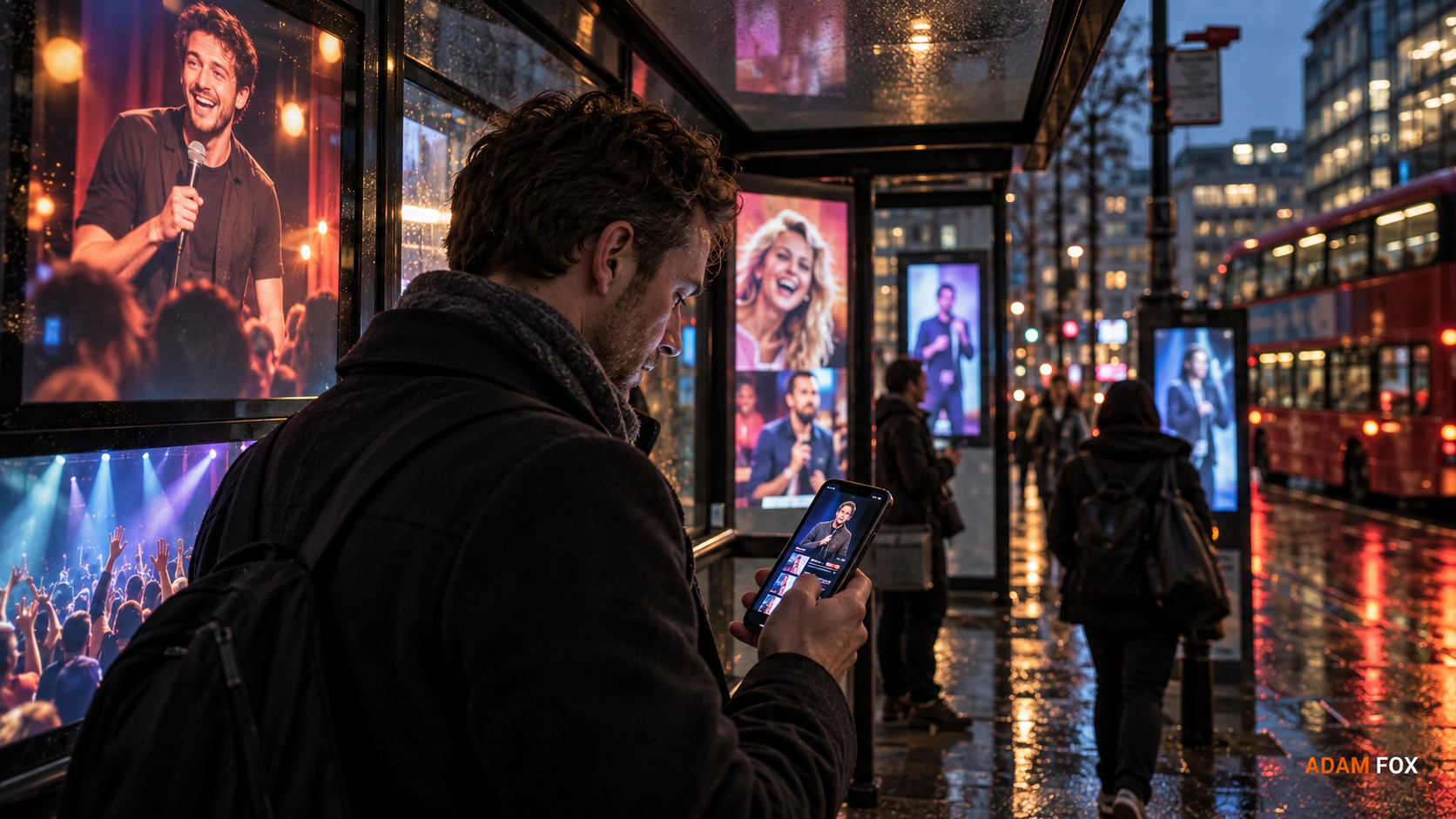
The Contempt Economy: Nobody Asked for This Much Entertainment
The problem isn't that somebody uploaded another video of a stranger being humiliated. It's that somebody else decided millions of people should see it.
And I think we've spent far too long pretending those are the same thing.
Somebody creates a piece of content.
A comedian delivers an offensive joke. An influencer humiliates a stranger. Somebody films an argument in a supermarket. A person makes an unnecessarily cruel remark about somebody they've never met.
They upload it.
Fine.
People have been creating provocative, offensive and occasionally unpleasant entertainment for generations. The internet has simply made publishing it considerably easier.
But what happens next is where things become interesting.
Because the content doesn't necessarily remain confined to the people who deliberately choose to watch it.
It gets recommended.
Distributed.
Repeated.
Placed in front of people who weren't looking for it.
And if the systems responsible discover that people respond strongly to it, the content has the potential to reach an enormous audience.
An audience that might not have any particular interest in the original subject.
An audience that might not even enjoy what they're watching.
And an audience that, in many cases, opened the platform for an entirely different reason.
I find that extraordinary.
We've spent years arguing about whether people should be allowed to produce offensive entertainment.
Whether comedians should be censored.
Whether society has become too sensitive.
Whether free speech is under threat.
And whether the people objecting simply need to develop a sense of humour.
Meanwhile, we've barely begun confronting what I consider a considerably more important question.
Who decided that because something attracts attention, everybody needs to be exposed to it repeatedly?
Because that's not a decision being made by the comedian.
It's not necessarily being made by the person watching.
And it's certainly not being made by the stranger who has become the subject of the entertainment.
It's being made by the systems determining what gets distributed.
And those systems have been designed, developed and optimised by companies with some fairly substantial commercial interests.
I don't believe we can continue discussing the social consequences of modern entertainment without examining the responsibility that comes with those decisions.
I came here to see what my mates were doing
There's something rather absurd about the modern social media experience.
Think about why Facebook originally became so popular.
You could reconnect with people you'd lost touch with.
See what friends were doing.
Share photographs.
Keep up with family.
Discover that someone you went to school with twenty years ago had moved to Australia, had three children and appeared to spend an unreasonable amount of time drinking cocktails beside a swimming pool.
It was social.
Not perfect, obviously.
There were arguments, irritating posts and people sharing far too much information about what they'd eaten for dinner.
But the fundamental proposition was straightforward.
You connected with people.
And you saw what those people chose to share.
Now open Facebook.
How much of what appears in your feed actually comes from the people you know?
That varies enormously between users, of course. I don't have a reliable current figure establishing precisely what proportion of the average Facebook feed comes from friends rather than recommendations.
But the shift towards recommended material is undeniable.
Meta openly acknowledges that its systems recommend content from accounts people haven't chosen to follow.
And in October 2025, the company announced improvements designed to help its recommendation engine learn people's interests more quickly.
A year later, in October 2026, it introduced additional AI-powered controls allowing people to describe the content they wanted to see more or less of.
The company presented these developments as improvements to personalisation.
And from a technological perspective, they are impressive.
But think about the change in the underlying relationship.
You used to choose the people you wanted to hear from.
Now the platform increasingly helps choose the people, subjects and behaviours it believes you'll find interesting.
That's a very different arrangement.
You open Facebook to see what your mates have been doing.
And Facebook effectively decides that what you'd really enjoy is another video of Ricky Gervais absolutely destroying somebody.
Perhaps you watch it.
Perhaps you laugh.
Perhaps you watch another.
And before long, your feed appears to contain more comedians than the Edinburgh Fringe.
But you didn't necessarily go looking for any of them.
You certainly didn't ask for them to become a substantial part of your everyday experience.
You simply demonstrated that you found something entertaining.
And the system interpreted that behaviour as useful information.
Which raises a question I think we should have been asking years ago.
Since when did enjoying something become an invitation to have it repeatedly pushed into your life?
There's a difference between a library and a loudspeaker
Imagine walking into a library.
There are thousands of books.
Some are brilliant.
Some are terrible.
Some contain ideas you agree with.
Others contain things you find deeply offensive.
You can browse.
Explore.
Make decisions.
And choose what you want to read.
The books exist.
You're free to access them.
Now imagine the library employs somebody who follows you around.
Every time you look at a book, they make a note.
You pick up a political satire.
They immediately start placing similar books in front of you.
You glance at a particularly provocative title.
Suddenly, they're following you around the building waving increasingly provocative material in your face.
You try to find a biography.
They hand you another book full of offensive jokes.
You head towards the history section.
They insist you'll probably enjoy something else.
Eventually, you leave.
Not necessarily because the books are objectionable.
Because you're fed up with somebody else deciding what you should consume.
That's a crude analogy, but it illustrates something that I think is fundamental to the modern attention economy.
There's a difference between making something available and actively encouraging somebody to consume it.
One preserves choice.
The other influences choice.
And while both can be perfectly legitimate, they carry different responsibilities.
A comedian making an offensive joke creates entertainment.
A social media platform repeatedly recommending that joke to millions of people makes a distribution decision.
Those aren't identical acts.
The comedian doesn't necessarily know who will encounter the material.
The person watching hasn't necessarily requested it.
But the platform is actively participating in determining where it appears.
And how often.
Now, to be clear, this doesn't mean every recommendation is made through a conscious decision by a human employee.
The systems operate automatically, using complex models trained on enormous quantities of information.
But automation doesn't eliminate responsibility.
Somebody decided what the system should optimise.
Somebody established the objectives.
Somebody determined which signals mattered.
Somebody designed the feedback mechanisms.
And somebody has the authority to change how the system behaves.
An automated decision is still the consequence of a system that human beings chose to build.
And I don't think we should allow the complexity of that system to obscure the responsibility for what it does.
The algorithm isn't simply showing us what we want
There's a particularly interesting admission in Meta's own engineering research.
In January 2026, the company published an explanation of improvements to its Facebook Reels recommendation system.
The engineers described a problem with traditional engagement-based recommendations.
Signals such as likes, shares and watch time don't necessarily reveal what somebody genuinely wants to see.
They can be noisy.
They can be misleading.
And they don't always capture the difference between something that produces short-term engagement and something that provides genuine longer-term value to the user.
That's not me accusing Meta of something.
That's the company's own technical explanation.
Its researchers developed a model using direct survey feedback to improve how accurately recommendations matched people's interests.
The company reported improvements in both user satisfaction and engagement.
Good.
That's progress worth acknowledging.
But I find the underlying admission far more significant than the technical achievement.
Because it confirms something I've been questioning for years.
What captures our attention isn't necessarily what we want more of.
You can watch an argument because you can't believe how ridiculous it is.
You can read an offensive comment because you're astonished somebody would say something so unpleasant.
You can watch a video of somebody being publicly humiliated and feel uncomfortable throughout the entire experience.
And yet you've still watched it.
You've still spent time with it.
You may even have shared it with somebody else to demonstrate how appalling you thought it was.
From the perspective of a recommendation system, that behaviour provides information.
But interpreting the meaning of that information is considerably more complicated.
You might be fascinated.
You might be offended.
You might be amused.
You might be horrified.
You might simply have been too distracted to scroll past.
Those aren't the same psychological experiences.
And I think there's something deeply concerning about the prospect of a system treating all sorts of attention as evidence that more of the same material might be valuable.
Meta is clearly trying to improve its understanding of those distinctions.
But that doesn't eliminate the broader question.
Even if a system becomes exceptionally good at identifying what somebody enjoys, does that mean unlimited repetition is desirable?
I enjoy a good comedy routine.
I don't want offensive comedy accompanying every spare moment of my life.
I enjoy watching a film.
I don't want somebody playing scenes from that film every time I pick up my phone.
I enjoy a bit of sarcasm.
I don't want to spend my entire day immersed in other people being sarcastic towards one another.
There's a difference between preference and proportion.
And I wonder whether we've become so obsessed with identifying people's preferences that we've neglected the importance of how much of any particular thing they consume.
The dose is part of the product
This takes me back to the observation that started the entire series.
Ten or fifteen years ago, somebody who wanted to watch Jimmy Carr might buy a DVD, attend a performance or deliberately select one of his shows.
They'd enjoy a particular form of entertainment within a recognisable context.
And eventually, they'd move on to something else.
Now, the same style of material can appear repeatedly throughout an ordinary day.
Not necessarily because the person has developed an extraordinary obsession with offensive comedy.
But because their viewing behaviour has contributed to the platform's understanding of their interests.
And this is the point I keep returning to.
Perhaps the content isn't inherently the problem.
Perhaps the exposure is.
We've discussed the research into desensitisation.
The way repeated experiences can influence perceptions of social norms.
The possibility that hostility can become more familiar through repetition.
And the evidence that visible social rewards can encourage people to repeat certain behaviours.
None of those findings establishes that watching provocative comedy causes somebody to become cruel.
But they suggest that the consequences of exposure may depend on considerably more than the nature of an individual piece of material.
Frequency matters.
Context matters.
Repetition matters.
And the accumulated environment matters.
Yet much of the debate about online harm still revolves around identifying particular types of content.
Is this video acceptable?
Should this comment be removed?
Has this creator crossed a boundary?
Those are legitimate questions.
But I wonder whether they're too narrow.
Because an individual joke might be perfectly acceptable while an environment saturated with thousands of similar examples creates consequences we haven't adequately considered.
The difference is important.
Something doesn't necessarily have to be harmful in isolation for its repeated exposure to deserve scrutiny.
That's the part of the conversation I think we're missing.
And it raises a responsibility that belongs specifically to the organisations determining how content is distributed.
The responsibility to consider not only what people are shown, but how relentlessly they're shown it.
Follow the money
I'm not particularly interested in pretending that social media companies are charities.
They're businesses.
They employ people.
They invest in technology.
They provide enormously valuable services.
And they're entitled to generate profits.
I own businesses myself.
I understand commercial incentives.
I understand the need to develop products people want to use.
And I understand that a service which people don't find valuable isn't going to remain commercially successful for very long.
But I also understand something else.
What makes a business profitable and what makes its product beneficial aren't automatically the same thing.
Sometimes they align beautifully.
Sometimes they don't.
And when they don't, responsible businesses have to make decisions about which consequences they're prepared to accept.
On 21 October 2026, Meta published its latest quarterly financial results.
The company reported revenue of approximately $64.6 billion for the three months ending September 2026.
Of that, approximately $63.1 billion came from advertising across its Family of Apps.
Its platforms averaged 3.64 billion daily active people during September.
Three point six four billion.
That's an extraordinary scale of human interaction.
Meta also reported that the number of advertising impressions delivered across its Family of Apps had increased by 10% compared with the equivalent quarter the previous year.
And in its financial commentary, the company acknowledged that improvements in AI, recommendations and engagement were contributing additional advertising revenue.
None of that proves Meta deliberately promotes harmful entertainment.
It doesn't establish that its systems prioritise hostility over welfare.
And it certainly doesn't mean every additional minute someone spends on Facebook is financially valuable in precisely the same way.
But it does establish that user engagement and advertising are deeply connected to the company's commercial performance.
And I think that connection matters.
Because when you operate a platform serving billions of people, relatively small changes in behaviour can have substantial commercial consequences.
A little more engagement.
A little more time spent using the service.
A little more advertising exposure.
Those changes can matter enormously at that scale.
Now consider the question from another direction.
What if reducing people's exposure to particularly provocative material improved their longer-term wellbeing but reduced their immediate engagement?
What if showing less of something meant people spent less time scrolling?
What if a recommendation system could identify that particular content was commercially effective but might contribute to undesirable cumulative experiences?
Which objective should take priority?
And who gets to decide?
Those aren't questions that can be answered simply by pointing to a set of quarterly financial results.
But I think the results demonstrate why the questions are important.
Because when revenue and engagement are connected, the company responsible for the system has a commercial interest in how successfully that system keeps people using it.
That's not a conspiracy theory.
It's the business model.
The question is whether the safeguards, incentives and measures of success adequately account for the consequences beyond immediate engagement.
The research exposes an uncomfortable tension
In March 2025, researchers Smitha Milli and colleagues published an investigation in PNAS Nexus examining engagement-based ranking on Twitter, now X.
They compared content selected by an engagement-driven algorithm with content presented through an alternative ranking arrangement.
Their findings were revealing.
The engagement-based system amplified emotionally charged, politically hostile material.
But the content it promoted wasn't necessarily what users said they preferred to see.
Think about that.
The system was effective at identifying material that generated engagement.
But engagement and stated preference weren't always aligned.
Now, this research concerned a particular platform, political content and a specific experimental arrangement.
It doesn't demonstrate that every recommendation algorithm behaves identically.
And it doesn't establish that all entertainment involving humiliation receives disproportionate distribution.
But it reveals an important potential conflict.
A platform can become effective at encouraging people to interact with material without necessarily becoming equally effective at improving the quality of their experience.
And there's another complication.
In 2023, researchers conducting a large field experiment on Facebook and Instagram examined what happened when consenting users were given chronological feeds rather than the default algorithmic recommendations.
The change substantially reduced time spent using the platforms.
It also changed what people encountered.
For Facebook users, exposure to material classified as uncivil or containing slurs fell.
But the researchers didn't find significant changes in the political attitudes they measured during the three-month experiment.
That's important.
Because it demonstrates that changing the content environment doesn't automatically produce dramatic changes in people's underlying beliefs.
We shouldn't assume the consequences of recommendation algorithms are simple, immediate or uniform.
Yet the absence of a measurable change in those particular political attitudes doesn't mean every possible psychological or social consequence has been ruled out.
The study wasn't designed to measure every form of interpersonal consideration, empathy, patience or long-term behavioural adaptation.
And that distinction matters.
There's a danger of treating research as though it answers questions it never attempted to investigate.
I think that's particularly relevant to this subject.
Because the effect I'm interested in isn't simply whether somebody changes their political opinions after using a different feed for three months.
It's whether years of repeated exposure to particular examples of human behaviour gradually influence how people interpret and treat one another.
That's a different question.
And it's one that remains extraordinarily difficult to answer.
But the difficulty doesn't make it irrelevant.
Especially when we already know that recommendation systems can materially alter what people encounter.
We don't need to prove a conspiracy to question the incentives
There's something else I think needs addressing.
The suspicion that technology companies know considerably more about the consequences of their products than they're prepared to disclose.
I understand why people feel that way.
These organisations have access to extraordinary quantities of information.
They can observe patterns in how people interact with content.
They can experiment with different recommendation systems.
They can measure changes in engagement.
And they employ some of the most sophisticated researchers and engineers in the world.
Independent researchers simply don't have the same access to the same information.
That creates a significant imbalance.
Now, it would be irresponsible to conclude that companies possess definitive evidence of particular social harms and are deliberately concealing it without evidence supporting that accusation.
We can't simply assume that because a company has extensive data, it must already know the answers to every question we're asking.
Some relationships are genuinely difficult to establish.
Some effects may only emerge over many years.
And even enormous datasets cannot necessarily isolate the causes of complicated human behaviour.
But I think there's a perfectly legitimate concern about transparency.
Because these companies know far more about how their systems behave than the people subjected to those systems.
They know what they're measuring.
What they're optimising.
What changes they're testing.
And what outcomes they consider commercially successful.
The public generally doesn't.
And independent researchers often have limited visibility into the decisions that determine what billions of people encounter.
That's an uncomfortable arrangement.
Not because every company is acting maliciously.
But because the social consequences of their products extend far beyond their shareholders and customers.
They extend into families.
Schools.
Workplaces.
Communities.
And the ordinary interactions through which society functions.
If a company has the ability to influence those environments at enormous scale, I don't think it's unreasonable to expect a corresponding degree of accountability.
Not just for the content it removes.
For the decisions that determine what it promotes.
We keep confusing freedom of speech with freedom of distribution
This is perhaps the most important distinction in the entire essay.
Somebody should generally be free to create provocative entertainment within the boundaries of the law.
That doesn't mean a commercial platform has an obligation to recommend it to millions of people.
Those are different things.
A comedian can publish an offensive joke.
People who enjoy that comedian can choose to watch it.
The material can remain available to anyone who deliberately seeks it out.
But that doesn't automatically mean the platform needs to place the same joke in front of somebody every time they open an app.
The freedom to create something isn't an entitlement to have it relentlessly amplified.
And choosing not to amplify something isn't necessarily the same as censoring it.
Think about a bookshop.
Thousands of books are available.
The owner decides which ones appear in the window.
Which receive prominent displays.
Which are recommended to customers.
And which remain available on the shelves for people who want them.
The existence of those choices doesn't mean the owner has banned every book that isn't prominently displayed.
It means distribution and promotion involve judgement.
Now, social media operates at an entirely different scale and through much more complicated mechanisms.
There are legitimate concerns about fairness, bias and the concentration of influence in private companies.
Those concerns deserve serious consideration.
But the underlying distinction remains.
Publishing and promoting aren't identical.
And if we're going to debate responsibility for online entertainment, we need to stop pretending they are.
Because the question isn't whether people should be allowed to enjoy offensive humour.
Of course they should.
It's whether companies should bear responsibility for the cumulative consequences of repeatedly pushing particular forms of content into people's lives.
That isn't a demand for censorship.
It's a question about distribution.
And I think it's remarkable how frequently those two conversations become confused.
The UK has started recognising that design matters
There's an important development that suggests regulators are beginning to recognise the distinction.
Under the UK's Online Safety Act, services within scope have duties relating to illegal content and, where applicable, content harmful to children.
Ofcom's guidance on protecting children specifically identifies recommendation systems as features that can influence the risk of harm.
It requires relevant services to assess how their design and operation may expose children to harmful content and to implement proportionate protections.
That's significant.
Because it recognises that online safety isn't simply a question of whether somebody uploads something inappropriate.
The design of the system matters.
The way material is recommended matters.
The way people encounter it matters.
And the features encouraging continued consumption can matter.
Now, the legislation doesn't establish that provocative comedy is inherently harmful.
Nor does it create a general legal obligation to protect every adult from being offended.
And it certainly doesn't answer the broader cultural questions I've been exploring throughout this series.
But I think the underlying principle is important.
The architecture of a platform can contribute to the risks experienced by the people using it.
And responsibility for that architecture cannot reasonably rest entirely with the individuals producing the content.
That's a meaningful shift in how we think about digital environments.
One that I suspect will become increasingly important as recommendation systems grow more sophisticated.
Because we're moving towards technology capable of understanding our preferences with extraordinary precision.
But that precision raises a new question.
Just because a system can predict what will keep somebody engaged, should that always be what it chooses to show them?
There's a difference between giving people what they want and giving them what benefits them
This is where things become philosophically uncomfortable.
Because who gets to decide what's good for somebody?
I don't particularly like the idea of technology companies making moral judgements about what adults should and shouldn't consume.
I don't want Facebook deciding that I need wholesome entertainment rather than Jimmy Carr.
I don't want some corporate committee determining that provocative humour is bad for me.
And I certainly don't want my entertainment choices controlled by somebody who believes their personal values should dictate everyone else's.
That would be an entirely different problem.
But I don't think the alternative has to be unlimited algorithmic amplification.
There's a difference between respecting somebody's preferences and exploiting every opportunity to hold their attention.
And there's a difference between protecting choice and assuming that every moment of engagement represents an informed decision.
Imagine opening Facebook and being presented primarily with content from the people you've deliberately chosen to follow.
You could still discover new creators.
Still watch Reels.
Still enjoy offensive comedy.
Still explore whatever subjects interested you.
But the default experience would be more closely connected to your original intentions.
You'd have meaningful control over how much recommended content entered your feed.
And perhaps the system would be less inclined to assume that watching one type of material meant you wanted it repeatedly.
None of that requires banning anything.
It requires giving greater weight to deliberate choice.
The technology already demonstrates that recommendations can be adjusted according to feedback.
Meta's October 2026 changes are an example of that direction.
The question is how far those controls go, how understandable they are and whether they're sufficient to counteract the tendency of personalised feeds to dominate the experience.
Because there's a distinction between being given the ability to correct a system and being given genuine authority over the environment the system creates.
And I think that distinction matters.
Especially when the default experience is designed by a company whose commercial objectives may not always align perfectly with yours.
You can't outsource every consequence to the user
There's a particular argument I encounter frequently in discussions about digital wellbeing.
People should simply take responsibility for what they consume.
Turn off the phone.
Stop scrolling.
Unfollow the accounts.
Use the settings.
Delete the app.
And to an extent, I agree.
Personal responsibility matters.
I've built a substantial part of my work around helping people recognise that they have more control over their attention than they often realise.
I don't believe we should surrender all responsibility for our behaviour to the technology companies whose products we use.
But there's something rather convenient about businesses designing increasingly sophisticated systems to encourage engagement and then placing the entire responsibility for managing that engagement on the individual.
We wouldn't necessarily accept that logic in other industries.
If a business deliberately designs an environment that influences behaviour, we generally recognise that the design itself deserves scrutiny.
We don't simply assume every possible consequence must be the fault of the person using the product.
And I think the same principle should apply here.
The user has responsibilities.
The content creator has responsibilities.
And the platform has responsibilities.
Those responsibilities aren't identical.
But they coexist.
I can decide not to spend an hour watching offensive comedy.
The comedian can decide what material to create.
And the platform can decide how aggressively it recommends that material to people who haven't actively requested it.
Each has a degree of control.
And each should be accountable for the decisions within that control.
The difficulty is that those levels of control aren't remotely equal.
I can influence what I choose to watch.
But I cannot personally inspect or redesign the recommendation systems determining what billions of people are exposed to.
I cannot establish how much provocative content is being distributed.
I cannot measure the cumulative psychological consequences across society.
And I certainly cannot examine every commercial incentive involved in those decisions.
The companies operating those systems possess considerably greater control over the environment.
And with greater control should come greater responsibility.
Not absolute responsibility for every bad thing that happens.
But meaningful responsibility for the choices they are uniquely positioned to make.
What if we measured the things that don't generate revenue?
There's a question I'd love to put to the people designing these systems.
How do you measure the social value of restraint?
Not simply the absence of content that clearly breaches a rule.
I mean the broader consequences of choosing not to amplify something.
Imagine an algorithm identifies a video of somebody being publicly humiliated.
The video is legal.
It doesn't necessarily violate the platform's policies.
And previous engagement data suggests that distributing it widely might generate substantial interaction.
But the system also recognises that the material involves an unwilling participant whose embarrassment is the primary source of entertainment.
What should happen?
Perhaps nothing.
Perhaps it should remain available to the people who want to watch it.
Perhaps it should receive less prominent distribution.
Perhaps the system should avoid repeatedly recommending similar material.
There are several possible responses.
But whichever approach is chosen, the decision has consequences.
Now consider the difficulty of measuring those consequences.
If the platform amplifies the video, it can measure the views.
The watch time.
The comments.
The shares.
The advertising opportunities.
If it chooses not to amplify the video, what can it measure?
The humiliation that didn't spread?
The additional comments that were never written?
The stranger who didn't wake up to discover that another hundred thousand people had watched their worst moment?
The person who wasn't encouraged to imitate the behaviour?
The social norm that may have been marginally less reinforced?
Those outcomes are extraordinarily difficult to quantify.
And I think that creates a structural problem.
The commercial benefits of amplification can be measured immediately.
Some of the social benefits of restraint may be almost impossible to observe.
And when organisations rely heavily on measurable outcomes, there's a risk that the things which resist measurement become undervalued.
That doesn't mean companies are incapable of considering longer-term welfare.
Meta's own work on measuring genuine user satisfaction demonstrates that more sophisticated objectives are possible.
But it does raise a question about what organisations choose to prioritise.
Because perhaps the most important consequence of a recommendation decision isn't always what happens when something is shown.
Sometimes it's what doesn't happen when something isn't.
And that's a very difficult kind of value to place on a corporate dashboard.
I'm not standing outside this system pointing fingers
There's an uncomfortable contradiction in my own position that I think deserves acknowledging.
I publish content.
I use social media.
I write provocative essays.
I deliberately choose headlines that challenge people and encourage them to pay attention.
And I'm perfectly aware that a particularly sharp observation can attract considerably more engagement than a carefully balanced explanation.
I'm not immune to the incentives I'm describing.
Neither are most people who publish anything online.
We want our work to reach people.
We want it to resonate.
We want people to read it.
And when something performs particularly well, it's tempting to understand why and produce something similar.
That's perfectly natural.
But it creates a responsibility.
Because there's a difference between using provocation to encourage people to think and using provocation simply because it produces a reaction.
I don't want to build an audience by making ordinary people feel small.
I don't want to create outrage for its own sake.
And I don't want the value of my work determined entirely by whether a recommendation system considers it engaging.
That's not why I write.
I want to investigate questions that matter.
Challenge assumptions.
Connect observations.
Explore relationships that existing research may not have examined in their entirety.
And occasionally make people uncomfortable enough to reconsider something they've previously accepted without question.
But that discomfort should serve a purpose.
It shouldn't simply be a mechanism for keeping somebody scrolling.
Because if I start measuring the value of my writing entirely through engagement, I'll eventually risk making decisions that serve the platform rather than the reader.
And I think that's precisely the problem we're discussing.
The commercial environment can begin influencing the behaviour of the people operating within it.
Creators learn what performs.
Platforms learn what retains attention.
Audiences learn what attracts approval.
And over time, those influences can begin reinforcing one another.
Not because everybody involved has deliberately decided to make society more hostile.
But because the system rewards particular outcomes.
And people adapt.
Nobody asked for this much entertainment
I want to return to something that I think gets lost in almost every discussion about the attention economy.
Most people didn't join social media because they wanted an unlimited supply of entertainment.
They joined to connect.
To communicate.
To see what friends were doing.
To share parts of their lives.
To discover things.
And to participate in communities.
Over time, those platforms became increasingly sophisticated at identifying content capable of capturing attention.
And the experience changed.
Not overnight.
Gradually.
More recommendations.
More short-form video.
More personalised content.
More opportunities to keep watching.
And increasingly, less need to decide what you wanted to consume next.
The system would decide for you.
Again, there are enormous benefits to that.
People discover things they love.
They find communities.
Learn skills.
Encounter ideas they might otherwise have missed.
And enjoy genuinely brilliant entertainment.
I don't want to ignore any of that.
But I think we've become far too comfortable assuming that more entertainment is automatically better.
That if somebody enjoys something, they should be exposed to more of it.
That if a video generates engagement, it deserves wider distribution.
And that if content attracts attention, the attention itself is evidence of value.
I don't believe those assumptions hold up.
Not when we're discussing the cumulative effects of what people consume.
Not when we're considering how repeated exposure can influence perceptions of normal behaviour.
And certainly not when somebody else's humiliation has become the source of the entertainment.
Because the internet doesn't simply provide us with information anymore.
It increasingly constructs the environment through which we observe other human beings.
It influences which behaviours appear common.
Which people appear important.
Which interactions deserve attention.
And which examples of humanity are repeated until they become familiar.
That's an extraordinary amount of influence.
And I don't believe the organisations exercising it should be able to avoid responsibility by claiming they're simply giving people what they want.
Not when the systems deciding what people want are built and operated by those same organisations.
Not when the commercial incentives are connected to engagement.
And not when the consequences of repeated exposure remain insufficiently understood.
The responsibility isn't to make the internet harmless
I don't want a sanitised internet.
I don't want every provocative opinion suppressed.
I don't want comedians prevented from doing what comedians have always done.
And I don't want society becoming so frightened of uncomfortable ideas that nobody is prepared to challenge anything.
That would be a disaster.
But I also don't believe the only alternative is an environment where virtually anything capable of generating attention can be repeatedly pushed towards people who never deliberately sought it out.
There has to be room between those extremes.
Room for deliberate choice.
Room for restraint in distribution.
Room for meaningful transparency about what recommendation systems optimise.
Room for independent investigation into the longer-term consequences of repeated exposure.
And room for companies to recognise that commercial success isn't the only relevant measure of whether their products are serving society well.
We shouldn't need definitive proof of every possible psychological consequence before asking whether the architecture of an entertainment environment deserves improving.
Nor should we assume that every proposed safeguard represents an attack on freedom.
Sometimes the most responsible decision isn't to remove something.
It's simply not to push it quite so aggressively.
And perhaps that's the distinction we need to recover.
The right to create.
The freedom to choose.
And the responsibility involved in deciding what gets amplified.
They're three different things.
Yet we've spent years arguing about the first while allowing the third to shape enormous portions of our lives.
I think it's time we started paying closer attention.
Because the question isn't whether Jimmy Carr should be allowed to make an offensive joke.
Of course he should.
The question is why somebody who enjoyed that joke once might encounter similar material repeatedly, across different platforms, throughout an ordinary week.
And who benefits when that happens.
We know the platforms provide valuable services.
We know creators can benefit enormously from their distribution.
We know audiences enjoy discovering content they might otherwise have missed.
But we also know that what captures attention isn't necessarily what people genuinely want more of.
We know that engagement-based recommendations can amplify hostile material.
And we know that repeated exposure can influence some psychological responses, even if the broader social consequences remain difficult to establish.
I think those facts are sufficient to justify asking bigger questions.
Questions about responsibility.
About restraint.
About the cumulative environment we're creating.
And about whether the relentless pursuit of engagement is always compatible with the kind of society we want to live in.
Because perhaps we've been asking the wrong question all along.
Not whether the content is acceptable.
Not whether the comedian should be allowed to say it.
Not whether the person watching is too easily offended.
But whether the people deciding how relentlessly that content is distributed have given sufficient consideration to what repeated exposure might be doing to us.
Nobody asked for this much entertainment.
We opened our phones to see what the people we cared about were doing.
And somewhere along the way, somebody decided that showing us whatever would keep us watching was a better business model.
I think it's time we questioned what that decision is costing us.
Independent research and sources
1. Meta Platforms (21 October 2026). Meta Reports Third Quarter 2026 Results.
Official financial results showing $64.6 billion in quarterly revenue, approximately $63.1 billion from advertising, and 3.64 billion daily active people across its Family of Apps. The company's commentary links AI investment, stronger engagement and improved recommendations with additional advertising revenue. These figures establish commercial incentives, not deliberate promotion of harmful content.
2. Meta Engineering (14 January 2026). Adapting the Facebook Reels RecSys AI Model Based on User Feedback.
A technical explanation of Meta's efforts to improve recommendation quality by supplementing behavioural engagement signals with direct user survey feedback. It acknowledges the limitations of interpreting likes, shares and watch time as reliable evidence of genuine user interests.
3. Meta (13 October 2026). Your Algorithm, Your Words: New Ways to Shape What You See on Facebook.
Meta's announcement of AI-powered tools allowing users to provide more detailed feedback and influence personalised recommendations within Facebook Feed and Reels.
https://about.fb.com/news/2026/10/introducing-your-algorithm-facebook/
4. Milli, S., Carroll, M., Wang, Y., Pandey, S., Zhao, S., & Dragan, A. D. (2025). Engagement, User Satisfaction, and the Amplification of Divisive Content on Social Media. PNAS Nexus, 4(3), pgaf062.
A preregistered algorithmic audit demonstrating that engagement-based ranking on Twitter amplified emotionally charged and hostile political material, including content users did not necessarily prefer.
https://doi.org/10.1093/pnasnexus/pgaf062
5. Guess, A. M., Malhotra, N., Pan, J., et al. (2023). How Do Social Media Feed Algorithms Affect Attitudes and Behavior in an Election Campaign? Science, 381(6656), 398–404.
A large field experiment during the 2020 US election examining the effects of replacing algorithmic Facebook and Instagram feeds with chronological ordering. The intervention reduced time spent on the platforms and changed exposure patterns but did not produce statistically significant changes in measured political attitudes over three months.
https://doi.org/10.1126/science.abp9364
6. Ofcom (2026). Protection of Children Duties Under the Online Safety Act.
Regulatory guidance explaining how relevant online services must assess and mitigate risks to children, including those created or intensified by recommendation systems and other service-design features.
7. Ofcom (10 December 2025). Online Nation 2025: From Apps to AI Search — How the UK Goes Online.
Research reporting that UK adults spent an average of four and a half hours online daily, with Alphabet- and Meta-owned services accounting for more than half of total online time.
8. Robertson, C. E., Del Rosario, K. S., & Van Bavel, J. J. (2024). Inside the Funhouse Mirror Factory: How Social Media Distorts Perceptions of Norms. Current Opinion in Psychology, 60, 101918.
An interdisciplinary review examining how selective exposure to disproportionately visible or extreme online behaviour can distort perceptions of what others believe and consider normal.
https://doi.org/10.1016/j.copsyc.2024.101918
Research gaps and questions for further investigation
Cumulative exposure: Independent longitudinal research is needed to establish whether repeatedly recommended provocative or humiliation-based entertainment produces different psychological and social outcomes from deliberately chosen exposure to the same material.
Recommendation objectives: More transparency is required regarding the extent to which platforms optimise engagement, satisfaction, retention, wellbeing, content diversity and safety, and how competing objectives are weighted.
Commercial incentives: Research should examine whether changes designed to reduce exposure to potentially harmful but engaging material create meaningful commercial trade-offs, rather than assuming such conflicts are inevitable in every circumstance.
Distribution versus availability: More investigation is needed into the consequences of making content discoverable through deliberate search while reducing its automatic recommendation, including effects on expression, user choice, creator livelihoods and cumulative exposure.
Behavioural feedback versus genuine preference: Existing research confirms that engagement is an imperfect proxy for user satisfaction. Further evidence is needed on the effectiveness of explicit preferences, personalised exposure limits and user-controlled recommendation settings.
Long-term social consequences: There is insufficient evidence to quantify how recommendation systems may contribute to changes in social norms, empathy, restraint, interpersonal hostility or expectations of other people over multiple years.
Independent access to platform data: Researchers require appropriate privacy-protecting access to data and experimental evidence capable of testing public-interest questions that cannot be adequately answered using information visible to ordinary users.
Children and adults: Regulatory attention has increasingly focused on protecting children, but more research is needed into the broader effects of content saturation on adults and the indirect consequences for the social environments in which children develop.
Alternative business models: Further investigation should compare advertising-led recommendation systems with subscriptions, more chronological feeds, stronger user-directed discovery and other approaches, without assuming that any single model automatically produces better outcomes.
The central argument of this essay is that responsibility for online entertainment extends beyond those creating and consuming it to the organisations determining how extensively it is distributed. The commercial incentives and technical mechanisms are documented. Their precise contribution to wider social changes remains uncertain and warrants further investigation.