
The Contempt Economy: It's Only a Joke. Until You're the Joke.
For you, it was thirty seconds of entertainment. For somebody else, it might have been the worst day of their life.
And the chances are, you'll never know.
You'll never know whether the person you laughed at went home embarrassed.
Whether they spent the evening replaying what happened.
Whether they were already struggling with something nobody else knew about.
Whether they lay awake wondering how many people had seen the video.
Or whether they woke up the next morning frightened to leave the house.
Because you weren't there for any of that.
You watched the clip.
You laughed.
Perhaps you left a comment.
Maybe you shared it with a mate.
And then you carried on scrolling.
By lunchtime, you'd probably forgotten the whole thing.
But the person in the video?
They don't necessarily get to forget.
And increasingly, I think we're overlooking that rather important distinction.
We've developed an extraordinary appetite for watching other people being humiliated.
Sometimes it's genuinely funny.
Sometimes somebody has behaved so ridiculously that the reaction seems entirely deserved.
Sometimes the humour comes from a clever observation, an unexpected response or a perfectly delivered insult.
And sometimes it's simply somebody being unnecessarily cruel to another human being.
But whatever the circumstances, there's something that I think deserves considerably more consideration.
The audience experiences the entertainment. The person being humiliated experiences the consequences.
And those can be two completely different things.
Everybody loves a good comeback
I love comedy.
I enjoy provocative humour.
I've laughed at things that, if I'm being perfectly truthful, I probably shouldn't have found quite so funny.
Jimmy Carr. Ricky Gervais. Frankie Boyle.
I find them hilarious.
And I don't feel remotely guilty about that.
I can appreciate a brilliantly delivered insult without believing that every offensive remark is automatically acceptable in ordinary life.
Because context matters.
We've explored that throughout this series.
A comedian performing for a willing audience operates within a particular social arrangement.
People generally understand what they're attending.
They know the performer.
They understand the style of entertainment.
And they have some expectation of what the experience might involve.
It's not unconditional permission to humiliate people, but the context makes an enormous difference.
Now consider what happens when somebody takes that particular style of humour and introduces it into an ordinary interaction.
Perhaps somebody working behind a shop counter makes a mistake.
Maybe someone says something awkward at a family gathering.
Perhaps a stranger behaves in a slightly unusual way in public.
And somebody decides that the situation presents an excellent opportunity to make a joke at their expense.
The remark lands.
People laugh.
The amateur comedian feels rather pleased with themselves.
After all, they've made people laugh.
What could possibly be wrong with that?
Well, quite a lot, potentially.
Because the person being mocked didn't necessarily agree to participate.
They weren't performing.
They weren't attending a comedy show.
They weren't inviting an audience to examine their behaviour.
They were simply going about their life.
And somebody else decided that their discomfort represented an opportunity for entertainment.
That distinction seems remarkably obvious to me.
Yet judging by the volume of humiliating content circulating online, I suspect it's one we're increasingly willing to overlook.
The person laughing knows what they meant
There's a particular phrase that I think has become one of the most convenient excuses in modern social interaction.
It's only a joke.
Three words.
Apparently capable of absolving somebody of almost anything they've said.
Make an unnecessarily cruel remark about someone's appearance?
It's only a joke.
Embarrass somebody in front of their colleagues?
It's only a joke.
Mock somebody's insecurity?
It's only a joke.
Continue taking the piss long after the other person has stopped enjoying it?
For fuck's sake. Can't you take a joke?
And suddenly, the conversation isn't about the behaviour itself.
It's about the supposedly inadequate sense of humour of the person receiving it.
Psychologists Justin Kruger, Cameron Gordon and Jeff Kuban investigated this phenomenon back in 2006.
Their research examined the difference between how people making teasing remarks interpret their behaviour and how the people receiving those remarks experience it.
The findings were revealing.
People delivering teasing remarks often regarded their behaviour as playful and relatively harmless.
The recipients were considerably more likely to interpret the same remarks as malicious.
The person making the joke understood their own intentions.
The recipient didn't necessarily experience those intentions in the same way.
And that's where things become complicated.
Because we judge ourselves through what we believe we intended.
But other people experience us through what we actually do.
You might genuinely believe you were being funny.
That doesn't mean the other person found it funny.
You might believe the remark was harmless.
That doesn't mean it caused no harm.
And you might believe somebody is being unnecessarily sensitive.
That doesn't mean you've correctly understood their circumstances.
There's a distinction between intending to hurt somebody and hurting somebody.
The two aren't always the same.
And recognising that difference isn't political correctness.
It's basic social awareness.
The audience disappears. The embarrassment doesn't.
Imagine an ordinary person being filmed during an embarrassing moment.
Not a celebrity.
Not a politician.
Not somebody who deliberately chose a life in the public eye.
Just an ordinary person.
Perhaps they're frustrated.
Perhaps they've made a mistake.
Perhaps they've responded badly to somebody provoking them.
Or perhaps they've done absolutely nothing wrong.
Somebody records the interaction.
The video is uploaded.
And suddenly, a moment that should have lasted thirty seconds has acquired an entirely different existence.
People share it.
Comment on it.
Make jokes about it.
Add their own interpretations.
Some defend the person.
Others criticise them.
Some decide to make the situation considerably worse by inventing circumstances nobody involved has confirmed.
And the person at the centre of it all has almost no control over what happens next.
What interests me here is the difference between the original interaction and its digital afterlife.
Historically, a humiliating experience might have been witnessed by a relatively small number of people.
That doesn't mean it was harmless.
Embarrassment can be deeply unpleasant regardless of how many people are watching.
But the audience was generally limited by the circumstances.
Now, the audience can continue expanding long after the original interaction has ended.
And the embarrassment can be revisited repeatedly.
In 2024, researchers Charles Monge, Nicholas Matthews and David DeAndrea published a study in the Journal of Communication investigating the persistence of harmful online messages.
Their experiment involved 520 participants.
They found that messages perceived as remaining visible for longer were judged to be more harmful, and that people were more inclined to blame moderators who could have intervened but hadn't.
Now, this wasn't a study measuring the psychological distress of people appearing in humiliating videos.
It examined how observers interpret persistent harmful messages.
But it highlights something fundamental about the digital environment.
The duration of harm is no longer necessarily determined by the duration of the original behaviour.
And I think that's extraordinarily important.
Because the person making the joke can move on.
The audience can move on.
Even the person who uploaded the video might eventually forget about it.
But the material can remain accessible.
It can resurface.
It can reach somebody new.
It can become the subject of another round of ridicule.
And the person involved may have to confront the same moment again and again.
Not because they've done anything new.
Because somebody else has rediscovered something old.
We've turned humiliation into something people can revisit
There's an aspect of the internet that I find particularly unsettling.
We don't simply witness embarrassing moments anymore.
We preserve them.
And then we distribute them.
And then we encourage other people to revisit them.
Sometimes years later.
Imagine making an embarrassing mistake at seventeen.
Something stupid.
Something immature.
Something that your friends find hilarious.
Twenty years ago, that moment might have become an occasionally embarrassing story told at a reunion.
Today, there's a possibility that somebody recorded it.
And that recording might exist long after everyone involved has grown up.
Perhaps it will never resurface.
Perhaps nobody will care.
But perhaps somebody will find it, share it, and give an entirely new audience the opportunity to pass judgement.
What bothers me is the loss of control.
The inability to decide when an embarrassing chapter of your life should be allowed to end.
In 2024, communication researcher Michael Haugh examined 26 incidents of online public denunciation.
His analysis explored how recordings, photographs and descriptions of behaviour could become the starting point for wider public condemnation.
A moment of behaviour is removed from its original circumstances.
It's presented to a new audience.
People interpret it.
They judge it.
They share it.
And the act of sharing invites more people to participate.
This is particularly interesting because the people joining in don't necessarily understand the original interaction.
They may not know what happened beforehand.
They may not understand the relationship between those involved.
They might not know whether the person being mocked was frightened, distressed, confused or deliberately provoked.
But they have enough information to produce a reaction.
And social media makes reacting extraordinarily easy.
A laugh.
A comment.
A share.
A sarcastic remark.
Another joke.
Individually, those actions might appear relatively insignificant.
Collectively, they can transform a single embarrassing moment into an experience involving thousands of strangers.
And the person being targeted isn't necessarily being judged for what actually happened.
They're being judged according to whatever version of events has become popular.
The crowd doesn't know the person
This is where I think the human consequences become particularly difficult to understand.
Because a person on a screen is still a person.
That sounds ridiculously obvious.
But I wonder how frequently we actually remember it.
Imagine watching somebody being ridiculed online.
You don't know them.
You don't know their family.
You don't know whether they're confident or insecure.
You don't know whether they've recently experienced a bereavement.
You don't know whether they're struggling financially.
You don't know whether they've spent the last six months dealing with anxiety, depression or some other difficulty.
You know almost nothing about them.
You know what you've been shown.
And sometimes that's less than a minute of their entire existence.
Yet people are remarkably comfortable forming judgements based on those fragments.
They're stupid.
They're pathetic.
They're weird.
They're ugly.
They're ridiculous.
They're deserving of ridicule.
And before long, the comment section can become a competition to see who can produce the most devastating insult.
Now, perhaps the person featured really has behaved appallingly.
Perhaps criticism is entirely justified.
Perhaps there's a legitimate public interest in exposing what happened.
Those possibilities matter.
But they don't automatically justify every subsequent act of humiliation.
And they certainly don't mean that everybody participating in the ridicule understands the consequences of their behaviour.
I think there's something deeply uncomfortable about strangers collectively deciding that somebody deserves to be humiliated without knowing anything meaningful about the person they're targeting.
Because what they're experiencing isn't a relationship.
It's entertainment.
The person becomes a character.
A subject.
A target.
Something to react to.
And somewhere in that process, I suspect it becomes easier to forget that there's an actual human being attached to the image.
Somebody who exists independently of the joke.
Somebody who has to continue living after the comments stop.
The pile-on changes everything
There's another distinction that I think deserves considerably more attention.
One person making an offensive remark isn't necessarily the same experience as a hundred people doing it.
Even when each person believes they're making an isolated joke.
Imagine somebody publishing an unkind comment about a stranger.
The person reads it.
Perhaps they're hurt.
Perhaps they shrug it off.
Perhaps they challenge it.
Now imagine another person adding a comment.
Then another.
Then another.
Each one slightly more personal.
Slightly more humiliating.
Slightly more aggressive.
Eventually, the original remark has become something much larger.
But here's the problem.
The twentieth person commenting might not feel responsible for the first nineteen comments.
They might believe they're simply adding a bit of humour to an existing conversation.
They might not even consider the possibility that the person being discussed is reading everything.
They just see an opportunity to contribute.
And perhaps receive a little approval of their own.
Yet the person on the receiving end doesn't necessarily experience twenty independent jokes.
They experience twenty people directing ridicule towards them.
And if that becomes two hundred people?
Or two thousand?
The experience changes again.
One person's joke can become another person's sustained humiliation when an audience decides to join in.
Not everybody who laughs at something is participating in bullying.
And not every unpleasant comment forms part of a coordinated campaign.
But there's a difference between an isolated incident and a cumulative experience.
And that difference is particularly important when we start discussing the psychological consequences.
Because people don't necessarily process every interaction independently.
Experiences accumulate.
They interact with existing insecurities.
They affect how safe people feel.
And they can influence the way somebody understands their own place in the world.
Which is where the subject becomes considerably more serious than whether somebody has a sense of humour.
The research tells us the consequences can be substantial
In February 2026, researchers Yixuan Li, Yuhui Liu, Monja Knoll and Ingrid Obsuth published a substantial systematic review in Clinical Psychology Review.
They examined 125 studies involving 260,608 participants across 33 countries.
Their research investigated the mechanisms linking cyberbullying victimisation with psychological difficulties among young people.
And the findings were concerning.
Cyberbullying victimisation was associated with increased risks of depression, anxiety, self-harm and suicidality.
But the researchers were interested in more than the existence of those relationships.
They wanted to understand what might help explain them.
Their analysis identified several significant pathways, including emotional regulation difficulties, internal psychological distress, stressful experiences and social support.
That last one particularly interests me.
Social support.
Because I wonder whether one of the most damaging aspects of public humiliation isn't simply what somebody says to you.
It's what the experience might lead you to believe about how other people see you.
Imagine a child being humiliated online.
They see the comments.
They see people laughing.
Perhaps some of those people are classmates.
Perhaps some are complete strangers.
Perhaps somebody they considered a friend has joined in.
What does that experience communicate?
That people think they're ridiculous?
That nobody likes them?
That they're somehow deserving of being treated badly?
Those conclusions aren't necessarily accurate.
And they aren't inevitable.
But they're entirely plausible interpretations for somebody already struggling with confidence or belonging.
And when humiliation becomes public, it can potentially interfere with something fundamental to psychological wellbeing.
Our sense of connection to other people.
I think that's a much more important consideration than whether the original remark was particularly funny.
Because the person delivering the insult might be thinking about entertainment.
The person receiving it might be thinking about their own worth.
Those are two extraordinarily different experiences.
The damage isn't always visible
There's something about human distress that I think we regularly misunderstand.
We tend to recognise suffering when somebody demonstrates it.
They cry.
They become visibly upset.
They get angry.
They withdraw from an interaction.
They tell us they've been hurt.
But not everybody responds like that.
Some people become quiet.
Some laugh along.
Some minimise what happened.
Some pretend they don't care.
And some go home and process the entire experience privately.
This isn't limited to online abuse.
It happens in schools.
Workplaces.
Friendship groups.
Families.
Everywhere human beings interact.
But the digital environment introduces another complication.
The people responsible may never observe the emotional response.
They see the content.
They see the reactions.
They see the engagement.
They don't necessarily see what happens afterwards.
And I wonder whether that distance influences how seriously people consider the consequences.
Because if somebody makes a cruel remark to a person standing directly in front of them, they might witness the impact.
They might see the person's expression change.
They might recognise that the joke has gone too far.
They might feel uncomfortable themselves.
Online, those signals can disappear.
The person making the remark might never encounter the recipient again.
The audience certainly might not.
And the entire interaction can become a collection of words and numbers on a screen.
Yet the emotional consequences are experienced by somebody living in the physical world.
Somebody with a body that responds to stress.
A mind that can replay uncomfortable experiences.
And relationships that may be affected by what has happened.
I think that's an important part of this conversation.
Digital humiliation isn't experienced by a digital person.
It's experienced by a human being.
And the consequences don't necessarily remain online.
The point where entertainment becomes dangerous
I want to address something particularly uncomfortable.
Because when we discuss online humiliation, bullying and the psychological consequences of public ridicule, there is a subject that we cannot responsibly ignore.
Suicide.
And I think we need to approach it with considerably more care than the internet generally encourages.
I've seen discussions where somebody dies and people immediately identify the online abuse they experienced as the reason.
Sometimes there may be strong evidence that the abuse contributed to their distress.
Sometimes the circumstances are less clear.
And sometimes the public has nowhere near enough information to understand what happened.
Suicide is extraordinarily complex.
Mental health, social circumstances, relationships, previous experiences, acute distress and countless other influences can interact.
It is rarely possible to identify one event as the sole cause of somebody's death.
And when the person is no longer here to explain their experience, our understanding becomes even more limited.
But there's an important distinction between recognising that complexity and dismissing the potential contribution of online abuse.
Research has repeatedly identified serious associations between cyberbullying and suicidal thoughts and behaviours.
In 2018, researchers led by Ann John at Swansea University published a systematic review covering 26 independent studies and more than 156,000 children and young people.
Their meta-analysis found that people who experienced cyberbullying had substantially higher odds of self-harm and suicidal behaviours than those who had not.
For example, the pooled odds of self-harm were approximately 2.35 times higher among those experiencing cyberbullying victimisation.
That doesn't establish that cyberbullying directly caused those outcomes.
People experiencing abuse may also face other difficulties, and the relationships can be complicated.
But it does establish that the association is serious.
And the more recent 2026 review adds considerably to our understanding of the psychological mechanisms potentially involved.
So I think there's a legitimate question to ask.
If we know that sustained online humiliation and bullying are associated with serious psychological distress, why are we so comfortable treating public ridicule as harmless entertainment simply because the people delivering it claim they're joking?
Not every offensive joke is bullying.
Not every humiliating video produces serious distress.
And certainly not every person who experiences online abuse will develop a mental health problem.
But we know enough to recognise that the consequences can sometimes be substantial.
And those consequences deserve consideration before something terrible happens.
Not only afterwards.
Because the purpose of understanding risk isn't to allocate blame once somebody has suffered.
It's to recognise where harm might be prevented.
And to help people access support before their circumstances become overwhelming.
The problem with demanding proof of harm
There's another aspect of this conversation that bothers me.
We often seem to demand evidence that somebody has been seriously hurt before we're prepared to acknowledge that behaviour might have been unacceptable.
Someone objects to a cruel remark.
They're told to stop being sensitive.
Someone explains that a joke made them uncomfortable.
They're told they're overreacting.
Someone asks for a humiliating video to be removed.
They're told to develop a sense of humour.
But if the consequences later become severe?
Suddenly everybody starts talking about kindness.
Mental health.
The importance of treating people decently.
And how nobody could possibly have known.
I find that contradiction difficult to reconcile.
Because surely we shouldn't need somebody to experience serious psychological distress before we recognise the value of basic consideration.
I don't need a scientific study to tell me that deliberately humiliating somebody can be unpleasant.
I don't need to know whether somebody has an existing mental health condition before recognising that an unnecessarily cruel remark might hurt them.
And I don't believe the responsibility to behave reasonably should depend on whether the recipient can demonstrate the extent of their suffering.
That doesn't mean we should treat every uncomfortable experience as evidence of wrongdoing.
Sometimes people will misunderstand us.
Sometimes jokes will fall flat.
Sometimes somebody will be offended by something entirely reasonable.
And sometimes difficult conversations need to happen regardless of whether people find them uncomfortable.
But there's a difference between accepting that discomfort is an unavoidable part of human interaction and deliberately creating discomfort because it entertains other people.
And I think that distinction gets lost far too frequently.
We shouldn't need proof that somebody has been damaged before deciding that their dignity was worth considering.
It's different when it's your child
As a father, this is where the subject becomes considerably more personal.
I have two daughters.
And like most parents, I want them to grow up confident, resilient and capable of navigating difficult relationships.
I don't want to shield them from every uncomfortable experience.
I don't want them believing that other people have an obligation to agree with everything they say.
And I certainly don't want them growing up thinking that the world should accommodate every emotional response they experience.
That's not how life works.
But I do want them to understand the difference between being challenged and being humiliated.
Between somebody making a joke and somebody deliberately trying to make them feel small.
Between ordinary friendship disagreements and behaviour intended to undermine their confidence.
And I want them to understand those distinctions from both sides.
Because I don't simply want to protect them from becoming the target of cruelty.
I want them to recognise when they might be contributing to it themselves.
Imagine your child coming home upset because somebody has made an embarrassing video of them.
Other children have seen it.
Perhaps they've shared it.
Perhaps people are laughing.
Perhaps the situation has already become something the adults involved don't fully understand.
As a parent, your immediate concern probably isn't whether the original joke was particularly clever.
It's how your child is coping.
Whether they feel supported.
Whether they're frightened about returning to school.
Whether they believe their friends have turned against them.
And whether they know that what happened doesn't determine their value as a person.
Now imagine being the parent of the child who uploaded the video.
Would you consider the behaviour harmless simply because it attracted hundreds of likes?
Would you celebrate the fact that your child had entertained their friends?
Would you tell the other family to stop being so sensitive?
I'd hope not.
I'd hope you'd want your child to understand that other people aren't simply material for their entertainment.
Because that's the lesson that matters.
Not whether the video was popular.
Not whether everybody laughed.
Whether the behaviour demonstrated appropriate consideration for another human being.
And I think that's something we need to teach much more deliberately.
Not every embarrassment requires an audience
There's an uncomfortable question sitting underneath all of this.
Why do we increasingly feel compelled to share other people's embarrassing moments?
Think about the videos that circulate online.
Someone trips over.
Someone makes a mistake.
Someone becomes angry.
Someone says something ridiculous.
Someone behaves in a way that other people find amusing.
And somebody reaches for their phone.
Sometimes the resulting content is genuinely harmless.
The person featured might enjoy the joke as much as everybody else.
They might have agreed to being recorded.
They might even be the person who uploads it.
There's nothing inherently wrong with sharing funny moments.
But sometimes the person being recorded hasn't consented.
They may not even realise what's happening.
And the decision about whether their behaviour becomes entertainment is made by somebody else.
That's where I think we need to exercise considerably more judgement.
Because recording something doesn't automatically mean it needs publishing.
And witnessing something funny doesn't automatically create an entitlement to distribute it.
Perhaps somebody's embarrassing moment can simply remain an embarrassing moment.
Perhaps an awkward interaction doesn't need a global audience.
Perhaps a stranger having a bad day doesn't need their behaviour preserved for other people to laugh at.
And perhaps the fact that something would attract engagement isn't a particularly good reason to share it.
I find it interesting that we've become increasingly concerned about protecting personal information online while simultaneously normalising the publication of other people's most uncomfortable experiences.
We worry about privacy.
We worry about data.
We worry about what companies know about us.
Yet people will happily upload a video of a complete stranger in an embarrassing situation without giving much consideration to what that person might want.
It's a peculiar contradiction.
And I think it reflects a broader problem.
We're becoming extraordinarily comfortable treating other people's lives as content.
Even when those people never agreed to become part of the entertainment.
Who is responsible when the crowd joins in?
I don't believe responsibility for online humiliation sits entirely with one person.
There are different decisions being made at different stages.
The person who delivers the original remark.
The person who records the interaction.
The person who uploads it.
The people who share it.
The people who add their own insults.
And the systems that determine how widely the content circulates.
Those decisions aren't equally harmful in every situation.
Nor is everybody who watches or laughs morally responsible for every consequence.
That would be a ridiculous standard.
But I think it's equally ridiculous to pretend that the wider audience has no influence.
Consider what happens when somebody makes an offensive joke about another person.
If nobody responds positively, the incentive to repeat the behaviour may be limited.
If thousands celebrate it, that creates a very different form of feedback.
And if the interaction is repeatedly shared, the person receiving the ridicule may experience consequences far beyond the original incident.
We've explored the social reinforcement mechanisms in the previous essay.
But here I think the responsibility deserves examining from another angle.
Not whether the audience encourages the person delivering the joke.
Whether the audience recognises that the person receiving it exists.
And whether that recognition influences what they choose to do next.
Sometimes the most considerate response might be to challenge the behaviour.
Sometimes it might be to avoid sharing the content.
Sometimes it might be to offer support privately.
And sometimes it might simply be to recognise that a stranger's humiliation doesn't require your participation.
We don't have to respond to everything.
We don't have to share everything.
And we certainly don't have to contribute another insult simply because everybody else seems to be enjoying themselves.
There's a form of maturity in recognising that you're not obliged to participate in somebody else's entertainment.
Especially when the entertainment comes at the expense of someone who didn't choose to be involved.
Comedy isn't the problem. Indifference might be.
I want to be careful not to turn this into an argument against offensive humour.
Because that's not what I believe.
I think comedy serves an important purpose.
It challenges authority.
It exposes hypocrisy.
It allows us to explore uncomfortable subjects.
It gives people permission to laugh at things that might otherwise feel too difficult to discuss.
And sometimes the most offensive joke is also the most insightful.
I don't want to lose any of that.
But I don't believe the value of comedy depends on removing our responsibility to consider other people.
Professional comedians can make mistakes.
Ordinary people can make mistakes.
We all can.
And somebody occasionally saying something inappropriate isn't evidence that society is collapsing.
What concerns me is the possibility that we've developed an entertainment environment in which the consequences for the person delivering the joke and the person receiving it have become increasingly disconnected.
The comedian gets applause.
The content creator gets views.
The person sharing the video gets engagement.
The audience gets entertainment.
And the person being humiliated?
Well, apparently they should learn to take a joke.
I struggle with that.
Because it places almost the entire burden of emotional responsibility on the person with the least control over the interaction.
The person who didn't necessarily ask to participate.
The person who might not have consented to being recorded.
The person who cannot control how widely the material circulates.
And the person whose response may become another opportunity for ridicule.
That's an extraordinarily uneven arrangement.
And I don't think acknowledging it makes me woke.
I think it makes me somebody who recognises that other people exist beyond their usefulness as entertainment.
The moment everybody moves on
There's a particular image I keep coming back to.
Not a real incident.
Just a hypothetical moment that, unfortunately, doesn't require much imagination.
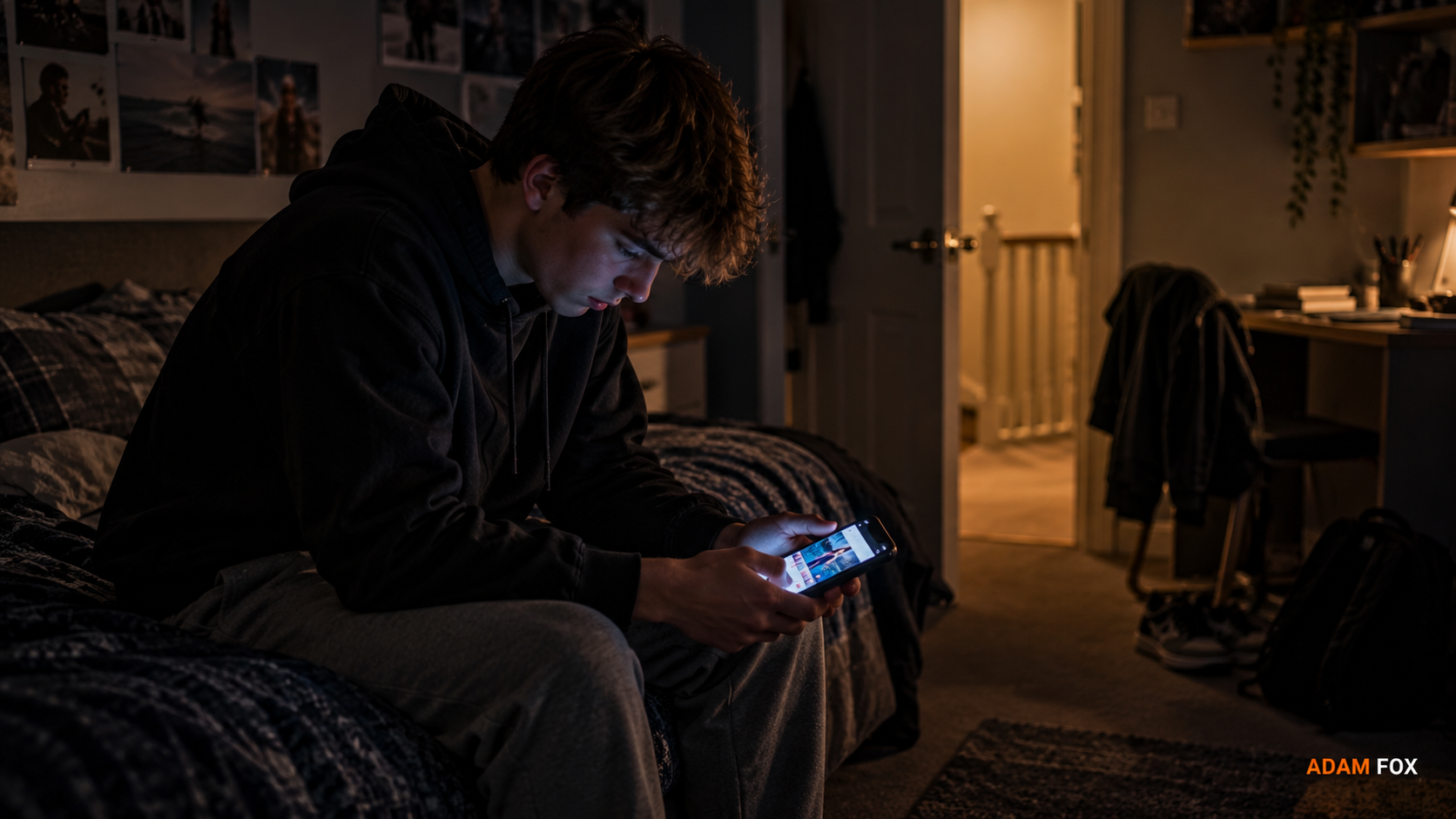
A young person sitting on the edge of their bed.
Phone in hand.
Reading comments beneath a video of something embarrassing that happened earlier in the day.
People are laughing.
People are sharing it.
Some are adding increasingly personal remarks.
Others are tagging their friends.
The numbers keep climbing.
And somewhere else, the person responsible is watching the same numbers with an entirely different emotional response.
One sees popularity.
The other sees humiliation.
One feels entertained.
The other feels exposed.
One might be thinking about what to post next.
The other might be wondering whether everybody at school has seen it.
And then the person responsible puts their phone down.
Makes a cup of tea.
Watches television.
Goes to bed.
They've had a good day.
The person being mocked might not have.
That's the imbalance I want people to think about.
Not because every embarrassing video creates this experience.
Not because every joke causes serious distress.
And not because we should live in constant fear of inadvertently upsetting somebody.
But because the consequences of our behaviour don't necessarily end when our involvement does.
We can move on from something while somebody else is still living through it.
And I think that's a responsibility worth recognising.
Especially in an environment where our actions can reach people we will never meet.
The question we keep failing to ask
We spend an enormous amount of time debating whether somebody should be allowed to make a particular joke.
Whether comedians have gone too far.
Whether society has become too sensitive.
Whether people are offended too easily.
Whether free speech is under threat.
Those are legitimate discussions.
But I think we're neglecting something much more immediate.
The people involved.
Not the abstract principle of whether a joke should be permitted.
Not the political argument surrounding the language.
Not the commercial success of the content.
The human being on the receiving end.
Because there are situations where the right to say something and the wisdom of saying it are two entirely different considerations.
You might have every right to make a particular remark.
That doesn't mean it's necessary.
You might be perfectly entitled to criticise somebody.
That doesn't mean public humiliation is the most appropriate way to do it.
And you might genuinely find something funny.
That doesn't mean the person involved wants their embarrassment distributed to thousands of strangers.
The problem isn't that people laugh at offensive jokes.
The problem arises when the entertainment becomes more important than the person.
When the applause matters more than the consequences.
When the audience matters more than the relationship.
And when somebody's discomfort becomes acceptable simply because enough people find it amusing.
I don't think we need to eliminate offensive humour to address that.
I think we need to recover something much simpler.
Consideration.
The ability to recognise that somebody else's experience may be entirely different from our own.
And the maturity to accept that our intentions don't automatically determine the consequences of our behaviour.
Because the person on the receiving end isn't necessarily evaluating the cleverness of the joke.
They may be evaluating what the experience means about how other people see them.
Whether they still belong.
Whether they're safe.
Whether the humiliation will ever stop.
And occasionally, those questions can become much more serious than the people creating the entertainment ever imagined.
We may never know precisely how many lives have been affected by the cumulative experience of online ridicule.
We may never be able to establish the contribution of every joke, comment, share or humiliating video to somebody's emotional wellbeing.
And we certainly shouldn't pretend that one cruel remark inevitably causes a particular psychological outcome.
Human beings are considerably more complicated than that.
But perhaps we don't need to wait for the worst possible consequences before recognising that our behaviour carries responsibility.
Perhaps the most useful question isn't whether somebody can take a joke.
Perhaps it's whether we understand what we're asking them to take.
Because for the audience, it might be thirty seconds of entertainment.
For the person being mocked, it might become something they carry for considerably longer.
It's only a joke.
Until you're the joke.
And suddenly, nobody seems particularly interested in whether you're laughing.
Independent research and sources
1. Kruger, J., Gordon, C. L., & Kuban, J. (2006). Intentions in Teasing: When “Just Kidding” Just Isn't Good Enough. Journal of Personality and Social Psychology, 90(3), 412–425.
Research investigating the differences between how people delivering teasing remarks interpret their intentions and how recipients perceive the same remarks. It found that recipients often interpreted teasing more negatively than those delivering it expected.
https://doi.org/10.1037/0022-3514.90.3.412
2. Monge, C. K., Matthews, N. L., & DeAndrea, D. C. (2024). The Persistence of Toxic Online Messages Influences Perceptions of Harm and Attributions of Blame. Journal of Communication, 74(5), 399–409.
An experimental study involving 520 participants examining how the persistence of harmful online messages influences perceived harm and responsibility, including the role of moderators capable of intervening.
https://doi.org/10.1093/joc/jqae024
3. Haugh, M. (2024). Online Public Denunciation as Recursive Social Practice. Internet Pragmatics, 7(1), 161–191.
Analysis of 26 incidents of online public denunciation examining how individual moments of behaviour become the subject of wider condemnation through recording, publication, interpretation and repeated sharing.
https://doi.org/10.1075/ip.00105.hau
4. Li, Y., Liu, Y., Knoll, M., & Obsuth, I. (2026). Mechanisms Linking Cyberbullying Victimisation to Internalising Problems in Youth: A Systematic Review and Meta-Analytic Structural Equation Modelling. Clinical Psychology Review, 123, 102672.
A systematic review of 125 studies involving 260,608 participants across 33 countries, investigating the psychological mechanisms connecting cyberbullying victimisation with depression, anxiety, self-harm and suicidality. Identified mediating factors included emotional regulation, social support, psychological distress and life stressors.
https://doi.org/10.1016/j.cpr.2025.102672
5. John, A., Glendenning, A. C., Marchant, A., et al. (2018). Self-Harm, Suicidal Behaviours, and Cyberbullying in Children and Young People: Systematic Review. Journal of Medical Internet Research, 20(4), e129.
Systematic review involving 26 independent studies and more than 156,000 children and young people. It identified substantial associations between cyberbullying victimisation, self-harm and suicidal behaviours. The findings demonstrate increased risk associations rather than establishing direct causation in individual cases.
https://doi.org/10.2196/jmir.9044
6. NSPCC (2026). The Impact of Harmful Online Content on Children.
A February 2026 briefing drawing on Childline counselling sessions and NSPCC Helpline contacts from 2024–25. Documents young people's experiences of online bullying and other harmful content, including the effects on their wellbeing and their ability to feel comfortable using online services.
https://learning.nspcc.org.uk/research-resources/2026/impact-harmful-online-content-children
7. Samaritans. Media Guidelines for Reporting Suicide.
Evidence-informed guidance emphasising the complexity of suicide, the importance of avoiding simplistic causal explanations, and the need to communicate responsibly about suicidal behaviour and prevention.
https://www.samaritans.org/about-samaritans/media-guidelines/10-top-tips-reporting-suicide/
Research gaps and questions for further investigation
Humiliation versus cyberbullying: Much existing research focuses on sustained cyberbullying, harassment or hate speech. More investigation is needed to establish the consequences of individual humiliating incidents that become amplified through widespread sharing, particularly where the original behaviour was described as humour.
Audience size and psychological impact: Research should examine how the visibility, perceived size and composition of an online audience influence the psychological consequences of public embarrassment, independently of the original incident.
Persistence and repeated exposure: More longitudinal research is needed to understand whether the repeated resurfacing of humiliating material causes distinct psychological consequences compared with isolated incidents that are not permanently recorded or shared.
Intention versus experienced harm: Existing research demonstrates differences between the intentions of people making jokes and the interpretations of recipients. Further investigation is needed into how this divergence affects accountability, reconciliation and sustained online harassment.
Cumulative audience participation: Research should investigate how large numbers of relatively minor contributions—likes, jokes, shares and comments—interact to produce collective experiences of humiliation or exclusion.
Individual vulnerability and protection: More evidence is required to understand how existing mental health, emotional maturity, social support, peer relationships and personal circumstances moderate the impact of public humiliation.
Suicide and self-harm: Although research identifies substantial associations between cyberbullying and serious psychological outcomes, causal pathways remain complex. Further longitudinal investigation is necessary, without reducing individual deaths or crises to a single presumed cause.
Platform responsibility: Independent investigation should examine how amplification, content-removal processes, reporting mechanisms and algorithmic recommendations affect the persistence and potential psychological consequences of publicly humiliating material.
The central argument of this essay is that the psychological consequences of publicly humiliating somebody may extend substantially beyond the original incident, particularly when the material is shared, repeatedly encountered and amplified by an audience. Evidence strongly supports the seriousness of cyberbullying-related harm, while the specific effects of humiliation presented as entertainment require further research.