

The Attention We Choose: A Child Sitting Still Isn't Necessarily Paying Attention.
THE ATTENTION WE CHOOSE — PART I: THE SKILL WE FORGOT TO TEACH
Learning to Direct What We've Reclaimed
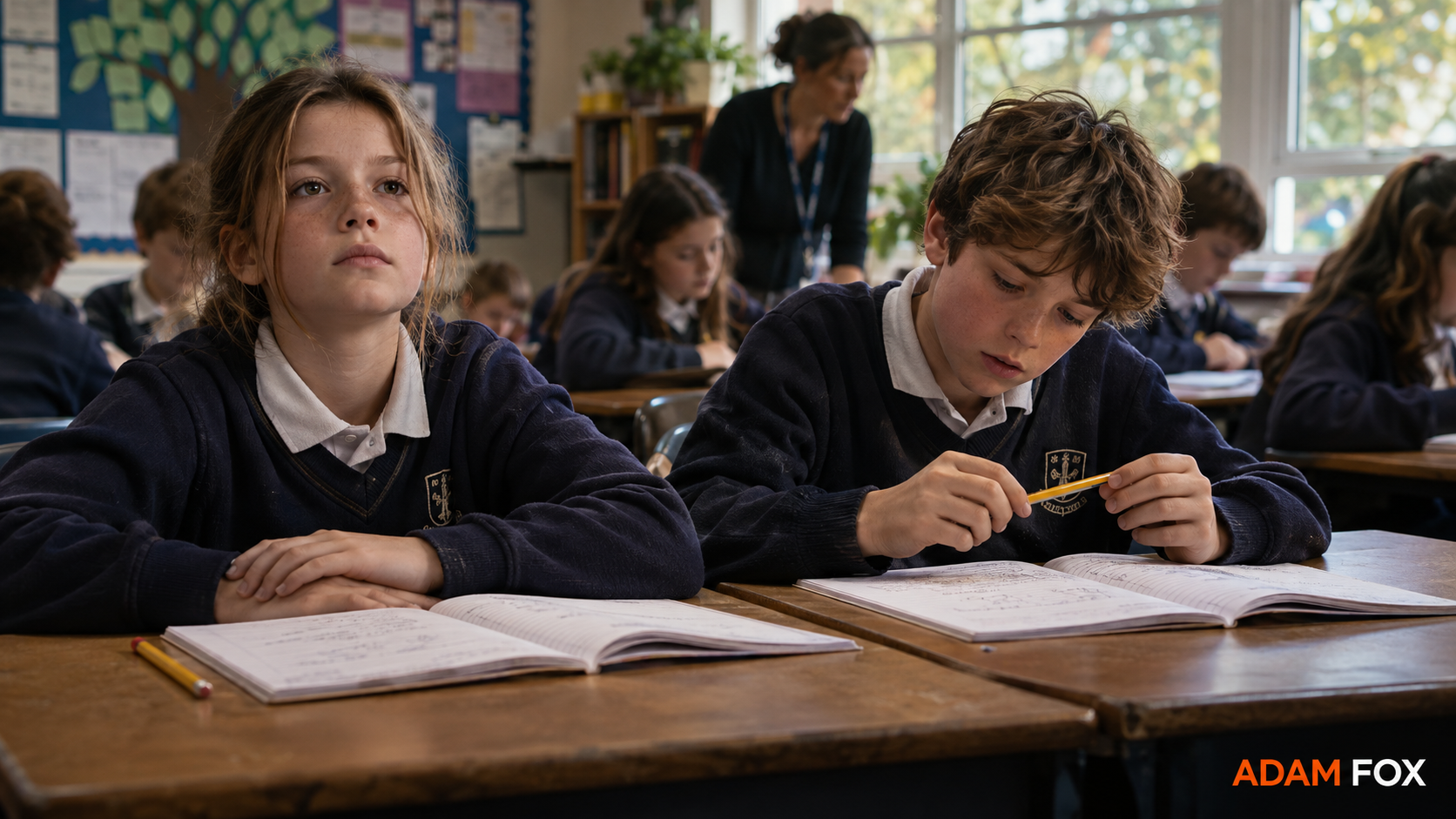
A child sits quietly at their desk.
Back straight. Eyes forward. Hands still.
They don't interrupt. They don't fidget. They don't distract the children around them. When the teacher speaks, they look in the right direction.
The perfect pupil.
At least, that's how it appears.
But there's something we cannot see.
What is actually happening inside that child's head?
They might be following every word, making connections and developing a genuine understanding of the subject.
Or they might be thinking about what happened at lunchtime.
They might be worried about getting something wrong.
They might have stopped understanding the lesson ten minutes ago but be too embarrassed to ask for help.
They might be concentrating exceptionally hard.
Just not on the lesson.
Now consider the child sitting three desks away.
They're shifting in their chair. Playing with their pencil. Occasionally looking around the classroom.
They ask questions.
Sometimes inconvenient ones.
From the outside, they look distracted.
But perhaps they're following the explanation perfectly. Perhaps the movement helps them remain engaged. Perhaps their questions demonstrate a level of understanding that the silent child hasn't yet reached.
We have two children displaying very different behaviour.
And we're tempted to make a judgement about their attention based on what we can see.
The problem is that looking attentive and actually paying attention aren't necessarily the same thing.
And if we don't understand that distinction, we risk teaching children how to appear engaged rather than how to engage.
We've Made Stillness Look Like Success
Walk into almost any school and you'll recognise the expectations.
Sit nicely.
Face the front.
Keep your hands to yourself.
Listen carefully.
Wait your turn.
None of these expectations is inherently unreasonable.
Classrooms contain large numbers of children, all of whom deserve the opportunity to learn. Teachers need to explain things without competing with constant noise and movement. Children need to understand how their behaviour affects others.
A degree of order is necessary.
Nobody benefits from a classroom where every child does whatever they please.
But somewhere between creating an environment suitable for learning and measuring whether learning is happening, we can make a mistake.
We start treating the appearance of good behaviour as evidence of good attention.
The quiet child becomes the attentive child.
The fidgeting child becomes the distracted child.
And the child who complies most consistently can become the one we worry about least.
Yet compliance tells us something about behaviour.
It doesn't tell us everything about understanding.
In its 2025 report Unlocking High-Quality Teaching, the Organisation for Economic Co-operation and Development makes precisely this distinction.
The OECD explains that visible behaviours, including apparently paying attention or moving a pencil across a page, don't necessarily establish that a pupil is cognitively engaged.
That's an important observation.
Because it challenges one of our most convenient assumptions about education.
A classroom can look productive without every child being mentally involved in what they're supposed to be learning.
And the reverse can also be true.
A classroom where children are discussing, questioning and occasionally moving around can contain substantial intellectual engagement.
The appearance of the room isn't enough to tell us.
We need to look more closely at what's happening within it.
Attention Has More Than One Face
Educational researchers have understood for decades that engagement is more complicated than simple compliance.
In 2004, Jennifer Fredricks, Phyllis Blumenfeld and Alison Paris published an influential review examining school engagement.
They identified three interconnected dimensions: behavioural, emotional and cognitive engagement.
Behavioural engagement concerns participation, effort and conduct.
Emotional engagement involves feelings such as interest, belonging, enjoyment or frustration.
Cognitive engagement concerns the mental investment involved in learning, understanding and working through difficult ideas.
These dimensions can overlap.
But they aren't identical.
A child might behave appropriately while feeling completely disconnected from the subject.
Another might be fascinated by a lesson but struggle to demonstrate that interest through conventional classroom behaviour.
A third might enjoy an activity without putting much effort into understanding the underlying concepts.
And a child can be working extremely hard to understand something without appearing particularly enthusiastic.
The researchers weren't suggesting that behaviour is irrelevant.
They were demonstrating that engagement cannot be reduced to a single observable characteristic. journals.sagepub.com
This becomes especially important when we consider what teachers are actually trying to achieve.
The objective of a mathematics lesson isn't to produce thirty children who can sit silently for forty-five minutes.
It's to help those children understand mathematics.
The objective of a reading lesson isn't simply to have everyone looking at a book.
It's to develop their ability to read, understand and interpret what they're reading.
Stillness might help create the conditions for those outcomes.
But it isn't the outcome itself.
And when we begin confusing the two, we risk rewarding the wrong thing.
The Child Who Looks Like They're Listening
This isn't simply a theoretical concern.
A 2025 study by Rune Lomholt and Ane Qvortrup, published in the European Journal of Psychology of Education, explored how teachers and researchers interpret children's classroom behaviour.
The researchers analysed thirty-eight hours of observations across four Danish primary schools.
They found that the same observable behaviour could indicate different forms of engagement or disengagement depending on what was happening around it.
Looking away, asking questions, talking and other visible behaviours could not be understood reliably without considering the activity, the teacher's instructions and the surrounding context.
In other words, behaviour doesn't come with a label explaining what it means.
We interpret it.
And those interpretations can be wrong.
The study was relatively small and qualitative, so it cannot establish how frequently teachers misinterpret individual pupils or whether particular classroom strategies improve learning.
But it illustrates a problem worth taking seriously.
The same behaviour can mean different things in different circumstances. Springer Nature Link
Think about a child staring at the classroom wall.
They might have abandoned the lesson entirely.
Or they might be mentally working through a difficult question.
An adult watching them cannot know which explanation is correct simply by observing their eyes.
Now think about a child who immediately raises their hand whenever a teacher asks a question.
They may understand the subject exceptionally well.
Or they may have learned that enthusiastic participation attracts approval.
Even answering correctly doesn't necessarily establish deep understanding.
Children can remember information without understanding how it connects to anything else.
They can follow a demonstrated method without knowing why it works.
And they can produce the correct answer through familiarity while remaining unable to apply the same principle in a different situation.
None of this makes observation useless.
Teachers have to observe.
Parents have to interpret behaviour.
But observation should be the beginning of understanding, not the end of it.
Movement Doesn't Automatically Mean Distraction
I think one of the more interesting assumptions we make about attention concerns movement.
We frequently associate concentration with being physically still.
Someone who sits quietly appears focused.
Someone who fidgets appears restless.
And when children become restless, our instinct is often to ask them to stop moving.
Sometimes that's entirely appropriate.
Movement can disturb other pupils. Repeated tapping, chair rocking or unnecessary interruptions can make concentration more difficult for everyone nearby.
But the relationship between movement and attention isn't as simple as we might assume.
Research involving children with ADHD provides an interesting example.
In 2015, Dustin Sarver and colleagues investigated the relationship between physical activity, attention and working-memory performance.
The study involved twenty-nine boys with ADHD and twenty-three typically developing boys, all aged between eight and twelve.
The researchers found that higher levels of movement were associated with better working-memory performance among the children with ADHD, although performance wasn't brought up to the level of the comparison group.
Among typically developing children, higher activity was associated with somewhat poorer working-memory performance.
Crucially, changes in movement did not predict changes in measured attention in either group.
The researchers suggested that some movement may serve a compensatory function during demanding working-memory activities for some children with ADHD.
That's a fascinating finding.
But it needs to be interpreted carefully.
It doesn't mean all children with ADHD concentrate better when moving.
It doesn't mean fidgeting automatically improves attention.
And a small laboratory study involving boys cannot establish what every child should be allowed or encouraged to do in a busy classroom.
What it does demonstrate is that assuming movement always interferes with thinking is too simplistic.
For some children, eliminating movement may remove something that helps them manage a demanding task.
For others, movement may genuinely become a distraction.
The important question isn't whether a child is moving.
It's what effect the movement is having on their engagement and on the learning environment around them.
Even the Research on Movement Isn't Settled
There is an obvious temptation here.
Once we recognise that stillness isn't essential to attention, we might swing too far in the opposite direction.
We could decide that children need more movement and that physical activity is the answer to classroom concentration.
But the broader evidence is more complicated.
A systematic review and meta-analysis published in April 2026 examined classroom activity breaks across thirty-five studies involving approximately 7,700 pupils aged six to sixteen.
The researchers identified a small positive average effect on working memory.
However, they did not find statistically significant improvements across the other cognitive and academic outcomes examined.
A separate meta-analysis published in August 2026 examined twenty-five randomised controlled trials and reported pooled benefits for attention and several executive-function outcomes.
The authors nevertheless warned about substantial differences between studies and uncertainty surrounding the size of those effects.
These findings are not necessarily irreconcilable. The reviews used different inclusion criteria, outcome measures and analytical approaches.
But they don't justify a simple conclusion that more movement always produces better concentration. doi.org+1
The responsible interpretation is narrower.
Movement breaks may be useful for some pupils and circumstances.
They should not be treated as a universal substitute for good teaching, appropriate support or understanding a child's individual needs.
And none of this means classrooms should abandon behavioural expectations.
A child who needs to move still needs to understand how their movement affects the people around them.
We can respect individual differences without pretending that thirty children can all have completely unrestricted environments.
Good education requires balancing needs.
The mistake is assuming that everyone needs exactly the same thing.
Eye Contact Is Another Misleading Signal
There is a similar problem with the expectation that children should look directly at someone to demonstrate that they're listening.
Most adults recognise the instruction.
Look at me when I'm talking to you.
It sounds reasonable enough.
Eye contact is an important part of communication for many people.
It can help us recognise emotional expressions, follow conversations and signal engagement.
But it isn't a universal requirement for understanding.
The National Autistic Society explains that some autistic people find eye contact uncomfortable and may prefer different forms of communication.
For some, concentrating on maintaining eye contact can introduce an additional demand rather than making listening easier.
And this raises an uncomfortable possibility.
A child might be using substantial mental effort to satisfy an adult's expectation about how listening should look.
Effort that could otherwise have been directed towards understanding what the adult was saying.
We want them to listen.
But we're insisting that they demonstrate listening through a particular behaviour.
Those two objectives aren't always compatible.
Of course, avoiding eye contact doesn't prove somebody is listening either.
Nor does it automatically indicate autism.
The point is that eye contact, like physical stillness, is an imperfect indicator.
We need to stop treating these outward signals as definitive evidence of what's happening internally.
A child might demonstrate understanding by answering a question.
By carrying out an instruction.
By explaining something in their own words.
Or by recognising when something doesn't make sense.
These are potentially more informative than simply making themselves look attentive.
And they allow room for children whose behaviour doesn't match our expectations.
The Quiet Child Can Be the One Who Needs Help
There is another consequence of equating good behaviour with good attention that deserves consideration.
The children who struggle most visibly are often the children whose difficulties are noticed first.
They interrupt.
They leave their seats.
They distract others.
They fail to complete work.
Their difficulties become apparent because they affect the classroom around them.
But not every child communicates difficulty through disruption.
Some become quiet.
Some withdraw.
Some continue copying information without understanding it.
Some become exceptionally good at following instructions while avoiding anything that might expose uncertainty.
The child who is desperate not to get into trouble may appear beautifully behaved.
Yet their attention could be occupied by anxiety about making a mistake rather than by the learning itself.
This doesn't mean quiet children are secretly struggling.
Many genuinely are engaged, comfortable and learning well.
Nor should every quiet pupil be subjected to constant questioning to prove they're paying attention.
That would simply replace one unhelpful expectation with another.
But it does mean we should be cautious about assuming that the absence of visible difficulty proves the absence of difficulty.
This matters enormously to me as a parent.
Children don't all express themselves in the same way.
Even within the same family, two children can react very differently to frustration, uncertainty or feeling overwhelmed.
One might want to discuss everything immediately.
Another might become quiet and need time before they can explain what's wrong.
Neither response tells the whole story on its own.
And if we interpret silence as a refusal to engage, we risk making the situation harder.
Sometimes a child needs encouragement to participate.
Sometimes they need a clearer explanation.
Sometimes they need a little more time.
And sometimes they need an adult to recognise that what looks like reluctance is actually difficulty.
We won't get those judgements right every time.
But we have a better chance when we stop assuming behaviour always means what it appears to mean.
A Calm Classroom Still Matters
Before we turn this into an argument against classroom discipline, there is an important distinction to make.
Teachers aren't wrong to expect children to listen, follow instructions or avoid disrupting others.
A classroom is a shared environment.
One child's freedom to move, talk or experiment cannot automatically override another child's need for quiet or predictability.
Some activities genuinely require stillness.
Others require careful listening or the ability to follow safety instructions without debate.
And children need to develop the capacity to regulate their behaviour when circumstances demand it.
These are important life skills.
But there is a difference between developing those capabilities and using them as our primary measure of learning.
A teacher may need a class to remain quiet during an explanation.
That doesn't mean every quiet child understands the explanation.
A child may need help reducing disruptive movement.
That doesn't mean their movement proves they aren't thinking.
And a child who asks challenging questions may need to learn when and how to ask them.
That doesn't mean the questions themselves represent poor attention.
The goal should be a classroom where appropriate behaviour supports meaningful learning.
Not one where the appearance of appropriate behaviour is mistaken for learning itself.
The Education Endowment Foundation's guidance on supporting pupils with special educational needs and disabilities in mainstream schools reflects this broader principle.
It emphasises high-quality teaching, appropriate support and the removal of barriers to learning and participation.
In practice, that can include explicit instruction, scaffolding and flexible approaches that respond to individual needs while maintaining ambitious expectations.
This isn't a call for lower standards.
It's a call for more intelligent ones.
What Happens When We Look Beyond Behaviour?
If we cannot reliably judge attention by whether children are sitting still, we need better ways to understand what they're experiencing.
Fortunately, this doesn't require inventing an entirely new educational system.
Many effective teachers already use approaches designed to reveal pupils' thinking rather than simply observe their behaviour.
The Education Endowment Foundation's guidance on checking for understanding emphasises gathering evidence from pupils and using that evidence to adapt teaching.
Techniques can include carefully designed questions, brief written responses, mini-whiteboards and opportunities for pupils to explain their reasoning.
The purpose isn't to keep children constantly busy.
It's to make understanding more visible.
And there is a substantial difference between those objectives.
Consider a child completing a mathematics problem.
They might write the correct answer.
We could stop there.
Or we could ask them to explain how they reached it.
Perhaps they understood the principle perfectly.
Perhaps they followed a method without understanding why it worked.
Perhaps they guessed.
Their explanation helps us distinguish between those possibilities.
Now consider a child struggling with a reading task.
Instead of assuming they're distracted because they keep looking away, we could investigate whether the vocabulary is unfamiliar, the instructions are unclear or the material is too demanding.
The answer might be that they genuinely need help managing their attention.
But it might be something else entirely.
That's the value of curiosity before judgement.
The OECD's research on cognitive engagement reinforces the importance of giving pupils meaningful intellectual challenges while providing appropriate support.
Tasks need to be demanding enough to encourage thinking without becoming so difficult that pupils cannot make progress.
And teachers need opportunities to understand how pupils are approaching those tasks, not merely whether they appear to be working.
This isn't about turning teachers into psychologists.
It's about recognising the limitations of what we can see.
A child's behaviour provides information.
Their understanding provides different information.
And good teaching needs both.
Participation Isn't the Same as Understanding Either
There is another trap here.
If silence doesn't prove engagement, we might conclude that active participation does.
More discussion.
More questions.
More movement.
More visible enthusiasm.
But we should be careful.
A child can enthusiastically participate in something without developing a meaningful understanding of it.
They can enjoy an experiment without recognising the scientific principle.
They can dominate a discussion without considering anyone else's ideas.
They can complete an exciting activity while missing the intended learning entirely.
Researchers Michelene Chi and Ruth Wylie explored this distinction in their 2014 ICAP framework.
Their work examines different ways learners interact with information, including passive, active, constructive and interactive forms of engagement.
The framework proposes that learning can deepen when pupils do more than receive or manipulate information and begin generating explanations, connecting ideas and developing understanding through meaningful interaction.
But it also makes clear that the nature of the mental activity matters. doi.org
We shouldn't confuse activity with thinking any more than we confuse stillness with concentration.
A busy classroom isn't automatically a successful classroom.
An entertaining lesson isn't automatically an effective lesson.
And a child who appears enthusiastic isn't necessarily learning more than one who prefers to work quietly.
The real question is what the activity is helping the child understand.
We need to move beyond judging attention by how it looks.
Whether the child is silent or animated.
Whether they're sitting still or shifting in their seat.
Whether they make eye contact or look elsewhere.
These observations might offer clues.
But they are not the complete picture.
Attention Should Lead Towards Independence
There's a wider issue underneath all of this.
And it's one I think we should be paying much more attention to.
What are we actually preparing children for?
If our objective is simply to produce children who sit quietly, follow instructions and complete assigned work, then visible compliance becomes a perfectly understandable priority.
We can reward it.
Measure it.
Praise it.
But if our objective is to help children become adults who can think independently, question assumptions, understand their own needs and direct their attention deliberately, we need something more.
We need children who can recognise when they're concentrating.
And when they're not.
Children who understand that struggling with a task doesn't necessarily mean they're incapable of completing it.
Children who feel able to ask for clarification rather than simply pretending they've understood.
Children who can recognise when their attention has wandered and begin learning what helps them return.
And children who gradually become capable of distinguishing between what deserves their attention and what merely demands it.
None of this requires abandoning discipline.
In fact, learning to manage behaviour appropriately is part of becoming more independent.
But independence cannot develop through compliance alone.
At some point, children need opportunities to understand the reasons behind their actions and take increasing responsibility for them.
That might begin with something as simple as asking a child what helped them understand a difficult problem.
Or allowing them to explain why a particular environment makes concentration easier.
Or recognising that the child who moves occasionally while working might have identified something useful about their own needs.
We don't have to accept every explanation without question.
Children can misunderstand their own behaviour, just as adults can.
But we should take their observations seriously.
Because a child who begins understanding how their attention works is developing something far more valuable than the ability to look attentive when an adult is watching.
They're beginning to develop self-direction.
We Need to Look Beyond What We Can See
There is an understandable reason we've relied so heavily on visible behaviour.
It's accessible.
Teachers cannot see inside thirty different minds.
Parents cannot know exactly what their children are thinking.
And nobody can assess the quality of someone else's attention every minute of the day.
We need practical indicators.
But indicators have limitations.
A quiet classroom can provide excellent conditions for learning.
It can also conceal confusion, disengagement and anxiety.
A restless child might be distracted.
They might also be concentrating.
A child who asks questions might be struggling to follow.
They might equally be demonstrating the curiosity and understanding we're supposed to be encouraging.
We cannot eliminate that uncertainty.
Nor should we pretend that every behaviour has a hidden positive explanation.
Sometimes a child really isn't listening.
Sometimes they genuinely need to settle down.
Sometimes they need a clear boundary.
But we should be willing to investigate before we judge.
Because what we're trying to develop isn't the appearance of attention.
It's the ability to use attention meaningfully.
And the danger of rewarding only what we can see is that children may become increasingly skilled at satisfying our expectations without necessarily becoming more capable of directing their own minds.
A child who has learned to sit still has learned to sit still.
That may be useful.
But it doesn't tell us whether they've learned to pay attention.
And if we want children to grow into adults who can direct their attention independently, we need to care about the difference.
The goal isn't to raise children who look like they're listening. It's to help them become people who understand how to listen, think and choose for themselves.
Sources and Further Reading
The following independent research and professional guidance informs the arguments presented in this essay.
1. OECD (2025). Unlocking High-Quality Teaching: Ensuring Cognitive Engagement.
An authoritative review exploring cognitive engagement, why visible classroom behaviour is an incomplete indicator of learning, and how teachers can encourage deeper thinking.
Read research OECD
2. Fredricks, J. A., Blumenfeld, P. C., & Paris, A. H. (2004). School Engagement: Potential of the Concept, State of the Evidence. Review of Educational Research, 74(1), 59–109.
Foundational review examining the behavioural, emotional and cognitive dimensions of student engagement.
Read research journals.sagepub.com
3. Lomholt, R., & Qvortrup, A. (2025). Categorising Student Behaviours as Manifest Indicators of Learning Engagement: A Contextual Approach. European Journal of Psychology of Education, 40, Article 121.
Qualitative study examining how the same behaviours can indicate different forms of engagement depending on classroom context.
Read research Springer Nature Link
4. Sarver, D. E., Rapport, M. D., Kofler, M. J., Raiker, J. S., & Friedman, L. M. (2015). Hyperactivity in Attention-Deficit/Hyperactivity Disorder (ADHD): Impairing Deficit or Compensatory Behavior? Journal of Abnormal Child Psychology.
Experimental investigation into physical movement, working-memory performance and attention among children with and without ADHD.
Read research pubmed.ncbi.nlm.nih.gov
5. Melguizo-Ibáñez, E., et al. (2026). Classroom Active Breaks as a Physical-Educational Intervention for Executive Functions and Mathematical Outcomes: A Systematic Review with Meta-Analysis. Educational Psychology Review, 38, Article 43.
Review of classroom activity-break interventions examining working memory, attention and academic outcomes, including limitations and inconsistent findings.
Read research Springer Nature Link
6. European Journal of Pediatrics (2026). Effects of Active Breaks on Attention and Executive Function in Children and Adolescents: A Meta-Analysis.
Meta-analysis of twenty-five randomised controlled trials, reporting potential benefits alongside substantial heterogeneity and uncertainty.
Read research pubmed.ncbi.nlm.nih.gov
7. National Autistic Society. Autism and Communication.
Professional and community-informed guidance explaining differences in communication styles, including eye contact and individual preferences.
Read guidance autism.org.uk
8. Education Endowment Foundation (2020). Special Educational Needs in Mainstream Schools.
Evidence-informed recommendations on inclusive education, effective teaching and reducing barriers to learning and participation.
Read guidance EEF
9. Education Endowment Foundation (2026). How Checking for Understanding Can Guide Your Teaching in the Classroom.
Practical evidence-informed guidance on making pupils' understanding visible and using that information to adapt instruction.
Read guidance EEF
10. Chi, M. T. H., & Wylie, R. (2014). The ICAP Framework: Linking Cognitive Engagement to Active Learning Outcomes. Educational Psychologist, 49(4), 219–243.
Research framework examining different modes of cognitive engagement and their relationship with learning.
Read research doi.org
Research Gaps
Reliable indicators of attention. More evidence is needed to establish which combinations of behavioural observation, pupil feedback and assessment most accurately identify meaningful engagement across different ages and classroom contexts.
Individual movement needs. Evidence suggests that movement may support some cognitive processes for some children, but the effects vary. Larger studies are needed to establish when movement supports engagement, when it interferes and how adjustments can work within shared classrooms.
Neurodiversity and engagement measurement. More research is needed into how conventional expectations around stillness, eye contact and participation affect the identification of genuine engagement among children with different neurodevelopmental and sensory profiles.
Teaching self-direction. Although research supports strategies that make children's thinking and understanding visible, less is established about which approaches help children independently recognise and regulate their attention over the long term.
Balancing classroom needs. Further research could clarify how educators can accommodate individual attentional needs while maintaining predictable, accessible learning environments for every pupil.