THE ALGORITHM BETWEEN US: You And I Are Not Seeing The Same Internet
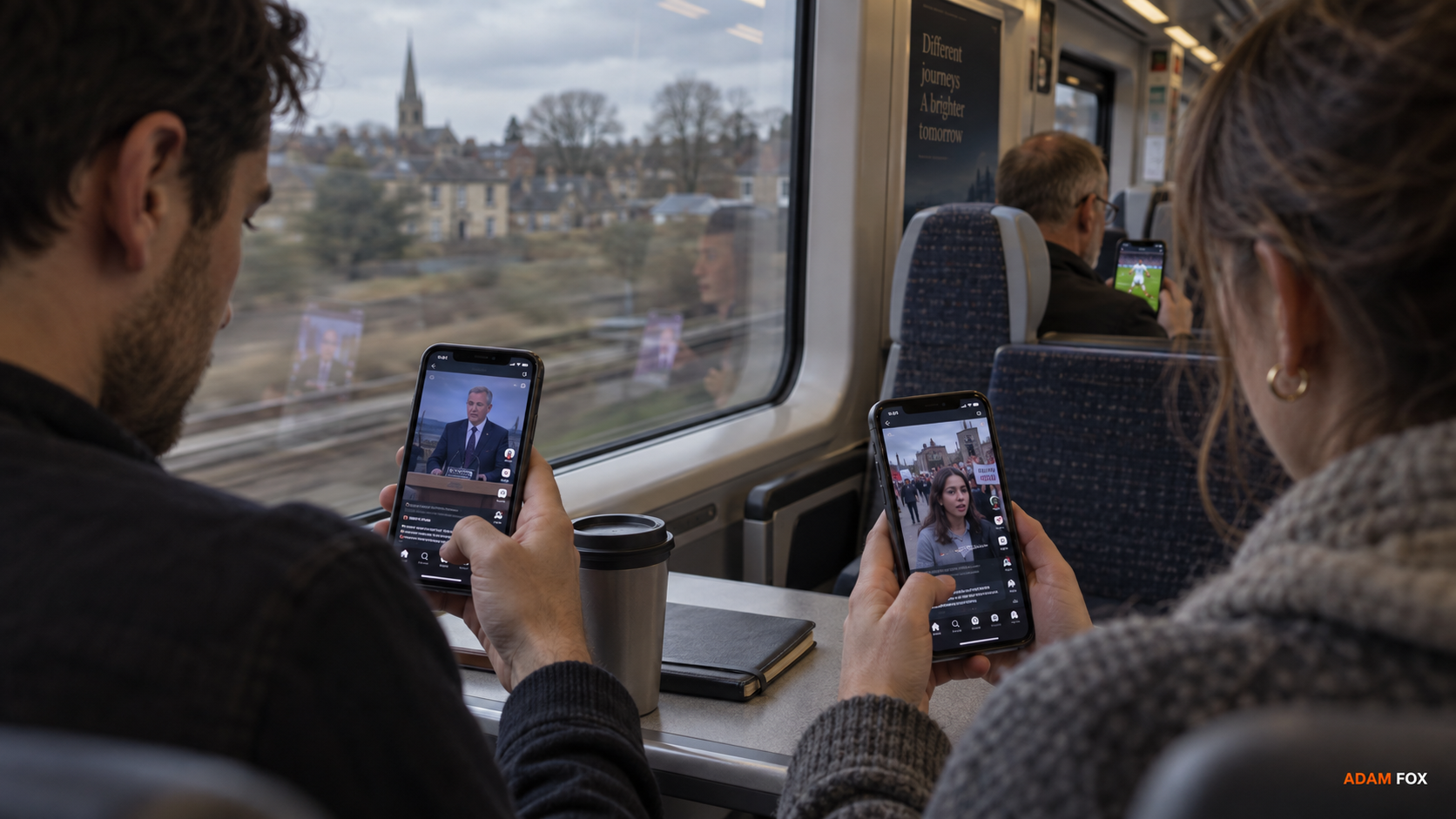
Put two phones next to each other.
Same app.
Same logo.
Same country.
Same day.
Same internet.
Now scroll.
Within seconds, the illusion disappears.
Your feed might contain a political argument, a business video, someone talking about parenting, a dog falling off a sofa, a news clip, an advert for running shoes and a bloke explaining why everything you've been told about cholesterol is apparently wrong.
The person sitting beside you might see none of it.
Their phone contains football.
Celebrity gossip.
A different political argument.
A different version of the same news event.
Recipes.
Gym content.
A comedian you've never heard of.
A creator explaining that something you barely knew existed is currently the most important issue facing civilisation.
Same platform.
Different world.
We already know this in a trivial sense.
Of course recommendations are personalised.
That's the whole point.
I see things I might like.
You see things you might like.
Excellent.
But I've started wondering whether we fully understand what follows from that seemingly harmless sentence.
Because increasingly, the internet is not simply showing us different entertainment.
It is becoming one of the places where we learn what is happening.
What people think.
What other people are angry about.
What supposedly matters.
What is normal.
What is controversial.
What “everyone” is talking about.
What people like us believe.
What people unlike us believe.
And when the system deciding which slice of reality reaches me is different from the system deciding which slice reaches you, something changes between us.
Not necessarily our politics.
Not automatically our beliefs.
Certainly not in the simple way people sometimes claim.
But perhaps something more basic.
The evidence available to each of us starts diverging before we've even begun arguing about what it means.
That is the thing I want to investigate.
Not:
Are algorithms evil?
Too easy.
Not:
Is social media destroying democracy?
Far too large.
A narrower question.
What happens to a society when millions of people increasingly encounter the world through individually curated versions of it?
First, are we actually seeing different internets?
Yes.
That part isn't controversial.
TikTok says explicitly that no two For You feeds are the same.
Its recommendation systems use signals including what people watch, skip, like, share, comment on, search for and follow. For most users, TikTok says interaction signals including watch time are generally weighted more heavily than factors such as device settings or location.
The system is trying to predict what will be interesting or relevant to you.
Not humanity.
You.
This is the product.
And TikTok isn't unusual in the broader sense.
Personalised ranking now sits underneath huge parts of search, shopping, streaming, social media and news discovery.
A scoping review of personalised social-media experiences puts the point plainly: social platforms filter and prioritise information using personal data and behaviour, meaning different users can encounter different selections of information even inside the same service.
So when two people say:
“I saw this everywhere.”
That sentence has become surprisingly ambiguous.
Everywhere where?
Everywhere on your feed?
Everywhere among the people you follow?
Everywhere inside a recommendation system trained partly on your previous behaviour?
That is not the same thing as everywhere.
This matters more because platforms increasingly mediate news
Once upon a time, personalisation mostly meant:
You like Hip-hop music.
I like Rock.
Wonderful.
Different recommendations.
The consequences become more interesting when the same machinery helps distribute information about politics, wars, immigration, health, crime, economics and culture.
The Reuters Institute's Digital News Report 2026, based on almost 100,000 online news consumers across 48 markets, found that social media and video networks had, for the first time, become the most widely used route to online news on average across the markets studied.
Fifty-four per cent said they used social or video networks for news, compared with 51 per cent using news organisations' own websites and apps.
Among 18–24-year-olds, the shift was much stronger: social platforms, video networks and AI chatbots were now the main route to news for more than half of respondents globally.
That does not mean 54 per cent of people believe everything TikTok tells them.
It means increasingly, the doorway through which information enters public awareness is a platform.
And the doorway is personalised.
That's different.
Newspapers selected reality too
We need to kill one myth before going any further.
There was never a golden age where humans all received objective reality directly from the universe.
Newspapers selected stories.
Editors decided what went on page one.
Television broadcasters chose the running order.
Radio programmes selected guests.
Owners had interests.
Journalists had perspectives.
Audiences chose newspapers partly because those papers reflected their worldview.
Humans have always filtered information.
The algorithm didn't invent selection.
What has changed is the scale, granularity and responsiveness of the selection.
A newspaper editor chooses one front page for hundreds of thousands of readers.
A recommendation system can effectively produce millions of different front pages.
And then change tomorrow's front page partly in response to what each reader did with today's.
That is new enough to deserve attention.
The feed watches you back
Imagine reading a newspaper that notices:
You spent eleven seconds longer on the immigration article.
Skipped the climate story.
Read the football piece twice.
Clicked the headline about tax.
Ignored the interview with a politician you dislike.
Shared the story about crime.
Then tomorrow's newspaper quietly rearranges itself.
More of this.
Less of that.
Maybe something adjacent.
Maybe something other readers with similar patterns also liked.
That is roughly the conceptual leap.
You are not simply consuming the feed.
Your behaviour is providing information that helps shape the next feed.
TikTok openly describes this process: watching, finishing, skipping, searching and interacting provide signals that influence future recommendations.
Which means the feed is neither purely imposed on you nor purely chosen by you.
It is co-produced.
You train it.
Then it changes what is available for you to respond to next.
Then your response trains it again.
That feedback loop is where this gets interesting.
The algorithm is not a puppet master
This distinction matters enormously.
There is a very seductive story in which helpless humans are manipulated by an all-powerful algorithm.
I don't think the evidence supports anything that simple.
Humans already prefer some information over other information.
We seek things consistent with our interests.
Our communities matter.
Our identities matter.
What we trust matters.
What we choose to click matters.
One experimental study using eye tracking presented politically partisan participants with mixed simulated Google search results.
Participants spent more time looking at politically aligned links and were more likely to select them.
The researchers described this as evidence for self-imposed filter bubbles: even when diverse information is available, people themselves selectively attend to and choose congenial sources.
So algorithms didn't invent selective exposure either.
We brought some of the ingredients ourselves.
Perhaps the algorithm is part mirror, part steering wheel
That's a more useful way of thinking about it.
It observes behaviour.
Mirror.
Then changes the environment.
Steering wheel.
Then we respond to that changed environment.
Mirror again.
Neither human nor algorithm has complete authorship.
Which creates a beautifully messy problem for anyone wanting a simple answer about whether “the algorithm” causes something.
Causes what?
Under which platform?
For which user?
Starting from which behaviour?
Optimising which signals?
Inside which network?
Over what period?
This subject gets complicated very quickly.
Good.
It should.
The famous filter-bubble argument is not as settled as people think
You've probably heard some version of this:
Algorithms show us things we already agree with.
That creates echo chambers.
Echo chambers make us more extreme.
Therefore social media algorithms polarise society.
Plausible.
Clean.
Great headline.
The evidence is much less tidy.
A huge research collaboration during the 2020 US presidential election examined Facebook at a scale researchers rarely get access to.
It found that the median adult Facebook user in the United States received substantially more content from politically like-minded sources than from cross-cutting sources.
For the median user, just over half of feed exposure came from like-minded sources, compared with around 15 per cent from cross-cutting sources.
So yes:
Information environments were politically uneven.
Then the researchers did something more interesting.
They experimentally reduced exposure to content from like-minded sources by roughly a third for more than 23,000 users.
What happened?
People saw more cross-cutting content.
They saw less uncivil material.
Exposure changed.
But the researchers found no measurable change across eight preregistered attitudinal measures, including affective polarisation, ideological extremity, candidate evaluations and belief in false claims.
That is incredibly important.
Changing the feed changed the feed.
It did not detectably change those political attitudes over the study period.
Another Facebook experiment produced a similar warning against easy conclusions
Researchers also removed reshared posts from the feeds of randomly selected consenting Facebook users during the same 2020 US election period.
Removing reshares substantially changed what people encountered.
Exposure to political news fell.
Exposure to news from untrustworthy sources fell.
Partisan news clicks fell.
Participants' news knowledge also fell.
But once again, researchers found no significant changes in political polarisation or measured political attitudes.
That is messy.
Removing a mechanism associated with the spread of political material reduced exposure to some potentially problematic information.
But it also reduced knowledge.
And didn't detectably alter the attitudes people often assume it must be shaping.
Real systems rarely behave as neatly as our favourite theories.
So algorithms aren't polarising us?
Not so fast.
That conclusion would be just as unjustified.
Those experiments studied particular platforms, users, interventions and one three-month election period.
They tell us something extremely valuable:
The causal relationship between algorithmic exposure and political belief is not simple.
They do not tell us algorithms are irrelevant.
Exposure itself matters.
Agenda setting matters.
Visibility matters.
Attention matters.
What information becomes available matters.
And newer platforms operate differently from Facebook in 2020.
Which brings us to TikTok.
TikTok gives researchers an unusually interesting laboratory
Facebook historically contains lots of content from networks people deliberately constructed.
Friends.
Pages.
Groups.
TikTok's For You feed is much more recommendation-led.
That makes it particularly useful for studying what an algorithmic feed itself serves after receiving certain signals.
In 2026, researchers published a large audit of TikTok recommendations during the 2024 US presidential election.
They created 323 controlled accounts across Texas, New York and Georgia and deliberately conditioned them with different partisan content.
They then collected more than 280,000 recommendations over 27 weeks.
What happened is worth reading carefully.
Accounts conditioned with Republican-aligned content received around 11.5 per cent more co-partisan recommendations than Democratic-conditioned accounts.
Democratic-conditioned accounts, meanwhile, received around 7.5 per cent more cross-partisan material, much of it anti-Democratic content.
That's a real asymmetry.
But here's the important bit.
The researchers could not definitively establish why it occurred.
They could rule out some observable engagement explanations, but they could not determine whether the pattern came from internal ranking rules, the available content ecosystem, interactions between the two, or other factors.
And the study did not establish that these recommendations changed people's votes or political beliefs.
Exposure.
Not mind control.
That distinction needs to survive the headline.
But exposure is still interesting
Suppose you and I start with slightly different interests.
Then one feed gives me more of one political frame.
Yours gives you more of another.
Over weeks, we encounter different creators.
Different stories.
Different examples.
Different scandals.
Different outrages.
Different policy issues.
Different people supposedly representing “the other side”.
Eventually we meet for dinner.
We're ostensibly discussing the same country.
But are we arriving with the same evidence?
This may be the deeper question.
Political polarisation research often asks whether people arrive at more extreme positions.
Perhaps we also need to ask:
Do people still possess enough overlapping informational experience to understand why someone else thinks differently?
That's not quite the same outcome.
Shared reality never required shared opinion
This is important.
Democracy does not require everyone to agree.
Thank God.
It requires disagreement.
Competing values.
Different priorities.
Alternative interpretations.
But disagreement works differently when two people are arguing about what the same evidence means than when they barely recognise each other's evidence.
Imagine:
We both watched the same political speech.
You thought it was brilliant.
I thought it was awful.
Fine.
Shared event.
Different interpretation.
Now imagine:
You saw the speech.
I saw only a fifteen-second clip of the worst sentence.
You saw three commentators explaining why it mattered.
I saw four creators mocking it.
You saw a follow-up correction.
I never received it.
I saw an allegation the following day.
You didn't.
Now we're no longer merely interpreting the same event differently.
Our informational foundations have diverged.
That seems socially significant even if neither of us became more ideologically extreme.
The old media world contained more common reference points
Again, not necessarily better reference points.
Just more shared ones.
Millions watched the same evening bulletin.
Read overlapping front pages.
Discussed the same television programme.
You could hate the BBC.
Love the BBC.
Distrust a newspaper.
Prefer another.
But large parts of society still bumped into many of the same stories.
Personalised media replaces some of that shared agenda with millions of individual agendas.
One person genuinely experiences immigration as the dominant issue of the week.
Another scarcely sees it.
One sees endless discussion about gender.
Another sees housing.
One believes everyone is talking about a particular conflict.
Another has heard almost nothing.
Both open a device containing “what's happening”.
The device just means something different for each.
This may be why “everyone is talking about…” has become dangerous language
Are they?
Or has the system identified that you are likely to watch people talking about it?
That's not the same thing.
I notice this myself online constantly.
Something suddenly appears everywhere.
Three days later:
Gone.
Was there an enormous national conversation?
Or did I interact with one thing and accidentally order the full tasting menu?
Hard to know.
That's an epistemic problem.
Not necessarily because the content is false.
Because the prevalence signal may be false.
A personalised feed can make a niche concern feel universal simply because it repeatedly appears inside one person's environment.
Repetition is evidence of recommendation, not necessarily importance
That's a distinction I want to keep.
If I see twelve videos about the same issue, what have I learned?
Potentially:
The issue is important.
Or:
The issue is popular.
Or:
People with my interests engage with it.
Or:
I watched two similar videos long enough that the system inferred I wanted more.
These explanations can look identical from my side of the screen.
That is fascinating.
The feed offers content.
But it also accidentally offers a model of the world.
What seems common.
What seems urgent.
What seems normal.
Algorithms don't need to lie to distort proportion
This might be one of the most important ideas in the whole project.
Imagine every video you see is factually accurate.
No misinformation.
No fake news.
Nothing invented.
Could your picture of reality still become distorted?
Of course.
Show me nothing except genuine violent crime for three hours and I may wildly overestimate how representative violent crime is of ordinary life.
Show me only genuine examples of political extremists and I may start believing the average opponent resembles the extreme.
Show me only successful entrepreneurs and normal employment starts looking unusual.
Show me endless genuine relationship betrayals and perhaps trusting people begins looking naive.
Selection changes perceived prevalence.
No falsehood required.
This is where algorithms meet an ancient human problem
We estimate the world partly from examples available to us.
Psychology has known for decades that easily recalled examples can influence judgements about frequency and probability.
Digital recommendation potentially changes the supply of available examples at enormous scale.
But we should resist jumping from that general psychological principle to claims that any particular feed necessarily changes any particular belief.
The Facebook experiments are a useful warning.
Exposure can change substantially without producing measurable short-term attitudinal change.
Humans are not blank hard drives.
We have families.
Friends.
Offline experience.
Existing identities.
Beliefs built over decades.
Other media.
Political attitudes can be stubborn.
Good.
The algorithm is one influence among many.
The human still chooses
This is another reason the manipulation narrative is incomplete.
We follow people.
Search topics.
Block accounts.
Scroll away.
Watch things twice.
Send them to friends.
Argue in comments.
Choose platforms.
Choose communities.
Our behaviour helps shape the information environment we later complain has shaped us.
This resembles the urgency problem in The Cost of Now.
Not one villain.
A feedback loop.
The system learns from human preferences.
Humans learn inside the resulting system.
Then both continue adapting.
Platforms know this loop exists
TikTok's own explanation says the system continuously learns from interactions and that users can deliberately influence recommendations through likes, searches, follows, “Not interested”, topic controls, keyword filters and even a full feed refresh.
It also says the platform deliberately interrupts repetitive recommendations in certain sensitive content categories and tries to introduce diversity into the feed.
That's significant.
Because it shows that recommendation diversity isn't some natural property that simply emerges.
It is something platforms can intentionally alter.
Which means design decisions help determine how narrow or broad an information environment becomes.
Personalisation can also feel extraordinarily good
This is another uncomfortable complication.
If algorithmic feeds were universally miserable, nobody would use them.
They are often brilliant.
I discover writers.
Ideas.
Podcasts.
People doing fascinating work.
Music.
Books.
Places.
Creators I would never have found.
Research on TikTok personalisation illustrates a positive side.
Two preregistered studies published in 2024 found that when users perceived the algorithm as understanding and serving positively valenced identity-relevant content, that perceived algorithm responsiveness was associated with greater feelings of social connectedness.
That's important.
A personalised feed can show someone:
People like you exist.
Your weird hobby isn't weird.
Other parents are experiencing this.
Other people think about this problem.
You aren't alone.
That's valuable.
The thing that connects us can also separate our information environments
Same mechanism.
Personalisation finds your people.
Wonderful.
Personalisation finds your interests.
Useful.
Personalisation finds your worldview.
Interesting.
But the better the system becomes at serving you, the less obvious it becomes what somebody unlike you is being served.
The feed doesn't merely know me.
It hides the alternative feeds from me.
That might matter.
This is different from consciously reading a partisan newspaper
If I buy a strongly partisan newspaper, I broadly know what I'm buying.
There is a masthead.
Reputation.
Editorial tradition.
I understand there is selection.
Algorithmic selection is harder to inspect because the selection process is individual and mostly invisible.
Research from the Reuters Institute across the UK, US, Germany and Spain found most people did not understand exactly how algorithmic news selection worked, although they were not simply passive or trusting; many expressed scepticism towards both algorithmic and editorial forms of selection.
That's the strange situation.
We know selection exists.
We just can't easily see the alternative edition.
Imagine a newspaper nobody else can inspect
Your newspaper arrives every morning.
Only your copy exists.
The editor watches which stories you read.
Nobody can tell you whether their version contained the same headline.
The newspaper never publishes the full list of stories it could have shown you.
And the criteria used to select them change constantly.
You might love that newspaper.
It knows you.
But auditing its influence becomes incredibly difficult.
That is roughly the research problem.
Algorithm audits are therefore becoming important
Researchers increasingly create controlled accounts, collect recommendations and compare what different behavioural profiles receive.
The 2026 TikTok study is one example.
A crowdsourced audit of Twitter's recommender system published in Scientific Reports also found that algorithmic curation could produce measurable differences in political amplification depending on users' political orientation and networks.
These studies are valuable because they stop treating “the algorithm” as a mystical object and start measuring actual output.
But audits are difficult.
Platforms change.
Recommendation systems contain enormous numbers of signals.
Researchers rarely know every internal mechanism.
Results can be platform-specific and time-specific.
And simulated accounts may behave differently from real humans.
This will be an important limitation throughout this entire project.
I suspect “filter bubble” may sometimes be the wrong metaphor
A bubble sounds sealed.
Nothing gets in.
You see only things you agree with.
That is too absolute for much of the evidence.
The Facebook study found like-minded exposure was common, but extreme echo chambers were far from universal.
People also encounter material accidentally.
Friends share things.
Algorithms explore.
Creators cross boundaries.
News breaks through.
Maybe the emerging environment is less like millions of sealed bubbles.
Maybe it's millions of differently tinted windows.
We can still see outside.
Just not quite the same version.
That might be more realistic.
Exposure to disagreement may matter in complicated ways too
It is tempting to say:
Easy.
Show everyone opposing views.
Problem solved.
Again, research isn't that simple.
A 2025 study examining selective and incidental political exposure on social media found frequent selective exposure associated with lower political tolerance, while incidental exposure was associated with greater tolerance only among people whose online political networks were already relatively diverse.
Other research has found exposure to like-minded arguments can increase polarisation, but the algorithmic selection itself did not consistently amplify the effect compared with random selection.
The content matters.
The context matters.
The network matters.
Who encounters the disagreement matters.
Simply throwing opposing opinions at people may do nothing useful.
Sometimes it may make things worse.
Human psychology remains irritatingly resistant to neat product fixes.
And then there is identity
We don't consume politics as detached analysts.
Issues attach to:
Who we are.
Who our friends are.
Where we live.
What we value.
What group we feel part of.
What group we fear.
So when personalisation learns identity-relevant interests, it may be doing more than selecting information.
It may increasingly organise information around identity.
The 2024 TikTok social-connectedness research found perceived algorithmic responsiveness was stronger when feeds contained frequent, positive, identity-relevant material.
That's exactly why personalisation is powerful.
It doesn't merely say:
Here is information.
It can say:
Here is information for someone like you.
That sentence has extraordinary consequences
Someone like you watches this.
People like you believe this.
People like you are angry about this.
People like you buy this.
People like you vote this way.
Again, the algorithm doesn't need to explicitly say any of those things.
Repeated association can create the environment.
And social identity may do the rest.
This is where I suspect The Algorithm Between Us will eventually need to go much deeper.
Not simply how algorithms personalise content.
How personalised content interacts with belonging.
Because belonging is much stronger than information.
There is also a supply-side problem
We talk as though algorithms choose from neutral shelves of content.
They don't.
Creators learn too.
They discover what performs.
Platforms provide analytics.
Creators see retention.
Views.
Shares.
Comments.
Watch time.
They adapt.
Titles become sharper.
Hooks stronger.
Content more emotionally legible.
Opinions become easier to categorise.
This produces another feedback loop.
Algorithm rewards behaviour.
Creators adapt to algorithm.
New content changes what algorithm has available to recommend.
Users respond.
Algorithm learns.
Creators learn again.
Nobody individually designed the final ecosystem.
It emerges.
Outrage has advantages in a competitive attention market
Careful nuance is often slow.
Anger is fast.
“This is complicated.”
Scroll.
“THEY ARE LYING TO YOU.”
Interesting.
That does not prove recommendation systems are explicitly coded to maximise outrage.
We need to be careful.
But any system optimising predicted engagement exists inside a human attention environment where emotionally activating content can perform strongly.
That means platform incentives, creator incentives and human psychology can interact without anyone needing an instruction saying:
Please radicalise user.
Emergent systems can produce uncomfortable outcomes from locally rational behaviour.
We've seen this theme before.
But does recommendation actually radicalise people?
This is where I want the project to be particularly careful.
The word radicalisation gets thrown around casually.
You watch one video.
Algorithm sends something stronger.
Then stronger.
Down the rabbit hole.
There are documented pathways and serious research concerns around recommender systems and extremist content.
But the strongest universal version of the claim has been challenged.
Evidence differs by platform, user population, period and methodology.
Even recent technical research proposing methods for reducing radicalised recommendation pathways begins from the recognition that recommender graphs can expose users to increasingly radical content, but simulations and graph metrics are not equivalent to demonstrating that ordinary humans become ideologically radicalised as a direct causal result.
That distinction will matter enormously.
There is enough genuinely concerning evidence here.
We do not need to exaggerate it.
I don't want this book to become “algorithms made people stupid”
That would miss almost everything interesting.
People had prejudice before TikTok.
Propaganda before Facebook.
Conspiracy theories before YouTube.
Partisan newspapers before smartphones.
Political violence before personalised feeds.
Humans are extremely capable of dividing themselves without machine-learning assistance.
The algorithm arrived inside an existing animal.
Us.
The fascinating question is what happens when ancient human tendencies meet systems capable of learning individual attention patterns at enormous scale.
We should also ask what the algorithm protects us from
The internet contains effectively unlimited information.
Without filtering, it would be unusable.
Personalisation solves a real problem.
There is far too much content.
Recommendation gives structure.
Relevance.
Discovery.
Efficiency.
It prevents every user drowning in the entire internet.
This is why simply saying “remove the algorithm” isn't much of a solution.
Replace it with what?
Chronological feeds are still selections.
Follower lists are selections.
Search results are ranked.
Editors select.
Friends select.
We cannot remove mediation.
The real question is what kind of mediation we want.
What should recommendation optimise for?
There.
That's the bigger question.
Predicted interest?
Watch time?
Satisfaction?
Diversity?
Accuracy?
Wellbeing?
Public value?
Serendipity?
User choice?
Social cohesion?
Safety?
Revenue?
Some combination?
These goals can conflict.
Show me only things most likely to interest me and you may reduce surprise.
Force diversity and you may make the product less enjoyable.
Prioritise authoritative information and somebody has to define authority.
Prioritise engagement and emotionally provocative material may benefit.
Prioritise wellbeing and now a technology company is making philosophical decisions about my good life.
There is no neutral objective.
The moment a ranking system chooses what “better recommendation” means, values enter the system.
Perhaps users need more visibility into the choice
Not source code.
Most people would rather eat the phone.
But meaningful control.
Why am I seeing this?
What signal caused this recommendation?
Can I tell the system:
Stop interpreting my morbid curiosity as a new personality?
TikTok now provides some tools of this kind, including “Why this post”, topic controls, keyword filters, “Not interested” and the ability to refresh the For You feed.
That's useful.
But how many people actively curate their algorithm?
I don't know.
That is one of the things worth investigating.
Because passive personalisation can become mistaken for preference
This concerns me.
The system observes what I watch.
Does watch time mean:
I agree?
I enjoy?
I'm horrified?
I can't believe someone said this?
I'm researching?
I'm angry?
I accidentally left the phone running?
Algorithms infer preference from behaviour.
Humans know behaviour is ambiguous.
Imagine slowing down to stare at a car crash.
The correct recommendation is probably not:
Here are forty-seven more.
Yet attention can look like interest.
Platforms use many signals and increasingly sophisticated models, so this example is deliberately simplistic.
But the underlying problem remains.
Observed behaviour is not identical to chosen preference.
Then the feed may feed the inferred preference back
This is where the title begins to make sense.
The algorithm sits between:
what happened,
what exists online,
and
what I encounter.
Not completely.
But increasingly.
And another algorithm sits between the same world and you.
If those systems infer different interests, identities and preferences, the informational path diverges.
A tiny divergence repeated thousands of times may become significant.
Not necessarily because one feed contains lies.
Because one life contains examples the other rarely sees.
Now add AI
This is where the next few years become even more interesting.
The Reuters Institute's 2026 report found weekly use of AI chatbots for news had increased globally from 7 per cent to 10 per cent in a year.
Among under-35s, 16 per cent reported using AI chatbots for news.
Only 1 per cent overall said AI was their main source, so this is still supplementary rather than dominant for most people.
But notice the shift.
Social feeds select which sources you encounter.
AI systems can increasingly synthesise the answer itself.
That introduces another intermediary layer.
We may move from:
Which article did the algorithm show you?
towards:
What version of the subject did your intermediary construct for you?
That is going to require serious scrutiny.
Not panic.
Scrutiny.
There may be a future where two people don't even receive the same explanation
We aren't fully there yet.
And I don't want to make claims the evidence cannot support.
But the trajectory is obvious enough to investigate.
Search used to give links.
Social platforms rank content.
AI increasingly provides an answer.
If those answers become personalised by user history, preference or context, the informational divergence could become more subtle still.
Not two different newspapers.
Two different explanations of the same question.
Again, that could be brilliant.
A child gets an age-appropriate explanation.
An expert gets technical depth.
Someone gets information in their language.
Personalisation can improve comprehension enormously.
The risk is when tailoring moves beyond how information is explained and begins meaningfully affecting which evidence, uncertainty or perspectives receive emphasis.
That boundary matters.
Maybe the real issue is not bubbles
It is epistemic distance.
How far apart are the information environments two people inhabit?
Not their opinions.
The inputs.
What did each person see?
What did each repeatedly encounter?
What seemed common?
What seemed threatening?
Which examples came readily to mind?
Which sources appeared credible?
Which issues were absent entirely?
That might be measurable.
And it may turn out to matter even where ideological attitudes barely move.
I suspect this is one of the questions worth pursuing hardest.
We also need to investigate algorithmic absence
This is harder than studying what people see.
What didn't I see?
That's almost impossible for an ordinary user to know.
A feed can show you something extraordinary.
You notice.
It cannot show you the absence of something.
You don't know the important article that never appeared.
The correction.
The moderate voice.
The boring context.
The event everyone outside your bubble knows about.
Absence leaves no notification.
That makes personalised curation unusually difficult to evaluate from inside.
Traditional editors could be criticised publicly
Why wasn't this on the front page?
Why did the BBC lead with that?
People could inspect a common output.
With personalised feeds, the object being criticised may be unique to the individual.
My feed isn't your feed.
The public cannot collectively inspect one front page because there may be millions.
Accountability becomes technically harder.
This is why independent auditing matters.
Yet a chronological feed isn't neutral either
Important.
Chronological ordering privileges:
Who you followed.
When they posted.
How often they post.
Your network construction.
Influencers capable of producing enormous content volumes could dominate.
Spam thrives.
People can still self-segregate.
Human selection doesn't disappear.
Switching off ranking doesn't create objective reality.
The Facebook election research is again useful here because interventions changing major components of feed architecture produced meaningful exposure changes without corresponding changes in measured political attitudes.
There is no magic feed setting labelled truth.
Maybe we need algorithmic literacy
Not teaching everyone machine learning.
Something simpler.
Understanding that:
Your feed is selected.
Repetition does not prove prevalence.
Engagement does not prove truth.
Your feed is partly reacting to you.
Someone else's feed may genuinely look different.
Not seeing something doesn't mean nobody is talking about it.
Seeing something constantly doesn't mean everybody is.
Recommendation is not reality.
That last line may become central to the whole project.
Recommendation is not reality
It is a model of what a system predicts will retain relevance for a particular user, subject to whatever other objectives and safeguards the platform uses.
Very useful.
Sometimes uncanny.
Occasionally brilliant.
But still a model.
TikTok effectively acknowledges this by giving users the ability to refresh their feed and reshape recommendations.
If pressing one button can begin constructing a different feed, the old one was clearly not the world.
It was one generated route through it.
The problem is that generated routes become lived experience
This is where it stops being abstract.
You cannot experience all available information.
Nobody can.
So the route matters.
What you repeatedly see becomes part of your actual life.
It produces conversations.
Emotions.
Questions.
Purchases.
Fears.
Ideas.
Knowledge.
Maybe votes.
Maybe identity.
Maybe nothing dramatic.
But attention is life in tiny units.
And recommendation allocates some of what reaches attention.
That gives it significance even if we remain deeply uncertain about downstream causal effects.
The strongest evidence may eventually show smaller effects than the loudest critics claim
That's possible.
The Facebook studies already force humility.
Maybe algorithms are less powerful at changing established beliefs than we imagine.
Maybe offline identity and social networks dominate.
Maybe users mainly get what they already wanted.
Maybe filter bubbles are overstated.
We should be completely open to that conclusion.
An investigation should be allowed to discover that its most interesting hypothesis is wrong.
Or the biggest effect may be somewhere researchers haven't traditionally looked
Not:
Did you become more left-wing?
More right-wing?
Did your policy position move seven points?
Perhaps:
What do you think everybody is talking about?
How dangerous do you think the other group is?
What does an ordinary member of that group look like in your mind?
Which issues do you think are common?
Which problems feel urgent?
Which institutions seem trustworthy?
How often do you encounter ambiguity?
How often do you encounter extreme examples?
What do you think counts as mainstream?
Those are questions about perceived reality rather than simple ideology.
That is where I increasingly suspect the interesting territory lies.
Two people can disagree without losing a shared world
We have managed it forever.
Football.
Religion.
Politics.
Music.
How to load a dishwasher.
Humans can disagree violently about the meaning of shared evidence.
But what happens when the evidence itself becomes personalised?
That's the question behind The Algorithm Between Us.
Not whether algorithms brainwash us.
Not whether humans have lost the ability to think.
Whether individualised information environments gradually weaken the amount of world we hold in common.
I don't know the answer yet
That is why I want to investigate it.
The current evidence is simultaneously reassuring and unsettling.
Reassuring because simple stories about algorithms automatically polarising users are not supported consistently by strong causal research. Large Facebook experiments changed information exposure substantially without detecting corresponding changes in political attitudes.
Unsettling because recommendation systems clearly do change exposure.
Like-minded content is disproportionately encountered in some environments.
Controlled TikTok accounts can receive measurably different political recommendation patterns depending on their initial conditioning.
Users themselves selectively choose congenial information.
Platforms learn from that behaviour and personalise what arrives next.
And social/video platforms are now among the primary routes through which huge populations encounter news.
All of those things can be true simultaneously.
That's what makes this worth writing about.
Maybe the algorithm between us isn't one algorithm
It is an ecosystem.
Your preferences.
My preferences.
Our friends.
Our searches.
Our histories.
Creators adapting to performance.
Platforms predicting engagement.
Moderation rules.
Advertisers.
Journalists.
Political actors.
Recommendation models.
Human curiosity.
Human anger.
Human tribalism.
All interacting.
Calling that whole system “the algorithm” is probably too simple.
But the phrase captures something real.
There is increasingly machinery between an event occurring and each of us encountering it.
And that machinery does not necessarily give us the same output.
Which leaves us with a strange new social problem
How do we understand somebody whose evidence looks nothing like ours?
Imagine two people arguing.
Each thinks the other has ignored reality.
Maybe neither has.
Maybe reality arrived differently.
One person's feed supplied fifty examples supporting one interpretation.
The other's supplied fifty examples supporting another.
Both can genuinely say:
“It's obvious. It's everywhere.”
Maybe this partly explains why some modern disagreement feels so bewildering.
Not:
I understand your evidence and reject your conclusion.
But:
How can you possibly believe that?
Perhaps because the world repeatedly presented to them contained different examples from the world repeatedly presented to you.
That's not an excuse for bad reasoning.
Or false claims.
Facts still matter.
Evidence quality matters.
But understanding the information environment may explain how intelligent people can arrive at dramatically different intuitions about what is obvious.
Before calling someone insane, perhaps compare feeds
Not literally every time.
But conceptually.
What are they seeing?
Which sources?
Which clips?
Which examples?
Which framing?
What have they not seen?
What have I not seen?
There is humility in that.
My feed feels like the internet.
It isn't.
It's my feed.
That one word matters enormously.
Perhaps shared reality now requires effort
Previously, shared reference points arrived partly through scarcity.
Limited television channels.
Newspapers.
Scheduled news.
Mass media.
We had fewer choices.
That created plenty of problems.
Gatekeeping.
Limited voices.
Concentrated power.
Some people simply weren't represented.
Personalised media shattered part of that structure.
Brilliant.
More voices.
More perspectives.
More access.
But abundance removed some accidental commonality too.
Maybe the next challenge is learning how to preserve pluralism without losing overlap.
Different voices.
Different interpretations.
But enough common informational ground that disagreement remains intelligible.
I don't know what that looks like yet.
That may be the investigation
Not:
How do we put everyone back in the same media box?
I don't want that.
The old gatekeepers weren't neutral and shouldn't regain monopoly power simply because algorithms create new problems.
The question is harder.
How much diversity should a personalised system introduce?
How much user control?
How transparent should recommendation be?
Should feeds deliberately surface uncertainty?
Should users be able to compare their information environment with a less personalised one?
Can we measure epistemic distance?
Can recommendation systems optimise for relevance and informational diversity?
What happens when AI begins mediating more news?
How much of polarisation is algorithmic and how much comes from us?
What happens when creators learn that division performs?
What happens when synthetic content becomes almost free?
And perhaps the biggest one:
Can a society remain deeply pluralistic if it no longer shares enough of the same reality to understand its own disagreements?
I don't have a neat ending for that.
I don't think there should be one.
This isn't the end of an argument.
It's the beginning of an investigation.
For now, I only know the first thing worth remembering.
The next time you open your phone and think:
This is what the world looks like today.
It probably isn't.
It is what your world looks like after an extraordinarily complex system decided which tiny fraction of everything available was most likely to be worth showing you.
The person sitting next to you is looking through another window.
The question is no longer simply whether you agree about what you can both see.
It is whether we have noticed that, increasingly,
you and I may not be seeing the same internet at all.
Sources And Further Reading
Reuters Institute For The Study Of Journalism, Digital News Report 2026.
Based on almost 100,000 online news consumers across 48 markets, the 2026 report found social media and video networks had become, on average, the most widely used route to online news across the markets studied. It also documents rapid growth in AI chatbot use for news, particularly among younger users, illustrating the growing role of algorithmically mediated third-party platforms in information access.
Brendan Nyhan, Jaime Settle, Emily Thorson et al., “Like-Minded Sources On Facebook Are Prevalent But Not Polarizing”, Nature (2023).
Using platform data and a field experiment involving 23,377 consenting US Facebook users during the 2020 presidential election, the researchers found like-minded-source exposure was common. Experimentally reducing that exposure by around one-third changed the information participants encountered but produced no detectable changes across eight preregistered political-attitude measures.
Andrew M. Guess, Neil Malhotra, Jennifer Pan et al., “Reshares On Social Media Amplify Political News But Do Not Detectably Affect Beliefs Or Opinions”, Science (2023).
A Facebook field experiment removed reshared posts from consenting users' feeds during the 2020 US election. This reduced exposure to political news, partisan news and content from untrustworthy sources and also reduced news knowledge, but did not produce detectable changes in measured political polarisation or attitudes.
Hazem Ibrahim, HyunSeok Daniel Jang, Nouar Aldahoul et al., “Systematic Partisan Content Skews In TikTok During The 2024 US Elections”, Nature (2026).
Researchers conducted 323 controlled algorithmic audits using accounts seeded with different partisan preferences across three US states. Across more than 280,000 recommendations over 27 weeks, the study identified asymmetric partisan-exposure patterns. The authors emphasise that their audit identifies recommendation skews but cannot definitively determine the internal mechanism producing them or demonstrate downstream changes in users' political beliefs or behaviour.
TikTok, “Making Your Feed For You” and Recommendation-System Documentation (updated 2025–2026).
TikTok describes the For You feed as individually personalised using signals including watch behaviour, likes, comments, shares, searches, follows and content information. The platform says interaction signals such as watch time are generally weighted heavily and provides controls including “Not interested”, keyword filtering, topic management and feed refreshing.
Mariek M. P. Vanden Abeele et al., “The Lonely Algorithm Problem: The Relationship Between Algorithmic Personalization And Social Connectedness On TikTok”, Journal Of Computer-Mediated Communication (2024).
Two preregistered studies found that users who experienced frequent positively valenced identity-relevant recommendations were more likely to perceive TikTok's algorithm as responsive to them, and that greater perceived algorithmic responsiveness was associated with stronger feelings of social connectedness. The research provides an important counterweight to accounts treating personalisation only as harmful.
Can Yang, Xinyuan Xu, Bernardo Pereira Nunes and Sean Wolfgand Matsui Siqueira, “Bubbles Bursting: Investigating And Measuring The Personalisation Of Social Media Searches”, Telematics And Informatics (2023).
An experimental framework examining personalised social-media search found limited effects from several hypothesised personalisation factors overall but more substantial one-sided patterns around polarised topics, illustrating that personalisation effects can differ significantly by subject matter.
Study Of Self-Imposed Filter Bubbles Using Eye Tracking And Search Selection (2022).
Participants examining simulated search results spent more time attending to and were more likely to select politically aligned links. The findings provide evidence that selective exposure can arise from user behaviour even when ideologically diverse information remains available, complicating accounts that attribute information bubbles entirely to algorithms.
Crowdsourced Audit Of Twitter's Recommender Systems, Scientific Reports (2023).
A crowdsourced algorithm audit found political amplification patterns varied with participants' political orientation and network characteristics, providing further evidence that recommendation systems can measurably alter the distribution of political exposure while interacting with pre-existing social networks.
“How Algorithmically Curated Online Environments Influence Users' Political Polarization” (2023).
Two experiments found exposure to like-minded arguments increased forms of political polarisation more than exposure to opposing arguments, but algorithmically selecting those arguments did not consistently amplify the effect relative to random selection. The findings reinforce the need to distinguish the effects of content itself from the effects of algorithmic selection.
“Unpacking Selective And Incidental Exposure Paths To Political Tolerance”, International Journal Of Public Opinion Research (2025).
US survey research found selective exposure on social media associated with lower political tolerance, while incidental exposure was associated with greater tolerance among users whose political networks were already diverse. The study illustrates the importance of distinguishing deliberately selected from accidentally encountered information.
Reuters Institute, “Emerging Uses Of AI Chatbots For News And What It Means For Journalism” (2026).
The report found weekly use of AI chatbots for news had risen globally from 7 per cent to 10 per cent, reaching 16 per cent among people under 35. Only 1 per cent overall identified AI as their main source of news, indicating that AI currently functions mainly as a supplementary intermediary rather than a dominant replacement for news media.
Research Gaps
The strongest popular version of the filter-bubble theory is not supported consistently by causal evidence.
People often encounter politically congenial information, but major Facebook experiments changing feed composition failed to produce detectable changes in several political attitudes over a three-month election period. Claims that algorithmic personalisation automatically creates political extremism therefore exceed current evidence.
Absence of short-term attitudinal effects does not establish absence of every effect.
Existing experiments measure particular outcomes over particular periods. Effects on issue salience, perceived norms, political knowledge, emotional responses, trust, long-term identity development or beliefs about what other groups are like may operate differently.
Platform effects should not be generalised.
Facebook, TikTok, YouTube, Instagram, X, search engines and AI chatbots use different recommendation systems, user interfaces and social structures. Evidence from one platform cannot automatically be transferred to another.
Platforms change faster than academic research.
A study published in 2026 may analyse a recommendation system operating in 2024. Ranking systems, moderation rules, creator behaviour and interfaces can change materially before research completes peer review.
Algorithm audits cannot always identify mechanism.
Researchers may detect differences in recommendations without knowing whether they arise from ranking rules, available content, creator behaviour, user networks or interactions between these factors. Output asymmetry is not automatically evidence of deliberate ideological bias.
Controlled accounts are not humans.
Sock-puppet audits allow researchers to isolate variables but cannot fully reproduce human curiosity, inconsistent behaviour, social relationships, changing beliefs or simultaneous use of multiple platforms.
Real-world information diets extend beyond one feed.
People encounter information through family, friends, television, radio, websites, podcasts, workplaces, search engines and offline experiences. A personalised social-media feed is only one component of a larger information environment.
User choice and algorithmic curation are deeply entangled.
People preferentially select congenial information even when diverse alternatives are available. Recommendation systems subsequently learn from those choices. Causal claims must therefore distinguish platform influence from selective human behaviour wherever possible.
Repetition does not automatically change belief.
The essay argues that repeated exposure may affect perceptions of salience or prevalence, but direct evidence connecting personalised recommendation frequency with specific real-world prevalence judgements remains incomplete.
The concept of “shared reality” is broader than the studies cited here.
Most research measures exposure, ideological segregation, attitudes or tolerance rather than directly measuring the amount of informational overlap a society needs for productive disagreement. “Shared reality” and “epistemic distance” are therefore guiding concepts for investigation rather than settled outcome variables.
Political exposure is only one part of algorithmic personalisation.
Most content on major platforms is not explicitly political. Identity, health, parenting, relationships, gender, lifestyle, business, consumption and culture may also contribute indirectly to worldviews and social perceptions but require separate research.
Personalisation can create meaningful benefits.
Relevant content can support discovery, belonging, minority communities, education and social connection. Any analysis focusing only on ideological risk would present an incomplete picture.
Diversity can conflict with user preference.
Recommendation systems deliberately increasing exposure to unfamiliar or opposing content may reduce enjoyment, relevance or perceived autonomy. There is no scientifically established ideal amount of informational diversity for every user.
Cross-cutting exposure is not automatically beneficial.
Encountering disagreement can increase tolerance in some contexts but can also reinforce hostility, defensiveness or group identity. The effect depends on content, tone, relationships and prior attitudes.
Chronological feeds are not neutral baselines.
They still reflect whom users follow, when people post and how frequently creators publish. Removing algorithmic ranking does not remove selection, homophily or uneven information exposure.
Identity-relevant personalisation deserves more research.
Evidence suggests personalised content can increase feelings of connection when people feel recognised by the algorithm. The same identity relevance might plausibly influence group boundaries or political interpretation, but those downstream effects cannot be assumed from connectedness research alone.
Creator adaptation is difficult to separate from algorithmic effects.
Creators change content in response to analytics, perceived platform incentives and audience behaviour. Recommendation systems therefore influence the supply of available material as well as its distribution, creating feedback loops that are difficult to isolate experimentally.
The relationship between emotionally provocative content and recommendation is frequently overstated.
Engagement-based systems may provide advantages to attention-grabbing content, but platforms use multiple objectives, safety rules and ranking signals. It would be inaccurate to claim major platforms simply “optimise for outrage” without platform-specific evidence.
Radicalisation claims require particular caution.
Exposure to extremist material, algorithmic pathways towards increasingly radical material and actual ideological radicalisation are different outcomes. Evidence for one does not automatically demonstrate the others.
AI introduces a newer and less studied intermediary layer.
Current news use through AI chatbots remains a minority behaviour, and evidence about its long-term impact on shared information environments is limited. Claims about AI creating fully personalised political realities remain hypotheses rather than established findings.
Personalisation of explanation can be beneficial.
AI systems adjusting language, depth and examples for different users can improve accessibility and comprehension. The important future question is whether personalisation affects merely how evidence is presented or which evidence, uncertainty and competing perspectives are included.
There is currently no accepted metric for “epistemic distance” between two individuals' information environments.
Developing ways to measure informational overlap, issue salience, source diversity and exposure asymmetry may be necessary before stronger claims about the erosion of shared reality can be tested.