
Move Your Fucking Bag
When Did Consideration Become Someone Else’s Job?
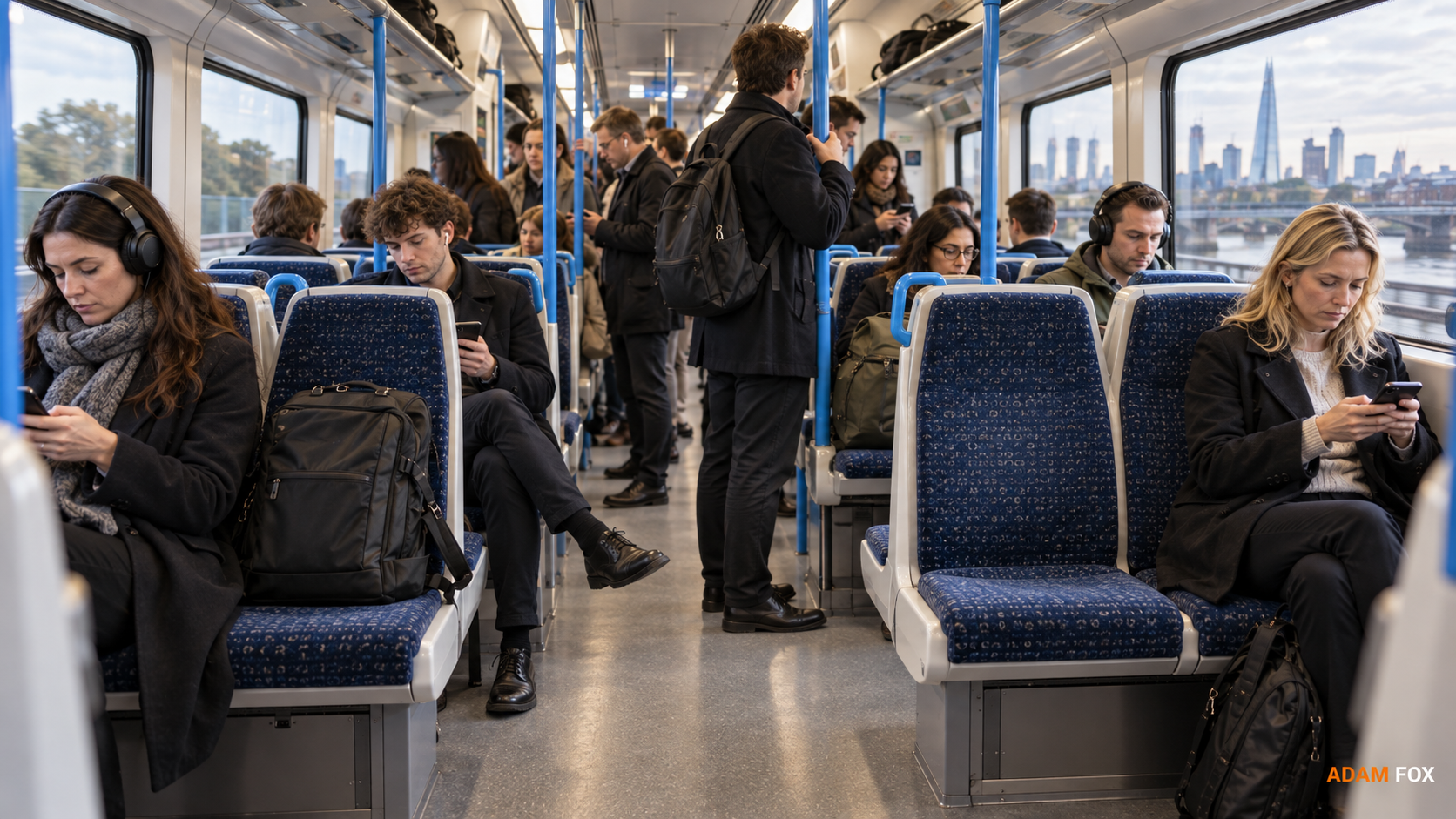
I noticed something on the train into London last week, and not for the first time.
Seats were arranged in pairs.
Nothing unusual there.
What was unusual was the apparent system everyone had independently agreed upon for ensuring those pairs remained occupied by one human being.
Option one:
Sit in the window seat and place your rucksack, handbag, laptop case or portable branch of Selfridges on the aisle seat beside you.
Option two:
Sit in the aisle seat and leave the window seat empty, ensuring anybody wanting to use it has to stop, ask you to move and then perform the awkward little dance required to get past your knees.
Either way, the objective appears to be the same.
Turn two seats into one for as long as socially possible.
Meanwhile, people are standing.
Not one person who has just got on and hasn't yet spotted a seat.
Loads of people.
At points there were probably fifteen people standing around each set of carriage doors.
And there are empty seats.
Technically.
They're simply occupied by bags, protected by bodies or surrounded by enough social friction that nobody bothers asking.
I sat by the window.
My rucksack went between my legs.
The seat next to me remained completely available.
Not because I'm some fucking humanitarian.
Because I bought one ticket.
There was one of me.
And therefore it seemed reasonably obvious that I was entitled to approximately one seat.
Apparently this is now radical thinking.
I understand why you want the second seat
Let's get the obvious bit out of the way.
Nobody particularly wants a stranger sitting six inches from them.
I don't.
If the train is empty, I would much rather have the pair to myself.
I can put my bag down.
Spread out slightly.
Avoid the weird negotiation over the armrest.
Nobody coughs on me.
Nobody watches a video over my shoulder.
Nobody falls asleep and gradually tilts into my personal airspace.
Lovely.
Research on rail passengers suggests that this desire for a bit of space isn't trivial either.
In one study of rush-hour urban commuters, the overall density of passengers in the carriage wasn't what best predicted stress responses. What mattered more was immediate proximity — how physically close other passengers were around the individual. People forced into tighter personal space showed greater self-reported stress, physiological stress responses and after-effects.
Other research on rail crowding has similarly found that crowding is not simply a headcount. Psychological perceptions of space, the surrounding environment and how people experience the situation all contribute to whether a journey feels crowded and stressful.
So yes.
I understand your handbag.
You aren't necessarily an arsehole because you would prefer the seat beside you to remain empty.
I would prefer it too.
The question is what you do with that preference once somebody else needs the seat.
Wanting something does not make you entitled to engineer it
There is an enormous difference between:
I hope nobody sits next to me.
and:
I'm going to arrange things so they have to ask permission.
That's the bit that interests me.
Because putting the bag on the seat doesn't actually prevent another passenger from sitting there.
Nor does choosing the aisle seat while leaving the window seat empty.
Both are more subtle than that.
They add friction.
Now the other person has to do something.
Stop.
Make eye contact.
Interrupt you.
Ask.
Wait.
Potentially ask again because your headphones are in.
Watch you move the bag.
Or wait while you stand up.
Then sit down knowing that, however politely the interaction happened, they have just made your journey slightly less comfortable.
You've transferred the social cost.
You get the benefit of extra personal space unless another person is willing to accept the discomfort of taking it away from you.
That's quite clever really.
Not admirable.
But clever.
“I'd move it if somebody asked”
This is the defence, isn't it?
I'd move my bag if somebody wanted the seat.
I'm sure you would.
Most people probably would.
But that isn't quite the defence it sounds like.
Psychologists Vanessa Bohns and Francis Flynn studied the discomfort involved in asking other people for help.
Across four studies, they found that potential helpers systematically underestimated how uncomfortable and embarrassing it could feel for somebody to have to ask.
Because of that mismatch, people in a position to help could assume:
“If they needed something, they'd just ask.”
The person needing the help experienced the situation differently.
Related experiments have repeatedly found that people also underestimate how willing strangers are to comply when directly asked for assistance. In some studies, people underestimated the likelihood of receiving help by as much as half.
Different scenario.
Same useful insight.
Having to ask is itself a cost.
That makes “I'd move it if they asked” fundamentally different from:
I moved it because I could see somebody might need the seat.
The first person is reactive.
The second is considerate.
Consideration should happen before the request
I think that's the thing we've muddled up.
We increasingly seem to define being considerate as complying politely when somebody raises the inconvenience we created.
That's a very low bar.
If I'm blocking a doorway and you say, “Excuse me,” and I move, I haven't performed a great act of consideration.
I've stopped blocking the fucking doorway.
If my trolley is diagonally across the supermarket aisle and I move it when you ask, congratulations to me.
If my children are running around a restaurant banging into people's chairs and I intervene only after somebody complains, I haven't been wonderfully responsive.
If my music is blasting from my phone on a train and I turn it down because somebody finally asks me to, I'm not suddenly considerate.
Consideration happened one decision earlier.
Before somebody else had to manage me.
That's the distinction.
Courtesy is noticing the likely effect of your behaviour on another person before they have to ask you to notice it.
The railway companies seem to grasp this
The idea that bags shouldn't unnecessarily occupy passenger space isn't some obscure social rule I've invented.
TfL's current Conditions of Carriage explicitly tell passengers to ensure their belongings do not block seats, aisles or doors. Small belongings can temporarily be put on seats, but they must be moved when somebody requires the seat.
National Rail conditions similarly allow luggage to be refused where it causes inconvenience or nuisance, there isn't sufficient room, or it obstructs parts of the train. Individual operators direct passengers towards luggage racks, overhead storage or space beneath seats.
In other words, the handbag hasn't purchased a ticket.
This shouldn't be controversial.
And yet on a busy commuter service you can walk through a carriage and see seat after seat performing secondary employment as a bag stand.
The bag is probably not the real issue
That's why I don't think this is really an essay about public transport.
The train simply makes the behaviour unusually visible.
We do versions of this everywhere.
The supermarket trolley abandoned across the aisle while its owner studies twelve varieties of pasta sauce.
The group walking four abreast along a narrow pavement, somehow surprised every time another human being approaches from the opposite direction.
The person who stops immediately after stepping off an escalator.
The driver parked across two spaces because opening their own door comfortably mattered more than anybody else being able to park.
The person having a speakerphone conversation in a quiet public place.
The family watching videos at full volume in an airport.
The person standing in a doorway to have a conversation.
The neighbour who leaves their car half across the pavement.
The dog owner whose extending lead has created an invisible tripwire across the entire footpath.
None of these is a civilisation-ending event.
That's important.
These are tiny things.
Individually, almost meaningless.
But culture is largely made out of tiny things repeated by millions of people.
And they all contain the same little calculation:
My convenience now. Someone else's inconvenience if necessary.
We have become incredibly good at protecting our bubbles
Modern life gives us remarkable control over our immediate environment.
Headphones.
Noise cancellation.
Phones.
Streaming.
Personalised feeds.
Private cars.
Home delivery.
Self-checkouts.
Remote work.
Food brought to the door.
Entertainment available instantly.
We can create an increasingly personalised bubble and carry it almost everywhere.
Most of that is brilliant.
I use loads of it.
I'm not suggesting we surrender our headphones and begin communal singing on the 07:02.
But there may be a psychological side effect to living inside increasingly customised environments.
Other people start feeling like intrusions into something we unconsciously experience as ours.
My seat pair.
My pavement.
My road.
My queue.
My soundtrack.
My journey.
My space.
The problem, of course, is that public life isn't actually yours.
It's ours.
And shared spaces require tiny acts of compromise from everybody using them.
Civil inattention is not the same as pretending nobody else exists
There is a useful sociological concept here.
Erving Goffman called it civil inattention.
In crowded public spaces, strangers cannot meaningfully interact with everyone around them.
So we develop a subtle social ritual.
Acknowledge someone enough to show you recognise their presence.
Then withdraw your attention enough to respect their privacy.
A glance.
A slight movement.
Making room.
Then leaving them alone.
Modern researchers continue to describe civil inattention as an important way that strangers navigate shared space without either intruding on each other or treating one another as though they are invisible.
That is beautifully different from what I'm complaining about.
Civil inattention says:
I see you, therefore I will not intrude.
What I'm describing says:
I don't need to account for you unless you force yourself into my attention.
One is privacy.
The other is obliviousness.
Maybe we're not actually oblivious
Here's the slightly more uncomfortable possibility.
Sometimes we know.
The bag goes on the seat precisely because we know another human could sit there otherwise.
The aisle seat gets chosen precisely because we know it adds one small barrier.
The trolley sits beside us rather than behind us because that arrangement is more convenient for us.
We aren't always failing to notice other people.
Sometimes we're noticing them enough to manage the situation in our favour.
Behavioural economists and psychologists have studied something related to this under the label moral wiggle room.
The broad finding is that humans sometimes prefer circumstances that allow us to behave selfishly without having to see ourselves as selfish.
If the consequences of our decision are slightly unclear, avoidable or easy to rationalise, we can preserve a positive image of ourselves while choosing the personally advantageous option.
A 2026 review of nearly two decades of research on wilful ignorance found robust evidence that people will sometimes avoid information about how their choices affect others, although the exact motivations and size of the effect vary considerably by context.
I'm not claiming anybody putting a Mulberry bag on a seat is conducting a subconscious behavioural-economics experiment.
But the idea is useful.
We are very good at finding arrangements where we get what we want without having to explicitly choose against somebody else.
Nobody asked for the seat.
Therefore nobody needed it.
Nobody complained about the music.
Therefore it wasn't bothering anyone.
Nobody told me I was blocking the aisle.
Therefore I wasn't really causing a problem.
That little gap between knowing and being forced to acknowledge provides enough moral space to remain a decent person in our own head.
“Nobody said anything” is a terrible standard
Think how often that sentence appears.
Nobody complained.
Nobody asked me to move.
Nobody said they minded.
Nobody told me it was too loud.
Nobody asked for the seat.
Okay.
But did you need them to?
This is where I think individualism has become slightly warped.
Personal freedom matters enormously.
You should not have to live your entire life continuously anticipating everybody else's preferences.
That way lies anxiety, resentment and people-pleasing.
I don't want a society in which everyone spends every minute terrified that their existence might mildly inconvenience another person.
Sometimes you will inconvenience people.
Sometimes they will inconvenience you.
That's what happens when eight billion humans share a planet.
The issue is not never cause inconvenience.
The issue is whether you make the tiny, obvious adjustments when the cost to you is negligible and the benefit to somebody else is clear.
Bag between your feet.
Thirty centimetres.
Done.
We confuse “I am entitled to” with “I should”
This appears everywhere now.
Am I allowed to put my bag there?
Can I play this aloud?
Can I recline the aeroplane seat?
Can I park here?
Can I take this call?
Technically, perhaps.
But rules are the outer boundary of behaviour.
They're not a substitute for judgement.
Plenty of things are permitted and still inconsiderate.
You shouldn't need a paragraph in the Conditions of Carriage explaining that a person has a stronger claim to a passenger seat than your gym bag.
You shouldn't need signage telling you not to stand directly in front of train doors while people are trying to get off.
You shouldn't need a laminated notice asking you not to watch TikTok at full volume inside a hospital waiting room.
A functioning society depends on millions of decisions too small to regulate.
That space is where consideration lives.
Shared spaces only work because of invisible cooperation
Think about how extraordinary a railway station actually is.
Thousands of strangers.
Different destinations.
Different languages.
Different moods.
Different backgrounds.
Different levels of patience.
All moving through the same relatively narrow collection of platforms, escalators, barriers and doors.
And for the most part, it works.
Why?
Not simply because there are laws.
Because people constantly cooperate in tiny ways.
Stand to one side.
Let people off first.
Don't push.
Move down the carriage.
Hold the door.
Give way.
Move the bag.
Offer the seat.
Queue.
We barely notice these behaviours when they happen.
That's exactly why they matter.
Civil society runs on things nobody gets thanked for.
Nobody applauds when I put my bag between my legs.
Nor should they.
That's the fucking baseline.
Consideration isn't sainthood
I think this distinction matters because conversations about courtesy often become moralistic very quickly.
Young people today.
Society has gone downhill.
Nobody has manners anymore.
People were better in the old days.
I'm suspicious of all of that.
Humans have presumably been selfish pains in the arse for as long as we've had arses.
People didn't suddenly discover inconsideration in 2026.
And social norms change.
Some things are arguably more considerate now than they were decades ago.
Greater awareness of disability.
Accessibility.
Mental health.
Personal boundaries.
Smoking around other people.
Discrimination.
Consent.
There is plenty of progress.
This isn't nostalgia.
It's an observation about one particular form of everyday awareness:
Do I notice the small cost my convenience imposes on the anonymous person beside me?
No sainthood required.
Crowding probably makes us more defensive, not more generous
There's another useful complication.
Crowded environments themselves can make personal space feel more valuable.
Research on rail commuting has repeatedly shown that crowdedness is psychological as well as physical. Immediate proximity, lack of control, unpredictable conditions and environmental discomfort can all shape stress.
Which creates an understandable paradox.
The more crowded the train gets, the more valuable the empty seat beside you feels.
Unfortunately, that's also precisely when somebody else most needs it.
That is when courtesy becomes meaningful.
Consideration that costs nothing isn't really tested.
The test is whether you're prepared to surrender a small amount of comfort when another person's need becomes greater.
Not give away your house.
Not donate a kidney.
Move the fucking handbag.
Why doesn't anybody challenge it?
This morning there were people standing while seats were effectively being discouraged from use.
Why didn't everyone just ask?
Some probably did.
Others perhaps preferred standing.
Some might have been leaving at the next stop.
But social friction matters.
Asking a stranger to change their behaviour carries a tiny risk.
Maybe they're rude.
Maybe they sigh.
Maybe they look annoyed.
Maybe you've misread the situation.
Maybe they'll move immediately and nothing happens.
The stakes are laughably low.
Yet humans are extremely sensitive to these tiny social negotiations.
Research showing that people underestimate others' willingness to help also shows just how poorly calibrated we can be about requesting things from strangers.
So the bag works.
Not because it's an impenetrable barrier.
Because it makes standing socially cheaper for some people than asking.
That's why the behaviour annoys me.
The owner benefits from somebody else's reluctance.
The aisle-seat trick might be even better
The aisle seat is particularly clever.
Because there is no bag.
Nothing visibly wrong.
The window seat is empty.
Perfectly available.
You simply have to ask another adult to move their entire body so you can reach it.
Again, on an empty train?
Sit wherever you like.
But once people are standing, I find the psychology fascinating.
Why wouldn't you move across voluntarily?
You can see the carriage filling.
You know somebody could sit beside you.
You know sitting beside the window automatically removes one step for whoever comes next.
Yet you remain in the aisle and wait for demand to be formally expressed.
Perhaps there are legitimate reasons.
Mobility issues.
Getting off shortly.
Anxiety.
Motion sickness.
A medical need.
You cannot infer someone's reason from a seat choice.
But every aisle seat on every busy train isn't occupied by someone with a hidden condition.
Some people simply prefer the aisle.
Fair enough.
Then remain alert enough to make the other seat genuinely accessible.
Preference isn't the issue.
Acting as though public access to the seat depends upon negotiations with you is.
The phone has amplified the problem
There is another ingredient.
It is easier than ever not to notice.
Sit down.
Headphones in.
Phone out.
World disappears.
The person approaching your seat has to penetrate multiple layers.
First the bag.
Then your attention.
Perhaps they wave.
Perhaps speak.
You don't hear.
They speak again.
Now you pull an earbud out.
“Sorry?”
“Can I sit there?”
“Oh. Yeah. Course.”
And perhaps you're genuinely surprised.
Not selfish.
Not malicious.
You simply weren't there.
Technology didn't create inconsideration.
But it has made accidental obliviousness extraordinarily easy.
We can occupy public space while directing almost all our attention somewhere else.
That makes consideration increasingly dependent on deliberate environmental awareness.
Looking up occasionally.
This goes far beyond manners
Manners get dismissed as old-fashioned because we associate them with arbitrary rules.
Which fork.
Which side.
Don't put elbows on the table.
Write thank-you letters.
Fine.
Some etiquette is cultural decoration.
But consideration serves a deeper purpose.
It reduces friction between strangers.
That matters enormously in densely populated societies.
You don't need to know me.
Like me.
Speak to me.
Share my values.
Vote like me.
Live like me.
You only need enough awareness to recognise:
My behaviour affects your experience too.
That is the minimum viable social contract.
What concerns me is the cumulative effect
One bag doesn't matter.
One loud video doesn't matter.
One pavement blocker doesn't matter.
One person not saying thank you doesn't matter.
One trolley doesn't matter.
But encounter enough tiny acts of disregard in a day and something happens.
You become more defensive yourself.
Why should I move?
Nobody else does.
Why should I let them in?
Nobody lets me in.
Why should I return the trolley?
Someone is employed to do that.
Why should I think about them when they clearly aren't thinking about me?
Courtesy can deteriorate reciprocally.
Not because people suddenly become bad.
Because cooperation feels increasingly foolish when you believe you're the only one doing it.
And that's how norms change.
Slowly.
Nobody announces them.
People simply observe what everybody else appears to tolerate.
Maybe that's why it pissed me off so much
It wasn't really about wanting people to sit down.
It was the symbolism of it.
Twenty people in one carriage.
Each sharing exactly the same problem.
We are all travelling somewhere.
We are all tired.
We all paid.
We all want space.
We all want the journey to be comfortable.
And the system works better if everybody gives up a tiny amount of personal convenience.
Yet some people try to preserve theirs until specifically challenged.
That seems to capture something wider about modern society.
We talk constantly about rights.
Less often about obligations that are too small to legislate.
The obligation to notice.
The obligation to make room.
The obligation occasionally to choose the slightly less convenient option because there are other fucking people here.
I don't want constant interaction
To be clear, I am not proposing some utopian train carriage where everyone sings songs and shares breakfast.
I still don't particularly want to talk to you at 6am.
You probably don't want to talk to me either.
Excellent.
We can sit next to each other in glorious silence.
That is one of the great achievements of British civilisation.
I'll look out the window.
You can stare at your phone.
Neither of us needs the other's life story.
Civil inattention works beautifully.
But civil inattention still contains the word civil.
I can leave you alone while also making space for you.
Those things are not opposites.
You shouldn't have to ask me to be considerate
That is where I land.
If the train is empty, put your bag wherever you want.
Put it on the seat.
Give it a little blanket.
Buy it a coffee.
I couldn't care less.
But when the carriage fills, move it.
Before anyone asks.
If you're blocking a path, move.
If people are trying to get off, stand aside.
If you're watching something in public, use headphones.
If somebody is walking towards you, make a little room.
If your trolley is blocking the aisle, pull it in.
If your comfort occupies something another person clearly needs, adjust.
Not because you're a saint.
Not because strangers are entitled to control you.
Not because we need to return to some imaginary golden age of manners.
Because you live among other human beings.
And sometimes being part of society means thinking one decision beyond yourself.
That's all consideration really is.
Maybe that's why the bag bothered me.
It is such a tiny thing.
So easy to move.
So easy not to put there in the first place.
The personal cost is practically zero.
Yet somebody else has to negotiate with you before you'll surrender the benefit.
And perhaps that's the standard we need to stop accepting:
I'll do the considerate thing if somebody makes me.
No.
Do it because you noticed.
Do it because they're there.
Do it because they shouldn't need to ask.
And seriously.
Move your fucking bag.
Sources
Transport for London, TfL Conditions of Carriage. TfL requires passengers to ensure belongings do not block seats, aisles, doors or other shared spaces; small belongings placed on seats must be moved if a passenger requires the seat.
National Rail, National Rail Conditions of Travel. National conditions permit restrictions on luggage where it causes inconvenience or nuisance, where space is insufficient, or where it obstructs train circulation areas.
LNER, Luggage information. LNER directs passengers to store small luggage beneath seats, medium luggage in overhead racks and larger items in dedicated storage rather than allowing belongings to obstruct shared passenger space.
Southeastern Railway, Luggage Guidelines. Southeastern similarly directs passengers towards luggage racks, overhead storage and designated spaces for belongings.
Evans, G. W. & Wener, R. E. (2007), Crowding and personal space invasion on the train: Please don't make me sit in the middle, Journal of Environmental Psychology. In 139 rush-hour urban rail commuters, immediate seating density rather than overall carriage density predicted several stress measures.
Mahudin, N. D. M., Cox, T. & Griffiths, A. (2012), Measuring rail passenger crowding: Scale development and psychometric properties, Transportation Research Part F. The study demonstrated that subjective crowding incorporates psychosocial and environmental dimensions rather than being reducible to passenger density alone.
Tsoi, K. H. & Loo, B. P. Y. (2023), A people-environment framework in evaluating transport stress among rail commuters, Transportation Research Part D. The research identified crowding, service unpredictability and uncomfortable rail environments among factors associated with perceived transport stress.
Kasper, D. V. S. et al. / contemporary work on civil inattention. Research building on Erving Goffman's concept describes civil inattention as a social practice through which strangers recognise one another's presence while respecting privacy in shared public environments.
Bohns, V. K. & Flynn, F. J. (2010), Why didn't you just ask? Underestimating the discomfort of help-seeking, Journal of Experimental Social Psychology. Across four studies, potential helpers underestimated the embarrassment and discomfort associated with having to request help.
Flynn, F. J. & Lake, V. K. B. (2008), If you need help, just ask: Underestimating compliance with direct requests for help, Journal of Personality and Social Psychology. Participants systematically underestimated the likelihood that strangers would comply with direct requests for assistance.
Zhao, X. & Epley, N. (2022), Surprisingly Happy to Have Helped: Underestimating Prosociality Creates a Misplaced Barrier to Asking for Help. Across multiple studies, people needing help underestimated helpers' willingness to assist and overestimated how inconvenienced helpers would feel.
Grossman, Z. & Hua, T. (2026), Willful ignorance in social decisions: Robust, yet contextually sensitive, Current Opinion in Psychology. The review summarises evidence that people sometimes avoid information about the social consequences of their decisions, allowing selfish behaviour to coexist with a positive self-image, while stressing substantial contextual variation in the effect.
Research gaps
There appears to be relatively little direct peer-reviewed research specifically examining the practice of placing bags on adjoining train seats or choosing aisle seats to discourage others from occupying adjacent seats. The interpretation of those behaviours in this essay as forms of territoriality or social friction is therefore an inference from broader research on crowding, personal space, public-space interaction and help-seeking rather than a directly established psychological mechanism.
A passenger occupying an aisle seat cannot automatically be assumed to be attempting to block access. Mobility needs, disability, anxiety, motion sickness, proximity to a destination, luggage management or other invisible circumstances may influence seat choice. Similarly, a bag briefly placed on an empty seat does not establish selfish intent, particularly when a carriage is quiet.
Research on crowding demonstrates that close physical proximity can generate discomfort and stress, helping explain why passengers may prefer an empty neighbouring seat. It does not establish that individuals deliberately obstruct seats as a stress-management strategy.
The research on help-seeking is also broader than the specific train scenario. Evidence that people can find asking uncomfortable and that helpers underestimate this discomfort supports the argument that “they can just ask” carries a social cost, but it does not measure the exact level of discomfort involved in requesting that a passenger move a bag.
Likewise, research on moral wiggle room and wilful ignorance should be applied cautiously. These studies examine controlled social and economic decisions and demonstrate mechanisms through which people can preserve self-image while behaving more selfishly. They do not show that commuters consciously or unconsciously use those mechanisms when occupying extra space.
Finally, this essay does not establish that society is objectively less considerate in 2026 than in previous periods. Reliable longitudinal evidence measuring everyday public consideration across generations is limited, and nostalgia can distort perceptions of past behaviour. The broader argument is therefore observational and philosophical: shared environments function better when people anticipate obvious effects on others rather than waiting to be explicitly challenged.