
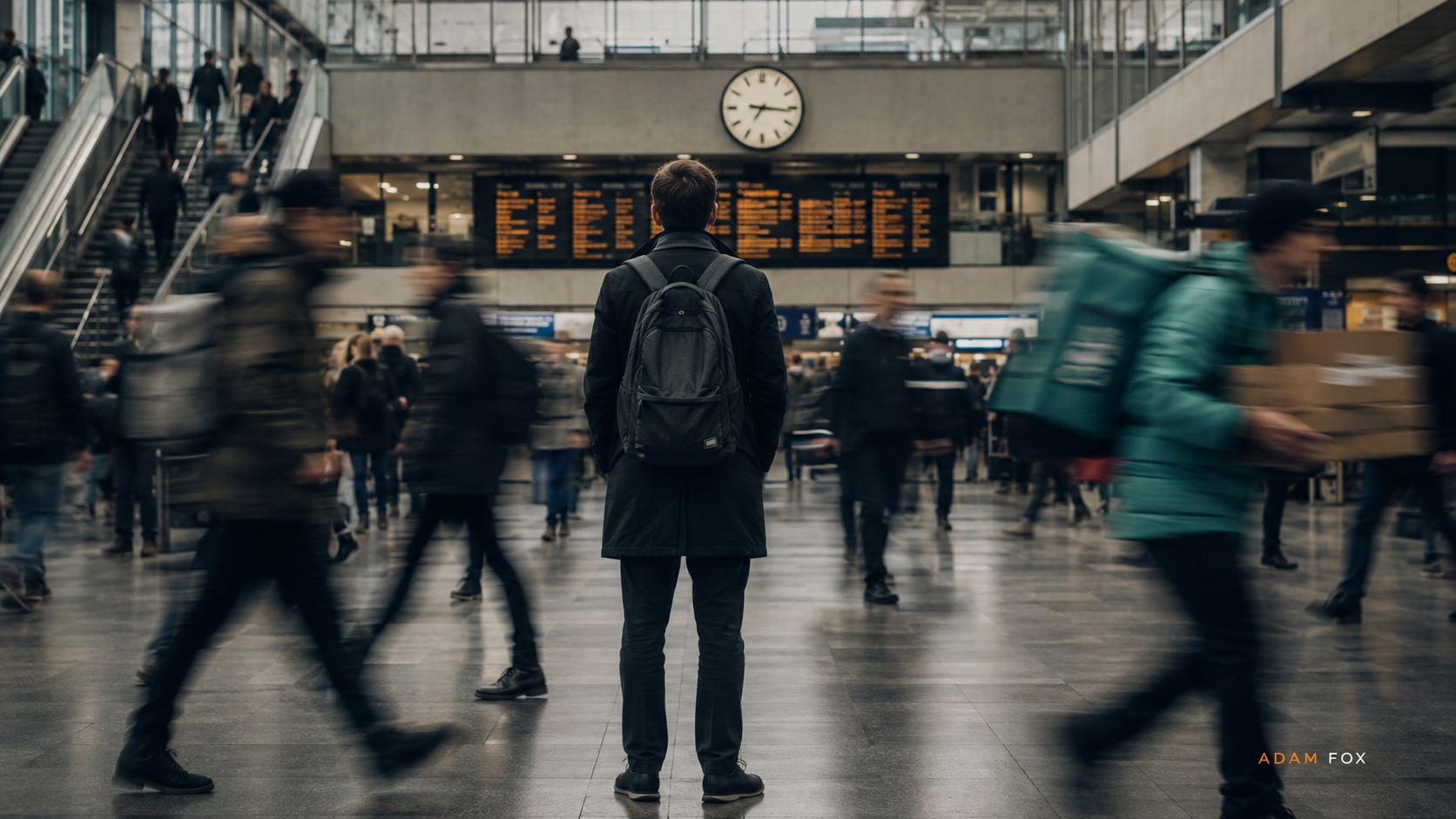
THE COST OF NOW: Everything Was Due Yesterday
I genuinely don’t know when everything became urgent.
Not genuinely urgent.
Not the building is on fire, someone is hurt, the deadline is legally fixed or if we don’t act now something terrible happens urgent.
Just… urgent.
Emails are urgent.
Deliveries are urgent.
Quotes are urgent.
Decisions are urgent.
Replies are urgent.
Someone sends you something at three o’clock in the afternoon and by nine the following morning they are wondering whether you received it.
Of course I fucking received it.
You sent it yesterday.
That doesn’t mean everything I was already doing ceased to exist.
Somewhere along the way, we seem to have developed this peculiar collective belief that because something can happen quickly, it therefore should happen quickly.
And once it should happen quickly, anything slower starts to feel like failure.
That shift matters.
Because I think it explains something strange about modern life.
We have more technology designed to save us time than any generation before us.
We have faster communication.
Faster transport.
Faster payments.
Faster information.
Faster manufacturing.
Faster delivery.
Faster access to services.
Faster computers.
Faster everything.
Yet hardly anybody seems to be wandering around saying:
“Brilliant. Look at all this spare time.”
Quite the opposite.
Everyone seems rushed.
Everyone seems behind.
Everyone has too much to do.
Everything needs chasing.
Everything needs moving.
Everything should have happened yesterday.
How the fuck did that happen?
Speed used to be the advantage
There is nothing inherently wrong with speed.
That point matters because this series is not going to become some misty-eyed argument that everything was better when we sent letters by horse.
It wasn’t.
Waiting six weeks for something that can now happen in six seconds is not inherently virtuous.
A faster ambulance is better.
A faster bank transfer is better.
Faster access to critical information can save lives.
Technology removing pointless friction can be extraordinary.
The problem begins afterwards.
Because human beings are remarkably good at turning improvements into expectations.
Imagine a process takes five working days.
Someone develops a system that reduces it to three.
Fantastic.
For a while, three days feels incredible.
Then three days becomes normal.
Eventually somebody does it in one.
Now one day feels impressive.
For a while.
Until everybody adjusts again.
Soon the company taking three days hasn’t become objectively worse at what it does. It may actually be performing the same service dramatically faster than it did ten years earlier.
But relative to the new expectation, it now feels slow.
That is the ratchet.
Speed improves.
Expectations follow.
Speed improves again.
Expectations follow again.
And crucially, expectations rarely seem to move backwards.
Once next-day delivery exists, three-day delivery suddenly feels disappointing.
Once instant bank transfers exist, waiting until Monday feels absurd.
Once somebody can answer an email from almost anywhere, “I wasn't at my desk” stops sounding like an explanation.
Once we know a message has been delivered, silence starts acquiring meaning.
Why haven’t they replied?
Are they ignoring me?
Have they forgotten?
Should I chase?
Perhaps they're doing something.
Remember that?
Doing something else.
Technology saved time. Then we spent it again.
The sociologist Hartmut Rosa has spent years studying something he calls social acceleration.
His work separates acceleration into several forms, including technological acceleration, faster social change and an increasing pace of life.
One of the most interesting parts of his argument is the apparent contradiction at the centre of modern progress.
Technology allows us to perform individual activities faster.
Logically, that should create more free time.
But it often doesn't.
Because we increase the number of activities we attempt within the same period.
If sending ten letters once took an afternoon and sending ten emails now takes twenty minutes, we don't necessarily finish at 10:20 and wander into the garden.
We send fifty emails.
Then answer another twenty.
Then squeeze in a meeting.
Then check the thing that arrived while we were doing that.
Then wonder why the day disappeared.
Researchers examining digital communication through Rosa's framework describe exactly this mechanism: communication becomes faster, so the volume of communication within each unit of time increases.
We didn't necessarily use technology to save time.
We used it to increase throughput.
That distinction is enormous.
Because once increased throughput becomes possible, organisations start designing themselves around it.
Customers become accustomed to it.
Markets compete on it.
Managers measure it.
Workers adapt to it.
Eventually what began as saved time becomes expected capacity.
The technology hasn't simply made the old world quicker.
It has changed what everybody believes should be possible.
And then we wonder why nobody has any bloody time.
We confuse possible with reasonable
I see this constantly in business.
Someone receives an enquiry.
Technically, they could respond immediately.
Therefore somebody decides they should.
A client asks for something.
Technically, it could be finished today.
Therefore tomorrow starts sounding slow.
Someone has access to their emails outside working hours.
Therefore an email sent outside working hours starts carrying an invisible possibility of response.
Nobody necessarily says:
“You must answer this tonight.”
That's the clever bit.
The expectation often doesn't need saying.
Researchers use the term workplace telepressure to describe the preoccupation and urge people can feel to respond quickly to message-based work communications. Research has linked stronger telepressure with poorer evaluations of work-life balance and impaired recovery from work.
The pressure can exist even when nobody has explicitly ordered us to respond.
We've learned the norm.
And norms are incredibly powerful because eventually they stop looking like rules.
They just look like reality.
I know that world rather well.
At one stage of my career, being dependable gradually became being permanently available. Calls could come early, late, on holiday, whenever. The more capable and reliable you demonstrate yourself to be, the easier it becomes for everybody around you to build their own working habits around your responsiveness.
Your usefulness becomes your accessibility.
And accessibility has no natural stopping point.
I eventually learned, painfully, that some workplaces do not value your time.
They value their access to it.
Those are not the same thing.
Urgency does something strange to our judgement
There is another problem.
Humans appear to be unusually susceptible to urgency itself.
Researchers Meng Zhu, Yang Yang and Christopher Hsee demonstrated what they called the mere urgency effect.
Across a series of experiments, participants sometimes prioritised less important tasks with smaller rewards simply because those tasks appeared more urgent.
The important thing here is that urgency wasn't merely acting as useful information.
People could prefer the objectively inferior task because of the urgency attached to it.
That should make all of us slightly uncomfortable.
Because modern life has become exceptionally good at manufacturing urgency.
Unread.
Due today.
Last chance.
Respond now.
Waiting for approval.
Action required.
ASAP.
Chaser.
Reminder.
Notification.
Red badge.
Countdown.
Someone is typing.
Your parcel is eight stops away.
None of those things automatically tells us whether something matters.
They tell us that something is happening now.
And our brains are not particularly good at treating those as separate categories.
So the immediate pushes past the important.
Again.
And again.
And again.
Until eventually an entire day can be consumed by responding beautifully to things that barely mattered.
Meanwhile the quiet work waits.
Thinking.
Planning.
Writing.
Learning.
Talking properly to someone.
Building something.
Walking.
Resting.
Working out what the fuck you actually want.
Important things have a terrible marketing department.
They rarely flash.
They rarely buzz.
They rarely chase you.
They sit quietly in the background assuming that, at some point, you will remember they matter.
Urgency doesn't have that problem.
Urgency kicks the door in.
But this isn't something being done to us
This is where the argument becomes uncomfortable.
It would be very easy to blame technology.
Or Amazon.
Or employers.
Or capitalism.
Or smartphones.
Or demanding customers.
And each of those things deserves scrutiny.
But none completely explains the problem.
Because we are not merely victims of immediacy.
We are participants in it.
We complain that our inbox is relentless while sending messages into everybody else's.
We complain about clients wanting everything immediately while becoming irritated when our own supplier takes two days to answer.
We want flexible working but expect people to be reachable when we need them.
We want evenings undisturbed by work but send somebody else an evening email because it happens to be convenient for us.
We want our weekends protected but order services that require somebody else to work theirs.
We want more control over our own time while becoming increasingly intolerant of other people exercising control over theirs.
That contradiction might be the most important idea in this entire series.
Researchers studying temporal autonomy describe time not simply as something we possess in equal twenty-four-hour quantities, but in terms of the control we have over its use.
That control matters.
Research has found that discretionary control over time influences how rushed people feel and relates to satisfaction with life.
Which makes intuitive sense.
Two people can each have three hours free.
If one person chose those three hours and the other only has them because nothing has demanded their attention yet, those three hours do not necessarily feel the same.
Autonomy matters.
But there is a problem.
My autonomy can collide with yours.
If I decide that my preferred timescale requires your immediate participation, my convenience has become a claim on your time.
And we do this constantly without recognising it.
“I need this today.”
Why?
Sometimes there is an excellent answer.
Often there isn't.
Often the real answer is:
Because today would be convenient for me.
That's not urgency.
That's preference wearing urgency's clothes.
When did yesterday become the deadline?
I suspect there wasn't a moment.
Nobody gathered the world together and announced that patience had been cancelled.
It happened gradually.
The letter became the fax.
The fax became the email.
The email became instant messaging.
Delivery windows shortened.
Customer-service expectations shortened.
Production cycles shortened.
News cycles shortened.
Response windows shortened.
And at each stage we adapted.
That's what humans do.
The extraordinary becomes ordinary remarkably quickly.
Then ordinary becomes expected.
Then expected becomes demanded.
And eventually the person who refuses to accelerate looks like the problem.
Maybe they are inefficient.
Maybe they're unresponsive.
Maybe they lack urgency.
Maybe they're not hungry enough.
Or maybe they've simply noticed something the rest of us haven't.
There is no finishing line here.
If every efficiency improvement merely resets the minimum expected speed, then efficiency cannot ultimately give us more time.
It can only increase the rate at which we consume it.
That's a very different proposition.
And it raises an awkward question for every productivity tool, communication platform and artificial-intelligence system currently promising to save us hours.
What happens to the hours?
Do we keep them?
Or does somebody notice we've become faster and quietly fill them back up?
History doesn't make me particularly optimistic.
Maybe waiting wasn't entirely waste
We've spent decades treating friction as something to eliminate.
Sometimes rightly.
But I wonder whether some of the friction we removed was doing something we didn't understand.
A letter couldn't be answered instantly.
So nobody expected it to be.
A person away from their desk couldn't be contacted.
So whatever you wanted either waited or you solved it yourself.
A shop closed.
A business finished for the day.
Someone went on holiday and became temporarily unavailable.
The boundary wasn't necessarily created through tremendous personal discipline.
Sometimes the technology itself created it.
There were gaps.
Delays.
Periods when nothing could happen.
And because nothing could happen, nobody interpreted nothing happening as failure.
We've removed many of those constraints.
Now almost everything can happen.
And perhaps that is precisely why we feel as though everything must.
This isn't an argument for going backwards.
It's an argument for understanding what we accidentally removed on the way forwards.
Because speed is useful.
Immediacy is useful.
Convenience is useful.
But usefulness does not create obligation.
Just because I can reach you now doesn't mean you owe me now.
Just because something can be delivered tomorrow doesn't mean everything should be.
Just because technology has made work faster doesn't mean the reclaimed minutes automatically belong to whoever notices them first.
And just because I have decided something is urgent does not mean I get to make it urgent for you.
Over the coming essays, I want to pull that apart.
The messages.
The deliveries.
The artificial deadlines.
The always-available employee.
The demanding customer.
The workplace urgency.
The disappearance of waiting.
The strange relationship between convenience and entitlement.
And eventually AI, which may be about to remove more friction from knowledge work than anything we have experienced before.
But before any of that, I think we need to recognise the basic pattern.
We built tools to save time.
Then we increased what we expected within that time.
Then we expected everyone else to keep up.
Now we are all running faster while simultaneously asking where our time went.
Perhaps the problem was never that we failed to save enough time.
Perhaps it was that every time we saved some, we immediately found another way to spend it.
And worse:
we started spending everybody else's too.
SOURCES AND RESEARCH GAPS
Key research areas:
- Hartmut Rosa, social acceleration: Rosa's framework distinguishes technological acceleration, acceleration of social change and acceleration in the pace of life. Importantly, the pace of life can accelerate despite technology theoretically reducing the time required for individual activities.
- Digital communication and the multiplication of activity: Research applying Rosa's theory to digital communication describes acceleration partly as increasing the number of action episodes within a unit of time, reducing pauses and increasing simultaneous activity.
- The mere urgency effect: Zhu, Yang and Hsee found across five experiments that people can prioritise objectively less important tasks because those tasks carry spurious urgency.
- Temporal autonomy: Goodin, Rice, Parpo and Eriksson define discretionary control over time as an important dimension of autonomy and report associations with feeling rushed and overall life satisfaction.
- Workplace telepressure: Research describes workplace telepressure as a preoccupation and urge to respond rapidly to message-based work communications and associates it with poorer work-life balance and reduced recovery.
- Lived-experience foundation: Adam's previous experience of constant availability and the gradual conversion of reliability into assumed accessibility provides the personal thread connecting the wider research to working life.
Research gaps:
- There is no single historical moment when “fast became mandatory”. The essay therefore deliberately presents this as gradual cultural adaptation rather than attributing it to one technology or date.
- The claim that the overall pace of life is objectively accelerating is contested. Recent scholarship has challenged whether empirical evidence supports a universal increase in the speed of everyday life. The stronger claim used here is that communication, production and other processes have accelerated and that social expectations can expand alongside that capability.
- Consumer expectations of response and fulfilment need their own deeper research. Later essays should examine how delivery standards, customer-service benchmarks and platform design have altered what people perceive as an acceptable wait.
- The relationship between technological time savings and increased workload needs separating by sector. The mechanism is plausible and well developed theoretically, but later essays should distinguish knowledge work, logistics, professional services and domestic life rather than assuming identical effects everywhere.
- AI requires separate treatment. Its effect on expected output, turnaround times and labour intensity is developing too quickly to fold responsibly into this opening essay and should be researched immediately before the dedicated AI essay is written.