
Alcohol Isn’t the Habit. It’s the Job It Does.
Most people do not drink because they have carefully assessed alcohol and concluded that ethanol is exactly what their evening needs.
They drink because of what they believe it will do.
Help them relax.
Make them feel less awkward.
Turn an ordinary evening into an occasion.
Take the edge off a difficult day.
Make conversation easier.
Mark the end of work.
Give them permission to stop thinking.
Alcohol is the substance.
The job it performs is something else entirely.
That distinction matters because habits become much harder to understand when we focus only on the visible behaviour.
You see someone pour a glass of wine every evening and it is easy to decide that the problem, if there is one, is the wine.
But the wine may be performing a function.
It may be the dividing line between work and home.
It may be the only point in the day when that person feels permitted to relax.
It may be a reward.
It may be company.
It may be relief.
It may be the ritual that tells their body the day is finally over.
Remove the drink without understanding the job and you leave the job vacant.
That empty space is often what people are really frightened of.
We Rarely Start Drinking for the Reason We Continue
My relationship with alcohol changed several times during my life.
When I was younger, it was primarily social.
Alcohol helped reduce self-consciousness. It loosened conversation. It made it easier to join in.
That mattered.
As a teenager and young adult, belonging is rarely discussed openly, but it shapes almost everything. You are constantly measuring whether you fit. Whether people like you. Whether you are too quiet, too serious, too reserved or simply not quite part of the group.
Alcohol can temporarily silence some of that internal commentary.
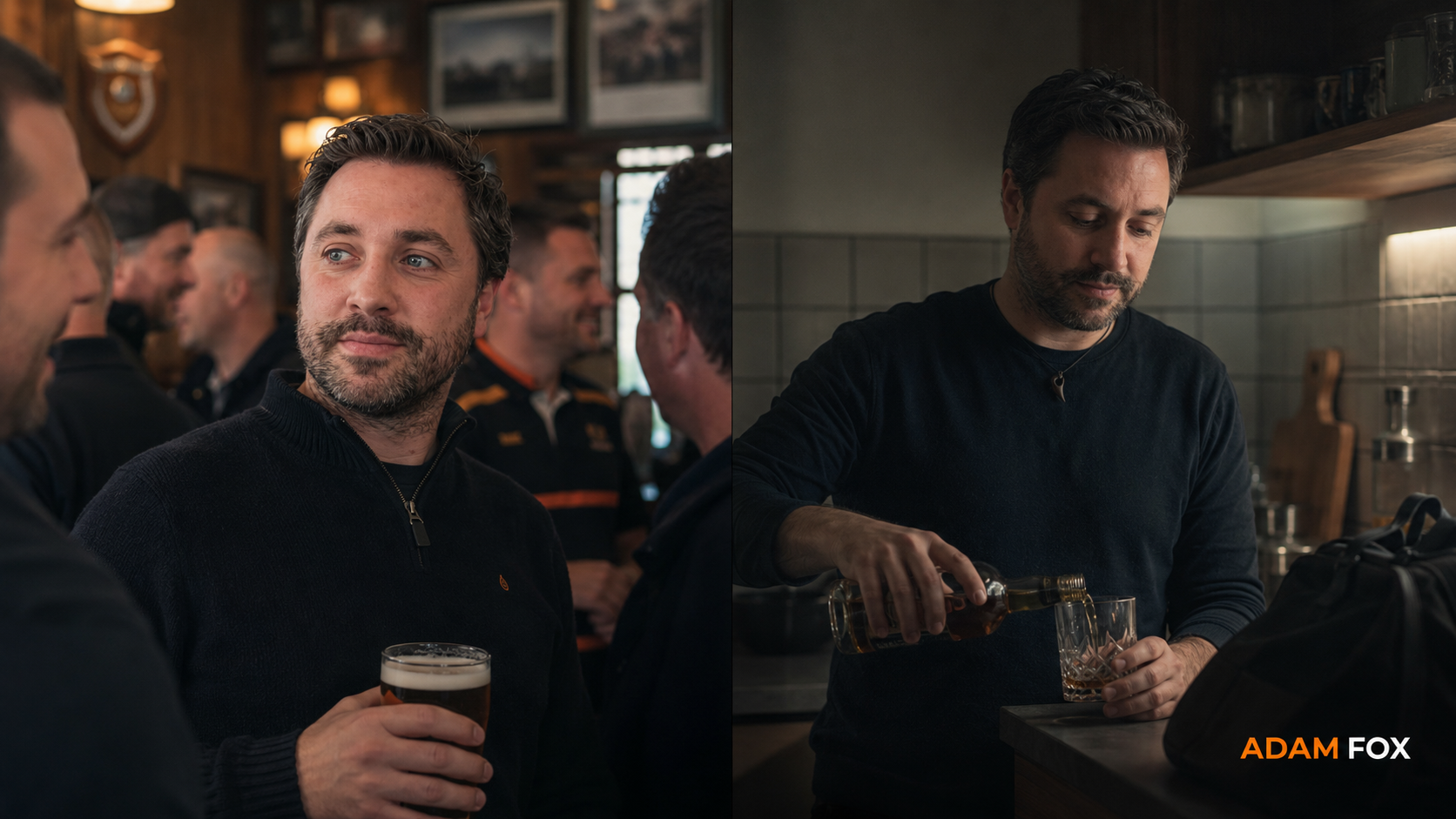
In rugby culture, it also operated as a form of participation.
You played the match.
You went into the clubhouse.
You drank with the team.
You joined the games, the jokes and the stories that would be repeated the following week.
The drink was not only a drink.
It was proof that you were in.
The same was true during my early management career.
A strong social and drinking culture existed among many of the managers I worked with. Long sessions, drinking games and nights that continued far beyond anything sensible helped create relationships outside the normal hierarchy of work.
People relaxed around one another.
The serious manager became funny.
The intimidating manager became human.
The young manager became part of the group.
Alcohol did not make anyone better at managing a supermarket.
But it helped people become familiar with one another, and familiarity can affect trust, opportunity and career progression.
Again, it was doing a job.
It helped create belonging.
Years later, I was still drinking alcohol, but I was no longer asking it to do the same thing.
I was not trying to fit into a rugby team or prove to senior managers that I was fun to be around.
I was trying to switch off.
The behaviour remained broadly recognisable.
The function had changed completely.
That is how habits evolve without us noticing.
We assume we are continuing something because we enjoy it, when in reality we may be using the same behaviour to solve a different problem.
What Job Is Your Drink Doing?
This is a far more useful question than simply asking how much someone drinks.
Quantity matters, obviously.
Frequency matters too.
But neither explains the entire relationship.
Two people may consume exactly the same amount of alcohol for completely different reasons.
One person might have two drinks at a wedding because they enjoy the taste and the occasion.
Another might have two drinks alone because they cannot tolerate the transition between a stressful day and a quiet evening.
The units may be identical.
The role is not.
That role can be difficult to see because alcohol is so deeply embedded in ordinary life.
We drink to celebrate a new job.
We drink after losing one.
We drink at weddings and funerals.
We drink because we are excited.
We drink because we are disappointed.
We drink to meet people.
We drink because we are lonely.
The same substance is presented as the appropriate response to almost every emotional state.
Good news?
Open a bottle.
Bad news?
You need a drink.
Nothing happened at all?
You have earned one anyway.
When a behaviour appears in every situation, it is worth asking whether the occasion is really driving it.
Alcohol as Permission
One of the most interesting jobs alcohol performed for me was giving me permission to stop.
During the most demanding years of my career, I found it incredibly difficult to switch off.
My body could leave work.
My mind often stayed there.
Problems continued turning over in my head. Decisions remained unfinished. Conversations were replayed. Risks appeared at two in the morning that had somehow remained invisible during the day.
A drink created a boundary.
It said the working day was finished.
It marked the moment when I was no longer expected to solve anything.
But the question I failed to ask was why I needed alcohol to grant that permission.
Why was I unable to sit down without earning it?
Why did stopping feel legitimate only after pouring something into a glass?
Why had rest become something that required a chemical signal?
Alcohol was not simply helping me relax.
It had become part of the ritual that allowed relaxation to begin.
That is not the same thing.
Rituals are powerful because they reduce the need for conscious decision-making.
You close the laptop.
You walk into the kitchen.
You open the cupboard.
You hear the bottle.
The day changes state.
Over time, the sequence itself becomes the trigger.
You may start anticipating the drink before you have decided whether you actually want it.
The habit is no longer an isolated choice. It is part of a chain.
And the more often that chain is repeated, the more natural it feels.
The Reward You Stop Questioning
Alcohol also operates as a reward.
I worked hard.
I dealt with difficult people.
I absorbed pressure.
I got through another ridiculous day.
Therefore, I deserved a drink.
There is nothing unusual about that logic. It is everywhere.
The danger is that rewards can become entitlements, and entitlements can stop being evaluated.
You no longer ask whether the reward improves your life.
You ask only whether you have earned it.
That is a significant shift.
A reward is supposed to give something back.
But if the reward disrupts sleep, makes the following morning harder, affects mood and reduces the quality of the next day, the calculation becomes less straightforward.
You may still decide it is worth it.
That is your choice.
But it should at least remain a choice.
For me, the drink gradually became automatic enough that I stopped properly evaluating the exchange.
I focused on the immediate benefit.
I paid less attention to the delayed cost.
That is not unique to alcohol.
Human beings are generally poor at comparing a reward we can experience now with a consequence that arrives later.
The drink changes how you feel within minutes.
The poorer sleep appears hours afterwards.
The increased anxiety might appear the following morning.
The lower energy affects decisions throughout the next day.
By then, the drink is no longer standing in front of you presenting the bill.
Work gets blamed.
Age gets blamed.
Stress gets blamed.
The kids get blamed.
The weather probably gets blamed.
Anything except the solution we keep using to cope with the problem.
Alcohol as Identity
There is another job alcohol can perform that is less obvious.
It can help maintain identity.
The person who knows their wine.
The person who always orders the first round.
The person who is good fun on a night out.
The person who drinks whisky by the fire.
The person who has a beer while cooking.
The person everyone expects to join them.
These identities feel personal, but they also exist inside relationships.
Other people learn who we are through repeated patterns.
When you change one of those patterns, it can feel to them as though you are changing the relationship itself.
That was one of the unexpected parts of stopping.
Some people were entirely comfortable with it.
Others seemed to need an explanation.
A simple “I don’t drink” could create more questions than ordering a drink ever had.
Why not?
Are you driving?
Are you ill?
Did something happen?
Are you never drinking again?
Alcohol is so normal that declining it can be interpreted as the unusual behaviour.
That social expectation gives alcohol another job.
It reassures other people that nothing has changed.
You are still part of the same group.
You are still willing to participate in the same rituals.
You are still the person they remember.
When someone stops drinking, they do not only remove alcohol.
They may also remove a role they used to perform for others.
That is why the pressure to drink again is not always really about the drink.
Sometimes it is about restoring the old arrangement.
The Fear of the Hole
Some people know they would probably feel better without alcohol and still cannot imagine giving it up.
That is often treated as irrational.
I do not think it is.
If alcohol performs several jobs, removing it can appear to leave several holes.
What will mark the end of the day?
How will I relax?
What will I do on Friday night?
What will I order in the pub?
How will I celebrate?
Will people think I am boring?
Will I still enjoy myself?
Will I still be invited?
Will I have to feel everything I currently soften?
Those are not insignificant questions.
It is easy for someone who has already stopped drinking to say that life is better without it.
But from the other side, the fear may not be about losing alcohol.
It may be about losing everything alcohol has come to represent.
Relaxation.
Connection.
Reward.
Routine.
Confidence.
Escape.
If those things are not replaced, the absence can feel enormous.
That is why simply telling someone to stop is rarely a complete answer.
The more useful question is:
What job would no longer be getting done?
If alcohol is the only way someone knows how to relax, then they do not merely need to remove a drink.
They need to relearn relaxation.
If alcohol is the only way they socialise, they may need to build confidence in social situations without it.
If alcohol is the reward at the end of every difficult day, they may need to examine why every day feels difficult enough to require one.
If alcohol is company, removing it may expose loneliness.
If alcohol is escape, the uncomfortable question is what they are escaping from.
The drink can be removed quickly.
The need beneath it may remain.
The Risk of Replacing the Substance and Keeping the System
This is also why habits often migrate.
Someone stops drinking and starts eating more.
Or shopping more.
Or scrolling more.
Or working more.
Or training with an intensity that becomes its own form of escape.
The visible behaviour changes.
The underlying job remains.
That does not mean every replacement is equally harmful.
Going for a run is clearly not the same as consuming several bottles of wine.
But the mechanism is still worth understanding.
Are you choosing the behaviour because it improves your life?
Or are you using it because you still do not know how to sit with whatever appears when the noise stops?
That is a question I have explored throughout my work on attention and agency.
The world offers endless ways to avoid discomfort.
Some are celebrated.
Some are condemned.
Some are sold to us as essential parts of adult life.
The common thread is that they can all become automatic answers to questions we have stopped asking.
Removing Alcohol Did Not Remove the Need to Unwind
When I stopped drinking, work did not suddenly become easy.
My responsibilities did not disappear.
The pressures that existed in my life were not imaginary.
Removing alcohol did not solve everything.
What it did was remove one variable.
That made the rest easier to see.
If I was stressed, I had to confront the stress.
If I could not switch off, I had to examine why.
If I was exhausted, I had to consider my workload, boundaries and sleep rather than briefly muting the feeling and carrying on.
That is one reason the decision lasted.
Stopping alcohol did not only make me feel better.
It made the systems around my life more visible.
The drink had been softening the symptoms just enough for me to continue tolerating some of the causes.
Without it, I had clearer feedback.
That feedback was not always comfortable.
But it was useful.
And useful information is central to agency.
You cannot improve a system you cannot see.
This Is Not an Argument Against Drinking
I am not suggesting that every drink conceals a deep emotional wound.
Sometimes a pint is a pint.
Sometimes someone likes wine with dinner.
Sometimes a group of friends goes out, drinks, laughs and returns to normal life without giving it another thought.
Not every behaviour requires psychoanalysis.
But repeated behaviours deserve curiosity.
Particularly when they become the default response to multiple situations.
You do not need to decide that alcohol is evil.
You do not need to label yourself.
You do not need to promise that you will never drink again.
You can simply ask what it is doing.
What changes after the first drink?
What feeling are you looking for?
What moment triggers the desire?
What would be missing without it?
What cost have you accepted as normal?
Those questions are not accusations.
They are information.
And the answer may be that alcohol occupies a small, enjoyable and controlled place in your life.
It may also reveal that the drink is carrying far more responsibility than you realised.
The Habit Is Only the Surface
For me, alcohol performed different jobs at different stages.
It helped me belong.
It helped me build relationships.
It helped me feel less guarded.
Later, it helped me mark the end of the day.
It helped me create temporary distance from pressure.
It helped me believe I was recovering.
The alcohol remained the same.
The need changed.
That is why focusing only on consumption can miss the more important question.
The habit is what we can see.
The job is what keeps it there.
And until we understand the job, we cannot honestly say whether we are choosing the habit or simply repeating the solution we have always used.
Alcohol may not be the problem.
But if it has become your answer to confidence, stress, boredom, reward, loneliness, celebration and sleep, it is doing an extraordinary amount of work.
The question is not whether you are allowed to drink.
Of course you are.
The question is whether you still know what you are asking the drink to do.
Because once you can answer that, you may discover that the thing you are frightened to lose is not the alcohol at all.
It is the feeling you have taught yourself can only be found inside the glass.
Explore Adam Fox’s wider work on attention, agency and the hidden systems shaping modern behaviour.