
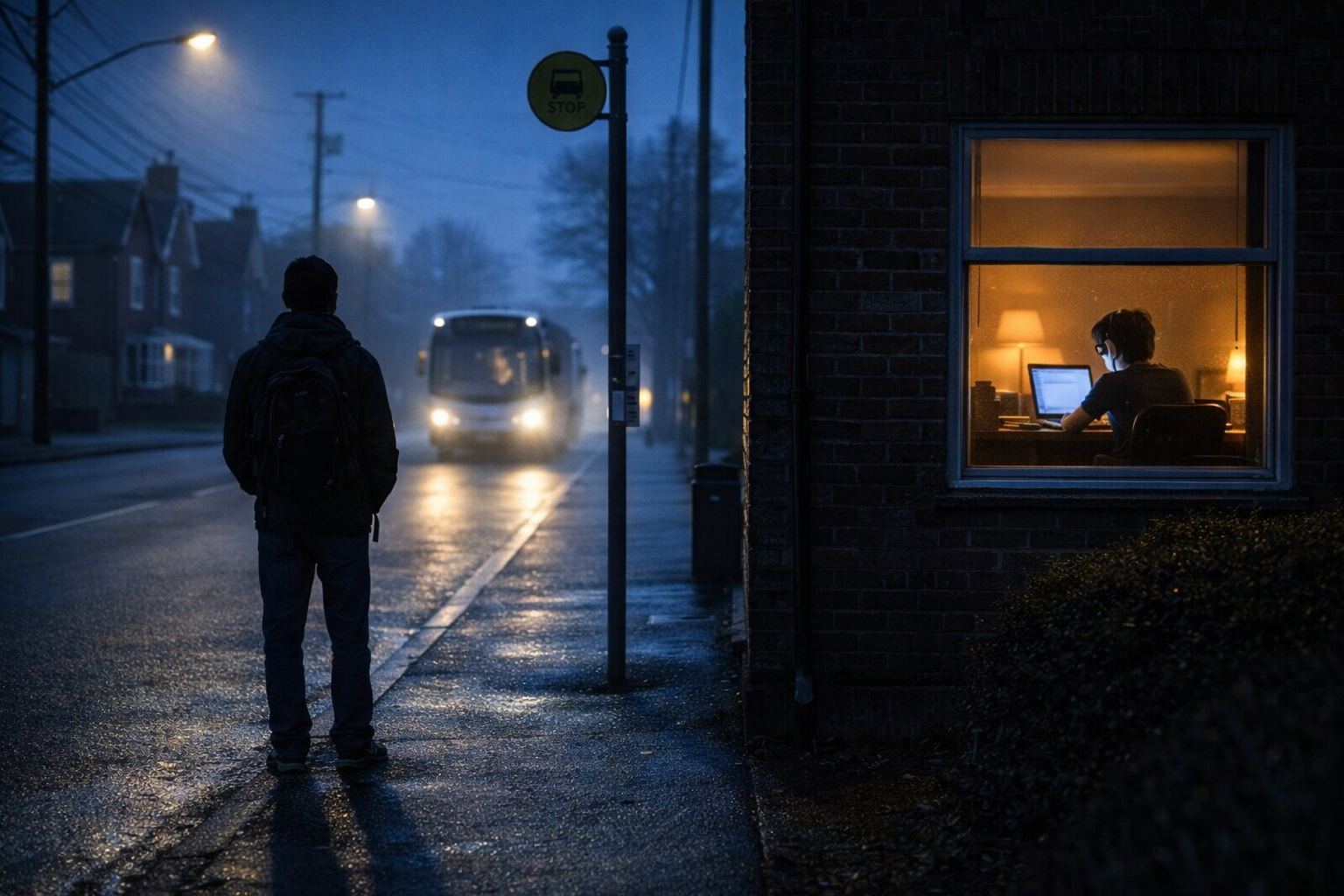
WHY TEENAGERS ARE NATURALLY NIGHT OWLS (AND WHY EARLY SCHOOL START TIMES FIGHT BIOLOGY)
When I was a teenager, I had a paper round.
That meant being up at 6am, walking down to the local newsagent for 6:30, collecting a stack of newspapers, and getting them delivered before heading home, getting ready, and catching the bus to school.
It never felt like a battle.
Even then, waking up early came naturally to me. I’d get up, get moving, and get on with the job.
But I remember noticing something interesting about my friends.
Many of them looked like they’d been dragged out of hibernation every morning. Sluggish. Half awake. Barely functioning before school.
Yet those same people would transform later in the day.
When evening came around and the rest of us were starting to wind down, they were only just getting going. When the party was starting, I was usually the one ready to call a taxi and head home.
At the time it just felt like a personality difference.
Some people were morning people. Some weren’t.
But the reality is far more interesting than that.
Because during adolescence, the human brain undergoes a shift in its biological clock that pushes sleep later into the night.
In other words, many teenagers are biologically programmed to be night owls.
And modern school schedules often force them to live completely out of sync with that biology.
THE TEENAGE SHIFT IN THE BODY CLOCK
During puberty, the circadian rhythm undergoes a measurable change.
The hormone melatonin, which signals to the body that it is time to sleep, begins to be released later in the evening.
In adults, melatonin may start rising around 8–9pm.
In teenagers, it often doesn’t begin until 10–11pm, sometimes even later.
This shift is known as a phase delay in the circadian rhythm.
The effect is simple.
Teenagers don’t feel sleepy until much later at night.
And because the body still requires roughly 8–10 hours of sleep, their natural wake time shifts later into the morning.
Left to their own schedule, many teenagers would naturally sleep from around midnight to 8 or 9 in the morning.
That is not laziness.
That is biology.
WHY EARLY SCHOOL START TIMES CREATE A PROBLEM
Now consider what most school systems expect.
Many secondary schools begin classes between 8:00 and 8:30am.
For a teenager to arrive at school on time, they often need to wake somewhere between 6:00 and 7:00am.
But if their brain does not begin producing melatonin until around 11pm, falling asleep earlier than that becomes difficult.
The result is predictable.
Teenagers are often forced to wake two to three hours earlier than their natural circadian rhythm would prefer.
This creates what sleep scientists call chronic sleep restriction.
Night after night, sleep is cut short.
Over weeks, months, and years, the sleep debt accumulates.
THE EVIDENCE FOR TEENAGE SLEEP DEPRIVATION
Research across multiple countries consistently shows that adolescents are among the most sleep-deprived populations in modern society.
Large studies indicate that the majority of teenagers get significantly less than the recommended 8–10 hours of sleep per night.
The consequences extend far beyond feeling tired.
Sleep deprivation during adolescence has been linked to:
• reduced attention and concentration
• poorer academic performance
• increased risk of depression and anxiety
• increased impulsivity and risk-taking behaviour
• higher rates of car accidents among teenage drivers
One study found that teenagers who sleep fewer than seven hours per night are significantly more likely to report symptoms of depression and emotional distress.
Another found that later school start times were associated with improved attendance, higher grades, and better overall wellbeing.
THE SCIENCE OF ADOLESCENT BRAIN DEVELOPMENT
Adolescence is a period of intense neurological development.
During these years, the brain undergoes major restructuring, particularly in the prefrontal cortex, the area responsible for:
• decision making
• impulse control
• long-term planning
• attention regulation
Sleep plays a crucial role in this development.
During deep sleep, the brain consolidates learning, strengthens neural connections, and clears metabolic waste products that accumulate during waking hours.
When sleep is shortened or disrupted, these processes are impaired.
For teenagers already navigating the complexity of cognitive and emotional development, chronic sleep deprivation can have significant long-term consequences.
WHY SOME TEENAGERS STILL WAKE EARLY
Of course, not every teenager is the same.
Even during adolescence, chronotype differences still exist.
Some teenagers naturally lean toward earlier rhythms.
That was likely my situation during those years with the paper round.
Chronotype has a strong genetic component, meaning some people will always lean earlier or later than others.
But the overall trend across the population is clear.
During puberty, most adolescents shift later.
WHAT HAPPENS AS WE AGE
Interestingly, the circadian rhythm tends to shift again later in life.
After the late teens and early twenties, many people gradually move back toward earlier wake times.
This is why older adults often find themselves waking earlier in the morning than they did when they were younger.
The circadian system is not static.
It evolves across the lifespan.
THE POLICY DEBATE AROUND SCHOOL START TIMES
Because of the growing evidence around adolescent sleep patterns, many sleep scientists and medical organisations have begun advocating for later school start times.
The American Academy of Pediatrics has recommended that middle and high schools begin no earlier than 8:30am.
Research examining schools that have shifted start times later has found several benefits.
Students often show:
• improved sleep duration
• better academic performance
• improved mood and mental health
• fewer behavioural problems
Some districts in the United States that delayed school start times also reported reductions in teenage car accidents, likely due to improved alertness.
Despite this evidence, widespread change has been slow.
School schedules are influenced by transport systems, parental work schedules, and long-standing institutional habits.
Changing them requires coordination across multiple systems.
WHAT MOST PEOPLE GET WRONG
One of the most common misconceptions about teenagers is that they are lazy in the morning.
In reality, many teenagers are simply being asked to function at a time when their biology is telling them to sleep.
Imagine being required to perform at your best at 3 or 4 in the morning.
That is roughly the biological equivalent many teenagers experience when they sit in their first lesson of the day.
Their brains are not fully awake yet.
Expecting peak cognitive performance under those conditions may not be realistic.
THE BIGGER LESSON
The teenage sleep problem highlights something larger.
Human biology does not always align neatly with the structures of modern society.
Work schedules, school schedules, and social expectations often assume that everyone functions best on the same timetable.
But circadian research suggests that humans operate across a range of natural rhythms.
Some thrive early.
Some thrive later.
And forcing everyone into a single schedule may create unnecessary friction between biology and behaviour.
FINAL THOUGHT
Looking back, my paper round probably suited my natural rhythm.
Waking early never felt unnatural.
But many of the friends I saw struggling in the morning were likely experiencing something very different.
Their internal clocks were simply set later.
And every school day, they were being asked to perform while their brains were still waking up.
Understanding that difference helps explain a lot of teenage behaviour that adults often misunderstand.
Sometimes the issue isn’t motivation.
Sometimes it’s timing.
SOURCES
Research referenced in this essay includes studies on adolescent circadian rhythms and sleep patterns, including work by:
• Mary Carskadon – adolescent sleep biology
• National Sleep Foundation adolescent sleep recommendations
• American Academy of Pediatrics school start time guidelines
• Chronobiology research on melatonin phase delay during puberty