
THE HUMAN ATTENTION PROJECT: WE ACCIDENTALLY BUILT A WORLD THAT HUMAN ATTENTION CANNOT SURVIVE
PART I — THE ENVIRONMENTAL MISMATCH
There is a growing sense that something is wrong with the way people are living.
Not dramatically wrong in the obvious sense. Most people are still functioning. They are still working, socialising, consuming content, raising families, paying bills, replying to messages, and getting through their days. From the outside, life appears relatively normal.
And yet underneath that surface sits a strange kind of exhaustion that seems increasingly difficult to escape.
People feel mentally full all the time. Attention feels scattered. Rest rarely feels complete. Silence has become uncomfortable. Moments that once felt ordinary — waiting in a queue, sitting quietly, walking without stimulation — now feel almost intolerable to many people.
At the same time, concentration appears to be deteriorating. Reading feels harder than it used to. Conversations feel shorter. Reflection feels rarer. More and more people describe the same vague but persistent sensation that their mind is permanently occupied by something, even when they cannot clearly explain what that something is.
Most explanations for this are individual.
People blame themselves. They assume they lack discipline, focus, structure, or self-control. Entire industries have emerged promising to solve these problems through better routines, stronger habits, improved productivity systems, or greater willpower.
Very little of that work addresses the possibility that the problem may not sit primarily within the individual at all.
Because there is another explanation. One that becomes increasingly difficult to ignore once you start looking closely at the environment modern human beings are now living inside.
What if human attention is not failing?
What if it is being asked to operate under conditions it was never designed to survive?
The modern world did not emerge with malicious intent.
There was no coordinated decision to overwhelm the human nervous system. No meeting where technology companies, advertisers, media organisations, employers, and platform designers collectively agreed to compete for every available second of human attention.
The problem is more complicated than that.
Every individual step that led here appeared useful at the time.
Faster communication made sense. Portable internet made sense. Smartphones solved genuine problems. Streaming services increased convenience. Social media connected people across enormous distances. Productivity software made work more efficient. Notifications reduced delays and improved responsiveness.
Each innovation, viewed independently, was logical.
The issue is not any single tool.
The issue is what happened when all of those tools converged into one continuous environment.
Because human biology did not evolve alongside them.
The environment changed rapidly.
The system responding to it did not.
That distinction matters enormously.
Human attention evolved under conditions radically different from the ones modern people now experience every day. For the overwhelming majority of human history, attention existed within comparatively stable sensory environments. Information moved slowly. Social groups were small. Silence was normal. Waiting was unavoidable. Boredom was built into the structure of life itself.
Threats certainly existed, but they were immediate and tangible. A sound in nearby bushes mattered because it might signal danger. A sudden environmental change demanded attention because survival depended on recognising it quickly. Attention evolved as a selective mechanism designed to identify meaningful changes in the environment while filtering out irrelevant background noise.
Just as importantly, attention also evolved alongside periods of recovery.
The nervous system was never designed for uninterrupted stimulation.
There were natural fluctuations between periods of alertness and periods of relative calm. Once a threat passed, the system settled again. Once activity ended, recovery followed. The environment itself enforced those rhythms.
Modern life rarely does.
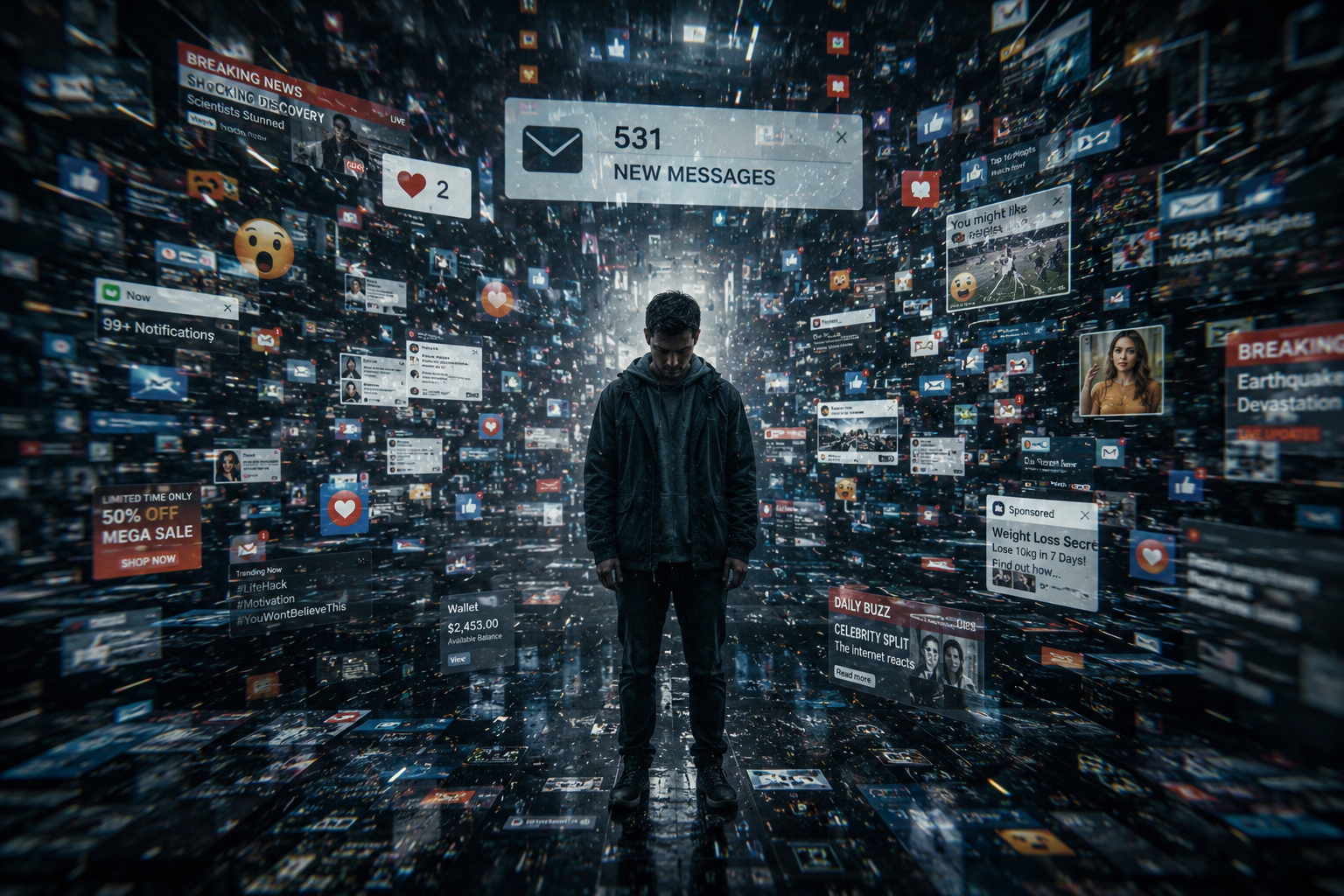
Instead, the human nervous system is now exposed to conditions that would have been historically unimaginable. Information arrives continuously. Social input never stops. Work no longer remains confined to physical locations. Entertainment is permanently available. News cycles operate without pause. Notifications create constant micro-interruptions throughout the day. Advertising systems compete aggressively for psychological engagement. Algorithms learn behavioural patterns and adapt in real time to maximise attention retention.
None of this exists at the scale human attention evolved to manage.
And yet the system still responds using ancient biological mechanisms.
That mismatch is the foundation of the entire problem.
One of the most important misconceptions about attention is the idea that it behaves like a simple conscious choice.
People often speak as though attention is entirely voluntary. As though focus is merely the result of deciding to concentrate hard enough. This assumption sits underneath a huge amount of modern productivity advice.
In reality, attention is heavily shaped by environmental conditions long before conscious decision-making becomes involved.
The brain is constantly scanning for novelty, unpredictability, social relevance, and potential threat. These mechanisms evolved because they were useful for survival. A sudden environmental change mattered. Something unexpected might require action. Social awareness improved group cohesion and reduced risk.
Modern digital systems exploit these same mechanisms continuously.
This is where the conversation becomes uncomfortable.
Because much of modern technology is not simply competing for attention accidentally. Attention has become the primary economic resource of the digital age.
The business model of enormous parts of the modern internet depends directly on maximising user engagement. The longer attention remains captured, the more profitable the platform becomes. This creates an enormous incentive to design systems that reduce disengagement and increase compulsive return behaviour.
Infinite scrolling exists for a reason.
Autoplay exists for a reason.
Push notifications exist for a reason.
Variable reward systems exist for a reason.
Algorithmic recommendation engines exist for a reason.
These systems are not neutral design choices. They are behavioural architecture built around one central objective:
Keep the user engaged.
And they work extraordinarily well because they are interacting with systems far older than the technology itself.
Dopamine is a particularly important part of this process, although it is frequently misunderstood. Popular culture often describes dopamine as a “reward chemical,” but research from figures such as Wolfram Schultz, Kent Berridge, and Terry Robinson paints a far more nuanced picture. Dopamine is heavily involved in anticipation, motivation, pursuit, and prediction. It helps direct attention toward what might matter next.
This makes variable digital environments incredibly powerful.
Every notification could contain something important.
Every refresh could produce something novel.
Every scroll could reveal social validation, threat, entertainment, outrage, or opportunity.
The uncertainty itself becomes psychologically engaging.
The result is a system that remains in a near-continuous state of low-level anticipation.
Not because people are weak.
Because the environment is systematically interacting with attentional vulnerabilities that evolved long before modern technology existed.
One of the most profound consequences of this environment is the collapse of genuine cognitive recovery.
Historically, periods of reduced stimulation happened naturally throughout the day. Waiting was unavoidable. Travelling involved looking out of windows or sitting with thought. Walking happened without constant audio input. Even boredom itself served a psychological function by creating space for reflection, imagination, and internal narrative processing.
Modern environments increasingly eliminate those spaces.
Now, the instant attention becomes unoccupied, something moves to capture it.
Phones emerge automatically in lifts, queues, waiting rooms, public transport, and even during brief pauses in conversation. Music fills silence. Videos fill stillness. Notifications interrupt gaps before the mind has time to settle.
This creates an environment where the nervous system is rarely allowed to idle.
That matters far more than most people realise.
Recovery does not only happen during sleep. Attention itself requires periods of reduced input in order to stabilise. The nervous system needs fluctuations between stimulation and calm. Without those fluctuations, activation becomes chronic.
This is where modern exhaustion becomes difficult to understand using traditional ideas of tiredness.
Many people are not physically exhausted in the historical sense. They are cognitively saturated.
Their attention never fully resets.
Their nervous system never fully settles.
Their environment never fully quietens.
And because this state has become culturally normalised, people increasingly interpret it as a personal weakness rather than an environmental condition.
That misunderstanding sits at the heart of the entire issue.
Most people still believe the primary challenge of modern life is time.
It is not.
The defining challenge of modern life is attention.
And the scale of that challenge is still massively underestimated.
PART II — WHAT THIS IS DOING TO HUMAN BEINGS
One of the strangest aspects of modern life is that people are surrounded by more stimulation, more convenience, more entertainment, and more connection than at any other point in human history…
Yet many feel increasingly detached from themselves, from each other, and from the present moment itself.
That contradiction matters.
Because it suggests the issue is not simply distraction.
Something deeper is happening.
Human beings are remarkably adaptive.
The brain constantly reshapes itself in response to repeated environmental conditions. Neural pathways strengthen through repetition. Attention patterns become habitual. Emotional responses become conditioned. The system learns from whatever environment it spends the most time inside.
This is one of the reasons modern attention problems are so difficult to recognise clearly.
The environment did not change overnight.
The adaptation happened gradually.
One notification at a time.
One additional platform at a time.
One extra stream of information at a time.
Until eventually, constant stimulation stopped feeling unusual and started feeling normal.
That normalisation hides the scale of what is actually happening.
Because when attention is continuously interrupted, redirected, fragmented, and externally controlled, the consequences extend far beyond productivity.
It changes the way people think.
It changes the way people feel.
It changes the way people experience life itself.
One of the clearest consequences is the erosion of sustained thought.
Deep thinking requires continuity. It requires uninterrupted cognitive space long enough for ideas to develop properly. Complex reasoning, reflection, creativity, emotional processing, and genuine understanding all depend on the ability to remain with a thought beyond its initial surface layer.
Modern environments increasingly work against that process.
The moment attention begins to settle, something interrupts it.
A message arrives.
A notification appears.
A thought about checking something enters awareness.
Even if the interruption lasts only seconds, the cognitive state changes. Attention shifts. The mind partially resets. The deeper layer of thinking collapses before it fully forms.
Over time, this trains the brain toward shallower patterns of engagement.
People become highly capable of rapid switching, quick responses, and surface-level information processing, while simultaneously struggling with prolonged focus, contemplation, and depth.
This is not simply about reduced productivity.
It affects identity formation itself.
Because identity is built partly through uninterrupted internal narrative. Human beings understand themselves by reflecting on experience, integrating memory, questioning emotion, revisiting thought, and constructing meaning over time.
That process requires internal space.
Modern environments increasingly remove it.
There is a growing difficulty many people now experience when left alone with their own thoughts.
Silence feels uncomfortable.
Stillness feels agitating.
Moments without stimulation feel empty rather than restorative.
This is often interpreted casually, but psychologically it is deeply significant.
Historically, human beings spent enormous amounts of time in low-stimulation environments. Walking, resting, waiting, observing, thinking. The mind had space to wander, process, imagine, and reflect without constant interruption.
Now, attention is continuously occupied.
The second external stimulation disappears, many people instinctively reach for another source of input. A phone appears almost automatically. Music fills silence. Content fills gaps. The environment rarely stops demanding engagement.
At first glance, this seems harmless.
But the inability to tolerate stillness creates profound consequences.
Because reflection only happens when attention is not permanently occupied.
Without reflection, emotional processing becomes shallower. Experiences pass through the system without being properly integrated. Thoughts remain unresolved. Feelings remain partially understood.
People continue moving while internally accumulating unfinished cognitive and emotional material.
This contributes heavily to the strange mental heaviness many people now carry constantly.
Not dramatic collapse.
Just persistent internal noise.
This fragmentation extends into relationships as well.
Modern communication creates the illusion of constant connection while often reducing the quality of attention people give each other.
Conversations increasingly occur alongside distraction. People message while watching television. Scroll while listening. Reply while doing something else. Partial attention has become socially normal.
The consequence is subtle but powerful.
People feel less deeply heard.
Less fully seen.
Less emotionally connected.
Not necessarily because relationships matter less, but because uninterrupted presence has become increasingly rare.
Deep human connection requires sustained attention. Empathy depends on noticing nuance, expression, pauses, tone, emotional shifts, and subtle behavioural cues. Those things become harder to perceive when attention is fragmented.
This affects friendships, parenting, romantic relationships, workplaces, and even people’s relationship with themselves.
Because the same fragmented attention people direct outward eventually becomes the way they experience their own internal world too.
There is also a growing emotional consequence to continuous stimulation that many people struggle to articulate clearly.
Modern life increasingly reduces tolerance for discomfort.
When stimulation is always available, distraction becomes immediate. Difficult emotions can be interrupted before they are fully experienced. Boredom can be escaped instantly. Waiting can be eliminated. Silence can be avoided.
This changes emotional conditioning over time.
Patience weakens.
Impulse control becomes harder.
Frustration tolerance declines.
The nervous system becomes increasingly accustomed to rapid relief from discomfort.
This matters enormously because many of the most important human processes require sustained engagement with discomfort.
Learning does.
Relationships do.
Creativity does.
Grief does.
Meaningful work does.
Personal growth certainly does.
When the system becomes conditioned toward constant relief and immediate stimulation, remaining with difficult processes becomes harder.
Not because people are weak.
Because the environment is training the opposite behaviour continuously.
One of the most overlooked consequences of this environment is the effect it has on memory.
Human memory does not simply record information passively. Attention plays a central role in determining what becomes encoded and retained. Experiences that receive fragmented attention are processed differently from experiences that receive sustained engagement.
This creates an increasingly strange phenomenon in modern life.
People consume enormous amounts of information while retaining surprisingly little of it.
Articles are skimmed.
Videos are half-watched.
Conversations are partially followed.
Thoughts are interrupted before completion.
The volume of input increases while depth of processing decreases.
This contributes to the feeling many people now describe of constantly consuming but rarely feeling genuinely nourished by what they consume.
The system becomes overloaded with information while simultaneously deprived of meaning.
The consequences become even more significant when viewed across childhood and adolescence.
Adults at least experienced part of life before this level of stimulation existed. Many children now do not.
Developing attentional systems are increasingly forming inside environments specifically engineered to maximise engagement. The baseline conditions shaping neurological development are fundamentally different from those previous generations experienced.
This matters because attentional habits formed early often become deeply embedded.
If constant interruption becomes normal before sustained focus fully develops, then fragmentation itself risks becoming the default attentional state.
The long-term implications of this are still not fully understood.
Research into digital attention, social media exposure, dopamine-driven behavioural loops, and adolescent mental health continues to develop rapidly, but the scale and novelty of these environmental conditions make longitudinal certainty difficult.
Humanity is effectively conducting a civilisation-scale behavioural experiment in real time.
And the participants are often too immersed in the environment to fully recognise what is happening.
Perhaps the deepest consequence of all is what this environment does to the experience of being present.
Presence requires attentional stability.
It requires the ability to remain psychologically where the body already is.
Modern environments increasingly pull attention elsewhere.
Into future concerns.
Into digital spaces.
Into unresolved loops.
Into anticipation of the next input.
The result is that many people rarely feel fully present in their own lives anymore.
They move through experiences while partially elsewhere mentally.
Meals.
Conversations.
Walks.
Family time.
Rest.
Even leisure increasingly occurs alongside parallel streams of stimulation and partial attention.
People are physically present but psychologically fragmented.
That fragmentation accumulates over time.
And eventually, many people reach a point where they feel strangely disconnected from their own existence without fully understanding why.
The modern environment did not just increase distraction.
It altered the conditions human consciousness operates within.
And the consequences of that shift are only just beginning to reveal themselves.
PART III — THE FUTURE OF ATTENTION
One of the biggest mistakes people make when thinking about attention is assuming this conversation is primarily about distraction.
It is not.
Distraction is the symptom.
The real issue is environmental incompatibility.
Human attention evolved under conditions that no longer exist, while the modern world continues accelerating toward even greater levels of stimulation, interruption, speed, and cognitive demand.
That trajectory matters because environments shape behaviour over time. They shape emotional regulation, social norms, cognitive patterns, and eventually culture itself. When environmental conditions change at scale, human behaviour changes alongside them whether people consciously recognise it happening or not.
This is why the future implications of attention loss extend far beyond productivity.
What is being altered is not simply focus.
It is the quality of human thought itself.
The ability to think deeply may become one of the rarest psychological states in modern society.
That sounds dramatic until you examine what deep thinking actually requires.
It requires uninterrupted time.
It requires cognitive stillness.
It requires the ability to tolerate boredom, uncertainty, and delayed resolution long enough for complex thoughts to develop properly.
Modern environments increasingly oppose every one of those conditions.
Instead, they reward immediacy.
Quick responses.
Rapid output.
Constant visibility.
Continuous engagement.
The system increasingly prioritises reaction speed over reflection depth.
This creates a dangerous cultural shift because shallow thinking often feels deceptively productive. It creates movement. Activity. Output. But depth requires slowing down long enough to process information properly, question assumptions, connect ideas, and tolerate complexity without immediately escaping into distraction.
That process is becoming harder for many people not because intelligence is declining, but because environmental conditions increasingly prevent deep cognitive immersion from occurring consistently.
The long-term consequence is not merely reduced concentration.
It is a society that struggles to think beyond the surface layer of problems.
This has implications everywhere.
Politics becomes more reactive and emotionally driven because fragmented attention favours outrage over complexity.
Media becomes increasingly sensational because emotional stimulation captures attention more effectively than nuance.
Education becomes harder because learning requires sustained engagement while the surrounding environment trains rapid attentional switching.
Workplaces become noisier and more cognitively exhausting because constant communication replaces periods of uninterrupted thought.
Relationships become shallower because partial attention slowly erodes emotional presence.
Even creativity changes.
Because creativity rarely emerges from constant stimulation.
It emerges from uninterrupted cognitive space.
Many of humanity’s most important ideas did not appear during periods of continuous input. They emerged during walking, silence, reflection, observation, boredom, contemplation, or sustained immersion in difficult problems.
Modern life increasingly removes those states.
That matters more than people realise.
Because when a civilisation loses depth of thought, it eventually loses depth of understanding.
There is also a growing possibility that human attention itself becomes economically valuable in ways most people still underestimate.
Throughout history, scarcity has always created value.
Attention is becoming scarce.
Not basic awareness.
Not passive consumption.
Sustained, directed, controllable attention.
The ability to remain focused without compulsive interruption may become one of the defining cognitive advantages of the coming decades.
Not because it sounds impressive philosophically, but because nearly every meaningful form of high-level human output depends on it.
Deep work depends on it.
Mastery depends on it.
Creativity depends on it.
Strategic thinking depends on it.
Emotional regulation depends on it.
Meaningful relationships depend on it.
The people capable of protecting and directing their attention may increasingly separate themselves from environments designed to fragment it continuously.
Not because they are superior human beings.
Because they are operating under different conditions.
Artificial intelligence accelerates this issue even further.
As AI systems become increasingly capable of producing rapid information, rapid content, rapid responses, and rapid stimulation, the volume of cognitive input surrounding human beings will rise dramatically.
This creates two possible futures.
One future produces continuous cognitive overwhelm. Endless content competing for attention. Constant stimulation. Permanent interruption. Human beings increasingly reacting rather than thinking.
The other future creates a growing premium on depth.
Because when information becomes infinite, discernment becomes more valuable.
When noise becomes endless, clarity becomes valuable.
When stimulation becomes constant, stillness becomes valuable.
When everyone is reacting instantly, the people capable of slowing down enough to think properly become increasingly rare.
This is why the future of attention is not merely technological.
It is philosophical.
The question is not simply whether humans will become more distracted.
The deeper question is whether people will still retain enough attentional stability to remain psychologically grounded inside increasingly engineered environments.
Children will likely sit at the centre of this issue.
Many adults still retain partial memory of a world before permanent digital immersion. They experienced boredom. Unstructured play. Long conversations without parallel stimulation. Walking without headphones. Waiting without devices.
Many children now enter algorithmically driven environments before their attentional systems fully develop.
That changes the baseline dramatically.
The issue is not that technology exists. The issue is that developmental environments increasingly prioritise stimulation intensity over attentional stability.
If childhood becomes dominated by continuous novelty, rapid feedback loops, and constant digital engagement, then the long-term consequences may extend far beyond distraction.
Patience may weaken.
Emotional regulation may weaken.
Tolerance for delayed gratification may weaken.
Internal reflection may weaken.
And because these changes occur gradually across entire populations, they risk becoming culturally invisible.
Future generations may simply perceive fragmented attention as normal human functioning because they never experienced anything different.
That possibility should concern people far more than it currently does.
None of this means technology itself is inherently harmful.
That simplistic conclusion misses the point entirely.
Human beings have always used tools to reshape environments. The problem is not tool creation.
The problem is environmental imbalance.
Modern systems increasingly compete for continuous psychological engagement while human biology still requires fluctuation, recovery, silence, and attentional stability in order to function properly.
The nervous system cannot remain in continuous activation indefinitely without consequences emerging somewhere downstream.
Those consequences are already visible.
Rising cognitive fatigue.
Persistent overstimulation.
Reduced attention spans.
Emotional exhaustion.
Difficulty sleeping.
Difficulty switching off.
Difficulty remaining present.
Difficulty thinking deeply.
Difficulty tolerating stillness.
These are not isolated failures occurring independently across millions of individuals simultaneously.
They are increasingly predictable responses to shared environmental conditions.
This is where the conversation around attention needs to evolve.
The solution is not simply telling people to become more disciplined.
Discipline matters, but discipline alone cannot fully compensate for environments specifically engineered to capture and fragment attention continuously.
The deeper challenge is environmental awareness.
People need to understand what conditions are doing to their nervous system before meaningful behavioural change becomes possible.
Because once people recognise the relationship between environment and attention, many modern struggles begin to make far more sense.
The issue is not that human beings suddenly became weak.
The issue is that modern environments became psychologically incompatible with many of the conditions human attention evolved to require.
The future will likely belong to people who understand this earliest.
Not because they completely reject technology or disappear into isolation, but because they consciously create conditions that allow their attention to stabilise rather than fragment continuously.
That may ultimately become one of the defining human skills of the twenty-first century.
Not intelligence.
Not productivity.
Not optimisation.
The ability to remain psychologically intact inside environments increasingly designed to pull the mind apart.
FINAL THOUGHT
Human attention is not collapsing because people stopped caring about focus.
It is struggling because the modern world continuously demands more from the nervous system than the nervous system evolved to handle.
And unless people begin understanding the environmental nature of that problem…
They will continue blaming themselves for reactions that make perfect sense in the conditions they are living in.
SOURCES AND RESEARCH GAPS
Key research areas:
- Cognitive load theory and task switching (Rubinstein, Meyer & Evans, 2001)
- Dopamine and anticipation-driven behaviour (Schultz, Berridge & Robinson)
- Attention capture and behavioural design in digital systems
- Stress physiology and chronic cognitive activation (Bruce McEwen)
- Human-computer interaction and digital distraction research
- Circadian rhythm and attentional recovery research
- Adolescent neurological development and digital stimulation studies
Research gaps:
- Long-term neurological impact of continuous digital stimulation across the lifespan
- Real-world measurement of sustained attention decline in modern environments
- Developmental impact of algorithmically driven attention systems on children
- Interaction between AI-generated content environments and human cognitive stability
- Longitudinal effects of chronic attentional fragmentation on identity and emotional regulation