
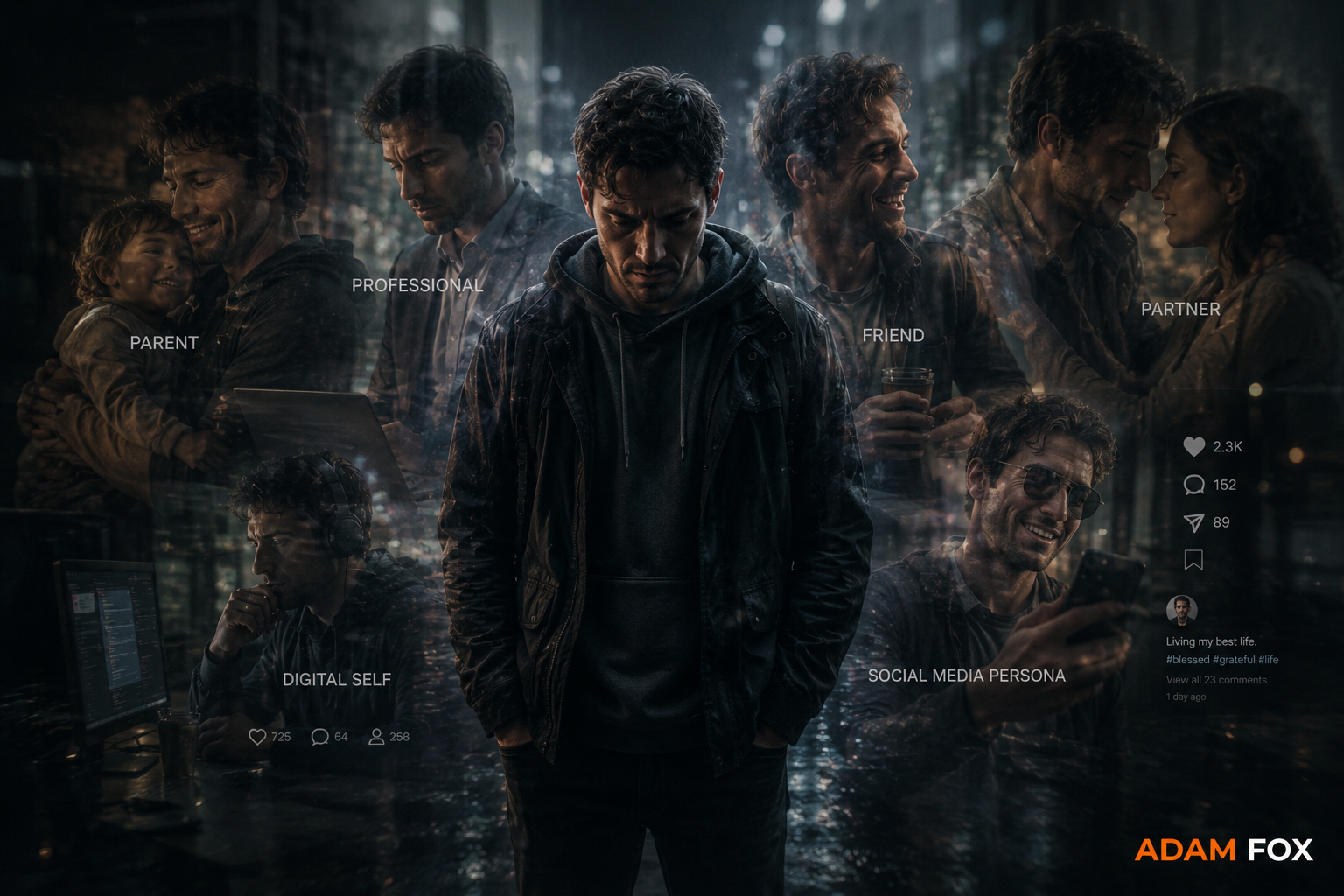
THE HUMAN ATTENTION PROJECT: MODERN LIFE IS FRAGMENTING THE SELF
PART I — THE ERA OF CONTINUOUS INTERRUPTION
One of the most common feelings in modern life is surprisingly difficult to describe.
People often talk about feeling busy.
Stressed.
Overwhelmed.
Burnt out.
Distracted.
But beneath all of those experiences sits something deeper that many people struggle to put into words.
A feeling of being pulled apart.
A feeling of never quite being fully present.
A feeling that despite constantly doing things, responding to things, managing things, and thinking about things, they are somehow absent from their own lives.
They are physically present.
But psychologically elsewhere.
And increasingly, they are everywhere at once.
Most people assume this is simply the unavoidable consequence of modern life.
Life is busy.
People have responsibilities.
Technology exists.
The world moves faster.
End of story.
Except that explanation doesn't quite go deep enough.
Because if the problem were simply workload, then many people would feel better after a holiday.
Many don't.
If the problem were simply long hours, then retirement would solve it.
Often it doesn't.
If the problem were simply stress, then weekends would fix it.
Yet countless people spend entire weekends mentally occupied by things that aren't physically present.
The problem is not merely that modern life asks a lot of people.
The problem is that modern life increasingly prevents people from fully arriving anywhere.
For most of human history, identity was relatively stable.
That does not mean life was easy.
Far from it.
Life was often harder physically, financially, and socially than it is today.
But psychologically, there were clearer boundaries.
You lived largely within a local environment.
You belonged to a relatively small community.
You occupied a limited number of social roles.
You were known by a relatively small number of people.
Work existed in a physical place.
Home existed in a physical place.
Community existed in a physical place.
And because those environments were largely separate, identity remained comparatively coherent.
A farmer was farming.
A parent was parenting.
A tradesman was working.
A friend was socialising.
The roles themselves may have been demanding, but they tended to happen one at a time.
The environment supported that separation.
Modern environments increasingly destroy it.
Today, a single individual may occupy more roles before lunchtime than previous generations occupied in an entire day.
A person can wake up as a parent, become an employee, answer messages as a business owner, respond to family issues, participate in multiple group chats, consume political content, compare themselves against strangers online, interact with clients, absorb international news, manage finances, communicate with friends, and engage with social media.
All before they have even eaten lunch.
The issue is not that these roles exist.
Human beings have always occupied multiple roles.
The issue is that technology collapsed the boundaries that once separated them.
Everything now exists in the same place.
The same device that delivers family photographs also delivers work emails.
The same screen that shows holiday pictures also shows political outrage.
The same phone that connects people to loved ones also connects them to every problem happening anywhere on the planet.
Every role arrives through the same doorway.
And because of that, the mind is constantly switching between identities.
This constant switching appears harmless because each individual transition feels small.
A quick email.
A quick message.
A quick notification.
A quick reply.
But psychologically, something much larger is happening.
Attention is repeatedly shifting between entirely different worlds.
A person may be helping their child with homework when a work notification arrives.
Physically, they remain sitting beside their child.
Psychologically, part of them has been pulled somewhere else.
They may be sitting in a meeting while thinking about family concerns.
Driving home while thinking about work.
Eating dinner while thinking about tomorrow.
Watching television while scrolling through social media.
Lying in bed while mentally rehearsing conversations that haven't happened yet.
Their body exists in one location.
Their attention exists in several.
This matters because attention is not simply a tool for getting things done.
Attention is the mechanism through which people experience reality.
Whatever receives attention becomes experience.
Whatever consistently receives attention gradually shapes identity.
And when attention becomes fragmented across dozens of competing demands, experience becomes fragmented too.
This is why so many people now describe feeling mentally exhausted despite rarely experiencing prolonged physical exertion.
Their nervous system is not managing one environment.
It is attempting to manage multiple overlapping environments simultaneously.
Work.
Family.
Finances.
News.
Politics.
Social media.
Relationships.
Entertainment.
Future planning.
Past regrets.
Personal ambitions.
Every one of them competing for the same finite attentional resource.
The irony is that many modern tools were created to simplify life.
Email was supposed to improve communication.
Smartphones were supposed to improve accessibility.
Social media was supposed to improve connection.
Productivity tools were supposed to improve organisation.
In many ways, they succeeded.
But collectively, they also created something unexpected.
They removed psychological separation.
And separation turns out to be more important than most people realise.
Human beings appear to need transitions.
They need endings.
They need beginnings.
They need moments where one role finishes before another begins.
Historically, the journey home from work acted as a transition.
The physical act of leaving one environment and entering another helped the mind adjust.
Work stayed at work because work physically could not follow people home easily.
That boundary no longer exists for millions of people.
Now work sits in pockets.
Beside beds.
On kitchen tables.
In living rooms.
On holidays.
At children's football matches.
During meals.
The office never fully closes because the environment no longer requires it to.
As a result, many people remain psychologically connected to multiple roles simultaneously.
And the nervous system never fully settles into any of them.
This creates a phenomenon that is becoming increasingly common.
People are present.
But they are not fully present.
They are listening.
But not fully listening.
Working.
But not fully working.
Resting.
But not fully resting.
Parenting.
But not fully parenting.
Relaxing.
But not fully relaxing.
The environment constantly encourages partial attention.
And partial attention creates partial experiences.
The consequences extend far beyond productivity.
Because identity is built through repeated experience.
When people spend years existing in states of divided attention, something begins to happen to their sense of self.
The boundaries between roles become blurred.
The feeling of continuity weakens.
Life begins to feel less like a coherent narrative and more like a series of interruptions.
People move from one demand to the next without fully arriving in any of them.
Not because they lack discipline.
Not because they are weak.
Not because they need another productivity app.
Because the environment itself increasingly rewards fragmentation.
Perhaps the most revealing question a person can ask themselves is this:
When was the last time you were completely where you were?
Not partly there.
Not mostly there.
Completely there.
No notifications pulling at you.
No future demands occupying your thoughts.
No parallel conversations happening in your pocket.
No mental switching between roles.
Just fully engaged with the thing in front of you.
For many people, the answer takes longer to find than they expect.
And that may be one of the clearest signs that something fundamental has changed.
Modern life is often described as busy.
That description is true, but incomplete.
The deeper issue is not busyness.
The deeper issue is interruption.
Not merely interruption of tasks.
Interruption of attention.
Interruption of presence.
Interruption of identity.
Because when a person is constantly pulled between competing versions of themselves, they eventually stop feeling fully connected to any of them.
And that is where the real consequences begin.
PART II — WHAT HAPPENS WHEN A PERSON CAN NEVER FULLY ARRIVE
If Part I described the environment, then Part II is about the consequence.
Because environments do not simply influence behaviour.
Given enough time, they influence identity.
And identity is not nearly as fixed as most people like to believe.
Most people think of identity as something solid.
Something permanent.
Something they possess.
A stable answer to the question:
"Who am I?"
But identity is far more dynamic than that.
In many ways, identity is an ongoing psychological construction built from attention, memory, experience, relationships, values, beliefs, habits, and repeated behaviours.
It is not something people discover once.
It is something they continuously reinforce through how they live.
And that is where modern life creates a problem.
Because reinforcement requires continuity.
Modern environments increasingly destroy it.
Human beings need coherent stories.
Not necessarily stories they tell other people.
Stories they tell themselves.
Every person carries an internal narrative explaining who they are, what matters to them, where they belong, what they value, what they fear, what they hope for, and where they believe their life is heading.
This narrative is not a luxury.
It is a fundamental part of psychological stability.
Without it, experience becomes fragmented.
Events stop feeling connected.
Life begins to feel reactive rather than intentional.
People lose their sense of direction.
The challenge is that coherent narratives require uninterrupted reflection.
They require enough psychological space for experiences to be processed and integrated properly.
Modern environments increasingly prevent that process from occurring.
Consider how many people now move through a typical day.
They wake up and immediately encounter information.
Messages.
Notifications.
News.
Emails.
Social media.
Before their own thoughts have fully formed, external demands have already entered awareness.
The day then becomes a sequence of responses.
Respond to work.
Respond to messages.
Respond to family demands.
Respond to notifications.
Respond to problems.
Respond to updates.
Respond to requests.
Respond to opportunities.
Respond to crises.
Respond to content.
Respond to information.
Respond.
Respond.
Respond.
The result is a life increasingly organised around reaction rather than reflection.
And reaction rarely creates clarity.
This helps explain why so many people describe feeling lost despite being incredibly busy.
From the outside, their lives appear full.
Responsibilities.
Commitments.
Relationships.
Projects.
Goals.
Plans.
Yet internally they often feel disconnected from themselves.
Not because they lack purpose.
Because they rarely have enough uninterrupted space to hear their own thoughts clearly.
The environment is constantly speaking.
And eventually the internal voice becomes difficult to distinguish from the external noise.
One of the most common modern experiences is a persistent sense of mental clutter.
People often describe it differently.
Brain fog.
Overwhelm.
Mental exhaustion.
Decision fatigue.
Stress.
Anxiety.
Sometimes all of the above.
These experiences are real.
But they are often discussed as though they exist independently.
In reality, they may be different expressions of the same underlying condition.
A nervous system struggling to process more inputs than it was designed to handle.
Imagine trying to read a book while somebody changes the page every thirty seconds.
Even if the book itself is excellent, comprehension becomes difficult because continuity disappears.
Modern life increasingly does something similar to consciousness.
Attention is repeatedly redirected before experiences can fully settle.
Thoughts begin but do not finish.
Feelings emerge but do not fully process.
Questions arise but do not reach resolution.
The result is an accumulation of partially completed psychological activity.
The mind remains busy.
But not necessarily productive.
Occupied.
But not necessarily clear.
This fragmentation often creates a deeper emotional consequence.
People begin losing the feeling of being fully present in their own lives.
This is difficult to articulate because it sounds abstract.
Yet most people recognise it immediately when described.
You are at dinner but thinking about tomorrow.
You are on holiday but checking work.
You are with your children but mentally inside your inbox.
You are reading a book but thinking about messages.
You are trying to sleep but replaying conversations.
You are physically present.
Psychologically elsewhere.
This state becomes so normal that many people stop noticing it.
Until something unusual happens.
A walk without a phone.
A quiet afternoon.
A camping trip.
A long conversation.
A day in nature.
A period of genuine immersion.
And suddenly they remember what uninterrupted presence feels like.
Not because the experience itself is extraordinary.
Because uninterrupted presence has become extraordinary.
Relationships often suffer quietly within this environment.
Not because people care less.
Because attention has become fragmented.
Most people have experienced a conversation where the other person is technically listening but not fully present.
Their eyes occasionally drift towards a phone.
Their attention flickers.
Their responses arrive slightly delayed.
Part of them is elsewhere.
The interaction continues.
But something important is missing.
Presence.
And presence is one of the most valuable things human beings can give each other.
Because presence communicates something deeper than words.
It communicates:
"You have my attention."
"You matter right now."
"I am here with you."
When attention becomes fragmented, relationships often become fragmented too.
Not dramatically.
Gradually.
Quietly.
Over years.
This fragmentation also affects emotional regulation.
Historically, difficult emotions often had nowhere to go.
People had to sit with them.
Think about them.
Process them.
Discuss them.
Write about them.
Reflect on them.
Modern environments provide endless opportunities to interrupt emotional discomfort before that processing occurs.
Feeling anxious?
Scroll.
Feeling lonely?
Consume content.
Feeling bored?
Open an app.
Feeling uncertain?
Seek stimulation.
Feeling uncomfortable?
Distract yourself.
Again, this is not a moral failing.
It is an environmental response.
The problem is that emotions rarely disappear simply because attention moves elsewhere.
Many remain unresolved.
Accumulating beneath the surface.
Creating the strange experience many people now report of feeling mentally exhausted without fully understanding why.
Perhaps the most significant consequence of all is the gradual erosion of self-continuity.
Self-continuity is the feeling that the person you were yesterday, the person you are today, and the person you hope to become tomorrow all belong to the same coherent story.
It is one of the foundations of psychological stability.
And it requires reflection.
It requires memory.
It requires integration.
It requires enough uninterrupted attention for experiences to become meaningful rather than simply memorable.
Modern environments increasingly interfere with that process.
Not because they are evil.
Not because somebody planned it.
Because they are optimised for engagement rather than integration.
The system encourages people to keep moving.
Keep consuming.
Keep responding.
Keep scrolling.
Keep switching.
Keep reacting.
The environment rewards motion.
But human beings require meaning.
And meaning develops more slowly than motion.
This may explain why so many people feel strangely disconnected despite living increasingly connected lives.
The issue is not a lack of information.
Not a lack of communication.
Not a lack of stimulation.
The issue may be a lack of uninterrupted psychological space in which all those experiences can become part of a coherent whole.
Because when a person can never fully arrive anywhere...
Eventually they stop feeling fully connected to themselves.
PART III — THE FUTURE OF HUMAN IDENTITY
For most of human history, one of the great psychological challenges of life was figuring out who you were.
The challenge facing many people now is slightly different.
It is remaining who you are.
That distinction may become one of the defining human challenges of the twenty-first century.
Because identity is no longer developing inside relatively stable environments.
It is developing inside environments specifically designed to compete for attention continuously.
And wherever attention goes repeatedly, identity tends to follow.
This is why the conversation around modern identity cannot be reduced to simple discussions about social media, screen time, or digital distraction.
Those are symptoms.
The deeper issue is that modern environments increasingly influence how people see themselves, what they value, what they aspire to become, and how they interpret their place in the world.
Historically, identity emerged largely through lived experience.
Family.
Community.
Work.
Friendship.
Belief systems.
Direct interaction with reality.
Those influences still matter enormously.
But they now compete against a second layer of influence that previous generations never experienced at this scale.
The digital environment.
And unlike family, community, or close relationships, digital environments never sleep.
They never stop speaking.
They never stop suggesting.
They never stop comparing.
They never stop shaping perception.
One of the most profound consequences of this is the gradual shift from identity being internally constructed to identity becoming increasingly externally influenced.
People naturally compare themselves to others.
That is not new.
Human beings have always done it.
What is new is the scale.
A person no longer compares themselves against a few neighbours, friends, colleagues, or members of their local community.
They compare themselves against thousands of carefully curated representations of other people's lives.
Every day.
For years.
Sometimes decades.
The comparison never ends because the environment never ends.
There is always another person.
Another achievement.
Another opinion.
Another lifestyle.
Another success story.
Another benchmark.
Another standard to measure yourself against.
This creates a psychological trap that previous generations experienced far less intensely.
The pursuit of a stable identity becomes increasingly difficult when the reference points are constantly changing.
The mind never settles because the comparison never settles.
A person can spend years chasing versions of success, happiness, beauty, productivity, status, or fulfilment that were never actually their own goals to begin with.
They simply absorbed them from the environment.
This is one of the least recognised forms of influence in modern life.
Most people still believe their aspirations belong entirely to them.
Some do.
Many don't.
Many are inherited from algorithms, social trends, cultural narratives, influencer ecosystems, advertising systems, and endless exposure to carefully selected examples of what life is supposedly meant to look like.
The environment increasingly participates in identity construction whether people realise it or not.
This matters because identity acts as a psychological anchor.
When identity is stable, people can tolerate uncertainty more effectively.
They know what matters to them.
They know what they stand for.
They know which opportunities to pursue and which to ignore.
They possess a degree of internal coherence.
When identity becomes fragmented, decision-making becomes harder.
Priorities become unclear.
Boundaries weaken.
External influence grows stronger.
The person becomes increasingly reactive to environmental signals because internal guidance becomes less distinct.
This creates a dangerous feedback loop.
The more fragmented identity becomes, the more people seek guidance externally.
The more guidance they seek externally, the more fragmented identity often becomes.
This process is likely to accelerate dramatically in the coming decades.
Artificial intelligence, personalised content systems, predictive algorithms, and behavioural targeting technologies are becoming increasingly sophisticated.
The next generation of digital environments will not simply react to behaviour.
They will anticipate it.
They will learn what captures attention.
What triggers emotion.
What creates engagement.
What reinforces habits.
What influences decision-making.
And they will adapt accordingly.
This does not require malicious intent.
It simply requires optimisation.
Systems optimised for engagement naturally become better at shaping behaviour.
And behaviour, repeated often enough, eventually becomes identity.
This raises an uncomfortable possibility.
The future threat to identity may not come from oppression, censorship, or overt control.
It may come from convenience.
People may gradually outsource more and more decisions because technology makes doing so easier.
What should I watch?
What should I buy?
What should I believe?
What should I prioritise?
What should I think about?
What should I pay attention to?
What should I care about?
As recommendation systems become increasingly effective, more of those decisions may be made indirectly by environments rather than consciously by individuals.
Not because people lose free will.
Because cognitive effort naturally follows the path of least resistance.
And modern systems are becoming extraordinarily good at reducing resistance.
This is where identity and attention become inseparable.
Because identity is not built from what people say matters to them.
Identity is built from what consistently receives their attention.
The things people repeatedly think about.
Repeatedly engage with.
Repeatedly prioritise.
Repeatedly consume.
Repeatedly reinforce.
Attention is the raw material from which identity emerges.
And that means the battle for attention is ultimately a battle for something much deeper than productivity.
It is a battle for self-authorship.
Self-authorship may become one of the most important psychological concepts of the future.
The ability to consciously determine:
What deserves attention.
What deserves belief.
What deserves emotional investment.
What deserves time.
What deserves energy.
Without automatically accepting whatever the environment places in front of you.
Historically, this process happened more naturally because environmental influence was comparatively limited.
Today it requires increasing intentionality.
Not because modern people are weaker.
Because modern environments are more powerful.
Children may feel the consequences most strongly.
The adults of today at least experienced some period of life before algorithmic environments became dominant.
Many children will not.
Their identities may develop entirely inside systems designed to maximise engagement from the very beginning.
Again, this is not a prediction of catastrophe.
It is an observation of unprecedented conditions.
Human beings have never before developed their sense of self inside environments this saturated with engineered attention capture.
Nobody truly knows what the long-term outcome will be.
But the question is significant enough that it deserves far more attention than it currently receives.
Despite all of this, there is reason for optimism.
Because awareness changes the equation completely.
The moment people understand that environments shape attention, and attention shapes identity, they gain something incredibly valuable.
Choice.
Not perfect control.
Not immunity.
Choice.
The ability to recognise influence before automatically accepting it.
The ability to question whether a belief genuinely belongs to them.
The ability to step back from the environment long enough to hear their own thoughts again.
The ability to reconnect with what actually matters to them rather than what merely captures their attention.
This may ultimately become one of the defining advantages of the future.
Not intelligence.
Not talent.
Not productivity.
Not even knowledge.
Self-awareness.
The ability to remain psychologically coherent inside environments increasingly designed to fragment attention continuously.
Because a coherent identity creates stability.
And stability creates freedom.
Freedom to think independently.
Freedom to act intentionally.
Freedom to live according to values rather than impulses.
Freedom to remain the author of your own life.
FINAL THOUGHT
Modern life does not merely compete for your time.
It competes for your attention.
And because attention shapes identity, what is ultimately at stake is not productivity, performance, or efficiency.
It is your sense of self.
The future may belong to those who can remain whole in a world that increasingly rewards fragmentation.
SOURCES AND RESEARCH GAPS
Key research areas:
- Identity formation and self-concept development
- Social comparison theory (Leon Festinger)
- Self-authorship and adult development theory
- Human-computer interaction and behavioural design
- Attention economics and digital platform engagement models
- Algorithmic personalisation and recommendation systems
- Developmental psychology and adolescent identity formation
Research gaps:
- Long-term effects of algorithmic environments on identity development
- Impact of continuous social comparison on self-authorship and self-concept
- Interaction between AI personalisation and psychological autonomy
- Longitudinal effects of attentional fragmentation on identity stability
- Developmental implications of growing up inside engagement-optimised ecosystems