
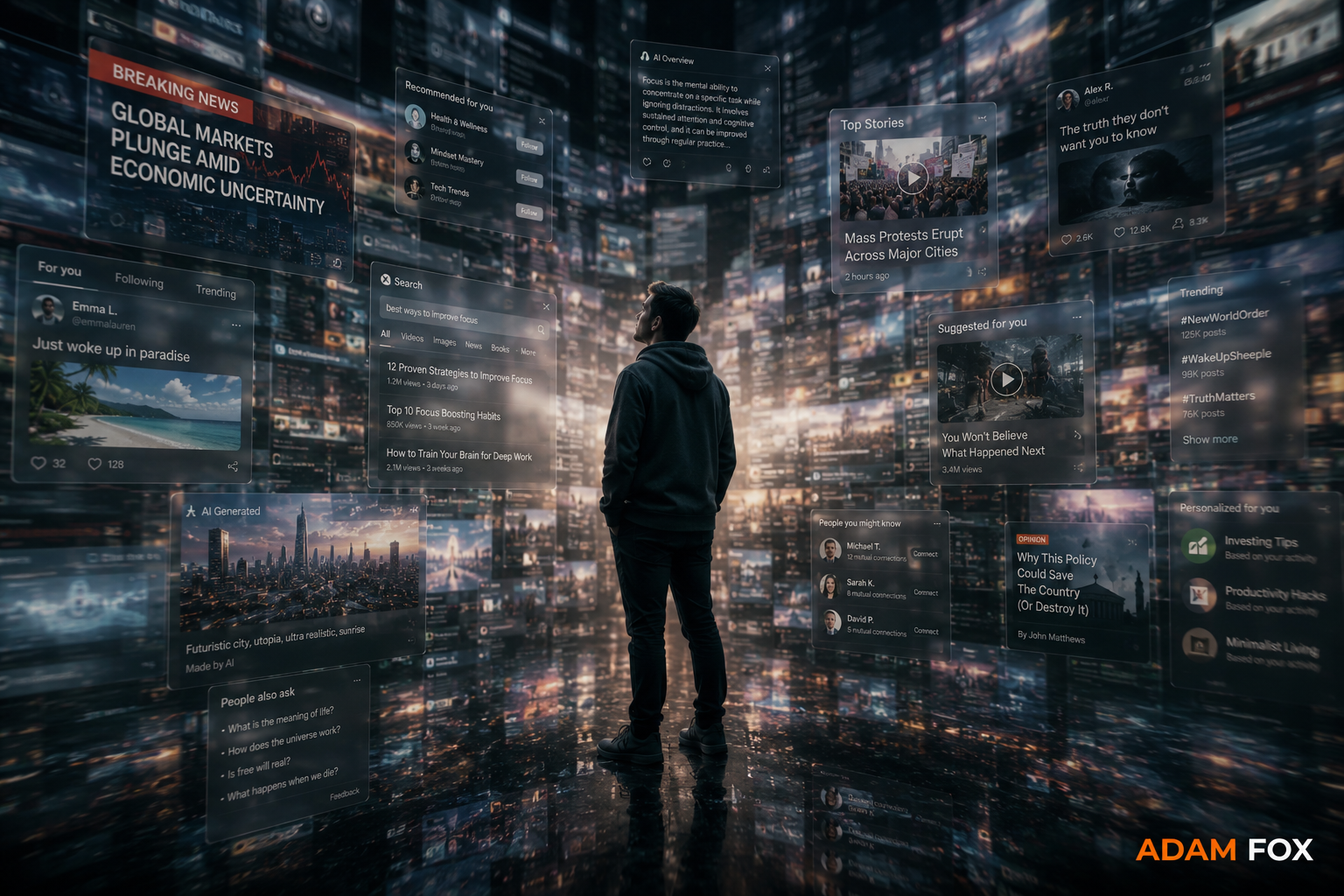
THE HUMAN ATTENTION PROJECT: THE INTERNET DIDN'T JUST CHANGE COMMUNICATION. IT CHANGED CONSCIOUSNESS
PART I — THE REWIRING OF HUMAN INTERACTION
Most people think the internet changed communication.
That is technically true.
It just isn't the whole story.
When people talk about the impact of the internet, they usually focus on the obvious changes. Information travels faster. Messages arrive instantly. News spreads globally within minutes. Businesses can communicate across continents. Families can remain connected regardless of geography.
All of that is true.
And all of it is remarkable.
But it is also the most superficial layer of what actually happened.
Because communication is not simply the transfer of information.
Communication shapes perception.
Perception shapes thought.
Thought shapes behaviour.
Behaviour shapes culture.
And culture eventually shapes consciousness itself.
The internet did not simply alter how information moves between people.
It altered the conditions under which human beings experience reality.
The consequences of that shift are still unfolding.
To understand the scale of what changed, it helps to remember just how recently the previous system existed.
For most of human history, information moved slowly.
Not a little slower.
Radically slower.
A person could spend most of their life knowing relatively little about what was happening beyond their immediate environment. News travelled through conversations, newspapers, radio broadcasts, television programmes, and personal relationships. Information was filtered naturally by geography, time, and effort.
If something happened on the other side of the world, it might take days, weeks, or months to reach you.
In many cases, it never would.
That wasn't necessarily a flaw.
It was simply the reality of human existence.
People lived primarily inside local information environments.
Their attention was largely focused on the people, problems, opportunities, and threats physically surrounding them.
The scale of awareness was smaller.
The speed of awareness was slower.
And because of that, the volume of information entering the human mind remained naturally constrained.
The internet shattered those constraints.
For the first time in history, access to information became effectively unlimited.
At first, this seemed entirely positive.
And in many ways, it was.
Knowledge became democratised. Learning became accessible. Expertise became easier to find. Geographic barriers collapsed. Entire industries transformed. Opportunities emerged that previous generations could never have imagined.
It is difficult to overstate how extraordinary that achievement was.
The problem was not increased access to information.
The problem was that human cognitive architecture remained largely unchanged while information availability exploded beyond anything it evolved to manage.
For the first time, people were no longer exposed primarily to information relevant to their immediate environment.
They were exposed to everything.
Every crisis.
Every opinion.
Every tragedy.
Every outrage.
Every success story.
Every argument.
Every catastrophe.
Every celebration.
Every political conflict.
Every cultural disagreement.
Every breaking news alert.
Every social comparison opportunity.
All arriving continuously.
All competing simultaneously.
All demanding attention.
The internet did not simply increase information.
It removed the natural limits that once protected the human nervous system from informational overload.
This created something entirely new in human history.
A globalised attentional environment.
For thousands of years, human attention operated primarily within local ecosystems.
Now attention operates inside a planetary one.
A person sitting in Northamptonshire can experience emotional reactions to events occurring in New York, Sydney, Tokyo, Kyiv, or Cape Town before breakfast.
Not because those events directly affect their immediate life.
Because the environment places them directly into awareness.
The nervous system often struggles to distinguish between informational proximity and physical proximity.
Something emotionally charged appearing repeatedly in your attention stream can begin to feel psychologically immediate regardless of where it occurs geographically.
This has profound consequences.
Because attention evolved to prioritise what appears important.
Modern environments continuously manufacture the appearance of importance.
The result is a mind increasingly pulled in multiple directions simultaneously.
One moment attention focuses on family.
The next moment it focuses on international politics.
Then financial markets.
Then celebrity scandals.
Then environmental concerns.
Then personal messages.
Then work emails.
Then breaking news.
Then social media updates.
Then another notification.
Then another.
Then another.
The human mind was never designed to process such a vast range of unrelated informational domains within the same hour.
Yet this has become completely normal.
So normal, in fact, that most people no longer recognise how unusual it actually is.
But information volume is only part of the story.
The more profound shift happened through communication itself.
Historically, communication involved natural friction.
You wrote letters.
You made phone calls.
You arranged meetings.
You waited for responses.
Conversations had beginnings and endings.
There were pauses.
Gaps.
Periods of uncertainty.
Periods where interaction stopped and reflection began.
Modern communication largely removed those boundaries.
Messages arrive continuously.
Conversations never truly end.
Work discussions remain active long after people leave the office.
Family communication remains active throughout the day.
Friendship groups continue indefinitely.
Information streams never close.
The result is not simply more communication.
It is continuous communication.
And continuous communication creates entirely different psychological conditions.
One of the most significant changes is the disappearance of informational closure.
Historically, people finished reading the newspaper.
Finished watching the news.
Finished a conversation.
Finished a meeting.
Finished work.
Information had natural endpoints.
Modern digital systems increasingly do not.
Feeds are endless.
News updates continuously.
Social media never finishes.
Messages continue arriving.
Content recommendations generate further content recommendations.
The system no longer provides clear signals that processing can stop.
And when processing never feels complete, the nervous system remains partially engaged.
Always anticipating.
Always scanning.
Always wondering what might arrive next.
This creates a low-level psychological state that previous generations experienced far less frequently.
A state of perpetual informational openness.
The conversation is never over.
The news is never finished.
The feed never ends.
The input never stops.
This fundamentally changes the relationship people have with knowledge itself.
Historically, information scarcity meant people worked to acquire information.
Today, information abundance means people increasingly struggle to filter information.
The challenge has inverted completely.
The question is no longer:
"How do I access knowledge?"
The question is:
"How do I decide what deserves my attention?"
That distinction matters because attention increasingly becomes the limiting factor.
Knowledge is abundant.
Attention is scarce.
And wherever scarcity exists, value follows.
This is one of the reasons attention has become the most contested resource in the modern world.
Every platform, organisation, advertiser, media company, political movement, influencer, and content creator is competing for the same finite cognitive resource.
Not time.
Attention.
Because attention determines what enters consciousness.
And consciousness ultimately determines how reality is experienced.
Perhaps the deepest change of all is that people increasingly experience reality through mediated environments rather than direct experience.
For most of human history, reality was largely encountered first-hand.
You experienced events directly.
You spoke to people directly.
You observed your environment directly.
Today, enormous portions of human experience are filtered through screens, platforms, algorithms, and recommendation systems before they ever reach awareness.
This does not necessarily make those experiences false.
But it does make them mediated.
And mediation changes perception.
Because whoever controls the flow of information increasingly influences how reality itself is experienced.
That influence may be the most important consequence of the internet age.
Not that communication became faster.
Not that information became available.
But that human consciousness increasingly became dependent on systems that sit between people and the world they believe they are experiencing.
And that may prove to be one of the most significant psychological shifts in human history.
PART II — THE COLLAPSE OF INTERNAL SPACE
One of the least discussed consequences of the internet age is not what it added to human life.
It is what it quietly removed.
Not information.
Not convenience.
Not communication.
Internal space.
For most of human history, people spent large portions of their lives alone with their own thoughts.
Not because they were intentionally practising mindfulness.
Not because they were following some ancient self-development philosophy.
Simply because the environment left them no alternative.
There were gaps.
Moments between activities.
Moments between conversations.
Moments between inputs.
Moments where attention had nowhere else to go except inward.
And when attention goes inward, something important happens.
The mind begins processing.
Experiences get organised.
Emotions get examined.
Memories get integrated.
Ideas get connected.
Questions emerge.
Meaning develops.
Identity forms.
This process is so normal and so deeply embedded in human psychology that most people rarely think about it consciously.
Yet it may be one of the most important functions the human mind performs.
Because human beings do not simply experience life.
They interpret life.
And interpretation requires space.
The internet changed that relationship fundamentally.
For the first time in human history, internal space became optional.
And increasingly, it became avoidable.
The moment a gap appears, something arrives to fill it.
A message.
A notification.
A headline.
A video.
A podcast.
A recommendation.
A comment.
A post.
A conversation.
An update.
A scroll.
Another scroll.
Then another.
Then another.
The modern mind rarely experiences true emptiness because modern environments are specifically designed to prevent it.
This is often presented as a convenience.
In many ways it is.
People no longer need to sit in silence if they don't want to.
But the question nobody seems to be asking is:
What happens when human beings lose the conditions under which self-reflection naturally occurs?
One of the clearest signs of this shift can be seen in people's growing discomfort with silence.
Not external silence.
Internal silence.
Many people can no longer sit quietly without reaching for stimulation.
The behaviour has become so normal that it often passes unnoticed.
A few seconds waiting for a coffee.
A few minutes sitting on a train.
A short queue at the supermarket.
A pause between meetings.
A trip to the toilet.
The phone appears almost automatically.
Not because anything urgent has happened.
Because attention has become conditioned against inactivity.
This conditioning is more significant than it first appears.
Because boredom and stillness once acted as gateways into deeper cognitive states.
The absence of stimulation allowed thoughts to emerge that were not directly controlled by external systems.
Questions surfaced.
Memories resurfaced.
Emotions became noticeable.
Connections formed.
The mind wandered.
And mind-wandering, despite its poor reputation, appears to play an important role in human cognition.
Research into the brain's default mode network suggests that when attention is not directed towards an external task, the brain often becomes highly active internally.
This is where autobiographical reflection occurs.
Future planning.
Memory integration.
Identity construction.
Imagination.
Creative insight.
Many of the processes people associate with understanding themselves depend on this internally directed mode of thinking.
The internet did not eliminate these processes.
But it dramatically reduced the environmental conditions that naturally trigger them.
This creates an interesting paradox.
People now spend more time connected than any previous generation.
Yet many report feeling increasingly disconnected from themselves.
At first glance, this makes little sense.
Surely more information should create greater understanding?
Surely more communication should create greater clarity?
Surely more access should create greater awareness?
Not necessarily.
Because awareness and information are not the same thing.
Understanding and information are not the same thing.
Wisdom and information are certainly not the same thing.
Information becomes understanding through reflection.
Without reflection, information remains largely unprocessed.
It accumulates.
But it does not necessarily integrate.
This may explain why so many people feel mentally overwhelmed despite consuming more self-help content, educational material, news, opinions, and advice than any generation before them.
The issue is not necessarily the quantity of information.
The issue is the lack of space available to process it properly.
People increasingly consume faster than they can integrate.
Learn faster than they can reflect.
React faster than they can understand.
The result is a strange modern phenomenon.
People know more.
Yet often feel less certain.
Because certainty is rarely produced by exposure alone.
It is produced by deep processing.
And deep processing requires uninterrupted cognitive space.
Social media accelerates this problem dramatically.
Historically, identity developed largely through direct interaction with relatively small groups of people.
Family.
Friends.
Neighbours.
Colleagues.
Local communities.
The feedback loops shaping self-perception were comparatively limited.
Today, identity develops inside environments containing potentially thousands or even millions of points of comparison.
Every day people encounter:
- Other people's successes
- Other people's lifestyles
- Other people's relationships
- Other people's opinions
- Other people's achievements
- Other people's appearance
- Other people's beliefs
Not occasionally.
Continuously.
The human mind evolved to navigate social comparison within small groups.
It did not evolve to compare itself against a global population twenty-four hours a day.
Yet that is increasingly what happens.
And because these comparisons occur constantly, identity formation becomes more complicated.
People are no longer simply asking:
"Who am I?"
They are increasingly asking:
"How do I measure up?"
That subtle shift matters enormously.
Because one question encourages self-discovery.
The other encourages self-evaluation.
And self-evaluation is endless when comparison opportunities never stop.
The internet also changed people's relationship with opinion itself.
Historically, most individuals encountered a relatively limited range of viewpoints.
Today, opinions arrive continuously from every direction.
Political opinions.
Social opinions.
Expert opinions.
Influencer opinions.
Media opinions.
Celebrity opinions.
Anonymous opinions.
Algorithmically selected opinions.
The result is not necessarily greater understanding.
Sometimes it creates greater confusion.
Because people increasingly outsource thinking to information environments that never stop speaking.
The challenge is no longer finding perspectives.
The challenge is creating enough internal space to decide which perspectives deserve attention.
This may be one of the defining psychological challenges of the internet age.
Not information overload.
Thought overload.
The human mind was never designed to process a virtually infinite stream of competing perspectives while simultaneously constructing a stable identity, maintaining emotional regulation, making decisions, nurturing relationships, and navigating everyday life.
Yet that is precisely what modern environments increasingly demand.
Perhaps the deepest consequence of all is that many people now spend more time reacting than reflecting.
Reaction is immediate.
Reflection is slow.
Reaction is rewarded.
Reflection often goes unnoticed.
Reaction keeps platforms active.
Reflection often pulls attention away from them.
And over time, environments that reward reaction naturally produce more reactive behaviour.
Not because people become less intelligent.
Because the conditions shaping thought change.
The internet did not simply alter communication.
It altered the balance between external input and internal reflection.
And when that balance shifts far enough, consciousness itself begins to change.
Because consciousness is ultimately shaped by whatever consistently occupies attention.
And for an increasing number of people, attention is no longer being directed primarily by them.
It is being directed by the environments surrounding them.
PART III — THE FUTURE OF HUMAN CONSCIOUSNESS
If the first phase of the internet changed communication, and the second phase changed attention, then the third phase may change something even more fundamental:
The nature of reality itself.
That statement sounds absurd at first.
Reality is reality.
Surely the internet cannot change reality.
And to be fair, the physical world remains largely unchanged. Gravity still works. The sun still rises. Human beings still require food, sleep, movement, relationships, purpose, and meaning.
The physical world remains remarkably consistent.
The problem is that human beings do not experience reality directly.
They experience their perception of reality.
And perception can be influenced.
Massively.
For most of human history, two people living in the same town would have experienced broadly similar versions of reality.
They would have seen similar events.
Read similar newspapers.
Known similar people.
Heard similar conversations.
Shared many of the same environmental inputs.
Their interpretations may have differed, but the raw material shaping those interpretations was relatively consistent.
That is no longer true.
Today, two people can live next door to each other and inhabit entirely different informational worlds.
Different news.
Different social media feeds.
Different influencers.
Different political content.
Different communities.
Different algorithms.
Different sources of validation.
Different fears.
Different priorities.
Different perceptions of reality.
This is one of the least understood consequences of modern technology.
The internet did not simply give people access to information.
It personalised reality.
And personalised reality has consequences.
Algorithms are often discussed as though they are neutral tools.
In reality, algorithms increasingly function as environmental architects.
They shape what enters awareness.
They determine what receives attention.
They influence what appears important.
They influence what appears urgent.
They influence what appears normal.
And over time, repeated exposure shapes belief.
Not because people are stupid.
Because attention shapes perception.
And perception shapes understanding.
Historically, reality existed largely outside the individual.
Today, reality increasingly arrives through personalised filters.
The danger is not necessarily misinformation.
The danger is fragmentation.
Because a society that no longer shares common informational foundations eventually struggles to share common understanding.
This is not simply a political issue.
It is a psychological one.
Human beings rely on shared realities to coordinate behaviour, solve problems, build communities, and maintain social trust.
The more fragmented those realities become, the harder those tasks become.
Artificial intelligence is likely to accelerate this dramatically.
Until now, most digital systems have primarily curated information.
Soon they will increasingly generate it.
That distinction matters enormously.
The internet initially acted as a giant library.
AI increasingly acts as a creator.
Articles.
Images.
Videos.
Voices.
Conversations.
Entire virtual experiences.
All capable of being generated, personalised, and optimised for individual attention.
The volume of available information is about to increase beyond anything humanity has previously experienced.
But information volume is not the biggest challenge.
The bigger challenge is that increasingly sophisticated systems will become capable of learning exactly what captures attention most effectively.
Not generally.
Personally.
This creates an uncomfortable possibility.
Future digital environments may become better at directing human attention than human beings themselves.
Not because people lose intelligence.
Because the systems analysing behaviour operate continuously, collecting vast quantities of behavioural data and refining engagement strategies in real time.
The attention economy may evolve into something far more precise.
The consciousness economy.
The question then becomes:
What happens when entire industries compete not merely for attention, but for interpretation?
What happens when systems increasingly shape how events are understood rather than simply delivering information about them?
What happens when people's beliefs, identities, priorities, and emotional reactions become progressively influenced by systems optimised for engagement rather than understanding?
These questions sound futuristic.
In many ways they are already here.
This is why the future conversation around attention cannot remain trapped inside productivity.
Productivity is a tiny part of the story.
Useful.
Important.
But tiny.
The real issue is much bigger.
The issue is agency.
Agency is the ability to direct your own attention, thoughts, decisions, and behaviour intentionally.
It is the feeling that your mind belongs to you.
That your opinions emerged through reflection.
That your priorities are genuinely your priorities.
That your decisions result from conscious thought rather than constant environmental manipulation.
Agency becomes increasingly important as informational environments become more sophisticated.
Because if attention can be captured, behaviour can often be influenced.
And if behaviour can be influenced repeatedly, identity itself may gradually shift.
Not overnight.
Gradually.
Quietly.
One recommendation at a time.
One algorithmic nudge at a time.
One engagement loop at a time.
This does not mean people become helpless.
Far from it.
Human beings remain remarkably adaptable.
But adaptation cuts both ways.
The same psychological flexibility that allows people to be influenced also allows them to become aware.
And awareness changes everything.
Because once people begin recognising how environments shape behaviour, attention, emotion, and thought, they start seeing patterns that were previously invisible.
They begin recognising that many struggles they interpreted as personal failures are often environmental consequences.
They stop asking:
"What's wrong with me?"
And start asking:
"What conditions am I operating inside?"
That shift may become one of the most important psychological developments of the coming decades.
The future may not belong to the people with the most information.
Information is becoming abundant.
It may not belong to the people with the fastest access to content.
Content is becoming infinite.
It may not even belong to the people with the most advanced technology.
Technology is becoming increasingly accessible.
The future may belong to the people who can still think independently despite all of it.
The people capable of reflection amidst noise.
Discernment amidst information.
Depth amidst speed.
Presence amidst distraction.
The people capable of creating enough internal space to decide what deserves attention before the environment decides for them.
This is where the conversation comes full circle.
The internet did not simply change communication.
Communication was only the mechanism.
The deeper change occurred because communication shapes attention.
Attention shapes perception.
Perception shapes thought.
Thought shapes behaviour.
Behaviour shapes culture.
And culture shapes consciousness.
The internet altered every layer of that chain.
We are still living through the consequences.
And because the changes happened gradually, many people have not yet fully realised the scale of what has occurred.
FINAL THOUGHT
The greatest impact of the internet may not be that it changed how we talk to each other.
It may be that it changed how we think, what we notice, what we value, what we believe, and ultimately how we experience reality itself.
And the next chapter of human history may be defined by whether we remain conscious participants in that process...
Or become products of it.
SOURCES AND RESEARCH GAPS
Key research areas:
- Media ecology and technological influence on perception (Marshall McLuhan)
- Attention economics and digital platform design
- Human-computer interaction research
- Algorithmic recommendation systems and behavioural influence
- Social comparison theory (Leon Festinger)
- Default mode network and internally directed cognition
- AI-driven personalisation and behavioural prediction systems
Research gaps:
- Long-term impact of personalised algorithmic environments on identity formation
- Psychological effects of AI-generated information ecosystems
- Impact of fragmented shared reality on social cohesion and trust
- Longitudinal effects of continuous digital mediation on independent thinking
- Relationship between algorithmic exposure and perceived agency