
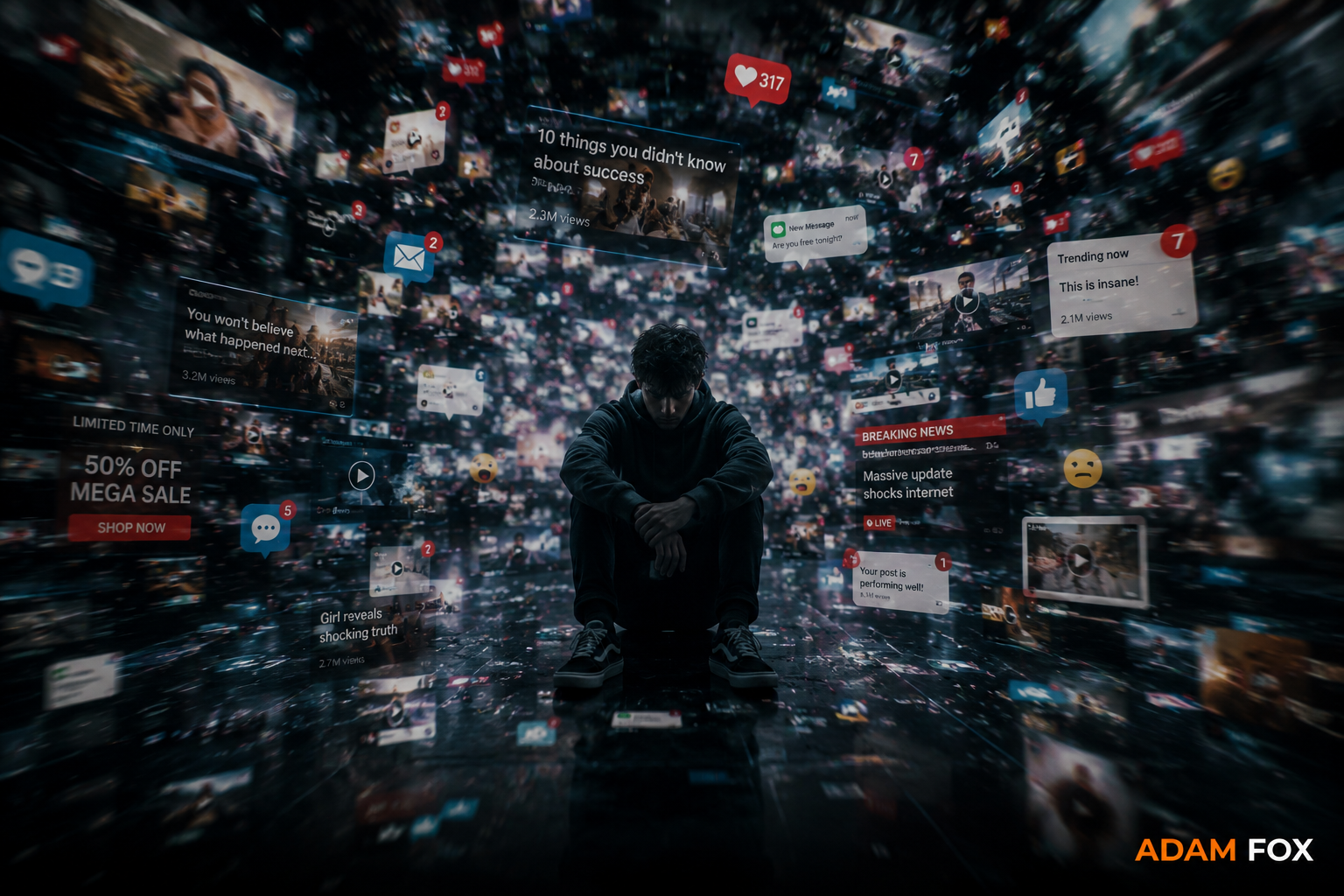
THE HUMAN ATTENTION PROJECT: WE NO LONGER KNOW HOW TO BE BORED
PART I — THE DEATH OF EMPTY SPACE
Boredom used to be unavoidable.
Not as a rare inconvenience.
As a normal part of human existence.
People waited without stimulation. Travelled without entertainment. Sat in silence. Stared out of windows. Walked without headphones. Queued without pulling a glowing rectangle from their pocket every thirty seconds.
There were gaps in life.
Small moments where nothing much happened externally, and because nothing much happened externally, attention turned inward instead.
Thoughts wandered.
Memories resurfaced.
Ideas connected.
Emotions processed.
The mind moved freely without being continuously directed by external systems.
Most people never consciously noticed how important those moments were because they existed everywhere. They were built naturally into the structure of everyday life.
Modern environments have almost completely removed them.
And most people still have not recognised the scale of what has disappeared.
One of the strangest behavioural shifts of the last fifteen years is how quickly human beings now move to eliminate even the smallest trace of boredom.
The reaction is almost automatic.
A lift journey lasts twenty seconds, so the phone appears.
A queue forms, so attention moves to a screen.
A television programme pauses for a moment, so scrolling begins simultaneously.
Even walking increasingly becomes something many people struggle to do without additional stimulation layered on top through podcasts, music, videos, or constant communication.
The environment no longer contains empty space because people have systematically filled it.
At first glance, this seems harmless.
Technology simply made waiting less frustrating.
But boredom was never just empty time.
Boredom served psychological functions modern culture rarely acknowledges properly.
One of the most important misconceptions about boredom is the assumption that it is purely negative.
People speak about boredom as though it is something to eliminate as efficiently as possible. The word itself carries negative emotional weight. To be bored is often treated as synonymous with wasting time.
This misunderstanding has shaped enormous parts of modern technology and entertainment design.
Everything competes to remove friction, remove waiting, remove stillness, and remove the possibility that attention might become unoccupied for too long.
But the human mind was never designed for continuous stimulation.
Periods of lower stimulation play a critical role in cognitive and emotional functioning. During moments where external demands reduce, the brain does not simply “switch off.” In many ways, it becomes more internally active.
This is where reflection happens.
Memory consolidation.
Imagination.
Internal narrative processing.
Creative association.
Emotional integration.
Many of the thoughts people describe as their deepest or clearest rarely emerge while attention is fully occupied by external input. They emerge later, during quieter moments where the mind finally has space to move without interruption.
Historically, boredom created those conditions naturally.
Modern life increasingly removes them before they can occur.
This has profound consequences because the human nervous system appears to require fluctuation between stimulation and stillness in order to regulate properly.
Modern environments increasingly favour permanent stimulation instead.
Every spare second becomes monetised.
Every gap becomes occupied.
Every pause becomes an opportunity for engagement.
The result is not merely distraction.
It is the collapse of attentional recovery.
Human attention was never designed to remain externally engaged for such prolonged periods of time. Yet many people now move through entire days without experiencing more than a few seconds of uninterrupted internal silence.
That constant occupation changes the baseline state of the nervous system.
The brain remains partially activated even during periods that previously would have allowed recovery. Anticipation remains active. Scanning remains active. Cognitive load accumulates continuously because the system is never fully allowed to settle.
This is one reason so many people now describe feeling mentally exhausted despite spending large portions of their day physically inactive.
The fatigue is not necessarily muscular.
It is cognitive saturation.
One of the most revealing signs that something deeper is happening can be seen in people’s relationship with silence itself.
Many people now struggle to tolerate it.
Not because silence is inherently uncomfortable, but because uninterrupted internal awareness increasingly feels unfamiliar. The moment stimulation disappears, unresolved thoughts and emotions become more noticeable.
And modern environments provide immediate escape routes from that discomfort.
Phones.
Music.
Scrolling.
Videos.
Messages.
Constant low-level input allows people to avoid sitting fully with their own thoughts almost indefinitely.
Again, this behaviour is often normalised because nearly everyone now participates in it to some degree.
But psychologically, it represents a major environmental shift.
Historically, human beings spent enormous amounts of time alone with their own cognition. Reflection was not a luxury practice reserved for mindfulness retreats or productivity gurus. It emerged naturally from the structure of everyday life itself.
Now reflection increasingly requires deliberate effort because the default environment works against it continuously.
That distinction matters enormously.
Because if an environment consistently prevents internal processing from occurring naturally, people gradually lose familiarity with their own internal world.
This becomes particularly important when considering creativity.
Modern culture often treats creativity as though it appears on command, but creativity rarely emerges from continuous consumption.
It emerges from cognitive space.
Ideas require incubation time. Connections form when attention is allowed to drift beyond immediate external demands. The brain needs periods where it is not fully occupied in order to process information at deeper levels.
Research into the brain’s default mode network strongly suggests that internally directed cognition plays a critical role in memory integration, imagination, autobiographical reflection, and creative insight. In simpler terms, some of the brain’s most important processing occurs when people are not actively focused on external tasks.
Modern environments increasingly interrupt those states before they fully develop.
The result is not simply reduced creativity.
It is reduced psychological depth.
Because many of the processes that help human beings understand themselves depend on uninterrupted internal space.
Children may be experiencing this shift most dramatically of all.
Previous generations experienced boredom as an unavoidable part of childhood. Long car journeys. Waiting rooms. Rainy afternoons. Wandering outside without structured stimulation. Inventing games simply because nothing else existed to fill the time.
Those conditions forced imagination to activate.
Children learned how to generate stimulation internally because external stimulation was not constantly available.
Modern childhood environments increasingly operate differently.
Now, boredom is often treated as a problem requiring immediate resolution. Devices appear quickly. Entertainment is instantly accessible. Attention becomes externally directed almost continuously.
Again, this is not about demonising technology.
It is about recognising environmental consequences.
If children rarely experience low-stimulation states, then important attentional and emotional skills may develop differently. The ability to self-generate focus, tolerate stillness, regulate emotion, and engage deeply with imagination may all be shaped by the conditions surrounding development.
The long-term implications of this remain uncertain because humanity has never previously raised children inside environments this saturated with engineered stimulation.
That uncertainty should probably concern people more than it currently does.
One of the most dangerous aspects of all this is how invisible the shift has become.
People no longer notice the absence of boredom because they adapted to environments where boredom rarely survives long enough to fully appear.
The absence feels normal.
The stimulation feels normal.
The constant input feels normal.
And because it feels normal, many people never stop to ask what continuous stimulation might be replacing psychologically.
But the disappearance of boredom did not simply remove empty time.
It removed many of the conditions under which human beings historically processed thought, emotion, memory, creativity, and identity itself.
And modern society is only just beginning to discover what happens when those conditions disappear.
PART II — WHAT HAPPENS WHEN THE MIND NEVER STOPS
One of the biggest misconceptions about stimulation is the assumption that the brain simply adapts to more of it without consequence.
It does adapt.
That is precisely the problem.
Human beings are extraordinarily responsive to environmental conditioning. The nervous system continuously recalibrates itself around repeated patterns of input, attention, emotion, and behaviour. What begins as occasional stimulation gradually becomes baseline expectation.
This is why modern life now feels psychologically normal despite conditions that would likely have appeared overwhelming only a few decades ago.
People no longer notice how little uninterrupted mental space they actually experience because the absence of that space became familiar slowly.
The adaptation was gradual enough to avoid triggering alarm.
But adaptation does not mean absence of consequence.
The mind appears to require periods where external input reduces enough for internal processing to occur properly.
Without those periods, psychological material accumulates without resolution.
Thoughts remain partially processed.
Emotions remain partially understood.
Experiences pass through awareness without ever fully integrating.
The result is a strange state where people remain mentally active almost constantly while simultaneously feeling psychologically disconnected from themselves.
This contradiction is becoming increasingly common.
People consume enormous amounts of information while struggling to think clearly.
They remain continuously connected while feeling increasingly isolated.
They are constantly stimulated while feeling emotionally flat.
At first glance these conditions appear unrelated.
In reality, they may stem from the same underlying environmental issue:
The mind rarely gets the uninterrupted space required to settle, reflect, and organise experience coherently.
One of the clearest consequences of this is the growing inability many people now have to remain fully engaged with a single thing for extended periods of time.
Reading has changed dramatically.
Many people now find themselves rereading paragraphs repeatedly because attention drifts before meaning fully settles. Long-form books feel harder than they once did. Even when people remain interested intellectually, their nervous system increasingly expects interruption.
Films are watched while scrolling.
Conversations happen while checking notifications.
Work occurs alongside multiple simultaneous streams of input.
Attention becomes divided so routinely that full immersion starts to feel unusual rather than normal.
This matters because immersion is not simply about concentration.
It is the gateway to depth.
Without sustained immersion, comprehension weakens. Emotional engagement weakens. Memory formation weakens. Experiences remain shallow because the mind never fully enters them deeply enough for richer processing to occur.
Over time, this creates a culture increasingly shaped by surface interaction rather than deep engagement.
Emotionally, the consequences may be even more significant.
Continuous stimulation creates a powerful mechanism for emotional avoidance.
Difficult thoughts can be interrupted before they fully form. Anxiety can be numbed temporarily through distraction. Loneliness can be softened through endless low-level social input. Boredom can be escaped instantly.
The problem is not that people occasionally distract themselves from discomfort.
Human beings have always done that.
The problem is that modern environments now make avoidance permanently available.
That changes emotional conditioning fundamentally.
Historically, many emotions eventually demanded attention because there were fewer escape routes from internal experience. People still avoided discomfort where possible, but the environment itself regularly forced confrontation with silence, stillness, waiting, uncertainty, grief, reflection, and unresolved thought.
Modern systems increasingly remove those confrontations.
This means people can remain externally occupied for astonishingly long periods without ever fully engaging with what is happening internally.
At first, this often feels helpful.
The stimulation provides relief.
But unresolved psychological material rarely disappears simply because attention moves elsewhere temporarily.
It accumulates underneath the surface instead.
This is one reason many people now experience a persistent sense of mental noise they struggle to explain clearly. Their attention rarely stops moving long enough for deeper emotional processing to complete properly.
The system remains busy.
But internally unresolved.
The consequences extend into identity formation itself.
Human beings develop stable internal narratives partly through uninterrupted reflection across time. People make sense of themselves by revisiting experiences, questioning behaviour, integrating memory, and constructing coherent meaning from emotional events.
That process requires internal continuity.
Modern environments increasingly fracture it.
When attention becomes continuously interrupted, the internal narrative becomes more fragmented too. Experiences are consumed rapidly without sufficient reflection to fully integrate them psychologically. Emotional reactions occur quickly but are often replaced by new stimulation before understanding deepens.
This creates an increasingly strange modern phenomenon:
People remain constantly occupied while simultaneously struggling to feel fully connected to themselves.
Not because identity disappears completely.
But because the conditions required to consolidate identity become weaker.
A fragmented attentional environment gradually produces fragmented psychological experience.
Relationships are also deeply affected by this shift.
Modern communication creates the appearance of near-constant social connection while often reducing the quality of attentional presence people give one another.
Partial attention has become culturally normal.
People now routinely:
- listen while scrolling
- message while speaking
- watch while replying
- interrupt conversations for notifications
- divide attention across multiple social streams simultaneously
The behavioural normalisation of divided attention subtly alters human connection itself.
Because connection is not built through proximity alone.
It is built through sustained presence.
Empathy depends on noticing nuance. Emotional intimacy depends on psychological availability. Trust deepens when people feel genuinely attended to rather than partially processed between interruptions.
Modern environments increasingly weaken those conditions.
This does not mean people care less about each other than previous generations did. In many ways, people may care deeply.
But caring and attending are not identical processes.
The tragedy is that many people now spend enormous amounts of time connected to others digitally while simultaneously feeling starved of genuine psychological presence.
There is also an important cognitive consequence that receives surprisingly little discussion.
The inability to tolerate boredom weakens the ability to tolerate delayed gratification more broadly.
Boredom itself is a form of low-level discomfort. Waiting without stimulation creates psychological tension. Historically, people experienced that tension regularly because life naturally imposed periods of inactivity and delay.
Modern systems increasingly eliminate those experiences.
Entertainment becomes instant.
Information becomes instant.
Communication becomes instant.
Relief from discomfort becomes instant.
This conditions the nervous system toward immediacy.
Over time, patience weakens because patience functions partly like a psychological tolerance built through repeated exposure to waiting and uncertainty.
When stimulation arrives instantly every time discomfort appears, the nervous system becomes progressively less comfortable with slowness, ambiguity, and delayed reward.
This matters enormously because many meaningful human processes require exactly those conditions.
Learning does.
Mastery does.
Long-term relationships do.
Creative work does.
Parenting certainly does.
The inability to remain engaged with difficult or slow-moving processes creates broader societal consequences than most people currently recognise.
One of the deepest ironies in all of this is that many people now spend huge portions of their lives seeking relief from overstimulation through… more stimulation.
People feel mentally exhausted, so they scroll.
Emotionally depleted, so they consume more content.
Unable to focus, so they seek faster dopamine hits through novelty.
The environment generating the overload increasingly becomes the same environment people turn to for relief from that overload.
This creates a self-reinforcing cycle that becomes difficult to interrupt because the stimulation provides short-term emotional regulation while simultaneously contributing to the long-term destabilisation of attention itself.
Again, this does not mean individuals are weak.
It means the environment is operating directly against mechanisms the nervous system evolved to regulate itself through.
And most people still do not fully recognise the scale of what that environment is doing to them psychologically.
The modern world did not simply make boredom disappear.
It replaced internal space with continuous external occupation.
And human beings are only beginning to understand what happens when the mind never truly gets a chance to be alone with itself anymore.
PART III — THE FUTURE OF STILLNESS
One of the most important questions of the next decade may not be technological.
It may be psychological.
Can human beings still tolerate being alone with their own mind?
At first glance, that sounds dramatic. But beneath the surface, modern behaviour increasingly suggests that uninterrupted internal stillness has become difficult for many people to sustain for even short periods of time.
The speed at which people now move to eliminate silence is revealing.
A conversation pauses, and phones appear.
A queue forms, and attention instantly shifts to stimulation.
A moment of discomfort arises, and content arrives almost reflexively to suppress it.
The nervous system is becoming increasingly conditioned against inactivity.
And because this conditioning is happening collectively, it is becoming culturally invisible.
That invisibility makes the issue far more dangerous.
The future implications of this extend far beyond distraction or entertainment habits.
Stillness is not simply relaxation.
It is one of the conditions under which human beings historically developed:
- self-awareness
- emotional regulation
- imagination
- philosophical thought
- creativity
- long-form reflection
- psychological integration
Without periods of uninterrupted internal space, those processes weaken.
Not immediately.
Gradually.
Quietly.
Until eventually people lose familiarity with the mental state required for deeper reflection altogether.
This is where the future becomes particularly concerning.
Because environments shape not only behaviour, but expectation.
Future generations may simply grow up assuming continuous stimulation is the normal human condition. They may never fully experience what sustained internal stillness actually feels like because the surrounding environment rarely permits it to emerge naturally.
That possibility changes the entire conversation.
The issue is no longer whether boredom is uncomfortable.
The issue is whether the disappearance of boredom fundamentally alters human cognition over time.
One of the greatest risks is the continued erosion of uninterrupted thought.
Deep thinking requires more than intelligence. It requires attentional stability long enough for thoughts to move beyond immediate reaction and into deeper integration. Complex reasoning, emotional processing, and creativity all depend on sustained cognitive continuity.
Modern environments increasingly disrupt that continuity before it fully develops.
The result is not merely shorter attention spans.
It is shallower mental processing.
A culture increasingly dominated by reaction rather than reflection.
This has enormous societal implications.
Political discourse becomes emotionally immediate because emotional stimulation spreads faster than nuance.
News becomes optimised for engagement rather than depth because attention rewards novelty and outrage more effectively than complexity.
Education becomes harder because sustained immersion competes directly against environments training rapid attentional switching from early childhood onwards.
Even relationships become more fragile because deep emotional intimacy requires uninterrupted psychological presence.
Fragmented attention gradually produces fragmented experience across almost every area of life.
This creates an increasingly strange contradiction in modern society.
People have unprecedented access to information while simultaneously struggling to think deeply about that information.
They consume more than any previous generation while often feeling psychologically emptier.
They remain constantly connected while reporting rising loneliness.
They are continuously stimulated while increasingly unable to tolerate stillness.
That contradiction is not accidental.
It reflects a system where external occupation increasingly replaces internal development.
And because modern environments reward stimulation economically, the trajectory continues accelerating.
Artificial intelligence will likely intensify this dramatically.
AI-generated content systems are about to increase the volume of available stimulation beyond anything human beings have previously experienced. Infinite personalised content, hyper-targeted engagement systems, adaptive recommendation engines, synthetic entertainment, AI-generated social interaction, and algorithmically optimised emotional triggers will create environments capable of capturing attention at unprecedented levels of precision.
This changes the future of attention entirely.
The issue will no longer simply be distraction.
It will become competition between human attentional stability and systems specifically designed to outcompete it.
That imbalance matters enormously because human biology still operates using mechanisms developed in radically simpler environments.
The nervous system did not evolve to process infinite input.
It evolved to survive local environments with natural fluctuations between stimulation and recovery.
Modern systems increasingly remove those fluctuations entirely.
This may create a future where stillness itself becomes psychologically rare.
Not because silence disappears physically, but because people lose the ability to remain unstimulated long enough to experience it properly.
That distinction matters.
A person can sit alone in silence while still remaining psychologically flooded by digital anticipation, unresolved input, compulsive checking urges, and fragmented internal attention.
Stillness is not merely the absence of noise.
It is the absence of compulsive external occupation.
And many people are moving further away from that state every year.
Ironically, this may also create a powerful future advantage for the people capable of reclaiming it.
Throughout history, scarcity creates value.
Stillness is becoming scarce.
Deep focus is becoming scarce.
Reflection is becoming scarce.
The ability to remain present without compulsive stimulation is becoming scarce.
Those abilities may eventually become enormously important psychologically, creatively, professionally, and emotionally.
Not because they sound impressive philosophically.
Because nearly every meaningful form of deep human functioning depends on them.
Creativity depends on cognitive space.
Insight depends on reflection.
Emotional regulation depends on attentional stability.
Meaningful relationships depend on uninterrupted presence.
Wisdom itself may depend partly on the ability to remain with difficult thoughts long enough for understanding to deepen rather than escaping into stimulation immediately.
This is where the future conversation around attention changes completely.
The issue is not whether people occasionally waste time scrolling their phones.
The issue is whether human beings can still access the internal psychological conditions required for depth.
Children may ultimately reveal the consequences first.
A generation raised inside continuous stimulation may develop fundamentally different expectations around attention, boredom, waiting, and emotional regulation.
If every moment of discomfort is interrupted quickly enough, the nervous system may never fully learn how to tolerate stillness, uncertainty, or delayed gratification naturally.
Again, this is not moral panic.
It is environmental observation.
The conditions surrounding development shape the systems developing inside them.
And humanity has never before raised children inside environments this saturated with engineered stimulation competing continuously for attention.
The long-term consequences remain uncertain.
That uncertainty alone should probably provoke far more caution than it currently does.
None of this means people must reject technology entirely or retreat from modern life.
That simplistic response misses the point.
The deeper issue is awareness.
Most people still do not recognise how profoundly environmental conditions shape the way they think, feel, regulate emotion, process experience, and direct attention.
Without that awareness, people continue interpreting overstimulation as personal weakness rather than environmental mismatch.
They continue blaming themselves for struggling to function under conditions no human nervous system evolved to handle continuously.
And that misunderstanding keeps the cycle intact.
The future may ultimately belong to people who consciously protect internal space.
Not because they are more disciplined than everyone else.
But because they understand something many people still do not:
A mind that never experiences stillness eventually loses its ability to think deeply altogether.
FINAL THOUGHT
Human beings did not evolve needing constant stimulation to feel psychologically safe.
We evolved needing periods of stillness to remain psychologically stable.
And if modern life continues removing those conditions…
The loss people experience may not simply be attention.
It may be depth itself.
SOURCES AND RESEARCH GAPS
Key research areas:
- Default mode network and internally directed cognition research
- Cognitive load theory and attentional fragmentation
- Dopamine and variable reward systems (Schultz, Berridge & Robinson)
- Human-computer interaction and digital overstimulation research
- Emotional regulation and attentional stability studies
- Child neurological development and digital stimulation exposure
- Creativity and incubation research in cognitive psychology
Research gaps:
- Long-term effects of continuous digital stimulation on reflective thinking
- Developmental impact of low-boredom childhood environments
- Interaction between AI-generated stimulation and human attentional stability
- Longitudinal effects of fragmented attention on emotional regulation and identity
- Relationship between boredom tolerance and psychological resilience