
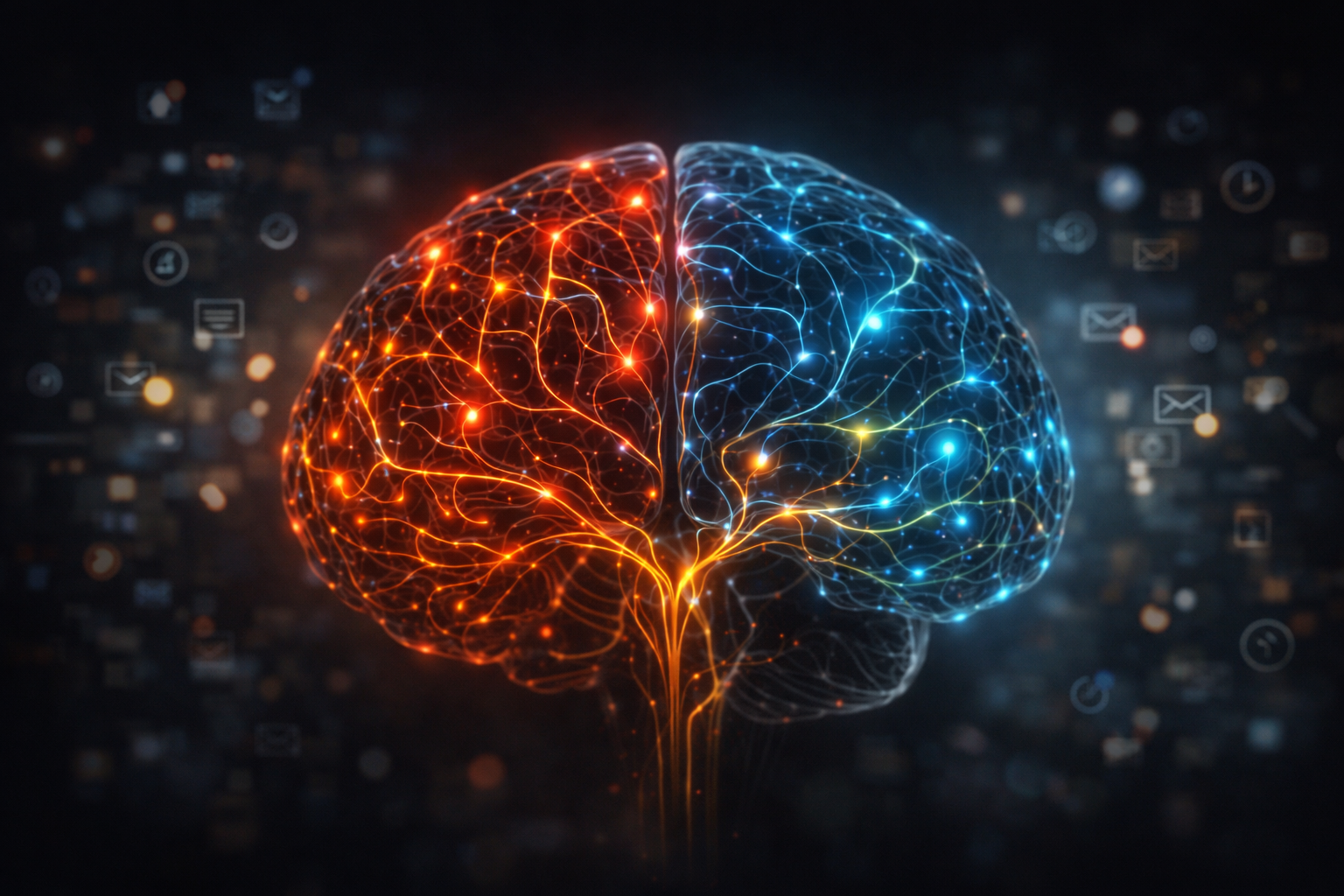
THE CHEMISTRY OF ATTENTION SERIES: THE SYSTEM — HOW IT ALL FITS TOGETHER
SECTION 1: THE LIE OF SEPARATE PROBLEMS
You’ve been taught to treat your struggles like they’re separate.
Focus is one problem.
Stress is another.
Motivation is something else entirely.
Sleep sits in its own box.
Burnout becomes a label you wear when it all collapses.
So you try to fix them one by one.
You try to “improve focus.”
You try to “reduce stress.”
You try to “get more motivated.”
You try to “sleep better.”
And when none of it sticks, you assume the issue is you.
That you’re inconsistent.
Undisciplined.
Missing something.
But that entire way of thinking is flawed from the start.
Because none of those things are separate.
They never were.
What you’re experiencing isn’t a collection of problems.
It’s a system expressing itself.
Every thought you have, every decision you make, every action you take is being shaped by a constantly shifting chemical environment inside your brain and body.
Not occasionally.
Constantly.
There is no neutral state.
There is no moment where your behaviour exists independently of that system.
Even now, as you’re reading this, that system is active.
Deciding whether you stay with this… or drift.
Whether you feel calm… or slightly tense.
Whether this feels interesting… or effortful.
And you’re not consciously controlling any of it.
That’s the part most people never fully grasp.
You are not operating above this system.
You are operating within it.
Dopamine isn’t just about motivation.
Cortisol isn’t just about stress.
Adrenaline isn’t just about urgency.
Serotonin isn’t just about mood.
Acetylcholine isn’t just about focus.
GABA isn’t just about calm.
Melatonin isn’t just about sleep.
Oxytocin isn’t just about connection.
Endorphins aren’t just about reward.
Each of these is part of a wider network.
And that network is constantly interacting.
Pulling you in different directions.
Adjusting based on your environment.
Learning from repetition.
Which means your behaviour isn’t random.
And it’s not purely a result of conscious choice either.
It’s the result of a system responding to what it’s exposed to.
If your environment constantly rewards quick hits of stimulation, your dopamine system will adapt to seek them.
If your environment maintains background pressure, your cortisol system will adapt to sustain it.
If your attention is repeatedly interrupted, your acetylcholine system will stop committing to depth.
If your recovery is compromised, your entire system will start operating at reduced capacity.
And from the outside, that looks like:
“I can’t focus.”
“I’m always stressed.”
“I have no motivation.”
“I’m exhausted.”
But those are descriptions.
Not explanations.
Because underneath all of them is the same thing.
A system doing exactly what it has been trained to do.
That’s why surface-level fixes don’t last.
You can force focus for an hour.
You can push through stress for a day.
You can get motivated for a week.
But if the system underneath hasn’t changed, everything eventually snaps back.
Not because you failed.
Because the system is stronger than the effort.
This is where most people get stuck.
They keep trying to override the system with willpower.
Instead of understanding it.
And until that shifts, nothing else does.
The goal isn’t to fix focus.
Or reduce stress.
Or increase motivation.
The goal is to see the system clearly enough to realise:
Those things were never separate in the first place.
SECTION 2: WHY PRODUCTIVITY ADVICE KEEPS FAILING
Most productivity advice is built on the same flawed assumption.
That behaviour sits at the top of the chain.
That if you can just control what you do, everything else will fall into place.
So the message becomes predictable.
Build better habits.
Stick to a routine.
Stay disciplined.
Be consistent.
It sounds logical.
Clean.
Actionable.
And completely incomplete.
Because it skips the most important part of the process.
The state that behaviour is coming from.
Behaviour is not the starting point.
It is the output.
And when you try to change the output without understanding what is producing it, you end up stuck in a cycle that looks like progress on the surface, but never quite holds underneath.
You start strong.
You commit.
You follow the plan.
For a few days, maybe even a couple of weeks, everything feels like it’s working.
You’re focused.
You’re ticking things off.
You feel in control.
Then something shifts.
Not dramatically.
Subtly.
Your attention starts to drift.
You feel resistance where there wasn’t any before.
Tasks that felt manageable now feel heavier.
You start delaying things.
Switching more.
Avoiding the harder work.
And because the model you’ve been given tells you this is a behaviour problem, you interpret it in a very specific way.
You think you’ve slipped.
Lost discipline.
Fallen off track.
So what do you do?
You double down.
You tighten the system.
You push harder.
And for a short period, it works again.
Until it doesn’t.
This cycle repeats itself so often that most people stop questioning the model.
They just assume the issue is consistency.
Or commitment.
Or effort.
But what’s actually happening sits underneath all of that.
Your internal state has changed.
Not your intentions.
Not your goals.
Your state.
The balance of chemicals driving your attention, energy, and decision-making has shifted.
Dopamine is pulling you towards quicker, easier rewards.
Cortisol is sitting slightly elevated, creating background pressure.
Adrenaline is nudging you towards urgency instead of depth.
Acetylcholine is struggling to stabilise because your attention keeps fragmenting.
GABA isn’t fully settling the system, so there’s always a low-level restlessness.
And now, the exact same behaviours that felt easy a week ago feel harder.
Not impossible.
But heavier.
This is where traditional advice completely misses the mark.
Because it treats behaviour as something you can apply regardless of state.
As if focus, discipline, and consistency are always equally available.
They’re not.
They are state-dependent.
And that changes everything.
Because now the question isn’t:
“How do I become more disciplined?”
It becomes:
“What state am I trying to operate from right now?”
If your system is calm, stable, and supported, behaviour feels easier.
Focus holds.
Decisions are clearer.
Effort feels proportional.
If your system is overstimulated, pressured, and fragmented, behaviour feels harder.
Focus slips.
Decisions feel heavier.
Effort feels disproportionate.
The behaviour hasn’t changed.
The system has.
And this is why habit formation, on its own, is unreliable.
The idea that you can repeat a behaviour enough times for it to become automatic only works if the conditions allow for consistent repetition.
But real life doesn’t provide consistent conditions.
Your environment changes.
Your stress levels fluctuate.
Your attention is constantly being pulled.
Your recovery varies.
So the system that’s supposed to support the habit is never stable enough to fully embed it.
Which is why habits don’t fail all at once.
They erode.
First, they feel slightly harder.
Then they require more effort.
Then they become something you have to think about.
Then something you delay.
Then something you skip.
Until eventually, they disappear.
Not because you didn’t build them properly.
Because the system they were built on wasn’t stable enough to hold them.
This is the part nobody talks about.
Because it’s easier to sell behaviour.
It’s harder to explain state.
But behaviour without state is like trying to build on shifting ground.
You can make it look solid for a while.
But it won’t hold under pressure.
And modern environments apply pressure constantly.
Which means if you’re relying purely on discipline and habit formation, you’re not just trying to improve.
You’re trying to override a system that is adapting in real time to everything around you.
And that’s a fight you will keep losing.
Not because you’re weak.
But because you’re working at the wrong level.
When you understand that, everything changes.
Because you stop trying to force behaviour…
And start questioning the state that behaviour is coming from.
SECTION 3: THE REAL STARTING POINT — ENVIRONMENT
If behaviour is the output…
And state is what drives behaviour…
Then the obvious question is:
What shapes state?
Environment.
Not occasionally.
Not in a general sense.
Constantly.
Your environment is not just where you are.
It is everything that interacts with you.
What you see.
What you hear.
What demands your attention.
What interrupts you.
What pressures you.
What rewards you.
Every input.
Every signal.
Every cue.
And your system is responding to all of it in real time.
This is where most people underestimate the problem.
They think of environment as something external.
Something separate from them.
Something they can “ignore” if they’re disciplined enough.
You can’t.
Because your brain doesn’t respond to intention.
It responds to exposure.
If something is in your environment, it is influencing your system.
Whether you consciously engage with it or not.
A notification you don’t open still creates a shift.
A message you don’t reply to still sits in the background.
An unfinished task still holds attention.
Noise still fragments focus.
Light still affects rhythm.
You don’t have to actively engage with something for it to have an effect.
The system is already processing it.
And this is where things start to become clearer.
Because when your environment is filled with constant low-level inputs…
Your system never fully settles.
Dopamine is constantly being triggered by potential rewards.
Not just actual ones.
Potential ones.
Something to check.
Something to respond to.
Something that might be more interesting than what you’re currently doing.
Cortisol doesn’t spike and resolve.
It lingers.
Because the environment doesn’t give you clear threats with clear endings.
It gives you ongoing demands with no real off switch.
Adrenaline fires in small bursts.
Not because you’re in danger.
But because everything feels slightly urgent.
Slightly time-sensitive.
Slightly important.
Acetylcholine never fully stabilises.
Because attention is constantly being interrupted.
Before it has a chance to deepen.
GABA doesn’t fully calm the system.
Because there is always something pulling it back up.
Melatonin gets pushed out of rhythm.
Because stimulation doesn’t stop when the day ends.
This isn’t dysfunction.
It’s adaptation.
Your system is doing exactly what it’s supposed to do.
Responding to the conditions it’s placed in.
And this is the shift most people never make.
They try to control their behaviour within the same environment that is shaping the behaviour they’re trying to change.
They try to focus in an environment designed to fragment attention.
They try to relax in an environment that maintains constant stimulation.
They try to build habits in an environment that disrupts consistency.
And when it doesn’t work, they take it personally.
But the environment hasn’t changed.
So the system hasn’t changed.
So the behaviour doesn’t change.
This is why environment is the starting point.
Not because it’s easier.
But because it’s upstream.
You don’t control your chemistry directly.
You don’t decide when dopamine spikes.
You don’t consciously regulate cortisol in real time.
You don’t switch acetylcholine on and off.
But you do control what you expose your system to.
And that exposure is what shapes everything else.
If the inputs stay the same…
The outputs stay the same.
No matter how hard you try to force it.
This is the part that separates surface-level thinking from actual understanding.
Because once you see environment as the driver…
You stop asking:
“How do I try harder?”
And start asking:
“What is my system being trained to respond to?”
That question changes everything.
Because now you’re not fighting yourself.
You’re looking at the conditions that are shaping you.
And once you change those…
The system has no choice but to adapt.
Not instantly.
But consistently.
That’s where real change starts.
Not at the level of behaviour.
But at the level of exposure.
SECTION 4: FROM FORCE TO ALIGNMENT
Most people are trying to force outcomes.
Force focus.
Force discipline.
Force consistency.
Force themselves to do things they “should” be doing.
And to a point, that works.
You can push through.
You can override resistance.
You can get things done even when your system isn’t supporting you.
But it comes at a cost.
Because force is not sustainable.
Every time you override the system, you’re borrowing energy from somewhere else.
Mental energy.
Emotional energy.
Physical energy.
And eventually, that debt gets collected.
That’s when things start to feel heavier.
Not suddenly.
Gradually.
The same tasks take more effort.
Decisions feel harder.
Focus becomes shorter.
You need more stimulation to stay engaged.
More breaks.
More escapes.
Until eventually, the system pushes back.
Not because it’s failing.
Because it’s protecting itself.
This is where burnout begins to form.
Not as a single moment.
But as the result of sustained misalignment.
You’re trying to operate in one direction.
The system is being pulled in another.
And over time, that tension builds.
Force keeps you moving in the short term.
But it increases resistance in the long term.
Alignment works differently.
Alignment is when the system starts working with you instead of against you.
Not because you’ve become more disciplined.
But because the conditions have changed.
Dopamine is no longer being constantly hijacked by low-value stimulation.
So it starts attaching itself to meaningful progress again.
Cortisol drops to a level where it signals importance…
Not constant pressure.
Adrenaline becomes situational again.
Used when needed.
Instead of running quietly in the background all day.
Acetylcholine gets the space it needs to stabilise.
Because attention isn’t being broken every few minutes.
GABA can actually settle the system.
Because there is room for it to do so.
Melatonin starts to regulate properly.
Because the system isn’t being artificially stimulated into the night.
Now look at what happens to behaviour.
Focus becomes accessible.
Not perfect.
But available.
Work becomes something you can stay with.
Instead of something you constantly escape from.
Decisions feel lighter.
Because your system isn’t overloaded.
Consistency becomes something that happens more naturally.
Not something you have to fight for every day.
This is the shift most people are missing.
They think the goal is to get better at forcing themselves.
It isn’t.
The goal is to reduce how much force is required in the first place.
Because when the system is aligned, behaviour doesn’t need to be dragged into place.
It follows.
Not effortlessly.
But without constant resistance.
And that’s a completely different experience.
This is also where most “gurus” lose people.
Because their model depends on effort.
More discipline.
More structure.
More control.
But they’re asking people to apply that effort in environments that are actively working against them.
So people try.
They fail.
They blame themselves.
And the cycle continues.
Alignment breaks that cycle.
Because instead of trying to overpower the system…
You start adjusting the conditions that are shaping it.
And when those conditions shift…
The system shifts.
And when the system shifts…
Everything downstream starts to change.
Not because you forced it.
Because you stopped fighting it.
SECTION 5: WHY THIS CHANGES EVERYTHING
Once you see this properly, the entire conversation around productivity starts to look shallow.
Not wrong.
Just incomplete.
Because most of it is focused on what people should be doing.
Very little of it looks at what is actually driving what they are doing.
That gap is where people get stuck.
They’re given strategies that assume a stable system.
Clear thinking.
Consistent energy.
Reliable focus.
But they’re trying to apply those strategies inside a system that is anything but stable.
So the advice feels right.
But doesn’t work.
And when that happens repeatedly, something else starts to form.
Not just frustration.
Doubt.
Not just in the advice.
In themselves.
Because if the method is sound…
And it’s not working…
The only logical conclusion is that something must be wrong with them.
This is where people start to label themselves.
Easily distracted.
Unmotivated.
Inconsistent.
Bad with time.
But those labels are just descriptions of behaviour.
They’re not explanations.
And when you don’t have the explanation, you default to blame.
This is why understanding the system changes everything.
Because it removes the need to personalise the problem.
You stop seeing your behaviour as a reflection of your character.
And start seeing it as a response to your conditions.
That doesn’t remove responsibility.
But it redirects it.
Away from:
“I need to be better.”
Towards:
“I need to understand what’s shaping this.”
That shift is subtle.
But it’s powerful.
Because now you’re not trying to fix yourself.
You’re trying to understand the system you’re operating within.
And that opens up a completely different level of thinking.
You start to notice patterns.
Why certain environments drain you.
Why others make things feel easier.
Why some days focus holds…
And others it disappears completely.
You stop expecting consistency from a system that is constantly being influenced.
And start looking at what’s influencing it.
This is also where you begin to separate what is actually within your control… from what you’ve been trying to control unsuccessfully.
You don’t control your chemistry directly.
You don’t decide when you feel motivated.
You don’t switch focus on like a light.
But you do influence the conditions that make those states more or less likely.
And that’s where the leverage sits.
Not in trying to control behaviour at all times.
But in understanding what makes certain behaviours more accessible in the first place.
This is the difference between surface-level productivity…
And deeper understanding.
One focuses on what to do.
The other focuses on why doing it feels easy sometimes… and almost impossible at others.
And once you understand that, the entire model shifts.
You stop chasing optimisation.
You stop layering more strategies on top of unstable foundations.
You stop assuming that effort alone is the answer.
And you start working at the level where real change actually happens.
Upstream.
At the level of the system.
That’s what separates this from the usual noise.
Because this isn’t about doing more.
Or doing it better.
It’s about understanding what’s been driving everything all along.
And once you see that clearly…
You don’t go back to thinking about productivity the same way again.
SECTION 6: CLOSING THE LOOP
This was never about dopamine.
Or cortisol.
Or any of the individual chemicals on their own.
Each one matters.
Each one plays a role.
But none of them tell the full story in isolation.
Because what you’ve been experiencing isn’t a collection of separate effects.
It’s a system.
Dopamine pulling you towards what feels rewarding.
Cortisol keeping you alert to pressure.
Adrenaline preparing you to react.
Acetylcholine trying to stabilise your attention.
Serotonin regulating your baseline.
GABA attempting to calm the noise.
Melatonin managing recovery.
Oxytocin shaping connection and safety.
Endorphins reinforcing effort.
All of it interacting.
All of it adjusting.
All of it responding to the same thing.
Your environment.
That’s the thread that runs through everything in this series.
Not one chemical.
Not one behaviour.
The system.
And the system doesn’t care what you intend to do.
It responds to what you repeatedly expose it to.
If your environment rewards distraction, your system will lean towards distraction.
If your environment maintains pressure, your system will carry tension.
If your environment fragments attention, your focus will weaken.
If your environment disrupts recovery, your capacity will drop.
Not because you chose it.
Because you adapted to it.
That’s the part most people never fully accept.
You are not operating independently of your environment.
You are being shaped by it.
Continuously.
Which means the behaviours you’ve been trying to fix…
Were never just behaviours.
They were signals.
Signals of a system under certain conditions.
Signals of what your brain has learned to prioritise.
Signals of how your chemistry has been trained to respond.
And once you see them that way, the frustration starts to fade.
Because you’re no longer asking:
“What’s wrong with me?”
You’re asking:
“What is this system responding to?”
That question brings you back to control.
Not control over every outcome.
But control over where it actually matters.
At the level of exposure.
At the level of environment.
At the level of what you repeatedly allow to shape your system.
This is what ties everything together.
You don’t need to master each chemical.
You don’t need to micromanage your brain.
You don’t need a perfect system layered on top of everything else.
You need awareness.
Awareness that your behaviour is not random.
Awareness that your state is not fixed.
Awareness that your system is constantly adapting.
And awareness that the direction it adapts in…
Is not an accident.
It’s a result.
A result of what you surround yourself with.
A result of what you repeatedly engage with.
A result of the conditions you operate in every day.
Change those conditions…
And the system changes with them.
Not instantly.
But inevitably.
That’s the part the industry doesn’t want to dwell on.
Because it doesn’t sell well.
It doesn’t package neatly.
It doesn’t promise quick wins.
But it’s the truth underneath all of it.
You were never broken.
You were responding.
And now you have a choice.
Keep trying to fight the system…
Or understand it well enough to finally start working with it.
SOURCES AND RESEARCH GAPS
This series has been written to prioritise clarity and real-world understanding over academic presentation, but the underlying ideas are grounded in well-established neuroscience, psychology, and behavioural science.
At a high level, the system described draws on three overlapping areas:
Neurochemistry and neuromodulation — how brain chemicals such as dopamine, serotonin, acetylcholine, GABA, cortisol, and others regulate attention, motivation, stress, and behaviour.
Cognitive neuroscience — particularly research into attention systems, executive function, task switching, and the cost of interruption.
Behavioural science and environmental psychology — how repeated exposure, cues, and modern environments shape habits, decision-making, and perceived effort.
Key areas of established understanding include:
Dopamine as a driver of motivation, prediction, and reward-seeking behaviour rather than simple “pleasure.”
Cortisol and adrenaline as adaptive stress responses that become problematic when chronically activated without resolution.
Acetylcholine’s role in attention, learning, and neural signal clarity, particularly in sustained focus.
GABA as the brain’s primary inhibitory system, helping regulate overactivity and promote calm.
Serotonin’s involvement in mood regulation, stability, and perceived control.
Melatonin’s regulation of circadian rhythm and recovery.
Oxytocin’s role in social bonding, trust, and perceived safety.
Endorphins as part of the body’s natural reward and pain-modulation system following effort or stress.
The cognitive cost of task switching and interruption, which degrades focus and increases mental fatigue.
The brain’s tendency to adapt to repeated environmental stimuli, reinforcing patterns of behaviour over time.
Where this series differs from traditional presentation is not in the science itself, but in how the pieces are connected.
Most research isolates variables.
This series treats them as a system.
RESEARCH GAPS AND LIMITATIONS
While each individual chemical and mechanism is well studied, there are important limitations in how the full picture is currently understood.
- SYSTEM-LEVEL INTEGRATION
Much of the existing research examines single chemicals or isolated processes.
Real life does not operate in isolation.
There is still limited practical, real-world modelling of how multiple neuromodulators interact simultaneously under everyday conditions such as:
Constant digital stimulation
Chronic low-level stress
Frequent task switching
Sleep disruption
The “system” described in this series reflects a synthesis of known mechanisms, but the full complexity of their interaction in modern environments is still evolving.
- MODERN ENVIRONMENTAL LOAD
Most foundational neuroscience research was not conducted in environments that resemble modern life.
The scale, frequency, and intensity of:
Notifications
Digital media
On-demand stimulation
Continuous cognitive load
are relatively recent.
There is growing research into attention fragmentation and digital overload, but long-term, system-wide effects across multiple chemical pathways are still being explored.
- INDIVIDUAL VARIABILITY
People do not respond identically.
Genetics, lifestyle, health, sleep, nutrition, and personal history all influence how these systems behave.
The patterns described in this series are broadly applicable, but not uniform.
What destabilises one person’s system may be tolerated differently by another.
- SUBJECTIVE EXPERIENCE VS MEASURABLE DATA
Science can measure chemical activity.
It can observe behavioural patterns.
But the lived experience — how effort feels, how resistance shows up, how attention drifts — is harder to quantify precisely.
This series leans into that lived experience to bridge the gap between what is measurable and what is actually felt day to day.
- CAUSE VS CORRELATION IN BEHAVIOUR
In complex systems, clear cause-and-effect relationships are difficult to isolate.
For example:
Does a fragmented environment directly reduce acetylcholine stability?
Or does repeated behaviour within that environment train the system over time?
The answer is often both.
This series presents directional relationships based on established mechanisms, but real-world causality is layered and multifactorial.
FINAL NOTE
The aim of this work is not to present new science.
It is to connect existing understanding in a way that reflects how people actually experience their lives.
Not as isolated problems.
But as a system.
A system that is constantly adapting.
Constantly responding.
And, once understood clearly enough, capable of being worked with rather than fought against.