
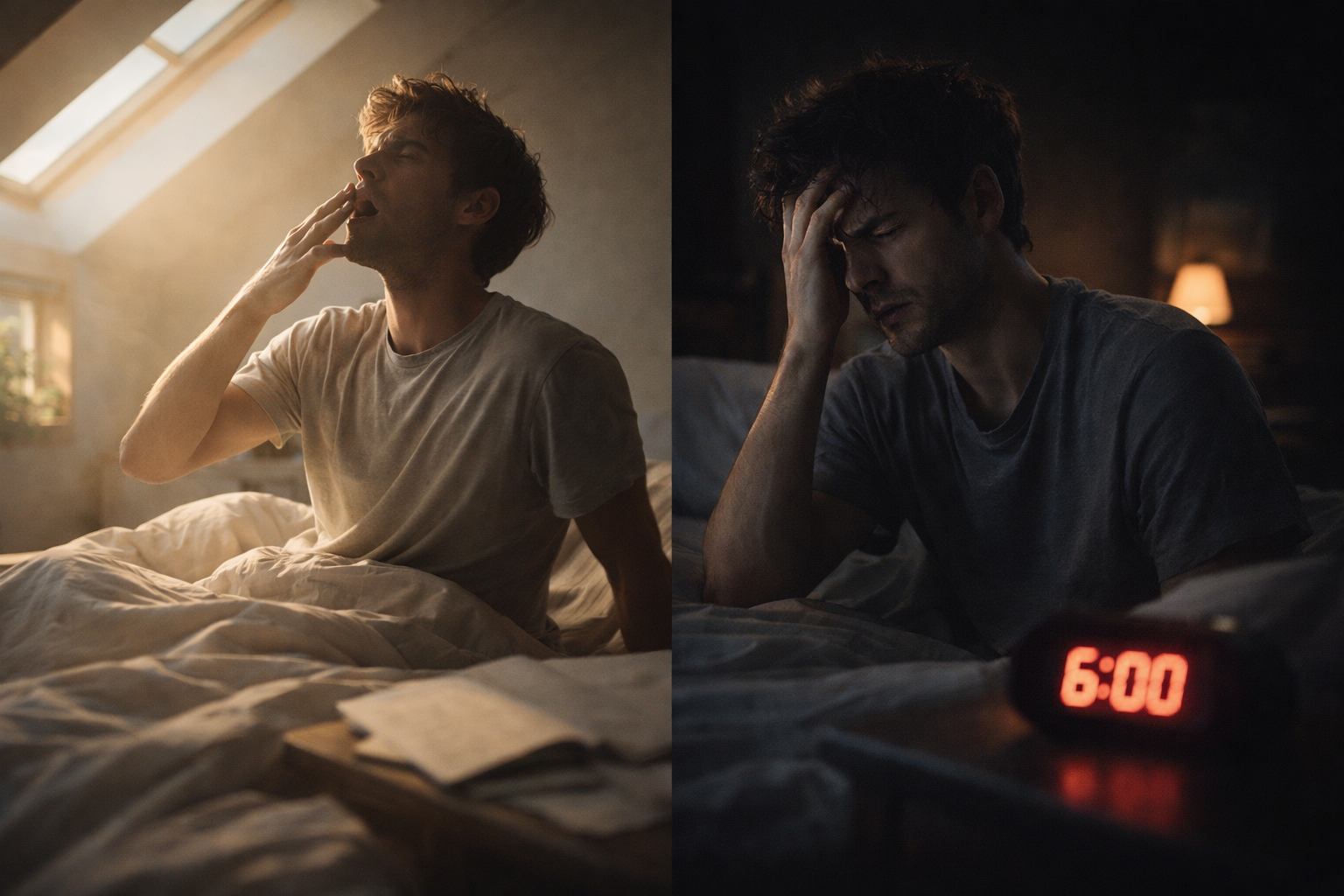
THE CHEMISTRY OF ATTENTION SERIES: MELATONIN – THE RHYTHM SHIFT
There’s a version of you that exists in the summer that doesn’t exist in the winter.
Same person. Same responsibilities. Same environment on paper.
But something feels different.
You wake up earlier without needing to force it. You feel more alert sooner. Your day seems to stretch out without feeling like a grind. You move through things with less resistance.
Then winter comes.
The alarm goes off and it feels heavier. Getting out of bed takes more effort. Mornings feel slower, darker, harder to start. Even when you do everything “right,” something still feels off.
Most people explain this away as motivation.
Or mood.
Or just “one of those things.”
But underneath it, there’s something far more predictable at play.
Melatonin is your body’s timekeeper.
Not in the sense of hours and minutes, but in the sense of rhythm.
It regulates when you feel sleepy.
When you feel alert.
When your system winds down.
When it prepares to wake up again.
It’s not about how long you sleep.
It’s about when your system thinks it should sleep.
And that system is heavily influenced by one thing above everything else.
Light.
Natural light tells your body what time it is.
Not the clock on your phone.
Not your schedule.
Not your intentions.
Light.
When light enters your eyes, especially in the morning, it signals to your brain that the day has started. Melatonin production drops. Cortisol rises appropriately. Your system begins to wake up.
In the evening, as light fades, the opposite happens. Melatonin rises. Your system prepares to rest.
That’s the natural cycle.
But modern life doesn’t follow that cycle.
You wake up to an alarm, not light.
You spend your morning indoors, often under artificial lighting that doesn’t fully signal daytime to your brain.
You look at screens early, flooding your system with light that doesn’t match the natural environment.
Then in the evening, when your body should be winding down, you expose yourself to more light.
Phones.
Laptops.
TVs.
All telling your brain the day is still going.
So the signals get mixed.
Your body is trying to follow a rhythm that your environment keeps disrupting.
This is where things start to shift.
You don’t feel tired when you should.
You feel wired at night, even when you’re exhausted.
You struggle to wake up, even after enough hours in bed.
It’s not always about sleep quality.
It’s about timing.
This is where your own experience becomes relevant.
When the light comes through your skylights in the summer, you don’t need to force anything.
You wake up naturally.
Not because you’ve suddenly become more disciplined.
Because your system is being aligned with the environment it expects.
Light comes in.
Melatonin drops.
Your system wakes.
It’s automatic.
In the winter, that signal disappears.
You wake in darkness.
There’s no natural cue telling your system it’s time to be alert.
So you rely on an alarm.
And even if you wake up, your system isn’t fully aligned with that decision.
You’re awake by instruction.
Not by rhythm.
That creates friction.
And that friction carries into the rest of the day.
You start slower.
You feel less sharp early on.
It takes longer to fully engage.
Again, not because you’ve changed.
Because the signals have.
This is where people start trying to override the system.
More alarms.
More caffeine.
More effort.
Trying to force alertness instead of creating the conditions for it.
And it works… to a point.
You can push through.
You can get moving.
But it’s not the same as your system working with you.
It’s you working against it.
This doesn’t just affect mornings.
It affects attention throughout the day.
When your rhythm is off, your energy isn’t stable.
You get peaks and dips.
Moments where focus feels easy, followed by periods where it feels harder than it should.
You become more reactive to those dips.
When energy drops, you look for stimulation.
You check something.
Switch tasks.
Move away from what requires effort.
Not because you lack discipline.
Because your system isn’t providing a consistent baseline to work from.
This is where melatonin quietly links back to everything else.
When your rhythm is disrupted:
- cortisol becomes less predictable
- dopamine becomes more reactive
- your tolerance for discomfort drops
- your ability to focus consistently weakens
Not because those systems are broken.
Because they’re operating on unstable timing.
And timing matters more than most people realise.
Your body isn’t just responding to what you do.
It’s responding to when you do it.
When that timing is aligned, things feel easier.
Not effortless, but smoother.
When it’s misaligned, everything feels slightly harder.
That’s the difference people notice between seasons.
More light → better alignment → easier mornings → more consistent energy.
Less light → disrupted signals → harder starts → more reactive days.
But this isn’t just seasonal.
Modern environments create the same disruption year-round.
Artificial light at night.
Screens before bed.
Indoor mornings without natural light.
All of it pushes your system away from the rhythm it’s designed to follow.
And when that happens, attention suffers.
Not because you can’t focus.
Because your system isn’t operating on a stable cycle.
This is where control becomes harder.
You’re not just managing tasks.
You’re managing energy that isn’t consistent.
And inconsistent energy leads to inconsistent attention.
Which leads to reactive behaviour.
This is why people feel like they’re “better” in certain conditions.
Not because they’ve suddenly improved.
Because their system is more aligned.
Melatonin doesn’t force you to sleep.
It sets the conditions for when sleep and wakefulness should happen.
And when those conditions are right, everything built on top of them becomes easier.
When they’re not, everything requires more effort.
That’s the shift.
You’re not just managing time.
You’re operating within a rhythm.
And when that rhythm is off,
everything else has to compensate.
Sources
- Czeisler, C. A. et al. (1999). Stability, precision, and near-24-hour period of the human circadian pacemaker
- Gooley, J. J. et al. (2011). Exposure to room light before bedtime suppresses melatonin onset
- Walker, M. (2017). Why We Sleep
Research Gaps & Limitations
- Individual differences in circadian rhythm (chronotypes) are still not fully understood
- Long-term effects of artificial light exposure on attention and behaviour continue to be studied
- Interaction between circadian disruption and digital behaviour patterns is still emerging