
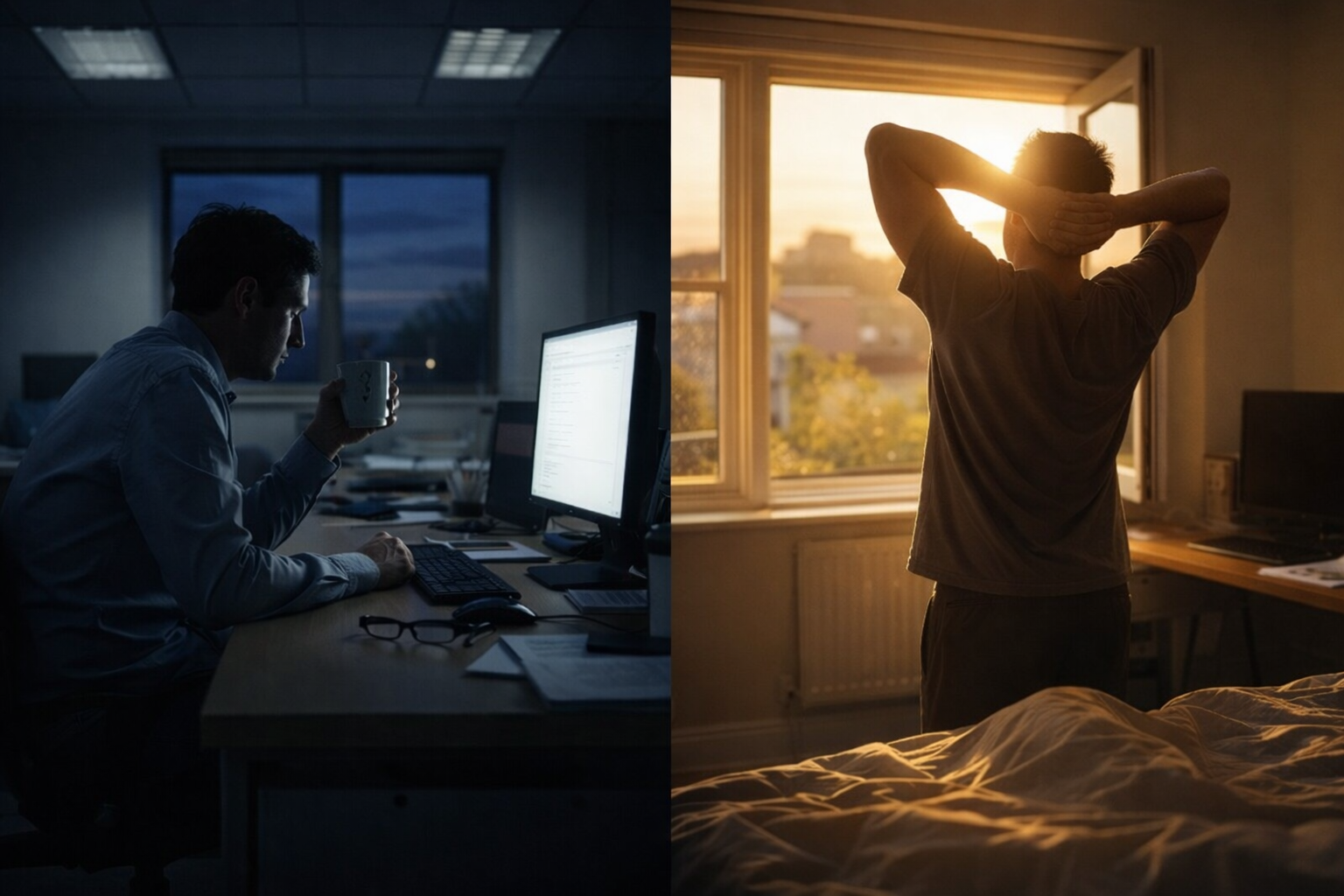
SOCIAL JETLAG: THE HIDDEN COST OF LIVING AGAINST YOUR BIOLOGICAL CLOCK
Most people associate jet lag with long-haul flights.
You get on a plane in London, land in New York, and your body suddenly has no idea what time it is. You’re wide awake at 3am, exhausted at 2pm, and it takes a few days for your internal clock to catch up with reality.
But something very similar happens to millions of people every single week.
The difference is they never board a plane.
They simply go to work.
Sleep researchers call this phenomenon social jetlag.
It describes the mismatch between our biological clock and the schedule imposed by society — work hours, school times, commuting patterns, and social expectations.
And for many people, the gap between those two clocks is far larger than they realise.
YOUR BODY LIVES IN ONE TIME ZONE
YOUR LIFE DEMANDS ANOTHER
Human beings operate according to two different clocks.
The first is biological time.
This is controlled by the circadian system inside the brain. It regulates when we feel alert, when we feel sleepy, when hormones rise and fall, and when the body is ready for food, work, and rest.
The second is social time.
This is the clock on the wall.
Work starts at a fixed hour. School starts at a fixed hour. Meetings start at fixed hours. Transport systems run on rigid schedules.
When those two clocks align, life tends to feel relatively easy.
But when they drift apart, people experience the circadian equivalent of crossing time zones.
Every day.
THE WEEKDAY–WEEKEND SHIFT
One of the simplest ways to see social jetlag is to compare sleep patterns between weekdays and weekends.
Many people follow a strict routine Monday to Friday.
They wake early for work. They set alarms. They cut sleep short if necessary to make it through the morning commute.
Then the weekend arrives.
Suddenly alarms disappear.
People sleep later. They stay up later. Their sleep pattern shifts by one, two, sometimes even three hours.
That shift is a strong clue.
It reveals where their biological clock actually wants to be when social obligations are removed.
Researchers measure social jetlag by calculating the difference between midpoint of sleep on workdays and midpoint of sleep on free days.
For example:
Someone who sleeps from 11pm to 6am during the week has a midpoint around 2:30am.
But if they sleep from 1am to 9am on weekends, the midpoint shifts to 5am.
That difference represents 2.5 hours of social jetlag.
In other words, their body is effectively changing time zones twice every week.
A WIDESPREAD PHENOMENON
The concept of social jetlag was first described by German chronobiologist Till Roenneberg, whose research examined sleep patterns across large populations.
His findings revealed something striking.
A large proportion of people experience at least one hour of social jetlag, and many experience two hours or more.
In practical terms, that means millions of people are living with a permanent mismatch between their biological rhythm and their daily schedule.
For some, the gap is small.
For others — particularly strong evening chronotypes — the gap can be substantial.
WHY SOCIAL JETLAG MATTERS
At first glance, social jetlag might sound like a minor inconvenience.
A bit of tiredness. A couple of sleepy mornings.
But the circadian system regulates far more than sleep.
It coordinates a wide range of physiological processes throughout the body.
These include:
• hormone release
• metabolism
• body temperature regulation
• immune function
• cognitive alertness
When circadian rhythms are repeatedly disrupted, these systems can become misaligned.
Research has linked higher levels of social jetlag with increased risk of several health issues, including:
• obesity
• metabolic dysfunction
• depression
• cardiovascular problems
One large study found that each additional hour of social jetlag was associated with measurable changes in metabolic health markers.
The exact mechanisms are still being explored, but the pattern appears consistent.
When biological timing and social timing repeatedly clash, the body pays a price.
SLEEP DEBT AND THE MONDAY MORNING CRASH
One of the most visible effects of social jetlag is the familiar Monday morning struggle.
People often sleep longer on weekends to compensate for lost sleep during the week.
But this creates a problem.
By shifting sleep later on Friday and Saturday nights, the circadian clock is pushed later.
Then Monday arrives, and the alarm drags it abruptly back again.
The result is a cycle of weekly circadian disruption.
Many people effectively experience a mild version of jet lag every Monday morning.
EVENING CHRONOTYPES BEAR THE BRUNT
Social jetlag does not affect everyone equally.
Morning chronotypes often align naturally with typical work schedules.
Early wake times feel manageable because their biological clock already runs earlier.
Evening chronotypes, however, face a greater challenge.
Their natural sleep timing may fall significantly later than the schedule imposed by work or school.
This forces them to wake during what is effectively their biological night.
Over time, the accumulated sleep restriction can create chronic fatigue.
This difference is one reason productivity advice built around early rising does not work equally well for everyone.
Some people are biologically suited to it.
Others are constantly fighting their internal clock.
THE PRODUCTIVITY CONSEQUENCES
Circadian misalignment affects more than just health.
It also affects performance.
When individuals operate outside their optimal circadian window, studies show declines in:
• attention
• reaction time
• memory
• decision making
In practical terms, this means someone forced to work during their biological low point may struggle to focus even when they are trying their best.
This has obvious implications for education, workplaces, and productivity culture.
We often treat performance as a matter of motivation or discipline.
But timing plays a significant role.
MODERN LIFE MAKES THE PROBLEM WORSE
Several aspects of modern life intensify social jetlag.
Artificial lighting delays sleep.
Screen exposure in the evening pushes circadian rhythms later.
Long commutes require earlier wake times.
Shift work creates even more extreme circadian disruption.
All of these factors widen the gap between biological time and social time.
In effect, modern society is designed around a schedule that does not suit everyone’s biology equally.
CAN SOCIAL JETLAG BE REDUCED?
Completely eliminating social jetlag may not be realistic for many people.
Work schedules and economic realities limit flexibility.
However, several strategies can help reduce its impact.
These include:
• maintaining consistent sleep schedules across the week
• increasing morning daylight exposure
• reducing bright light exposure late at night
• avoiding large weekend sleep shifts
Even small adjustments can help stabilise the circadian clock.
THE BIGGER LESSON
The concept of social jetlag reveals something important about modern life.
Human biology evolved in an environment where time was governed by the sun.
Today, time is governed by institutions.
Schools, workplaces, transport systems, and digital technologies all operate on rigid schedules that may not match the natural rhythms of the people using them.
The more those systems ignore biological timing, the more friction they create.
And that friction often shows up as fatigue, reduced focus, and declining wellbeing.
FINAL THOUGHT
When someone struggles to wake up on Monday morning, the problem may not be laziness or poor discipline.
It may simply be that their body clock is still living in a different time zone.
Understanding social jetlag shifts the conversation away from blaming individuals and toward understanding how modern schedules interact with human biology.
Sometimes the issue isn’t how hard people try.
Sometimes it’s the timing of the system they’re living inside.
SOURCES
Key research areas referenced in this essay include:
• Till Roenneberg – research on social jetlag and circadian timing
• European chronobiology studies examining weekday–weekend sleep differences
• Population studies linking circadian misalignment with metabolic health outcomes
• Sleep research exploring the effects of circadian timing on cognitive performance