
LIGHT, CIRCADIAN RHYTHMS, AND WHY MODERN HUMANS LIVE IN PERMANENT “BIOLOGICAL JET LAG”
For most of human history, the sun controlled everything.
When it rose, humans woke.
When it set, humans slept.
There were no alarms, no electric lighting, no glowing rectangles demanding attention at midnight.
Light dictated the rhythm of life.
Today, that system has been quietly broken.
Modern humans spend roughly 90% of their time indoors, surrounded by artificial lighting that is dramatically weaker than natural daylight. At the same time, we expose ourselves to bright artificial light late into the evening through screens, LEDs, and indoor lighting.
The result is a profound mismatch between our environment and the biological system that evolved to regulate sleep, energy, mood, and attention.
And light sits at the centre of the problem.
THE MASTER SWITCH IN YOUR BRAIN
Inside the human brain sits a structure known as the suprachiasmatic nucleus (SCN).
It acts as the body’s master circadian clock.
This cluster of roughly 20,000 neurons coordinates daily rhythms across the entire body, including:
• hormone release
• body temperature
• metabolism
• sleep cycles
• alertness
• immune activity
But the SCN cannot see sunlight directly.
Instead, it relies on signals from specialised light-sensitive cells in the eye called intrinsically photosensitive retinal ganglion cells.
These cells detect brightness levels in the environment and send signals to the SCN.
The brain then adjusts the timing of the circadian clock accordingly.
This process is known as circadian entrainment.
In simple terms:
Light tells the brain what time it is.
WHY MORNING LIGHT IS SO POWERFUL
Morning sunlight plays a particularly important role.
Exposure to light early in the day triggers a cascade of biological events.
These include:
• suppression of melatonin (the sleep hormone)
• increased cortisol release (promoting alertness)
• adjustment of the circadian clock for the next 24 hours
The earlier the brain receives natural daylight signals, the earlier the internal clock tends to run.
This is why people who wake naturally with sunlight often feel more alert and energised throughout the day.
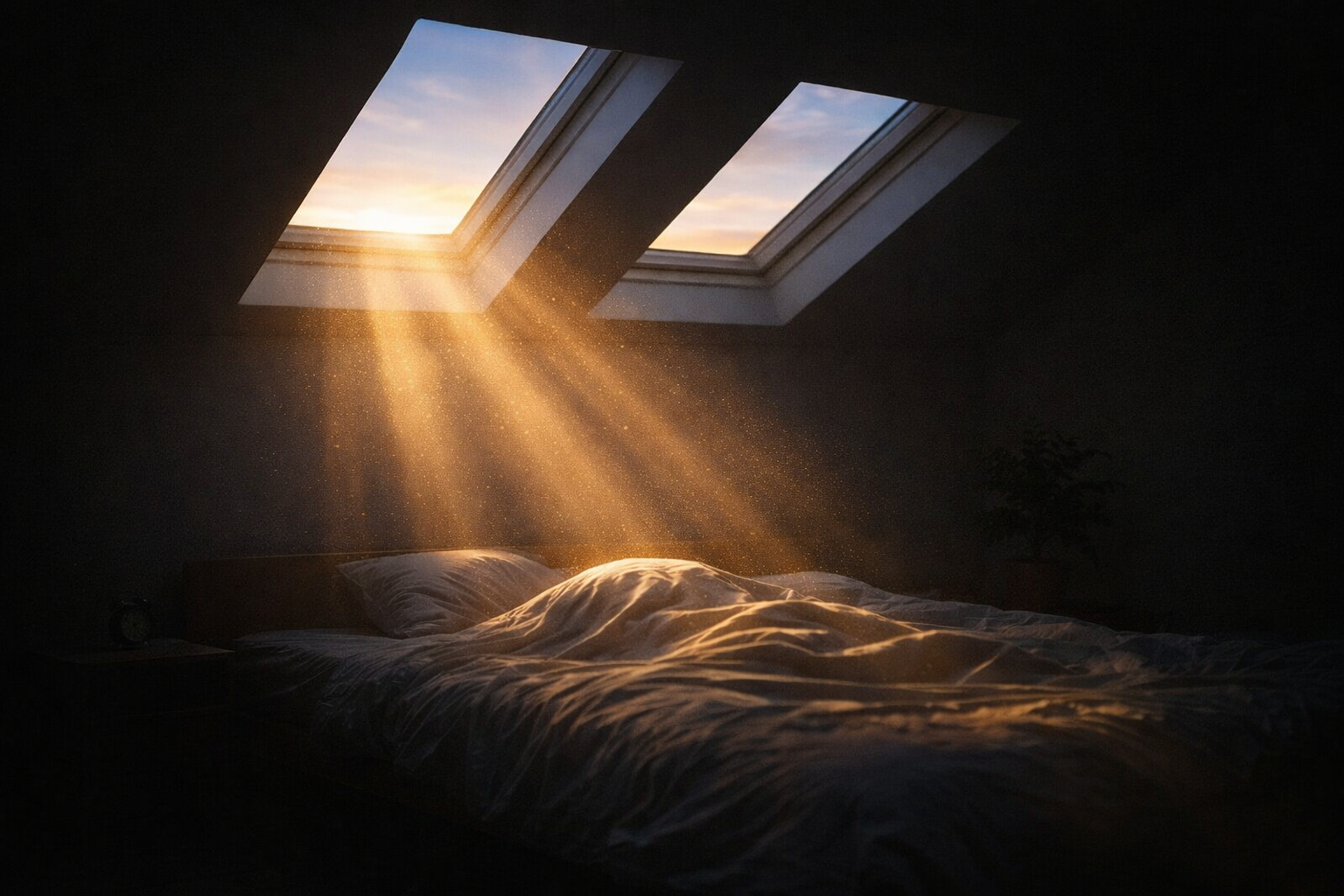
I’ve noticed this in my own bedroom. In summer, light pours through the skylights and I wake naturally around 5am without an alarm…When morning light floods the room, your brain receives a powerful “wake-up” signal without needing an alarm.
In winter, when sunrise is delayed and mornings remain dark, the brain receives weaker signals and sleep inertia becomes stronger.
That’s when alarms become necessary.
NATURAL LIGHT VS INDOOR LIGHT
The intensity difference between natural and artificial light is staggering.
Typical indoor lighting measures:
100–500 lux
A cloudy outdoor day measures roughly:
10,000 lux
Bright midday sunlight can reach:
100,000 lux
In other words, even a dull grey morning outdoors is dramatically brighter than most indoor environments.
This matters because the circadian system is highly sensitive to light intensity.
Indoor environments simply do not provide a strong enough signal for the brain to anchor the circadian clock properly.
This is one reason many people feel groggy in the morning when they wake indoors and do not see daylight until hours later.
EVENING LIGHT: THE OTHER SIDE OF THE PROBLEM
Morning light helps the clock start.
Evening light delays it.
Artificial lighting — particularly blue-enriched LED light from phones and laptops — can suppress melatonin production.
Research has shown that evening screen exposure can delay melatonin release by up to several hours.
This effectively pushes the internal clock later into the night.
When people then attempt to wake early for work or school, they are cutting off sleep before their body has completed its natural cycle.
The result is chronic sleep restriction.
THE MODERN LIGHT ENVIRONMENT
Humans evolved under a very specific lighting pattern:
Bright days. Dark nights.
Modern life has inverted that pattern.
Today we experience:
• Dim days (indoor living)
• Bright nights (screens and electric lighting)
From the perspective of the circadian system, this is the worst possible configuration.
The brain struggles to determine whether it is day or night.
THE CONSEQUENCES OF DIM DAYS
Insufficient daytime light exposure has been linked to a range of physiological and psychological effects.
These include:
• reduced alertness
• lower mood
• disrupted sleep cycles
• decreased cognitive performance
Daylight exposure has also been shown to influence serotonin levels, which play a major role in mood regulation.
This connection explains why many people experience seasonal mood changes during darker months.
SEASONAL AFFECTIVE DISORDER
One extreme example of light deprivation is Seasonal Affective Disorder (SAD).
This condition occurs when reduced winter daylight disrupts circadian rhythms and neurotransmitter regulation.
Symptoms can include:
• fatigue
• low mood
• sleep disturbances
• difficulty concentrating
Light therapy is often used as a treatment, where individuals are exposed to high-intensity artificial light in the morning to mimic sunlight.
This further reinforces the idea that light is one of the most powerful regulators of human biology.
PRODUCTIVITY, ATTENTION, AND LIGHT
Light exposure also influences cognitive performance.
Studies have found that workers exposed to natural daylight in offices report:
• better sleep quality
• increased productivity
• higher workplace satisfaction
One study from Northwestern University found that employees working near windows slept an average of 46 minutes more per night than those without natural light exposure.
The implications for attention and productivity are significant.
If the circadian system is misaligned due to poor light exposure, cognitive performance suffers.
WHAT MOST PEOPLE GET WRONG
One of the biggest misconceptions in productivity culture is the idea that discipline alone determines energy levels.
In reality, environmental cues play a massive role.
Light is one of the most powerful environmental signals affecting the brain.
If someone spends their days under dim indoor lighting and their evenings under bright artificial light, they are essentially training their brain to operate on the wrong schedule.
No amount of “grind mindset” fixes a biological signal problem.
PRACTICAL IMPLICATIONS
Circadian research suggests several simple interventions that dramatically improve biological alignment.
These include:
- Morning daylight exposure
Ideally within the first hour after waking.
- Reducing evening light exposure
Particularly blue light from screens.
- Sleeping in a dark room
Darkness allows melatonin production to occur properly.
- Spending time outdoors during the day
Even short outdoor walks can provide stronger circadian signals than indoor environments.
FINAL THOUGHT
My own lived experience of seasonal changes in my own natural rhythm illustrates something modern life often forgets.
Human beings evolved under the sun.
When natural light wakes us in the morning, the body’s internal systems activate exactly as they were designed to.
When that signal disappears — replaced by alarms, artificial light, and indoor living — the circadian system becomes confused.
And when the circadian system becomes confused, everything from sleep to attention to mood begins to suffer.
In many ways, the modern productivity crisis may not simply be a discipline problem.
It may be an environment problem.
SOURCES
Key research referenced includes work from:
• Till Roenneberg – circadian rhythms and social jetlag
• Andrew Huberman – light exposure and circadian regulation
• Northwestern University daylight workplace study
• National Institute of Mental Health – Seasonal Affective Disorder research
• Chronobiology research on lux levels and circadian entrainment